Showing posts with label sports science. Show all posts

Thursday, December 16, 2010

The man on the left in the image to the left is probably quite recognizable to NHL fans. Of course, that's NHL Commissioner Gary Bettman. The older gentleman in the NHL uniform, however, may not be as recognizable to some people. He is probably more iconic than Mr. Bettman in his own industry simply due to how many awesome people he has created in his life. That man is Stan Lee, creator of Spiderman, the X-Men, the Incredible Hulk, and Iron Man amongst his many superhero ideas. So with the handshake between Mr. Bettman and Mr. Lee, you had to assume that the NHL would eventually be rendered in a comic book at some point, right?

We'll start with what I do know to be a definitive fact. The major unveiling for this new collaboration between the NHL, Stan Lee, and Guardian Media Entertainment will happen on January 30 at the 2011 NHL All-Star Game this season in Raleigh, North Carolina, and it is officially being touted as "The Guardian Project". Each NHL team will have a superhero designed with respect to each team's logo, strengths, and weaknesses, and all 30 NHL teams' heroes will work together in most cases, but natural rivalries will still be prevalent in some interactions. The overall story is actually about a high school kid who discovers the ability to turn his superhero ideas into "the Guardians" who can battle evil.

The NHL and Guardian Media Entertainment were quick to point out at the unveiling of the project in October that none of the superheroes are being developed as NHL mascots. Rather, they will be completely original characters with five special powers each. For example, the Calgary Flames' superhero will be able to harness the power of fire while the Philadelphia Flyers' superhero should be able to go airborne.

"We worked really closely with all 30 teams over the last 10 months to really get the look and feel and personality of their team and incorporate it into the physical superhero," says Adam Baratta of Guardian Media Entertainment (GME), the partnership set up by the NHL and comic superhero legend Stan Lee's POW! Entertainment to launch and operate the franchise.

So that doesn't really give you a lot to work with, right? I'm aware. However, they have promised us a video, and I have your first glimpse of The Guardian Project!
Um... that didn't really help either, I suppose. But there appeared to be a few cool designs that were somewhat visible in that video. However, Variety brings the story to life with their article. In it, they describe a few characters:
"Most of the characters mimic their official mascots and incorporate the team uniform colors and reference the cities where they're based. Not surprisingly, the hero for the Philadelphia Flyers can fly; the Boston Bruins has a fierce bear; one for Anaheim's Ducks wears a wet suit and wields a spear while riding a surfboard; another for the St. Louis Blues is a Batman-like caped crusader who plays a saxophone; and another for Vancouver's Canucks is a walking version of its killer whale logo.

"Even teams without mascots get their own characters: The Toronto Maple Leafs are repped by a tree-like creature with tree limbs for arms and legs, The design process has been kept a secret from not only the public but also other teams, as well, in order to be able to lock down a final design and prevent others from demanding changes up through the launch.
Interesting. So the Maple Leafs' superhero is an ent? Needless to say, I really would like to see what some of these other superheroes look like with regards to their aesthetics. Ken Campbell of The Hockey News went in a slightly different direction as he tried to imagine what each team's superhero will look like, complete with heavy sarcasm and cynicism.

I was lucky enough to receive this teaser image which has a large number of the Guardians silhouetted against the glowing blue eyes in the background, so it appears that the story for the Guardians has been developed enough to have all 30 NHL Guardians and some sort of ominous presence in place. I can't say much more than this as I don't have a lot of additional info, but I think this is a new direction for professional sports teams to take, and it could be a major windfall. However, it could also fail miserably, so it remains to be seen how much of an effect this venture will have on the overall business for the NHL.

What I found quite interesting was the use of technology in the building of these superheroes. VICON House of Moves, under contract with Guardian Media Entertainment, decided to render the animation for the superheroes using the motion-capture technology of the Unreal Games Engine, an animation program that has brought life to video games such as Unreal Tournament, Medal of Honor, and Gears of War. The video above gives you just a glimpse of what this technology allows, and the team at VICON HOM continue to develop additional animated videos for Guardian Media Entertainment as part of their contract on this project. Essentially, VICON will be the major driver behind any animated video you see in relation to this project!

While it's tough to judge exactly how popular and how beneficial these partnerships will be for each participant, it is interesting to see some of the technology being used to help create these new Stan Lee creations in the form of NHL properties. I'm not willing to write anything off until the final product has been released, but this venture does have me intrigued at this point. Only time will tell, but January 30 is the big day for The Guardian Project!

Until next time, keep your sticks on the ice!

Sunday, December 5, 2010

If you've been to the movie theater or a home theater department at your local electronics store, you know that there is one number and one letter that is changing the way you get your entertainment: 3D. From the latest three-dimensional movie to the newest three-dimensional televisions, the planet seems hellbent on making couch potatoes into front-row fans. Saturday night, your routine of Hockey Night In Canada will take you to a new frontier as HNIC goes 3D for the first time ever.

I'm not against using technology to make hockey broadcasts better. The net cam gave us a whole new look at what goaltenders routinely see during a scrum in their crease, the ice-level commentator provides in-depth analysis and immediate interviews as things happen on the ice, high-definition television has made the game look and sound incredible, and instant replay - a Canadian invention, no less - has made its way into every sports broadcast on the planet. With the exception of the FoxTrax Puck, technology has made watching the game of hockey from your recliner much better than what it used to be.

There's a market for 3D technology at movie theaters. From Avatar to Toy Story 3 to the up-coming Yogi Bear movie, the success of these movies shows that the technology has been and is accepted as a movie theater add-on. However, the concept of 3D television hasn't really seen the light of day due to the extravagant costs associated with producing such broadcasts. Add into the fact that viewers have to purchase a new television set and a specially-crafted set of 3D glasses, and this venture seems like an idea straight out of Back To The Future.

Nevertheless, CBC and Hockey Night In Canada, in association with Panasonic Canada, are pushing full-steam ahead with their first broadcast of NHL hockey in three dimensions. My question is simple: WHY?

Rafe Needleman, a writer for CNet, pulled the sheets back and exposed the truth about 3DTV in his Janaury 15, 2010 article. He writes,
"Bruce Berkoff of the LCDTV Association and formerly a marketing executive at LG, noted that for all the hype around 3D, the television manufacturers are not really investing much in putting products on store shelves, nor are they expecting consumers to pay for it yet.

"Adding the capability for televisions to display alternating images for stereoscopic viewing through electronic shutter glasses is not expensive. It's the glasses themselves that are, and only a few 3D-capable sets actually come bundled with them. So consumers will be able to soon buy televisions ready for 3D without spending much."
It seems that electronics manufacturers simply are listening to the old supply-and-demand chain because people just aren't demanding 3DTVs yet. Gabriel Perna of International Business Times pointed out that major manufacturers just aren't mass-producing the 3DTVs to bring them to a reasonable price point for consumers. He writes,
"According to iSuppli, only four percent of the TVs shipped to retailers in the first quarter of 2010 -- about 1.8 million out of 46.5 million -- were 3-D. Samsung is currently leading the field, having sold 90 percent of all 3-D TV sets. In a press release, the company said it expects to sell 600,000 of them in the first six months of this year."
So as seen above, while you may have a 3D-ready TV, you're one of a small handful of people who will be able to view the game in 3D on Saturday. Then again, as pointed out in Mr. Needleman's article, your regular red-cyan lenses won't save your TV-viewing experience this weekend, either. According to September 21, 2010 survey results conducted "by Interpret, LLC, "an independent research company that examines trends in consumer attitudes and confusion surrounding 3D technologies", Hollywood Today's Anthony Coogan reports "that 35% of consumers polled said they would definitely purchase a 3DTV within the next 12 months. That percentage is up from 13% from the first quarter of this year". So that's encouraging... until you get to the glasses. Mr. Coogan wrote,
"The 3D glasses seem to be a major sore spot with many potential viewers. People who don’t ordinarily wear eyeglasses find them an unwelcome intrusion on their freedom. Those individuals who already wear glasses often struggle trying to fit 3D glasses over their prescription eyeglasses. Granted, the need to watch 3D with glasses is a nuisance at worst; at best they can transport the viewer into other worlds. So, the viewer always has the choice to wear or not to wear the glasses. The second issue about glasses is the price, which can be as high a $175, depending on the manufacturer of the 3DTV you purchase. Because they cost less to manufacture, most manufacturers are offering 3DTVs that use electronic, shutter glasses instead of the polarized type used in the theaters. The shutter glasses are battery-operated and sophisticated. Some dealers are offering the customer some basic incentives like two pair of 3D glasses free with the purchase of a 3DTV.

"There is an additional downside to the glasses issue, that of inter-compatibility. Panasonic glasses aren’t compatible with Sony TVs; Sony glasses aren’t compatible with Samsung TVs, and so on. ... When a group of people wanted to get together and watch a 3D movie or a 'live' sporting event the host of the gathering would need to provide every one of his or her guests with a particular pair of glasses that would work with their 3DTV. If glasses cost $149.95 and if the host has ten guests, that’s a lot of money to shell out."
And there lies the problem. If you own a 3DTV and have the glasses, you're set! If you want to invite your friends over, you all need the same manufacturer of glasses or there will be a problem watching the game in 3D. Which means you're better off watching the game in 2D.

It seems that North Americans might be more inclined to buy 3DTVs as opposed to other countries. Britons, for example, show a staggering difference in their views on 3DTV. According to Dave Parrack of Tech.Blorge.com,
"Of 4,199 British consumers questioned, just 89 stated they were likely to buy a 3DTV set in the next year. That’s just 2 percent, a tiny fraction when considered against the continual bombardment of advertising and 'You need to own this technology!'-style directives.

"Unsurprisingly, those aged between 25 and 34 are the most likely (around 5 percent) to buy into 3D, with those over 45 the least likely (just 1 percent) to do so."
Now, your head might be spinning with all these numbers and examples and survey results, but this all leads to one question: WHY IS CBC DOING THIS WHEN NO ONE WILL BE WATCHING IN 3D?

Look, it's nice to have the technology in place for when the day comes that the majority of people have a 3DTV in their homes and can watch 3D programming. There's no doubt that scientists and manufacturers have only scratched the surface of 3D technology. But with the major push over the last few years simply to get people off analog television signals and onto digital - let alone getting Grandma and Grandpa into the HDTV chatter - it seems that this push for 3DTV is nothing more than doing for doing's sake.

If a tree falls in the forest in 3D and no one is there to witness it in 3D, did it really happen in 3D? If no one is watching the game in 3D, does anyone really care if the technology is being used? While I think it's important to push the technological boundaries in terms of making the game more enjoyable for the fan, adding 3D telecasts of Hockey Night In Canada is simply unnecessary at this point in time. There are barely enough people watching in high-definition, so why want for nothing?

Until next time, keep your sticks on the ice!

Monday, July 12, 2010

I was on a hunt for pictures today from the past NHL season. Basically, I was looking for images with something that caught my eye in terms of seeing an oddity that might seem out of place. While there were a few photos that will be seen in the future on HBIC, there were a couple of images found on the Florida Panthers' site that had me scratching my head. While I understand that various teams use different technology and gadgets to produce photos that deliver a different view, I have absolutely no idea why the Florida Panthers used an overhead, infrared camera in their game against the New Jersey Devils on April 8, 2010. You'll see why in a second.

While overhead still cameras are nothing new in the NHL for photojournalists, this new technology provides absolutely nothing in terms of its effect or the resulting photo. Case in point? This looks ridiculous! And what purpose does it serve? I'm not a scientist, but all I see is a ridiculous pastel image of hockey players.

They took a few photos as well. Martin Brodeur stands alone in his net in this image, but you'd have a hard time recognizing Brodeur from this picture. Again, I can't see a purpose at this point in using an infrared camera to capture images.

If there is one thing I can possibly justify in using this technology is that the black puck would appear very clearly in the back of the net as long as no player is on top of it. But how often do close plays on the goal line have no players near the puck?

If the rule about players in the crease was still valid, I could see a use for this technology as the blue paint of the crease is very clear in the images. But that rule has gone the way of the dodo, so that line of reasoning is out.

Can anyone think of a reason that would prompt the Florida Panthers to use infrared cameras for overhead shots? And, as far as I can tell, these are the only pictures that were published using this camera for all thirty NHL teams. Any ideas as to what the Panthers might be doing with an infrared camera?

I'm all ears if you have any ideas.

Until next time, keep your sticks on the ice!

Thursday, May 20, 2010

It's interesting to see how some people have grown up after being quite famous at a younger age. Take the lady to the left, for example. That's Danica McKellar, formerly known as Winnie Cooper on The Wonder Years starring Fred Savage from 1988 until 1993. Today, the 35 year-old holds her mathematics degree from UCLA, having graduated summa cum laude, and writes books on math for middle-school girls to help them gain an appreciation for the subject. However, this isn't a Teebz's Book Club feature, so you're probably wondering why I'm talking about Danica McKellar and math. There's a perfectly good reason why.

Last year in June, I proposed a way to evaluate a defenceman's value in comparison to other defencemen around the league based upon team stats and personal stats. Admittedly, it's not a scientific evaluation of a player's value to his team, but it does give a numerical value to a player based on team and personal success. As a general manager, that's something that would be important to me as an evaluation tool.

This season, I decided to run the top ten defenceman in scoring through this tool, as well as adding a few other names for comparison purposes. Surprisingly, one player stands heads and shoulders above everyone else, and was better than Dennis Wideman's value of 4.28 last season.

Here is this season's look at Defenceman-Metrics. All defencemen below played a minimum of 41 games this season.
  • Mike Green of the Washington Capitals led all defencemen in scoring this season, and he leads the way in terms of his numerical value as well. Thanks to Washington's excellent season, Green checked in with an amazing 6.47 value!
  • Green's defensive partner, Jeff Schultz, didn't score as many points as Green, but he played the steady defensive role that the offensive Capitals needed. While Green was chipping in points, Schultz was piling up pluses. As a result, Schultz was valued at 4.40.
  • One of last season's worst player in terms of his value was New York Islander Brendan Witt. His -0.759 rating was the second-worst in the NHL, and he didn't do much to improve his standing this season. Witt scored a value of -0.55 this season, putting him in the bottom five of the league once again.
  • The New York Rangers had the worst-valued defenceman last season in Thomas Pock. Pock scored a league-low -0.78 in value. Pock didn't play in the NHL this past season, so there would be a new player crowned as the worst value in the league. That player would be Calgary Flame Steve Staios in terms of all the numbers I've run thus far. Staios came in with a value of -0.59, worst in the NHL.
  • While some people may think Nicklas Lidstrom had an unusually poor season, I'd argue that while his offensive production dropped off, but his value remained high. While Lidstrom scored a 3.76 last season, he still posted a 2.61 value this season. That would rank him fifth in terms of the top ten in scoring this season. Not bad at all, I'd say.
  • While Brendan Witt showed the ugly side of the Islanders' blueline, Mark Streit continues to show that his contributions to his team are high. Streit scored a solid 1.62 last season, and followed it up with a 1.53 this season. The worst team in the league has one of the top offensive defencemen. I'd love to see how good Streit's numbers would be if he played with Washington, Chicago, or San Jose.
  • Speaking about Chicago, Duncan Keith turned in another solid campaign. Last season, Keith turned in a 3.29, and this season saw him improve with a 3.94 value. While there's no doubt that Keith is a valued member of his team, it goes to show that he is still approaching his potential as an NHL player. Keith deserves a little recognition for that.
  • Drew Doughty, in his first season as an NHL regular, scored a very impressive 3.28 value with the Los Angeles Kings. Doughty had a superb season, so there was no doubt that his value will be high. I was impressed with just how high his value was.
  • There was talk early last season of Michael Del Zotto's impressive start with the Rangers, but this measuring tool is all about consistency. Unfortunately, Del Zotto couldn't continue his hot start, and his value suffered because of it. Del Zotto ended the season with a surprising 0.78 value.
  • Tyler Myers, however, showed exactly what consistency is all about as he had am impressive campaign with the Buffalo Sabres. Myers earned himself a Calder Trophy nomination, and I have to agree with that nomination after seeing him come in with a 2.51 value. Just to put that in perspective, Nicklas Lidstrom finished the season just 0.10 higher than Tyler Myers.
  • While a lot of people poked fun at the Toronto Maple Leafs this season for their on-ice struggles, perhaps no one personified that better than Tomas Kaberle. Kaberle finished tenth in scoring for defencemen this season, but only finished the season with a 1.03 value. His brutal plus/minus stat really killed his offensive production, and that's what this mathematical value is all about: showing you both sides of the ice.
  • One of the more surprising players to come out of this math was Christian Ehrhoff. Ehrhoff got little press outside of Vancouver about how good he was on both sides of the ice. Ehrhoff's middle-of-the-pack stats combined with his high plus/minus value put him at a value of 3.73! That's higher than Dan Boyle (2.67), Chris Pronger (2.59), Drew Doughty (3.28), and Nick Lidstrom (2.61), and all four of those players were in the top ten for defenceman scoring!
  • For as good as Pronger was for Philadelphia, Ryan Parent was not. Parent had a bad season in terms of points and plus/minus, and his -0.56 value showed. Parent has to be better if he wants to ever make Pronger money.
  • Another player I was pleasantly surprised with was former Manitoba Moose and current Dallas Star Marc Fistric. Fistric is more of a defensive defenceman, so plus/minus is the stat that will carry him in the player values, and he ended the season at a value of 1.81. You read that correctly as that value puts him higher than Mark Streit (1.53), Tobias Enstrom (1.66), and just behind Sergei Gonchar (1.84). As you can see, this equation gives equal weight to preventing goals as it does generating them.
  • We'll close this look at math in the same fashion as last season. Brian Campbell of the Blackhawks, whose reputation takes a beating due to his apparent lack of defensive contributions, posted a 2.80 last season. This season? Fairly similar in his 2.69 value. There's no doubt that Campbell brings offence to the game, but his defensive awareness isn't as bad as some make it out to be.
There's a little Thursday night math for everyone. My brain needs a break, so I'm kicking out of here for a few hours.

Until next time, keep your sticks on the ice!

Friday, May 7, 2010

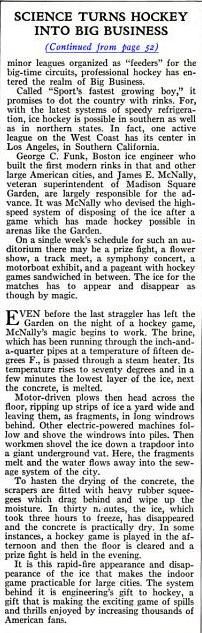
Hockey history is probably the biggest reason why I love this game so much. Diving deep into historical pieces allows one to appreciate the old sweaters and uniforms the teams wore, the old equipment that is now saved for museums, and the stories from those times that transcended that era. Thanks to Popular Science's online archives, we are lucky enough to take a glimpse into hockey back in 1935. Honestly, I found it fascinating.

Popular Science published five pages in their February 1935 edition of the magazine explaining the nuances of hockey. In it, they had some fairly amazing facts about the game back in 1935, and how different today's game is from that forgotten era.

The first page of the article has a wonderful picture of a goal-mouth battle between the Detroit Red Wings and the Chicago Black Hawks. Author Edwin Teale declared the sport of ice hockey as being in "the position of national winter sport of American fans", and its popularity was gained through what hockey is known for: "the fastest, roughest, hardest-hitting game on the sport calendar". Teale also speaks of the difference between Canadians, who apparently don't mind the cold to watch hockey, and Americans, who prefer the indoor game.

This carries into the second page where Teale writes about how fans can remain warm while the ice remains frozen. Namely, he describes in detail how the "ice griddle" of pipes work in the concrete floor within Madison Square Garden to create an one-inch thick layer of ice for the players. What is more surprising is that the ice-making equipment cost MSG a total of $70,000 in 1935! That kind of money was unheard of back then!

As Teale described, the battle between the refrigeration plant and the radiators in the stands to keep the fans warm was tedious before the investment. During one game, the ice was so slushy that skates cut through the ice and struck the concrete floor, ruining the skates. $180 worth of skates were damaged, and, at $15 per skate, was a costly loss for a dozen pairs of skates.

Of course, goaltender Roy Worters of the New York Americans - described as "[t]he guard at the net" by Teale - is plastered all over the page in his gorgeous sweater, and you can't miss the Ottawa Senators player in the top-right corner. Beautiful stripes! Just as a note, that Senators player picture had to have been taken during the 1933-34 season as the Senators had moved to St. Louis to become the Eagles for the 1934-35.

The third page contains some very interesting information. According to the information that Teale has, 17,647 hockey players were registered in Canada in 1935. The approximate population of Canada in 1935 was 10,845,000. That means approximately three people played hockey for every two thousand people in Canada at that time. That's not bad for a developing country.

Teale goes over a few standard rules, but the "one sports writer" who described hockey as "a combination of forked lightning, old-fashioned shinny, and second-degree murder" made me chuckle. Especially when you consider the picture above of an Ottawa Senators player up-ending a Boston Bruins player.

I found it interesting that the average weight of an NHL player in 1935 was 155-pounds, and that the 210-pounds that "Ching" Johnson weighed was "an exception". Also interesting to me is that a player's career lasted five years on average, and that his legs would be the first thing to go.

What caught my attention, though, were the dollar figures that NHL franchises were worth back at the start of the NHL. In 1924, "a franchise for one of the big cities cost about $3,000. By 1929, it had increased to $75,000. And, today, it stands at a hundred times its original figure, approximately $300,000". Considering that an expansion fee today is approximately $300-400 million, it appears that owning stock in an NHL franchise will never lose you money.

After some interesting injury information, there's a portion of the article dedicated to some headgear worn in the early NHL. Ching Johnson apparently sported "an aluminum protector to hold a broken jaw in place". And two Montreal Canadiens - Armand Mondou and Johnny Gagnon - wore "queer black headgear suggesting derby hats shoved down over their ears". Mondou is the first man in NHL history to be awarded a penalty shot, and it appears that he may be the first man who didn't play between the pipes to don headgear in an NHL game.

The fourth page of the article explains how the NHL added what seems like a very dumb rule in 1934 about how all players must wear skates. For a league that was started a decade earlier, you would think that these sorts of things would have worked themselves out by then, right?

Teale discusses some of the longer games seen in the first decade of the NHL, and explains how nets were altered to prevent the pucks from rebounding back out of the net where referees might miss the goal. He also speaks highly of Warren Roach, a shopkeeper who sharpened skates across from Madison Square Garden. Roach could sharpen up to 150 pairs of skates per day, and there's a fabulous picture in the lower-right of the page that shows him at work.

The history of the game, along with some information on the Intercollegiate Quadrangular Hockey League, is discussed, and we get to see that the Hobey Baker Award given to the champion of the four IQHL teams is nearly as old as the Stanley Cup!

The final strip of the article discusses how the ice is removed for the many events that occur at Madison Square Garden. There is some credit given to George C. Funk as the man who was largely responsible for the modern rinks in most large American cities. James E. McNally, MSG's superintendent, is credited as the man who developed the system to remove the ice and dry the concrete below in amazing speed for additional events happening at Madison Square Garden. McNally basically invented a primitive zamboni to aid in the drying of the concrete.

This article is one of the coolest "historical" articles I've read simply due to how thorough Mr. Teale was in his examination of the game. Take the time to read through some of the info from those pages. I'll bet you'll learn something that you didn't know. And that's why I love hockey history.

Until next time, keep your sticks on the ice!

Monday, March 22, 2010

I spent some time today scanning through the online archives of Popular Science. Normally, the magazine is focused more on technology and science, but they do branch out into sports science once in a while. Hockey has had a few articles printed on the pages of Popular Science, so let's take a look at some of the items examined by the magazine over its time.
  • Bob Sillery brings a little FYI on hockey to the pages of Popular Science's February 2003 maganzine. There are some generic facts on this page, but what caught my attention was the fact about George Owen of the Boston Bruins in 1928 on this page. This would make George Owen the first player in the NHL to wear some sort of protective headwear in a game, but there are no images proving this to be true. Anyone know of any pictures that exist of Owen wearing his helmet?
  • The December 1996 edition of Popular Science had an excellent explanation on how the FoxTrax puck worked. The glowing puck contained a battery, a circuit board, and 20 emitters that 16 sensors positioned around the ice and in the rafters would pick up. From there, the sensors would send the information back to computer that were hooked up through the cameras, enabling the cameras to create the tail on the puck. Those computers would then send that information to the Fox Puck Truck (nice name) where the information would be broadcast as the cameras displayed the game live. Pretty cool science in that whole system, right? The execution, however, left a lot to be desired.
  • The February 2002 magazine took a look at some skates that the Czech and German teams were wearing in the Salt Lake City Olympics. The t'blade skate, created by Würthner Sport of Germany, used a thinner blade to reduce gliding friction by up to 40% thanks to a warmer blade creating a layer of water. The skates were also 35% lighter, thus enabling players to be faster. While there were some noticeable differences - the skates sounded like tearing paper when moving along the ice - they had yet to be adopted by North American skaters. There are other sites that endorse their properties, but the t'blade still hasn't overtaken the normal chassis we see on skates to my knowledge. Anyone with more knowledge or experience wanna comment on the blades and chassis?
  • Finally, one article that caught my attention was August 2008 article about save percentage and how it doesn't tell the full story about a goaltender. Alan Ryder, who writes the Hockey Analytics site, states that shot quality is more telling about a goaltender than shot quantity. What this tells a person is how good a team defence is and how this reflects in a goaltender's overall stats. From the inserted stats board, you can see that Marty Turco's numbers improve his ranking by fifteen spots based on the shot quality rather than just save percentage. It's an interesting application of the numbers provided by the NHL, and it goes to disprove the inflated save percentages of some of the pretenders on the leader board.
There are more great hockey stories to be found in the Popular Science archives, and I'll be bringing those forward shortly. Hockey science is pretty cool if you ask me, and it's nice to see the major publications who focus solely on science and technology bringing sports science to the forefront.

Until next time, keep your sticks on the ice!

Saturday, February 20, 2010

The last few days of hockey have been spectacular. If you missed some of the Olympic hockey games today, you missed a few amazing performances. Today, the Swiss and Norwegians played an amazing game that featured everything television viewers could wants - goals, hits, saves, and drama. Tore Vikingstad of Norway scored a hat trick against the Swiss - his first ever while playing for the national team - and tied the game at 1-1, 3-3, and 4-4. Vikingstad played a marvelous game, and certainly deserves some recognition for his efforts today. This game might only be edged out by the Slovakia-Russia game from Thursday in terms of its excitement. All in all, we have had some excellent games in Vancouver thus far, and we haven't even hit the playoffs yet.

With tomorrow being rivalry day at the Olympics, I figured it's time to start cleaning out the mailbox. I have lots of stuff that needs to be sorted that really doesn't fit into any categories, so I want to use tonight as a way to get the info out.

I just want to put a disclaimer up here that if you don't like the music from the first two bands I am trying to help, please don't be a jerk and write stupid stuff in the comments. Personally, I'm a rock guy, but I'm willing to help these people out because they asked. Just because you may not like what you hear doesn't mean everyone else will share that sentiment. Use your head when commenting. Anything stupid will be deleted with extreme prejudice. Are we clear?

Ok, let's get to the mailbox.
  • Got an email from a gentleman named Dave Adnams. Dave works for Prhymetime Media, and he's helping a Vancouver band get their newest song onto playlists around the world. The band is called Bryan O'Ryan, and its members include Bryan Fogelman, Ryan Worsley, Zach Throne, Michael Nowak, and David Milwain. Head over to the Bryan O'Ryan site, and give a listen to their first two singles. Their newest tune, entitled "Crosby Stalls and Nash", has already received playtime on Canadian radio stations. Thanks for writing, Dave, and all the best to Bryan O'Ryan! They have a couple of great songs already!
  • More musical news to pass on your way. I received an email from Françoise Doherty, an aspiring filmmaker and musician from Canada. Françoise has written a song called "I Like Hockey" that she wanted to get out to the masses. I'm happy to help her song reach these masses. Please click here to access her CBC Radio 3 webpage, and give her song a listen. The CBC site is best optimized in Internet Explorer, so if it doesn't work in Firefox, go back to IE. I had to do that in order to listen to Miss Doherty's works. Thanks for writing, Françoise, and here's hoping that you have a ton of success in your music and film career! I'll tune in on Sirius 86 to catch more of your music!
  • I received an email from Liz Murphy about her company's product. Sani-Sport is a company that produces a sterilization "closet" for sports equipment to help prevent infections from bacteria and viruses. The cycle takes about 16 minutes, and Sani-Sport is already being used by 26 NHL teams. While this product isn't for the common beer league hockey player, hockey teams that want to ensure cleanliness for their athletes should investigate this product. Sani-Sport might be the best investment that any team can make in preventing unseen injuries like staph infections. This looks like a great product!
  • I had asked the other day about speculation on a March 4 press conference at MTS Centre in Winnipeg. There were rumours of the Thrashers moving to Winnipeg that would be announced on March 4, but a number of sources killed that rumour. That, of course, led to other teams' names being mentioned, including both the Phoenix Coyotes and the Florida Panthers. I am officially going on record here: the NHL is not coming back to Winnipeg. The press conference has nothing to do with the NHL whatsoever, according to those few reliable sources.
  • Teemu Selanne has now written his name into the Olympic record books. Selanne assisted on the powerplay goal in the second period by Kimmo Timonen to give him his 37th Olympic point, breaking a record held by Canadian Harry Watson, Czechoslovakian Vlastimil Bubnik, and Russian Valeri Kharlamov. It's one thing to score often at the NHL level, but it means something to score often at the Winter Olympics in a short tournament. Selanne has played in five Winter Olympics now, winning two bronze medals and a silver medal. Congratulations to Teemu Selanne, the most prolific scorer in Olympic men's hockey history!
That's all for tonight. My hockey teams plays in the final tomorrow evening, so we need to be ready. That means I need some sleep so I'm ready to rock tomorrow. Again, tomorrow is "rivalry day" at the Olympics as Sweden and Finland tangle, the Czech Republic take on Russia, and Canada plays the USA. Hunker down and catch some of the best hockey you'll see this season!

Until next time, keep your sticks on the ice!

Thursday, January 21, 2010

I'm sure you recognize the medical device to the left. The walking cast is a common sight for hockey players due to skates being the one piece of equipment that hasn't seen any sort of major upgrades in protecting the feet. From 100mph slapshots to hacks and slashes across the feet, all of these contribute to foot injuries in hockey. And it's not just players that suffer these injuries. You frequently see officials getting hit with pucks as they are rattled around the boards or cleared out of a zone, and they often come up gingerly on their sore feet if struck there. As of today, though, it appears that protection might be more affordable for all those who may want some additional protection thanks to the vision of one man.

Frank McClelland, a retired school teacher from Michigan, had been looking for some sort of protection for his feet when he played hockey because, like most players, he didn't enjoy the sharp pain in his feet when he was blocking shots. I also share this same sentiment as a defenceman as I find myself the victim of deflections and slapshots quite regularly when battling my check in front of the net. The University of Moncton has determined that a hockey puck at top speed has the same kinetic energy as a 22-caliber bullet (PDF document). Yowza! This might be why players hobble back to the bench when hit in the foot with the puck.

However, where this story takes a turn is when Mr. McClelland contacted me with his idea.

Mr. McClelland has come up with a product originally called "Ankle Armor", a plastic covering for the skate boot that provides added protection to the boot of the skate. His design has seen a number of revisions and redesigns, and an early model of the product is now being used by a couple of NHL teams, and there are a few more teams waiting for their shipment. Needless to say, Mr. McClelland's idea is starting to pick up speed as word gets out.

So how did this entire endeavour start? What does the final product look like? How does it compare to the earlier designs? What is the cost of these skate guards if I'm interested in buying them? Where can I get them? There are lots of questions that one may have, so let's work through this idea from conception to today.

Mr. McClelland started with clay models of his idea. The patent process followed shortly after, and it took approximately three years for the patent process to finally be approved by the US Patent Office. The patent is still pending in Canada, but the wheels are in motion. The key to the patent, however, is that the concept of the skate guards that Mr. McClelland has patented. Because of this, he owns the rights to how the design concept of the skate guards - an ingenious patent idea in terms of a business model.

With patents and prototypes in hand, Mr. McClelland approached all of the major skate producers that he could contact. Easton, Nike, Reebok, CCM - none of them were interested in Mr. McClelland's designs. For something that would be an easy "upsell" for all retailers, it seems like these companies might be a little short-sighted in their rejections. However, Mr. McClelland was undeterred by the lack of interest from the major skate companies.

Paul Boyer of the Detroit Red Wings was the first person to actually respond to Mr. McClelland’s many letters. Mr. Boyer, for those that may not be aware, is the equipment manager for the Red Wings, and he thought the skate guards were a great idea. The problem, Mr. McClelland told him, was financing, manufacturing, and engineering a better skate guard than his first prototypes. With Mr. Boyer’s encouragement, Mr. McClelland persisted in going to one manufacturer after another until finally making a connection with Lake Superior State University and their Prototype Development Center. With this connection, the wheels began to turn, albeit slowly at first.

The first prototype was a two-piece unit that was glued together. They were “ugly” and cumbersome compared to his later designs, and the glued pieces were liable to cracking and breaking apart when struck with a puck. Mr. McClelland even admitted that they were a closer resemblance to Frankenstein boots rather than hockey skates. The goal that Mr. McClelland wanted was a one piece guard, and he kept working toward that goal.

Finally, working with LSSU and getting his design into a CAD format, the engineering students at LSSU worked diligently with Mr. McClelland to improve upon his design. Mr. McClelland had two options: a thermal forming process, or an injection molding process.

Thermal molding was certainly more affordable, but the drawback is that the process has limitations in terms of what can be produced. It only uses one sheet of plastic. That means that the thermal mold will produce guards that have identical thickness over the entire guard, but any additional strength elements will be tougher to produce. While the cost may be lower than injection molding, this version of molding plastics was too limited in what could be done with the design of the guards.

Injection molding allows for the guards to made in large quantities with identical attributes. The drawback is cost as the creation of a mold is high, but large volume productions would counteract that cost.

After going through 14 design revisions and prototypes, Mr. McClelland and LSSU have finally come up with a finalized product. The final skate guard product will look like this, only in a clear plastic form.

Why are the guards clear? As Red Wings equipment manager Paul Boyer reported, the players don't like advertising that they are either injured or protecting a part of their body for the obvious reasons of not attracting attention to it. As Mr. Boyer put it, "the players don't want to wear anything that they don't have to". By making them clear, the skate guard becomes virtually invisible on the skate unless you're looking directly at it.

If you look at the final design of the guards, you can see there is some ribbing in the guards as well as some small rectangular holes. The ribbing provides added strength for the skate guards to protect the foot. You don't want your armor breaking in mid-combat, and the ribbing allows for some added strength in the design.

The small slits on the top of the guard are for ventilation so that you feet can still breathe under the guards. There's nothing worse than sweat pooling in your skates, and Reebok's EDGE design can attest to that. The slits on the side are slightly larger, and these allow for some movement of the straps that secure the guard to the skate boot. These are made to be universal for all skates, do the slightly larger slits will allow the skater to move the straps and fit the guards snugly to the skate. When the straps are done up, the bottom and rear straps are fairly protected by the guard and the boot.

You already know that the Red Wings' players are wearing the skate guards. Niklas Kronwall, Brad Stuart, and Patrick Eaves are the confirmed players from Detroit that have been wearing Mr. McClelland's guards. In fact, the two previous images were taken from a Hockey Night In Canada broadcast from November 28, 2009 when the Red Wings met up with the Montreal Canadiens. During the game, Stuart's guard had the rear strap either break or come undone, and he adjusts it during the play. CBC's website still has the video up, so here's a chance to see the guards in action in the NHL. Kronwall's guards can be seen early in the video after he takes a dirty hit, and Stuart's can be seen at approximately the 1:03 mark.

A second NHL team is also using them now. The Calgary Flames have a few sets that their defencemen are wearing. I haven't been able to confirm who the players are at this point, but equipment manager Gus Thorson has been in touch with Mr. McClelland about the Ankle Armor guards. As of the time of publishing this, both the Phoenix Coyotes and St. Louis Blues have been contacting Mr. McClelland, and both teams are awaiting their first sets of guards.

There have been reports of other teams using them, but these teams have not been in contact with Mr. McClelland. In fact, one team - the Montreal Canadiens - was featured in a Globe & Mail story written by Sean Gordon on January 2. In the article, Mr. Gordon writes,
"I took a shot off the foot in the Washington game [Nov. 20] and it hurt pretty bad," [Travis] Moen said in a recent interview. "That's when I decided to try them.”

“Them” refers to the moulded plastic skate guards he and a half-dozen other members of the Canadiens have taken to wearing in games.

“You still feel it when the puck hits you, it's just that it doesn't do as much damage,” Moen said. “They're pretty light and they don't really get in the way.”
Sound familiar? It did to Mr. McClelland. While he's tracked back how the Canadiens may have acquired his product without going through him, he has also heard reports of players wearing them from the Pittsburgh Penguins, Toronto Maple Leafs, and the Atlanta Thrashers. When I forwarded this article to Mr. McClelland, he said there was "no doubt whatsoever" that players were using his guards. However, he was concerned about who may be distributing them without his knowledge, but it appears that his sleuthing may have solved that problem. For now.

Perhaps the best part of this story is the partnership that Mr. McClelland has developed with LSSU. Due to their heavy involvement in the design and manufacturing process, royalties off the sales of Ankle Armor guards will be paid to the University as thanks for their hard work. While there is no doubt that the economy in Michigan can use a boost, helping out an institution such as LSSU will go miles in both the education side of the school as well as various other endeavours. All of the guards will be made in Michigan, and the product will carry a "Made in Michigan" motto as a reminder that this innovative product is a home-grown idea.

In terms of using the prototypes sent to me, I cannot say enough good things about the Ankle Armor skate guards. I no longer fear getting hit in the foot by a shot while playing defence, and blocking shots no longer leaves me black-and-blue reminders of my work. These may not prolong my career in the beer leagues, but they might be the difference for someone else out there. I fully and completely endorse the Ankle Armor product, and will be recommending the guards to everyone.

As a cost, Mr. McClelland couldn't nail down an exact price point at this time as he is still examining the market versus the manufacturing costs. He said that he would like to keep the price point below the $50 USD mark, but he is still researching the costs at this point. In comparison, the carbon-fibre skate guards that Saku Koivu and Josh Gorges of Montreal wore over the last couple of seasons or the guard that Daniel Sedin wore for a while this season will run you anywhere from $1000-1500 in total for maximum protection. While NHL players may be able to afford this cost, the average hockey parent probably doesn't want to pay for skate guards that cost more than the child's entire set of equipment.

As for production, the Ankle Armor skate guards are not yet on the consumer market, but you're not that far away. Production is supposed to start within the next four weeks, and the first set should be shipped out by mid-February, according to Mr. McClelland. Of course, that schedule could change, but that's where Mr. McClelland stands today with the product.

Without a doubt, Mr. McClelland has found a niche in an industry where the big boys generally have all the ideas. With his affiliations in the NHL, it appears that the skate guards may become popular faster than anyone could ever imagine. Mr. McClelland needs to decide on a new name for the guards but I will keep you posted when he decides. He says he’s open to suggestions, so if you have a good name for the skate guards, email me here and I'll pass on your suggestion!

Until next time, keep your sticks on the ice!

***All skate guard photos are property of Frank McClelland, and may not be used without Mr. McClelland's expressed written consent under any circumstance.***

Thursday, December 10, 2009

I recently spent some time down at my local library looking for some hockey-related material to examine and bring to light from years past. As you know from reading this blog, I am fond of the history of hockey, so I often spend chances looking for off-beat pieces of information and facts from yesteryear. Surprisingly, I found a very interesting article in an unusual place for hockey stories. The April 1968 issue of Popular Mechanics magazine featured an article that caught my eye not for the subject of the article, but for the stats listed in the article. I've heard the stories about Bobby Hull's slapshot being like a cannon, but the numbers posted in this article caused me a little concern. Especially when looking at one number for Gordie Howe.

We'll get to those in a minute. The article, written by William Barry Furlong, examines how science is changing the game of hockey in terms of examining a player's speed and motions. We all know how the introduction of composite sticks for shooters and lightweight pads for goaltenders have changed the game in the last twenty years, so I thought this examination by Popular Mechanics was quite interesting as the results were based solely on the players being examined.

As seen in the illustration on the first page of the article, Bobby Hull would be the fastest man in a race from center ice to a puck in front of the net. You'll notice that the players are measured in inches behind the leader, Bobby Hull. At first it didn't make sense in terms of a measurement, but the top two players in the race - Hull and Howe - were always the top scorers in the NHL during their primes. By showing that Howe and Hull won the most races to pucks, Furlong is stating the obvious, but it needs to be said: fast players who win the most races to pucks put themselves in the best position to be successful.

Why were these two men so successful? Well, Popular Mechanics looked at body shapes as a factor. Whether a player was an ectomorph, a mesomorph, or an ectomorph played a large factor in determining which body shape was the most successful in hockey.

An ectomorph is normally lean and wiry, having a body shape rating of 117. They are characterized by a light-muscular figure, a flat chest, being thin, and having small shoulders. Ectomorphs usually find it difficult to build muscle in short periods of time, but also have a hard time gaining body fat. Long necks, fingers, and toes are classic traits. Marathon runners have a classic ectomorphic shape.

A mesomorph is the classic body shape that is found to be "ideal". Men are normally rectangular in shape - their shoulders and hips are in proportion - while women demonstrate the classic hourglass figure. Mesomorphs build muscle and gain fat easier than ectomorphs do, and normally have good muscle mass. Boxers up to the light heavyweight ranking have classic mesomorph shapes.

An endomorph is normally seen as "chubby". Their body shape can give the illusion that their mass is concentrated to the abdominal area, but they have significant muscle mass over their bodies. They do not burn fat as easily as the mesomorphs, so losing the "soft" part of their bodies is not easy. The endomorph would appear stocky, but solid. Linemen in football are often endomorphs.

Now that we've defined what body shapes there are, there is a scale that helped to rank players based upon their body shapes. Each shape was a three-digit number than ranked the player based upon their shape in terms of the three definitions. The first number is the endomorphic rank; the second is the mesomorphic rank; the third number is the ectomorphic rank. Each player is given a three-digit rating: Bobby Hull's is 171 while Gordie Howe's is 363. As explained in the article, Hull is extremely muscular while Howe is less muscular, but a little stockier and wiry.

Furlong determined that similar "somatic body-typing" based on the ratings was the most effective way to shut down certain players. Bobby Hull, for example, had a rating of 171, and he would be best shut down by someone with a similar muscular mesomorphic shape. By his determination, Reggie Fleming of the New York Rangers would be the best player to shut down Hull since he had a 261 rating. With Gordie Howe, Eric Nesterenko of the Chicago Blackhawks was the best match-up against Howe since Nesterenko was rated with a 163 body shape.

An interesting examination to be sure, but one that seems entirely obvious, no? You would expect a guy like Scott Stevens to be the best match-up against Eric Lindros as opposed to a guy like Scott Niedermayer, right? The fact that Popular Mechanics ran a scientific rating system to determine this seems like overkill for something that would be visually obvious. But maybe it's just me.

If you note on that linked page, there are some other interesting things. If a player shoots the puck 44-feet away from the net at 100 mph, there would be zero chance that the goalie could stop the puck if fired to an open corner in 1968. To give you an idea, that would be 20-feet inside the blue line or approximately six-feet above the face-off circles in the offensive zone. Goalies today have no problem stopping the puck from that spot on the ice, so it would be acceptable to say that goaltenders today are much faster than goaltenders 40 years ago.

Also to note, if a player shoots the puck faster than 100 mph at that same distance, the pucks moves at 5.4 inches faster per mile per hour at which the puck is traveling. That's a fairly impressive statistic if the measurements made in 1968 are true. We'll see shortly that these numbers may, in fact, be entirely wrong. That means that goaltenders in 1968 may have had a very good chance at stopping a 100-mph-shot from 44-feet away.

How did Furlong come up with these numbers? It turns out that Popular Mechanics didn't actually do any testing of the NHL stars in question. Rather, the tests were done by a Mr. Lloyd Percival of the Toronto Sports College. In 1968, Mr. Percival did research at the Toronto Sports College on sports and the men who play them. Mr. Furlong, the author of the story, and Popular Mechanics simply published the findings of Mr. Percival without actually verifying that his findings were true and accurate.

Mr. Percival clocked each individual player from the six NHL teams in 1967, and found that the average skating speed for member of the Montreal Canadiens - the fastest team in the league - to be 22.3 mph. The slowest team in the league was the New York Rangers who clocked in at a league-low 19.4 mph. Interestingly enough, the Canadiens also shot the hardest in 1967 at 82.6 mph, while the Rangers were the weakest-shooting team at 76.3 mph.

Those numbers seem fairly believable considering that some NHL players in 1967, such as Terry Sawchuk, were less-than-committed to health and wellness like the players are today. However, Percival's numbers go way off the map when he starts looking at individual results.

The values that he found for shot speeds are a little ridiculous. If Bobby Hull was clocked at 118.3 mph, he is officially the hardest shooter to have ever laced up the skates in the NHL. Zdeno Chara officially set the NHL record at the NHL All-Star Game last season when he registered a blast of 105.4 mph. Yet Percival's findings show that Hull's shot was 13 mph faster than Chara's record-breaking slapshot.

Even more ridiculous is that Gordie Howe's wrist shot clocked in at 114.2 mph! According to his findings, Percival's numbers would indicate that Jean Beliveau's wrist shot at 105.9 mph would be slightly faster than Chara's slapshot. Physics alone say that this is entirely impossible.

While I'm not saying that Percival's findings are incorrect, I am saying that the technology in 1968 was in no way, shape, or form as accurate as the technology we have today. Being that this is the case, we should probably stop comparing numbers from yesterday to today because we're talking about different eras in hockey. Wayne Gretzky's record-setting point totals were played in an era where defensive hockey was rarely seen. Glenn Hall's record-setting consecutive starts total was in an era when it was unheard of for teams to play three or four games in a week. Things were different back then, and we should remember this when comparing numbers.

After all, do you really think that Gordie Howe's wrist shot is 9 mph faster than Chara's slapshot? And do you really think that Howe's slapshot was slower than his wrist shot?

Physically, it is impossible. For a magazine like Popular Mechanics, the mechanics of a slapshot versus a wrist shot should have raised doubts in Percival's numbers. I know they do when I look at them, and I'm just a blogger.

Until next time, keep your sticks on the ice!