RSS Feed
 Twitter
This is featured post 1 title
Replace these every slider sentences with your featured post descriptions.Go to Blogger edit html and find these sentences.Now replace these with your own descriptions.This theme is Bloggerized by Lasantha - Premiumbloggertemplates.com.

This is featured post 2 title
Replace these every slider sentences with your featured post descriptions.Go to Blogger edit html and find these sentences.Now replace these with your own descriptions.This theme is Bloggerized by Lasantha - Premiumbloggertemplates.com.

This is featured post 3 title
Replace these every slider sentences with your featured post descriptions.Go to Blogger edit html and find these sentences.Now replace these with your own descriptions.This theme is Bloggerized by Lasantha - Premiumbloggertemplates.com.


Showing posts with label history. Show all posts
Showing posts with label history. Show all posts
Sunday, March 13, 2011
Saturday, March 12, 2011
 8:20 PM
 nintendo
 There is no quantitative limit with regards to the respect and admiration I have for hockey history. There are so many great stories and so much fascinating imagery from the game that it should be celebrated as often as possible. Thankfully, Classic Auctions is holding another one of its fabulous sports memorabilia auctions, so I think it's time we revisit some of the great history seen in the game of hockey and some of the associated stories that have come along with these small glimpses into the annals of the game. Let's take a look at some of the more interesting pieces up for auction this time.
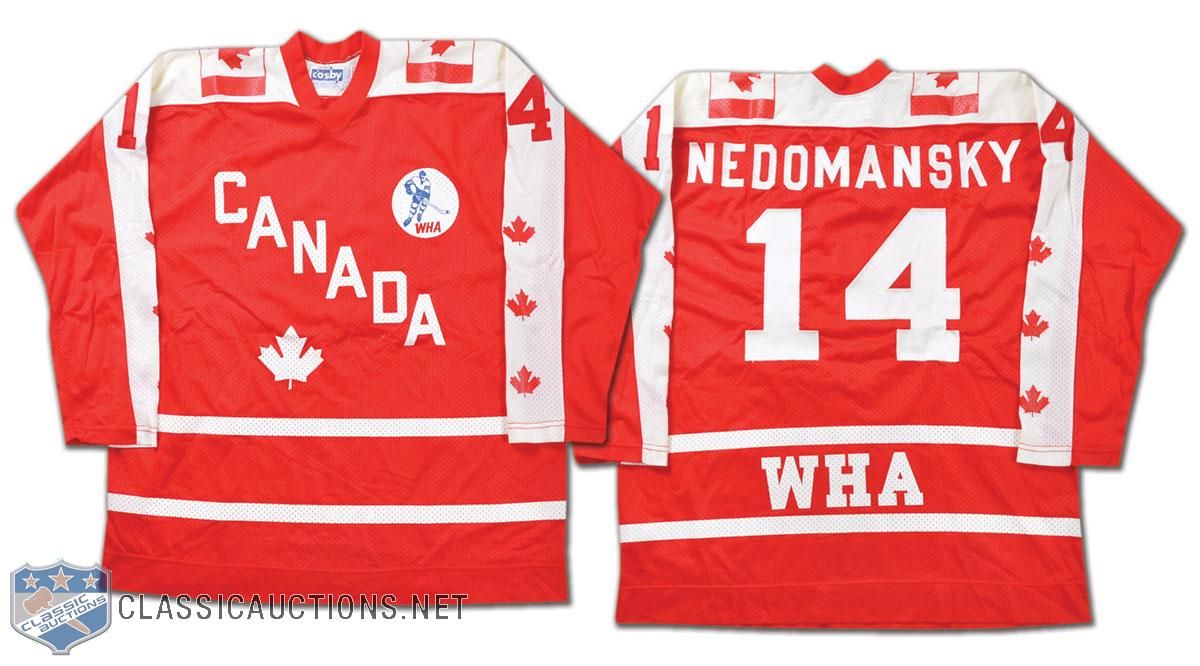
- We'll start this look into hockey history with a glimpse back at a jersey from an all-star. Vaclav Nedomansky was chosen as a WHA All-Star in 1976, and he played on Team Canada for the game in Cleveland, Ohio despite being from Czechoslovakia! The reason for this is that the WHA chose players for their all-star teams based upon where they played rather than where they were born! The Canadian-based WHA teams sent players as part of the Canada All-Stars and the American-based WHA teams sent players as the United States All-Stars. In 1976, Toronto Toros' star Nedomansky and the Canadian WHA All-Stars beat the US WHA All-Stars by a 6-1 score on January 13 at Richfield Coliseum!
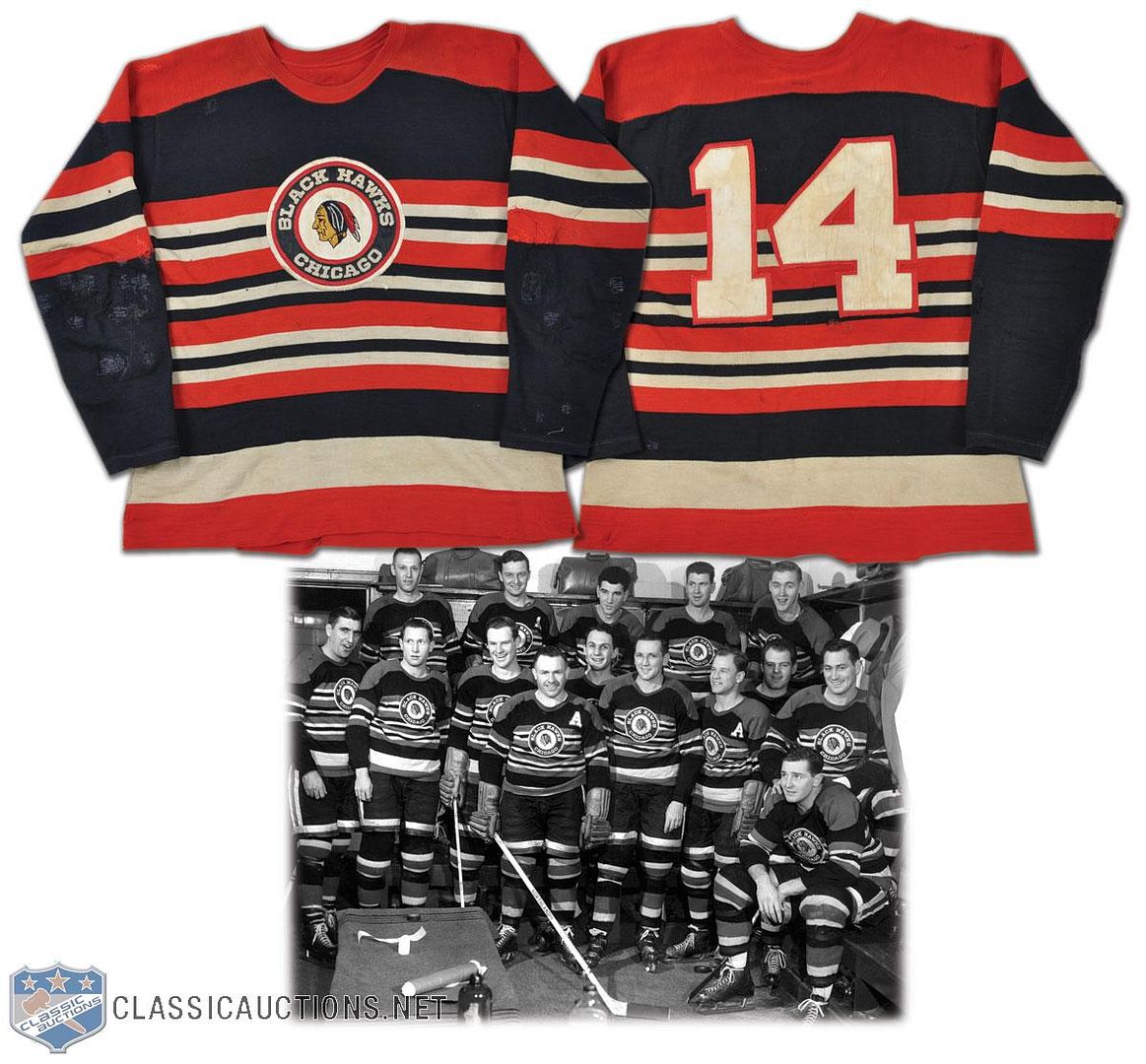
- We move on to an Original Six team. I have to say that I am a huge fan of this Blackhawks sweater from the 1950s. The colours, the stripes, the logo, the font... it truly is a thing of beauty! If there was ever an opportunity to bring back a different alternate jersey for the Blackhawks, this one gets my vote.
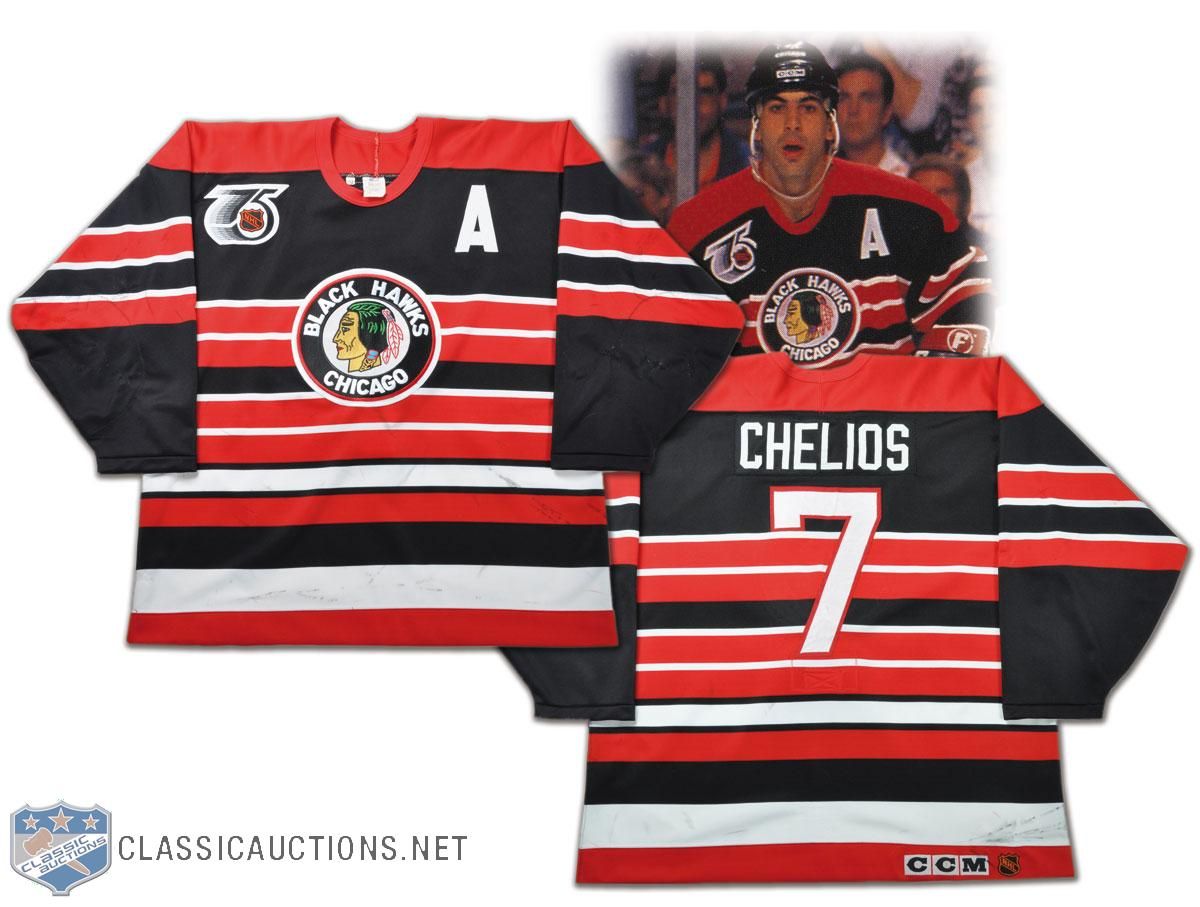
- Strangely enough, the Blackhawks have worn this look closer to the future. In 1991-92, the NHL had the Original Six teams wear a throwback jersey, and the Blackhawks decided on a jersey that looked remarkably like their sweaters from the 1950s. Two things I don't like: the rear font they decided on, and the name on the back. The font is just too skinny, and if you're going to throwback to a previous incarnation, go all the way or don't go at all.
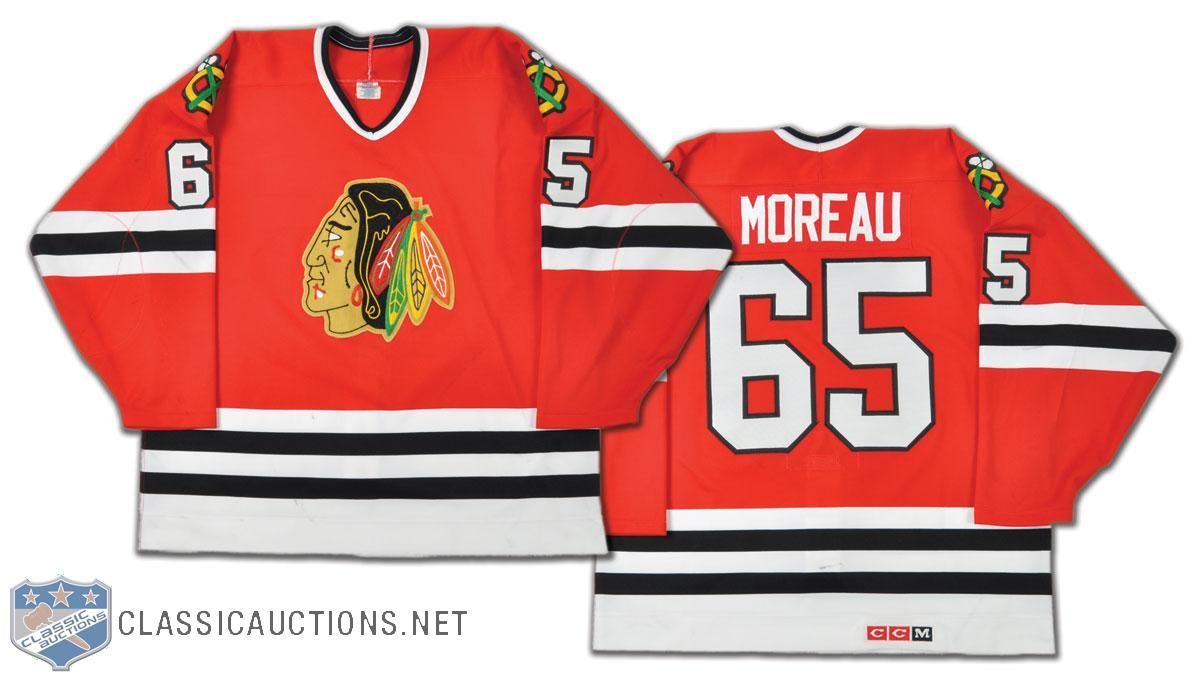
- This is a rare find, but I'm always intrigued when I come upon a number that I've never seen a player wear. Ethan Moreau apparently wore #65 during the 1994 preseason! If you're a Moreau fan, this number is one of those rare finds - much like Joe Sakic's #88 jersey when he played with the Nordiques!
- When you think of the Vancouver Canucks, does anyone else miss this look? I'm sorry, but as good as the current look is, there is still something about the skate logo that I truly miss about the Canucks. Maybe we'll see these beauties come back as an alternate one day? No one did yellow-orange-black like the Canucks did.
- As much as I hated them as a Penguins fan, there is something magical about the red-white-and blue of the Capitals. But I do have one question about this Doug Jarvis jersey from the early-1980s: why are the hem stripes so huge? They literally go right to the logo which is mid-torso! That's a little crazy.
- Just because there aren't enough Sutters in Calgary, here is more proof that the Sutter bloodline runs through the Flames. That's Shaun Sutter's jersey from the 1999-2000 season. Shaun is the son of Brian Sutter, and was drafted by the Flames when his dad coached there. Currently, Shaun serves as an assistant coach with the WHL's Regina Pats.
- I've looked at this before, but there was something going on with the Philadelphia Flyers in the late-1970s and early-1980s. Check out the location of the captain's "C" on Bob Clarke's jersey from 1976-77. It's nearly in the middle of his chest! And it's still pretty close to his mid-line in 1980-81! What gives? Why is it so close to the middle of his chest?
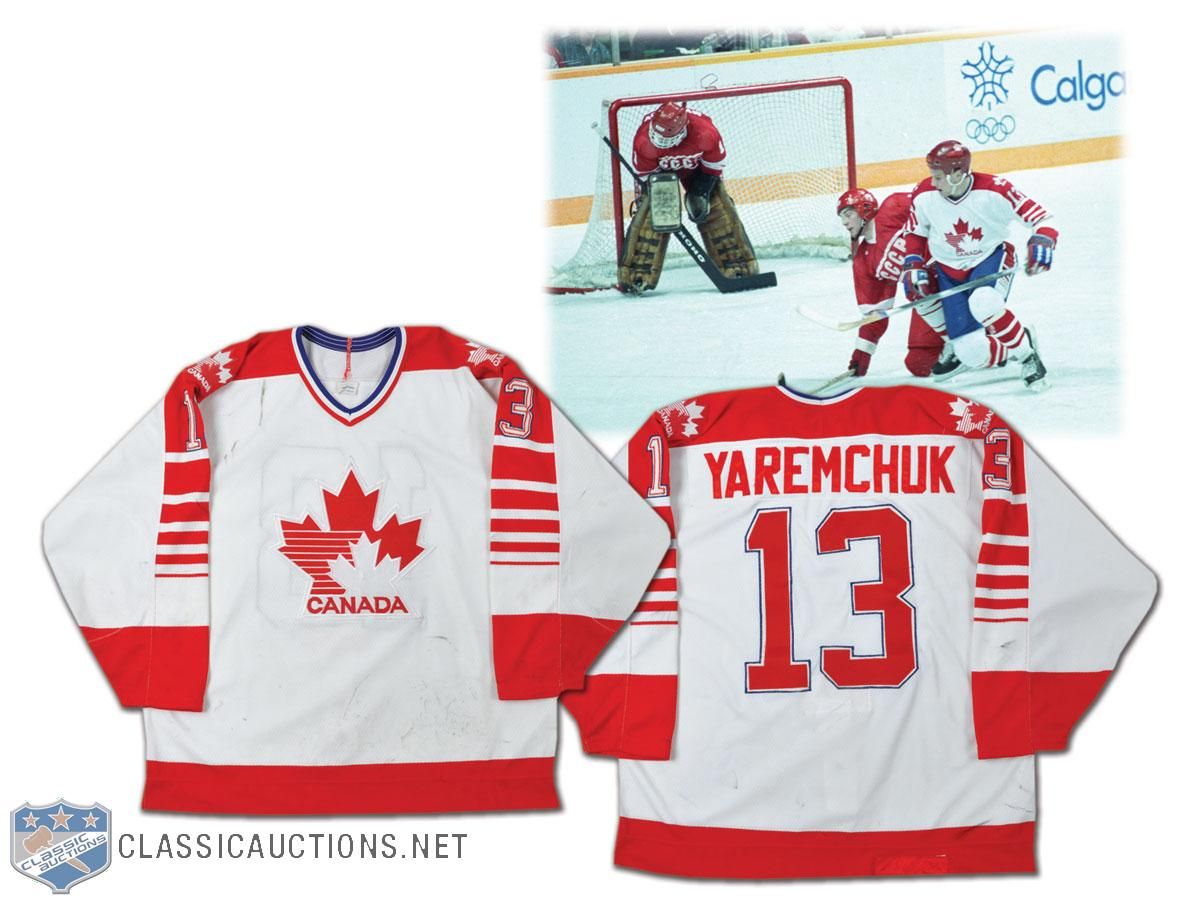
- We move to the international scene. There's a big story surrounding the 1988 Canada Olympic jerseys that I wasn't aware of before reading the story on the Classic Auctions site. This is Ken Yaremchuk's jersey, and he played alongside NHL players like Sean Burke and Andy Moog as they prepared to represent Canada at the 1988 Winter Games in Calgary. Here's the kicker: "An embroidered CCM crest on the rear hem has been covered with a patch of red tackle twill, obviously to comply with advertising guidelines. Canada received a fine of $100,000 for refusing to wear uniforms made by Tackla at the Games". I never knew that! Corporate America already had a hold on the Olympic Games back then! How cool is that little gem of hockey history? I'm hoping your answer was "very".
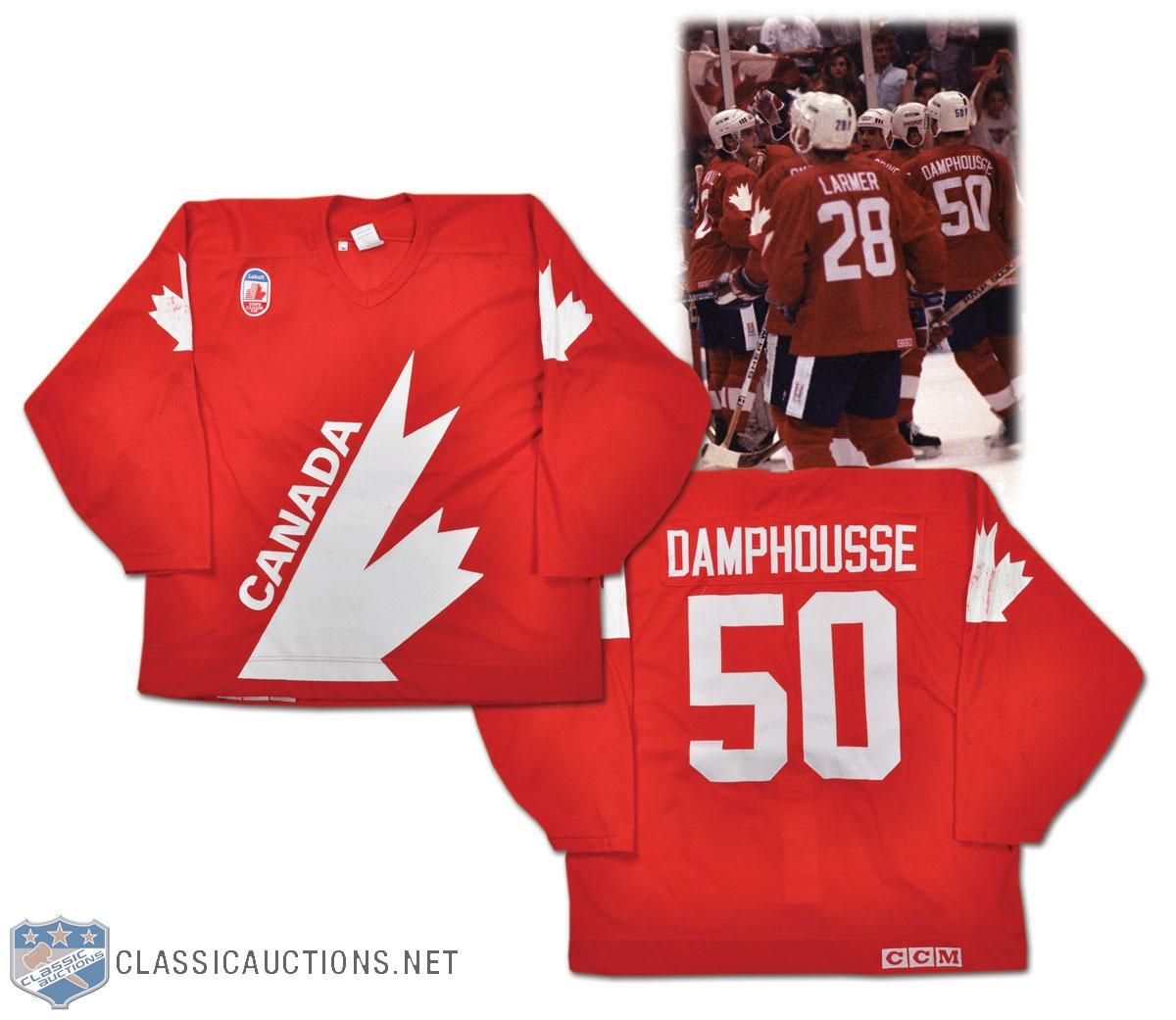
- Here's a number that wasn't seen on the ice at the 1991 Canada Cup, but Vincent Damphousse played during the selection camp. He wore #50 through the camp as he worked to play his way onto the team, but he was cut days before the Canada Cup started. It's another one of those number cameos by a player who never wore #50 again. We'll see more of Damphousse later in this article as he has another jersey in this exposé.
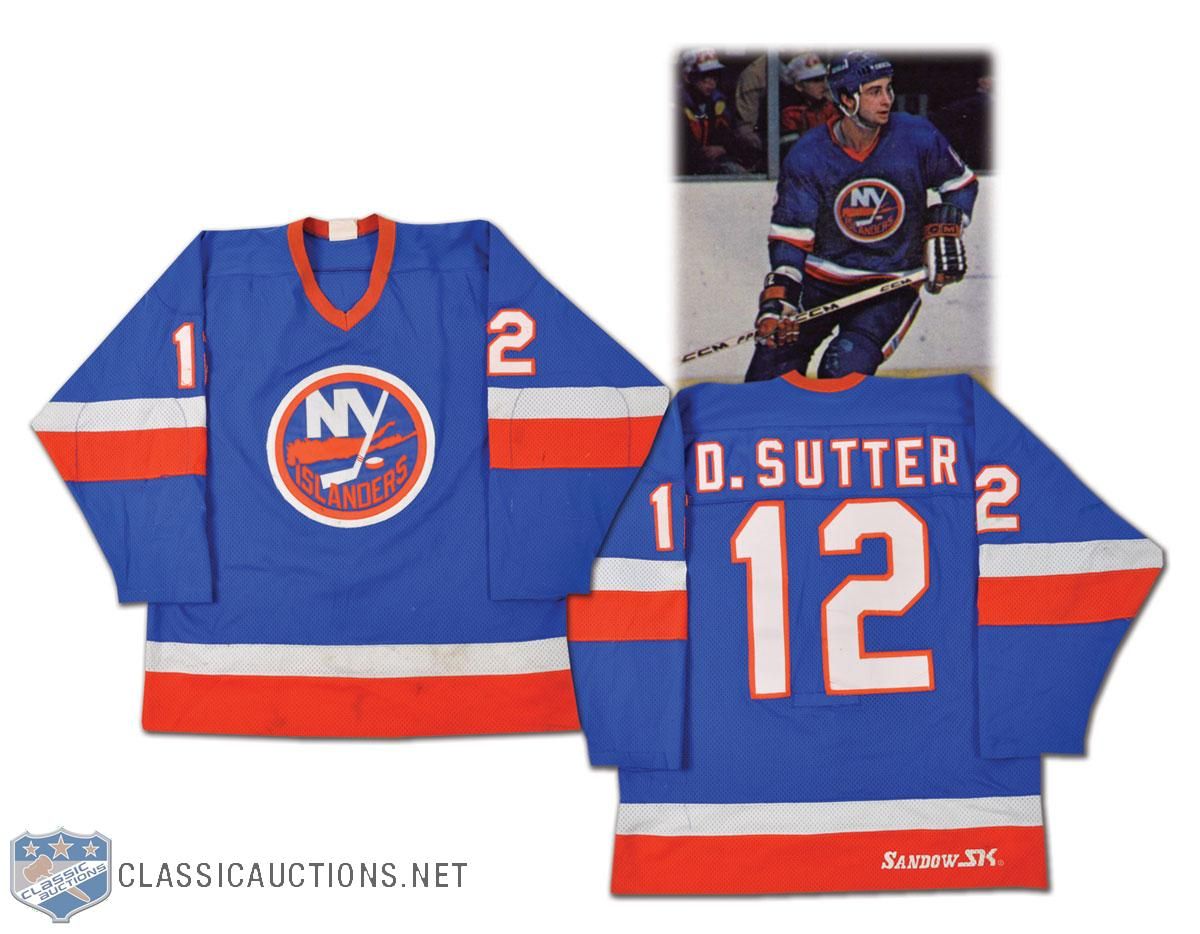
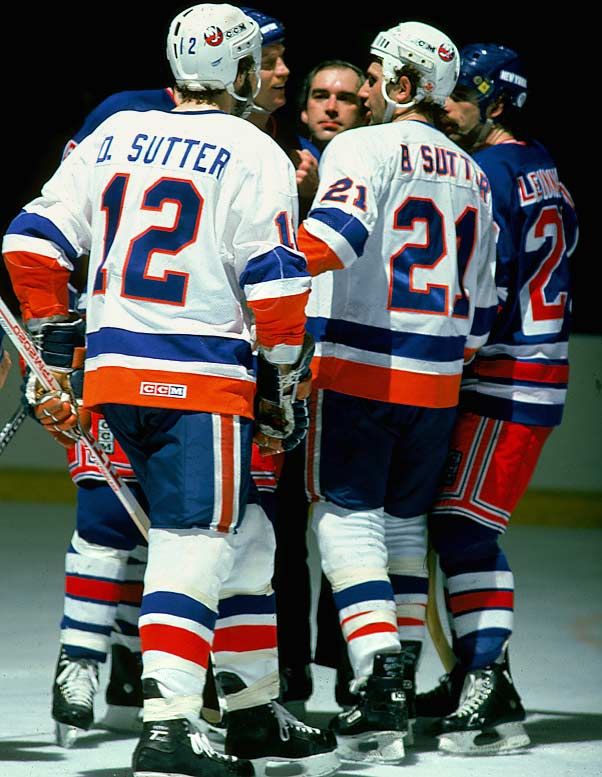
- We mentioned a couple of Sutters already, so let's bring a couple more onboard in this article. We get a good look at Duane Sutter's jersey with the Islanders from '81-82, and I'm always a fan of the first initial on a jersey. However, as we look at this photo with both Duane and Brent Sutter in it, does anyone see a major difference in the lettering? Duane's appears as single-colour font while Brent's font is double-coloured. It appears this was corrected as of 1981-82.
- With the Lightning changing their jerseys next season, it's always interesting to look back at some of their previous jerseys. Their inaugural jersey was interesting. Steve Kasper's jersey has that ridiculous font on it. I'm quite happy that it went the way of the dodo and was never seen again.
- I have to say that I always loved the colours of the Minnesota North Stars. We get to see that gorgeous green colour of the North Stars jersey here on Basil McRae's uniform from the 1987-88 season. This is what Minnesota hockey looks like. Bring back the green!
- Bob Rouse's jersey from his stint with the North Stars shows the addition of black to the colour scheme. This is how I think most people remember the North Stars. There were so many great memories of that Stanley Cup run in 1991 that ended at the hands of Mario Lemieux and the Pittsburgh Penguins in the final, but these great uniforms will stand out vividly in my mind.
- The jerseys that the North Stars wore in 1991-92 really took leaps and bounds in the wrong directions with their "re-design". Nothing about that design even comes close to giving off that great North Star vibe, and it feels pretty bland as a hockey jersey. Little did the hockey world know that the "north" part would soon be a thing of the past.
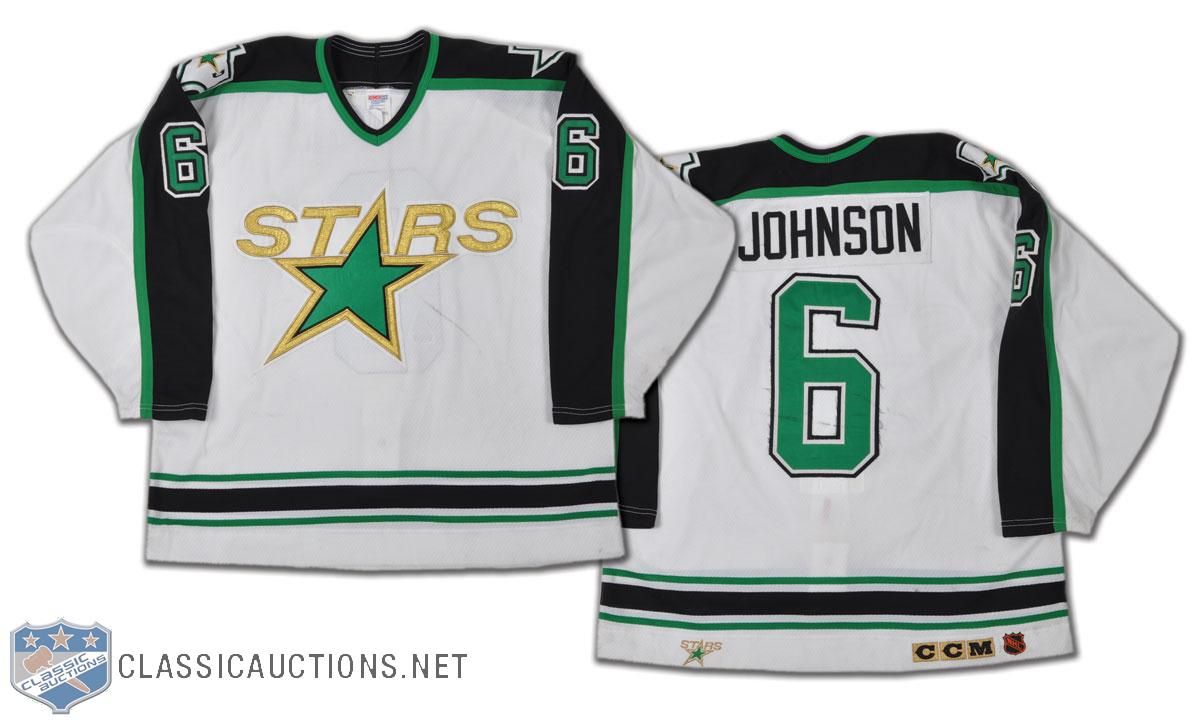
- By 1993-94, the Stars would be playing in Dallas, and they would be wearing uniforms that seemed to have a lot in common with the earlier re-design. Note to self, fans: if your team suddenly begins to remove the parts of the uniform that make you distinctly unique like, say, part of the team name, I'd be suspicious.
- Even the officials got in the act with some distinct designs. We've seen this image of Ron Ego calling a penalty in the WHA and discussed his red-striped officials jersey. I never scoured the internet for a picture with much intent because the referees seem to get lost in the shuffle of history. However, Wayne Mundey's referee sweater is a joy to behold!
- The NHL officials showed that they wore the NHL colours for a long time as this official's sweater from the 1970s has orange numbering to match the NHL shield on the front! Wasn't it nice when NHL All-Star teams and NHL employees all represented the league by wearing the league's colours? The "good ol' days", I suppose.
- The California Golden Seals seemed to miss the boat in the 1970s when they went pastel instead of staying true to their gorgeous green looks as the Oakland Seals. Bob Girard's uniform looks great, but it just doesn't have the same "pop" as the Oakland jersey does.
- The 1975-76 Kansas City Scouts jersey is a nice blend of colours, but that logo really draws the eyes to it. That logo features chain-stitching, a favorite of Mr. Paul Lukas over on Uni Watch Blog. I'm not saying the colours should return in the same fashion, but I really think someone needs to come up with a new "Scouts" ensemble. Any takers?
- Check out the logo on Nelson Pyatt's Colorado Rockies jersey from 1976-77. It looks a little off, doesn't it? That's because the Rockies didn't have their jerseys ready when the season started in 1976. The Kansas City Scouts had moved in the off-season before the 1976 season started to Denver, but they didn't have their jerseys ready in time for the start of the season. Thus the Rockies began the 1976-77 season with an odd-looking Rockies logo instead of their normal logos.
- Speaking of another jersey that just doesn't seem right, here is a Penguins jersey from the late-1960s. The stripes being light blue just don't seem right after having seen them in yellow-and-black for so many years. Another of the jerseys lost in the annals of history, I suppose.
- Don Maloney had an interesting career with the New York Rangers. While he wasn't officially the captain, he worked as acting captain whenever the Rangers saw their captain injured. Thus, he routinely is seen with the "C" on his sweater. However, Maloney is probably more well-known for his full name on the back of his sweater. I always thought that was pretty cool.
- How many people remember Guy Lafleur's tenure with the Broadway Blueshirts? The original "Flower" laced up the skates with the Rangers for 67 games in 1988-89, netting 18 goals and adding 27 assists. I don't remember this, but Lafleur wore #44 while with the Rangers.
- I found that the Detroit Red Wings did something as they evolved through the 1980s. In the late 1970s (and probably further back), the Red Wings used to use the wheel as the center point for their logo on their chests. The result? Greg Carroll's jersey looks seriously skewed because of the logo.
- Another gorgeous throwback jersey from the 1991-92 season was worn by the Detroit Red Wings. Doug Crossman played with them that season, and the stripes make this jersey look amazing. This is still one of my favorite hockey jerseys of all-time.
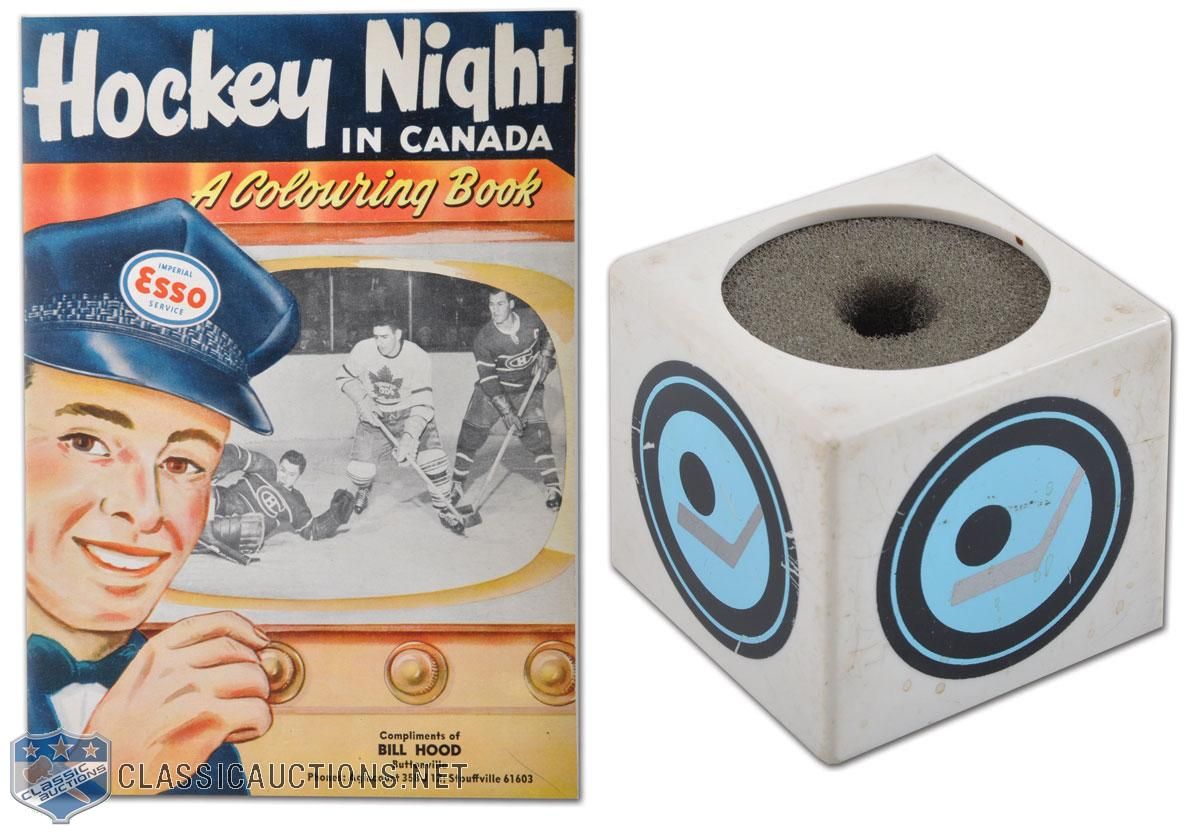
- How cool is this Hockey Night In Canada microphone cover and book? Ok, the book isn't all that important, but how awesome would it be to have that microphone caddy? I might want one of those more than I want a fabled HNIC towel!
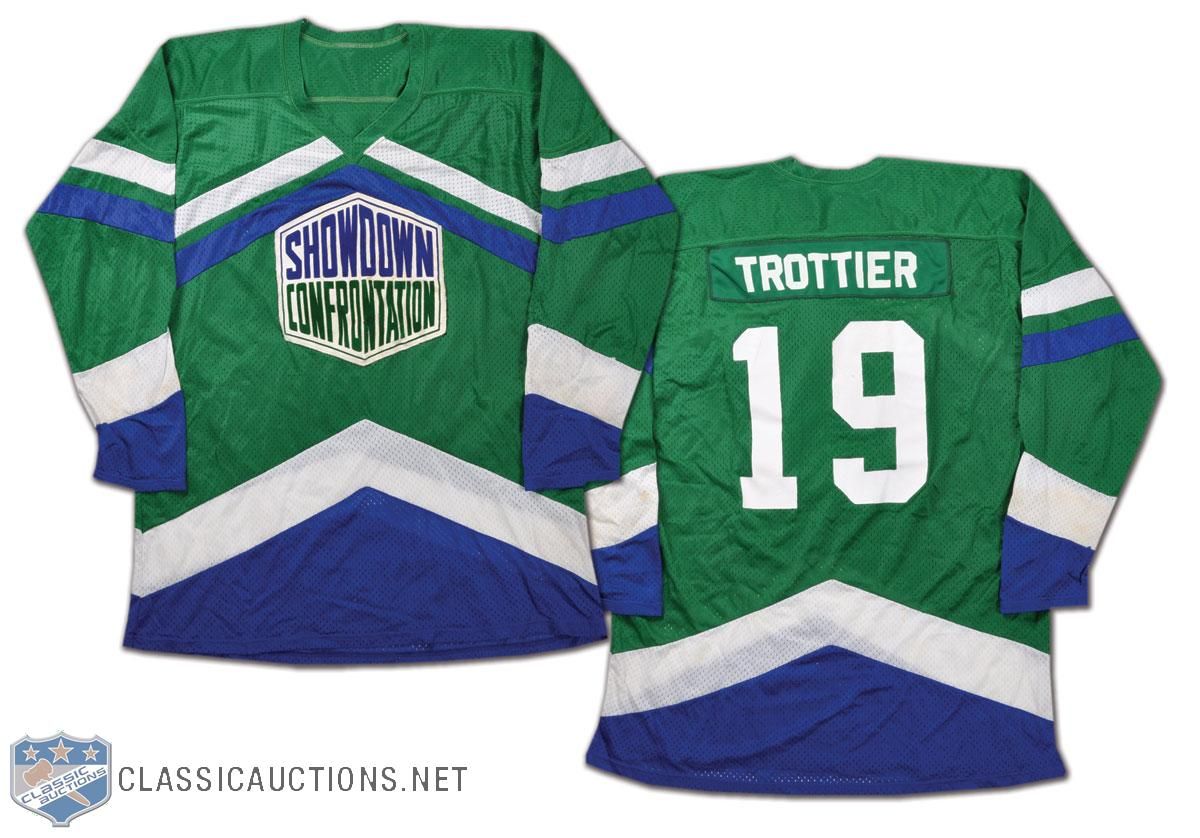
- We've seen a number of the NHL Showcase Confrontation jerseys in the past, but there's another one in the auction this time around. Bryan Trottier's jersey is up for grabs this time, and I must admit that I really like the colours on this jersey. I may have to research these Showcase Confrontation games a little more!
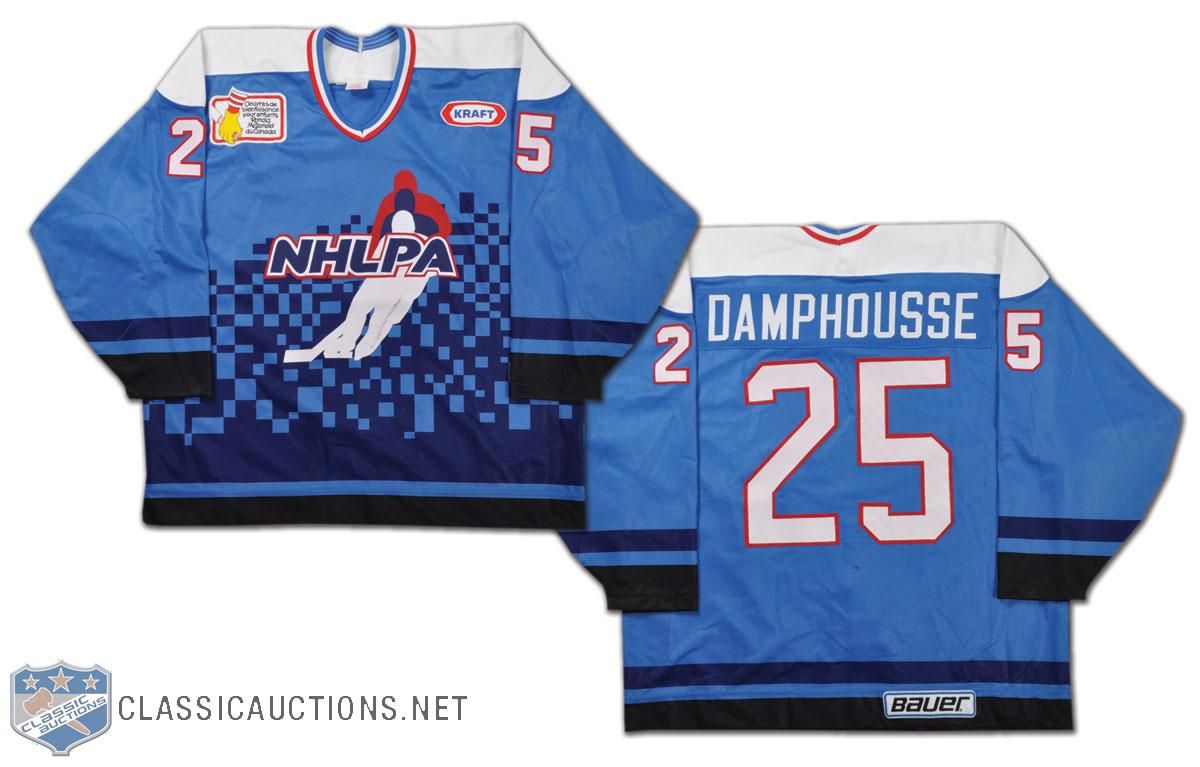
- There are lots of people who saw the NHLPA 4-on-4 Challenge from Hamilton, Ontario in 1995, but there seems to be zero tape of these games online anywhere. During the strike, the players got together at Copps Coliseum in Hamilton to play some four-on-four hockey while representing their respective regions: Western Canada, Ontario, Quebec, and the USA. Vincent Damphousse was invited, and he played for Team Quebec at the event in this gorgeous NHLPA jersey. I want it!
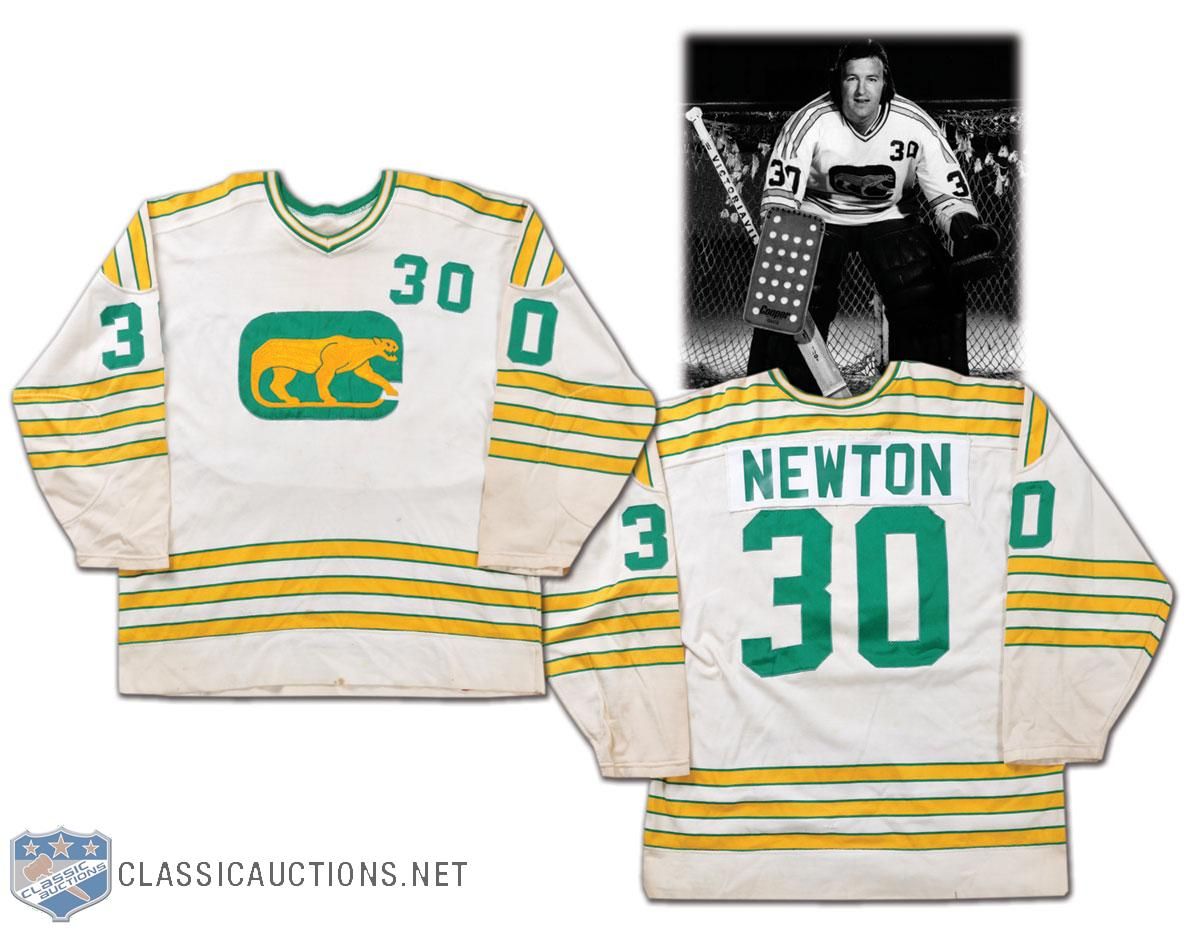
- We started with the WHA, so let's end it with a few WHA sweaters as well. The original team with the number on the shoulder was the Chicago Cougars, and Cam Newton's jersey from 1973-74 shows the number clearly. I'm still not a very big fan of having the number on the front of the jersey in hockey, but it seems to have made a comeback with some of the NHL teams today.
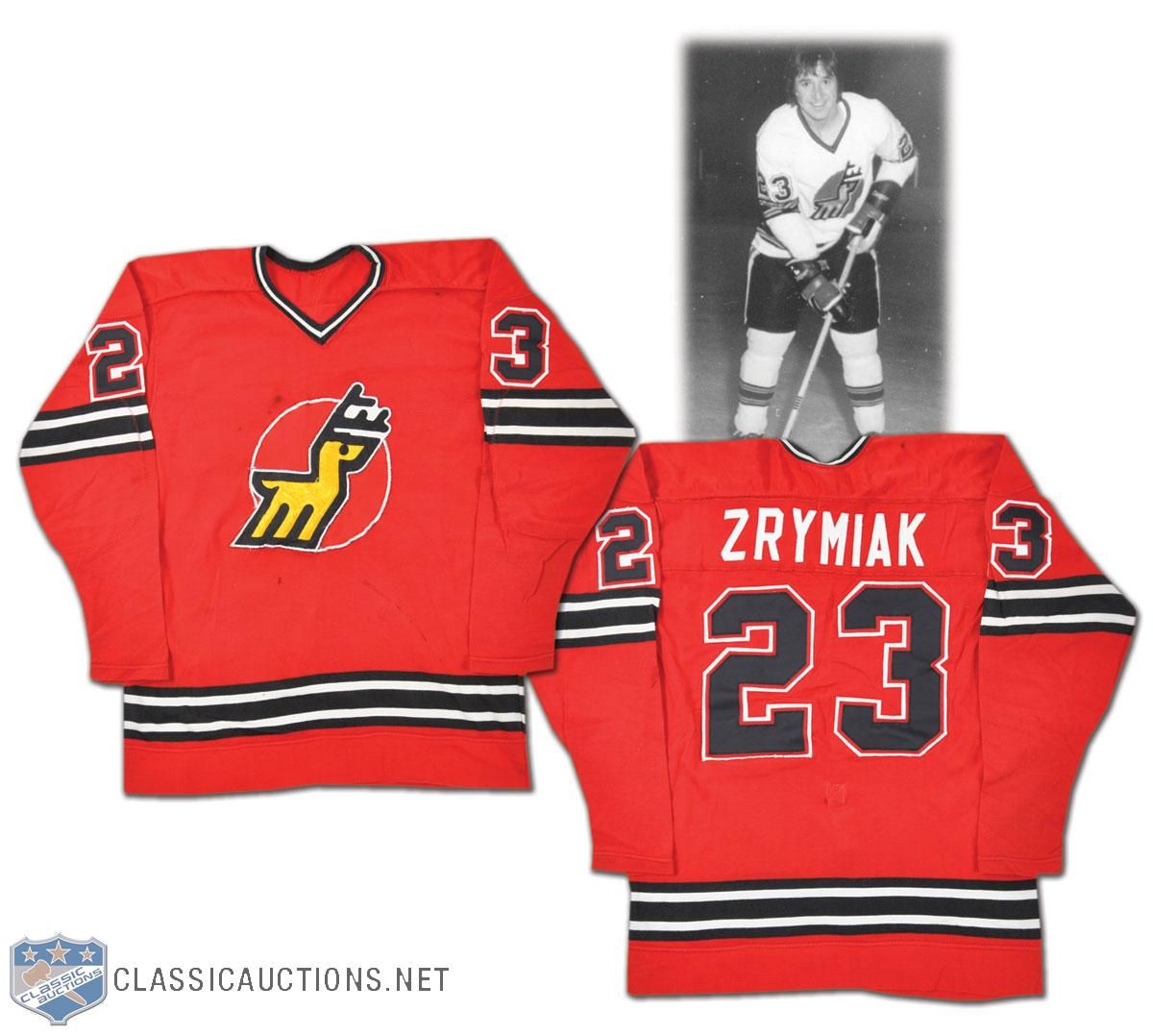
- Journeyman defenceman Jerry Zrymiak bounced around the WHA for a while, but he played with the Michigan Stags for a while during the '74-75 season. I'm not sure about you, but the name "Michigan Stags" just sounds like a manly name. The colour is a little less manly, though. I love the Stags' logo, though.
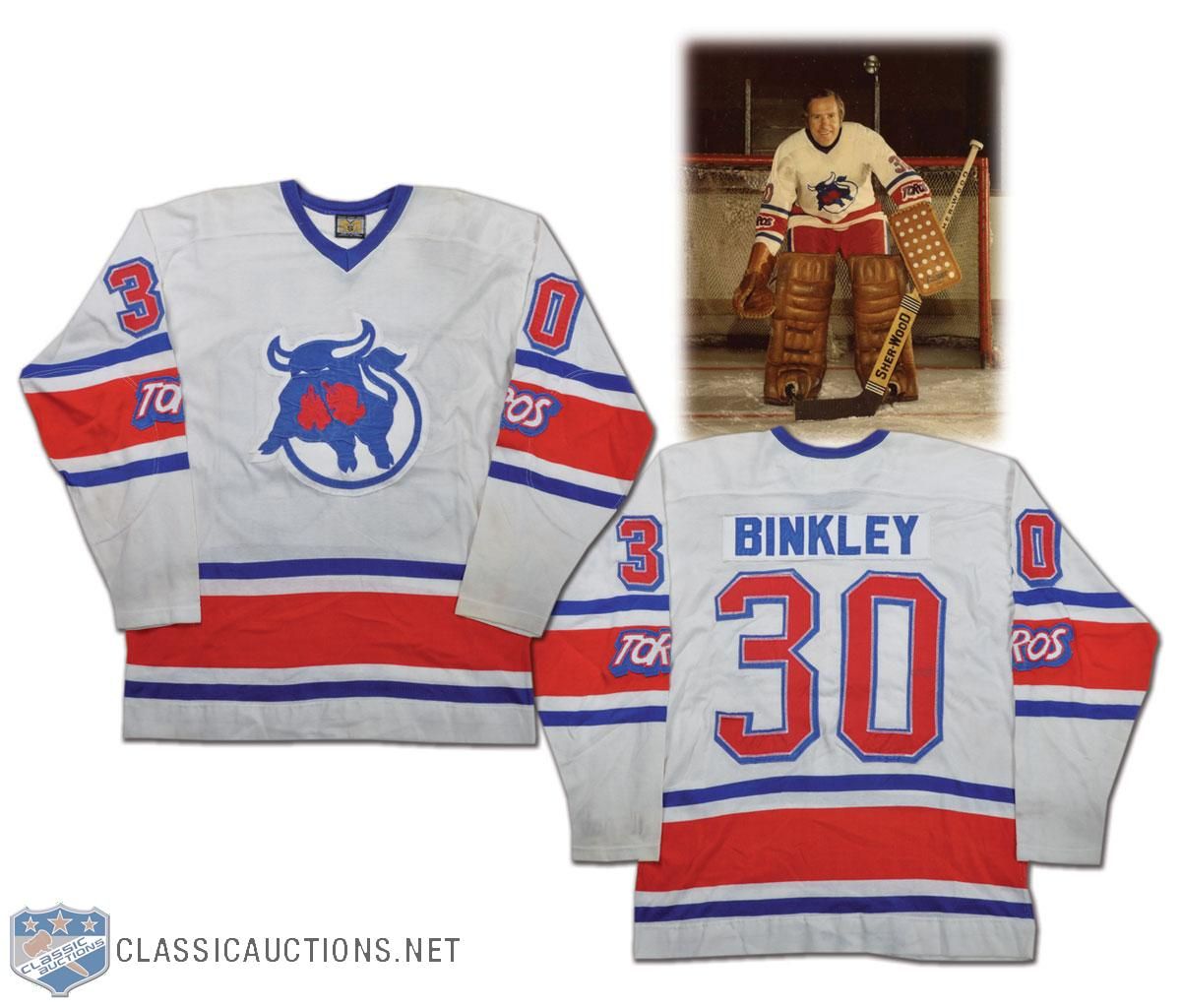
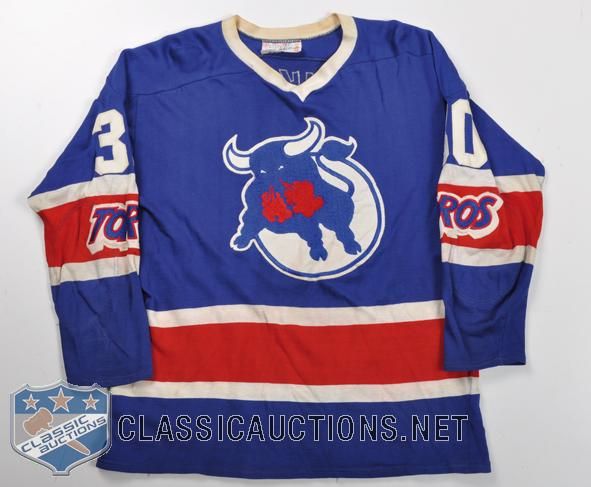
- Les Binkley starred in net for the Toronto Toros in 1975-76. I like the colours of the Toros' jerseys, but the important part is the "Toros" mark on the sleeve stripe. That's a huge detail on these jerseys, especially when you consider that the team moved after the '75-76 season and became the Birmingham Bulls. Why is this important? Check out the similarities in the Bulls' jersey to the Toros' jersey. The only thing missing is the "Toros" wordmark from the sleeve!
Until next time, keep your sticks on the ice!
Thursday, March 10, 2011
8:47 PM
nintendo
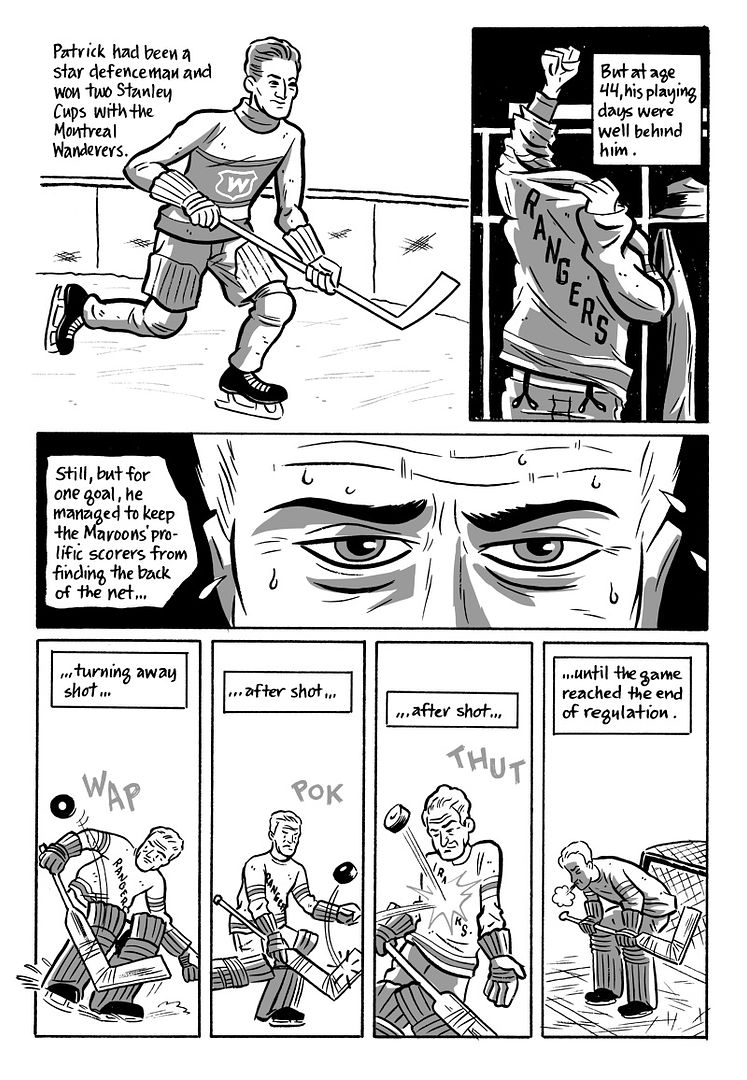
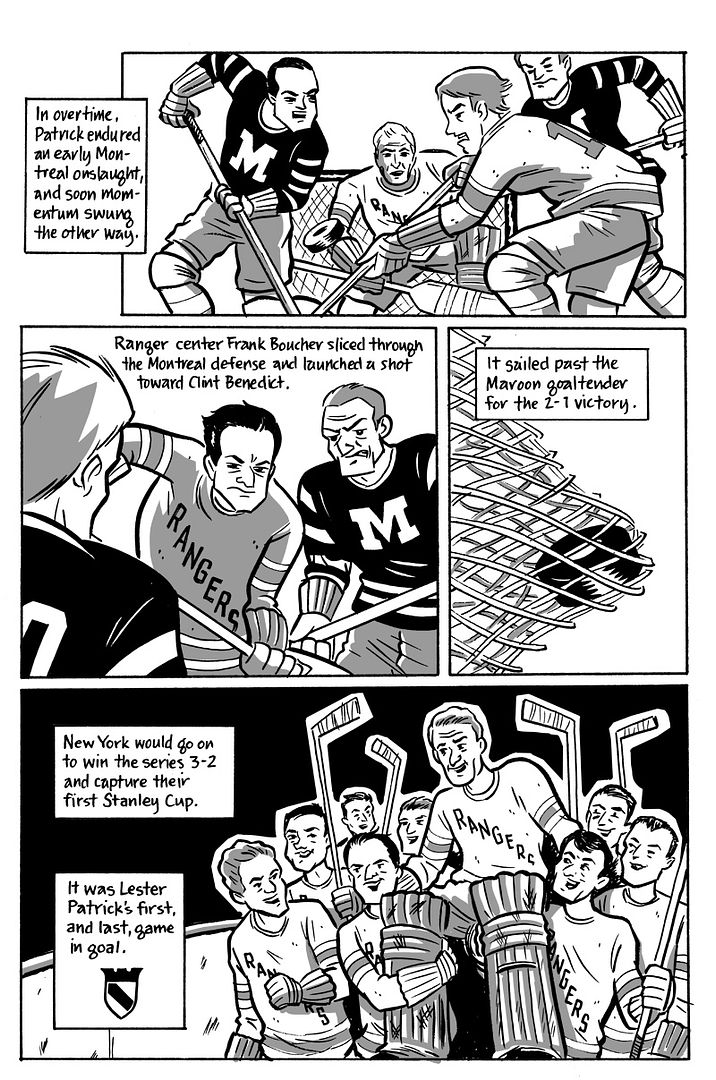
 I've told the story of Lester Patrick's goaltending heroics for the New York Rangers on HBIC before, but it's still a story that deserves to be told a thousand times again simply for the amazing tale of a man who was the epitome of putting the team first. Thankfully, pictures are worth a thousand words, so I'm told, so I'm always grateful when great artists contact me with their works about hockey. Artist extraordinaire Rob Ullman sent me his newest comic strip about Lester Patrick's tale, and it is a fantastic representation of the hockey legend's tale when Patrick went from coach to goaltender for the New York Rangers. Here is Rob's latest work, The Backstop From Behind The Bench. Enjoy!
Part One of The Backstop From Behind The Bench. As always, you can click the image to blow it up larger for easier reading.

Part Two of The Backstop From Behind The Bench.

Part Three of The Backstop From Behind The Bench.

Rob outdid himself on this one as he really did a great job in capturing the story in both words and images. I can't say enough about how good Rob's work is, and you can find a ton of excellent stuff over on his site, Atom-Bomb Bikini. There is some excellent artwork over there, so make sure you stop by his store and score yourself something great!
If nothing else, check out Rob in the Ginger Classic wearing the old-school Quebec Nordiques jersey! He looks like a young Peter Stastny out there! Well done on your jersey choice, Rob! Congrats on your success in the tournament, and thanks for sending me over these great pieces of artwork!
Until next time, keep your sticks on the ice!
Sunday, February 27, 2011
6:00 AM
nintendo
I spent a fair amount of Reading Week reading, but not a word of it was for school. I did not achieve my goal of getting caught up to the current post of Disunion, but I did start at the beginning and make it through early January.
But it doesn't matter how far I got, because now I am totally hooked. I can't believe I got myself into another long-term reading commitment, with at least two years of overlap between the Pepys Diary and Disunion! But it's too late to turn back now. I am absolutely loving Disunion. If you enjoy reading and thinking about history, you can't do much better than this.
Did you know there was almost a state called Franklin? Did you know that the state of West Virginia was created when people in the western end of Virginia chose not to secede with the rest of their state? (They weren't anti-slavery, but were more economically tied to the North.) Allan and I have come to the conclusion that we were taught just about nothing.
Perhaps that's why so many people in the southern US still believe myths and lies about the Civil War. Or perhaps there's another reason.
December 20, 2010 marked 150 years since South Carolina seceded from the United States of America, the first state to do so. Some white South Carolinians celebrated with antebellum-style balls, while others, mostly African Americas, protested outside.
Naturally, Confederacy-lovers claim that their celebration has nothing to do with slavery. Indeed, they claim that the southern states' secession and the bloodiest war in US history were not about slavery. According to them, it was all about states' rights. States' rights, states' rights, states' rights. Limiting the power of the federal government to tell local governments what to do. This is the mantra.
I don't know whether the people who cling to this talking point are actually ignorant of the truth, or if they know they are lying. Given the train wreck that is public education in the US, my guess is that a fair percentage of them believe this lie to be true. But about this there is no question: it's a lie.
Secession was not about states' rights, plural. It was about one state "right": the "right" to own human property and control a supply of forced, free labour.
Edward Ball is the author of the book Slaves in the Family, which chronicles his journey to find and meet the people who are descendants from the slaves owned by his own ancestors. (Great interview with Ball here.) On the anniversary of South Carolina's secession, he wrote an essay, "Gone With The Myths" for the New York Times. Here's an excerpt.
This Disunion entry, "Dancing Around History", also puts the lie to the states' rights myth, and counters the usual rationalizations in more detail.
Also: Creative Loafing: It's the slavery, stupid.
But it doesn't matter how far I got, because now I am totally hooked. I can't believe I got myself into another long-term reading commitment, with at least two years of overlap between the Pepys Diary and Disunion! But it's too late to turn back now. I am absolutely loving Disunion. If you enjoy reading and thinking about history, you can't do much better than this.
Did you know there was almost a state called Franklin? Did you know that the state of West Virginia was created when people in the western end of Virginia chose not to secede with the rest of their state? (They weren't anti-slavery, but were more economically tied to the North.) Allan and I have come to the conclusion that we were taught just about nothing.
Perhaps that's why so many people in the southern US still believe myths and lies about the Civil War. Or perhaps there's another reason.
December 20, 2010 marked 150 years since South Carolina seceded from the United States of America, the first state to do so. Some white South Carolinians celebrated with antebellum-style balls, while others, mostly African Americas, protested outside.
Naturally, Confederacy-lovers claim that their celebration has nothing to do with slavery. Indeed, they claim that the southern states' secession and the bloodiest war in US history were not about slavery. According to them, it was all about states' rights. States' rights, states' rights, states' rights. Limiting the power of the federal government to tell local governments what to do. This is the mantra.
I don't know whether the people who cling to this talking point are actually ignorant of the truth, or if they know they are lying. Given the train wreck that is public education in the US, my guess is that a fair percentage of them believe this lie to be true. But about this there is no question: it's a lie.
Secession was not about states' rights, plural. It was about one state "right": the "right" to own human property and control a supply of forced, free labour.
Edward Ball is the author of the book Slaves in the Family, which chronicles his journey to find and meet the people who are descendants from the slaves owned by his own ancestors. (Great interview with Ball here.) On the anniversary of South Carolina's secession, he wrote an essay, "Gone With The Myths" for the New York Times. Here's an excerpt.
I can testify about the South under oath. I was born and raised there, and 12 men in my family fought for the Confederacy; two of them were killed. And since I was a boy, the answer I’ve heard to this question, from Virginia to Louisiana (from whites, never from blacks), is this: “The War Between the States was about states’ rights. It was not about slavery.”
I’ve heard it from women and from men, from sober people and from people liquored up on anti-Washington talk. The North wouldn’t let us govern ourselves, they say, and Congress laid on tariffs that hurt the South. So we rebelled. Secession and the Civil War, in other words, were about small government, limited federal powers and states’ rights.
But a look through the declaration of causes written by South Carolina and four of the 10 states that followed it out of the Union — which, taken together, paint a kind of self-portrait of the Confederacy — reveals a different story. From Georgia to Texas, each state said the reason it was getting out was that the awful Northern states were threatening to do away with slavery.
South Carolina: “The non-slaveholding states ... have denounced as sinful the institution of slavery” and “have encouraged and assisted thousands of our slaves to leave their homes.”
Mississippi: “Our position is thoroughly identified with the institution of slavery — the greatest material interest of the world. ... There was no choice left us but submission to the mandates of abolition, or a dissolution of the Union.”
Georgia: “A brief history of the rise, progress, and policy of anti-slavery and the political organization into whose hands the administration of the Federal Government has been committed will fully justify the pronounced verdict of the people of Georgia.”
Several states single out a special culprit, Abraham Lincoln, “an obscure and illiterate man” whose “opinions and purposes are hostile to slavery.” Lincoln’s election to the White House meant, for South Carolina, that “the public mind must rest in the belief that slavery is in the course of ultimate extinction.”
In other words, the only state right the Confederate founders were interested in was the rich man’s “right” to own slaves.
It’s peculiar, because “states’ rights” has become a popular refrain in Republican circles lately. Last year Gov. Rick Perry of Texas wondered aloud whether secession was his state’s right in the aftermath of laws out of Congress that he disliked.
In part because of this renewed rhetoric, in the coming remembrances we will likely hear more from folks who cling to the whitewash explanation for secession and the Civil War. But you have only to look at the honest words of the secessionists to see why all those men put on uniforms.
This Disunion entry, "Dancing Around History", also puts the lie to the states' rights myth, and counters the usual rationalizations in more detail.
The citizenry, poised to tear a nation apart, was planning a grand party. The following afternoon, Palmer and other delegates who had assembled in the South Carolina city voted 169 to 0 for secession. That evening thousands flocked to Institute Hall in downtown Charleston to witness the formal signing of the “Ordinance of Secession.” Afterward “cannon were fired,” reported the Charleston Mercury, “and bright triumph was depicted on every countenance.”
On Monday, exactly 150 years later, Confederate enthusiasts sought to relive the festivities with an elaborate Secession Gala. Three hundred celebrants—dozens decked out like cavalier planters and Lady South Carolina—packed Charleston’s Gaillard Auditorium to celebrate the fateful vote. One could almost be forgiven for thinking the whole town had gone back in time.
Outside the ball, though, more than a hundred people staged a downtown march, capping off an afternoon of protest that included police-guarded demonstrations at local hotels and a candlelight vigil. The protesters, mostly black, carried signs reading “Don’t Celebrate Slavery and Terrorism” and “It’s not About Heritage.” “Slavery is what you defend when you have a party, a celebration, get drunk, holler loud, act like a rebel, and talk about how you’re celebrating your heritage,” said NAACP leader Reverend Nelson B. Rivers III. “No matter how you dress it up, it is still slavery.” As darkness fell around Gaillard Auditorium, they lit candles and sang “We Shall Overcome.”
Inside, the white gala attendees, nearly half of whom were dressed in period costume, belted out a rousing rendition of Dixie. The mood was festive and defiant. Slavery, many insisted, had nothing to do with their decision to buy the $100 ticket to attend the ball. “We’re not celebrating slavery,” maintained Sons of Confederate Veterans Commander-in-Chief Michael Givens. “We’re looking at the bravery and tenacity of the people who rose up.” When pressed, he and others admitted that the institution was an abomination. But they also took pains to emphasize that secession was about high tariffs or states’ rights. Anything but slavery.
Attendees at Monday’s ball would like to believe that the unanimity of slaveowners and non-slaveowners during the crisis proves that slavery wasn’t the driving issue behind secession. But a closer study of the contentious debate over secession in late 1860 shows how “fire-eaters” used fear of emancipation to coerce and persuade whites of all classes into ultimately supporting secession. (Needless to say, the state’s black majority likely didn’t support secession either—though no one bothered to ask them.) [Read more here.]
Also: Creative Loafing: It's the slavery, stupid.
Friday, February 25, 2011
7:00 AM
nintendo
This is a tangent to my previous post, but it deserves an entry of its own. I want to point out this excellent article by Adam Gopnik in The New Yorker: "How the Internet gets inside us".
Gopnik reviews a pile of recent books about the internet and society, dividing them into three themes: technology is our saviour, technology is our demise, and technology has always been met with these same two responses. Gopnik calls them "the Never-Betters, the Better-Nevers, and the Ever-Wasers". It's a perceptive and entertaining assessment of how we conceive of technology in our lives.
Here are a few bits I especially enjoyed.
Naturally, I love this historical perspective. One of my minor academic triumphs in grad school has been a paper arguing that the print revolution of the 1600s was a greater communications shift - a more significant information explosion relative to what preceded it, and a more cataclysmic cultural shift by far - than the one we are living through now. (Thank you, Elizabeth Eisenstein!)
This bit on how our perception of television, relative to the internet, has changed made me chuckle. I loved Gopnik's resolution, suggesting we back away from all-or-nothing thinking and, if technology is bothering us, perhaps a few small changes are in order.
You can read the whole thing here. It's the same New Yorker issue with the much-talked about story about Paul Haggis and Scientology. I haven't read this one yet, but several people we know have recommended it and it sounds great. Why not thank a tree and print them both?
Gopnik reviews a pile of recent books about the internet and society, dividing them into three themes: technology is our saviour, technology is our demise, and technology has always been met with these same two responses. Gopnik calls them "the Never-Betters, the Better-Nevers, and the Ever-Wasers". It's a perceptive and entertaining assessment of how we conceive of technology in our lives.
Here are a few bits I especially enjoyed.
One of the things that John Brockman’s collection on the Internet and the mind illustrates is that when people struggle to describe the state that the Internet puts them in they arrive at a remarkably familiar picture of disassociation and fragmentation. Life was once whole, continuous, stable; now it is fragmented, multi-part, shimmering around us, unstable and impossible to fix. The world becomes Keats’s “waking dream,” as the writer Kevin Kelly puts it.
The odd thing is that this complaint, though deeply felt by our contemporary Better-Nevers, is identical to Baudelaire’s perception about modern Paris in 1855, or Walter Benjamin’s about Berlin in 1930, or Marshall McLuhan’s in the face of three-channel television (and Canadian television, at that) in 1965. When department stores had Christmas windows with clockwork puppets, the world was going to pieces; when the city streets were filled with horse-drawn carriages running by bright-colored posters, you could no longer tell the real from the simulated; when people were listening to shellac 78s and looking at color newspaper supplements, the world had become a kaleidoscope of disassociated imagery; and when the broadcast air was filled with droning black-and-white images of men in suits reading news, all of life had become indistinguishable from your fantasies of it. It was Marx, not Steve Jobs, who said that the character of modern life is that everything falls apart.
We must, at some level, need this to be true, since we think it’s true about so many different kinds of things. We experience this sense of fracture so deeply that we ascribe it to machines that, viewed with retrospective detachment, don’t seem remotely capable of producing it. If all you have is a hammer, the saying goes, everything looks like a nail; and, if you think the world is broken, every machine looks like the hammer that broke it.
It is an intuition of this kind that moves the final school, the Ever-Wasers, when they consider the new digital age. A sense of vertiginous overload is the central experience of modernity, they say; at every moment, machines make new circuits for connection and circulation, as obvious-seeming as the postage stamps that let eighteenth-century scientists collaborate by mail, or as newfangled as the Wi-Fi connection that lets a sixteen-year-old in New York consult a tutor in Bangalore. Our new confusion is just the same old confusion.
Naturally, I love this historical perspective. One of my minor academic triumphs in grad school has been a paper arguing that the print revolution of the 1600s was a greater communications shift - a more significant information explosion relative to what preceded it, and a more cataclysmic cultural shift by far - than the one we are living through now. (Thank you, Elizabeth Eisenstein!)
This bit on how our perception of television, relative to the internet, has changed made me chuckle. I loved Gopnik's resolution, suggesting we back away from all-or-nothing thinking and, if technology is bothering us, perhaps a few small changes are in order.
It is the wraparound presence, not the specific evils, of the machine that oppresses us. Simply reducing the machine’s presence will go a long way toward alleviating the disorder. Which points, in turn, to a dog-not-barking-in-the-nighttime detail that may be significant. In the Better-Never books, television isn’t scanted or ignored; it’s celebrated. When William Powers, in “Hamlet’s BlackBerry,” describes the deal his family makes to have an Unplugged Sunday, he tells us that the No Screens agreement doesn’t include television: “For us, television had always been a mostly communal experience, a way of coming together rather than pulling apart.” (“Can you please turn off your damn computer and come watch television with the rest of the family,” the dad now cries to the teen-ager.)
Yet everything that is said about the Internet’s destruction of “interiority” was said for decades about television, and just as loudly. Jerry Mander’s “Four Arguments for the Elimination of Television,” in the nineteen-seventies, turned on television’s addictive nature and its destruction of viewers’ inner lives; a little later, George Trow proposed that television produced the absence of context, the disintegration of the frame — the very things, in short, that the Internet is doing now. And Bill McKibben ended his book on television by comparing watching TV to watching ducks on a pond (advantage: ducks), in the same spirit in which Nicholas Carr leaves his computer screen to read “Walden.”
Now television is the harmless little fireplace over in the corner, where the family gathers to watch “Entourage.” TV isn’t just docile; it’s positively benevolent. This makes you think that what made television so evil back when it was evil was not its essence but its omnipresence. Once it is not everything, it can be merely something. The real demon in the machine is the tirelessness of the user. A meatless Monday has advantages over enforced vegetarianism, because it helps release the pressure on the food system without making undue demands on the eaters. In the same way, an unplugged Sunday is a better idea than turning off the Internet completely, since it demonstrates that we can get along just fine without the screens, if only for a day.
You can read the whole thing here. It's the same New Yorker issue with the much-talked about story about Paul Haggis and Scientology. I haven't read this one yet, but several people we know have recommended it and it sounds great. Why not thank a tree and print them both?
Sunday, February 20, 2011
1:00 PM
nintendo
I will try not to overdo the Disunion posts, but I can't promise anything. This entry is worthy of Howard Zinn: "Jim Crow on West Broadway". There was always resistance! Meet Charles Sanders and Elizabeth Jennings, 19th Century forerunners of Rosa Parks, along with the organizing efforts of black New Yorkers, and a Georgia man who refused to chop wood, declaring that since Lincoln had been elected, he was now free.
Go read. Try not to get distracted by that house for sale on West 9th Street. At one time that would have topped my lottery list.
Go read. Try not to get distracted by that house for sale on West 9th Street. At one time that would have topped my lottery list.
9:30 AM
nintendo
I don't know if Freedom To Read Week is purposely timed to coincide with Reading Week, the mid-winter break for university students, but I'm celebrating my own freedom to read by diving headlong into "Disunion". I'm starting at the beginning, with the goal of being caught up with the current post by the time classes resume next week.
My friend Alan With One L should be happy to read this: he learned about Disunion through my post here, and like me, he couldn't just pick up in progress, he had to start with the first post. I have to thank him, too. I thought I was too far behind to get caught up, but his enthusiasm convinced me otherwise. Now we can gush about this together in April.
So far, this blog is amazing, a must-read for history lovers, especially if you're into the 19th Century, as I am. It was no surprise to me to read that political life in mid-1800s America was louder, more divisive and more violent than it is today.
Right away, we see how all of the US - not only the southern states - was complicit in the slave trade...
...and how slavery came to be abolished in the US. Even in the first few posts, I see glimpses of how the people's abolition movement pushed leaders in that direction. Older generations of USians learned that "Lincoln freed the slaves," while younger students in more progressive areas learned that Lincoln would have been content to preserve slavery if he could still preserve the Union. Neither is correct.
So now my reading will take me to 17th Century London and 19th Century America along with 21st Century Canada.
My friend Alan With One L should be happy to read this: he learned about Disunion through my post here, and like me, he couldn't just pick up in progress, he had to start with the first post. I have to thank him, too. I thought I was too far behind to get caught up, but his enthusiasm convinced me otherwise. Now we can gush about this together in April.
So far, this blog is amazing, a must-read for history lovers, especially if you're into the 19th Century, as I am. It was no surprise to me to read that political life in mid-1800s America was louder, more divisive and more violent than it is today.
Hurled brickbats, smashed glass and howled curses were the soundtrack of American electoral politics a century and a half ago. The oratorical eloquence that most people today associate with the 19th century — those resonant fanfares of prose carved upon monuments, enshrined in history textbooks, hammered into the brains of 10th graders — often provided little more than the faintest melodic line, drowned out amid the percussive din. Last week’s notorious “head-stomping” incident outside a Senate debate in Kentucky, footage of which has drawn nationwide condemnation and half a million views on YouTube, seems almost gentle in comparison.
On the last Friday night before the 1860 election, Senator William H. Seward delivered a rousing Republican campaign address to a large outdoor gathering on 14th Street in Manhattan. Afterward, crowds of pro-Lincoln “Wide Awakes” fanned out through the surrounding area. Wide Awakes, members of an organization with strong paramilitary overtones, could be a menacing sight: they wore military-style caps and shrouded themselves in long black capes made of a shiny fabric that reflected the flames of the torches they carried. Some strapped axes to their backs, in tribute to their rail-splitting hero.
According to the next day’s Times and other papers, things began to spin out of control when supporters of a rival presidential contender, John Bell, charged toward the Lincoln men, “calling them ‘negro stealers,’ ‘sons of b____s,’ &c.” At the corner of 12th Street and Fourth Avenue, several dozen volunteer firemen — members of Engine Company 23 — joined the fray, swinging roundhouse blows with clubs and heavy iron wrenches that the Wide Awakes tried to parry with their torches. But the tide of battle turned when the young Republicans brought their Lincoln axes into play. They chased the enemy back into the company firehouse and promptly began smashing down its barricaded doors, as other idealistic marchers flung bricks and cobblestones. (News reports are vague about what finally ended the fracas.)
Similar disturbances happened almost daily in various East Coast cities. In Baltimore the previous night, Republican marchers had been pelted with stones and rotten eggs. (That city was justly known as “Mobtown”; dozens sometimes died in a single campaign season there.) In Washington on Election Day itself, pro-slavery forces stormed a Wide Awake clubhouse a block or two from the Capitol. The attackers practically demolished the building and were only narrowly prevented from burning the ruin — along with several Wide Awakes trapped on the third floor — by the timely arrival of police.
There was little talk of bipartisan civility during that particular election cycle.
Right away, we see how all of the US - not only the southern states - was complicit in the slave trade...
If you had risen early on that Sunday morning, you probably would have ventured out to marvel at the wreckage left by the past night’s storm. Trees had toppled; shop signs lay smashed on the cobblestones. All along the wharves of lower Manhattan, ships had lost spars and rigging.
And on the harbor’s restless water, a three-masted merchant vessel tossed and bucked at her mooring lines. If you drew close, you might still have caught a whiff of the distinctive stench that every well-traveled mariner in that day and age knew: the reek of close-packed bodies, of human misery, of captivity and death.
She was the slaver Erie, and she had recently come to New York as a captive herself. A U.S. naval vessel, patrolling for ships engaged in the illicit trade, had seized her off the mouth of the Congo River. Flinging open the hatches to the cargo hold, the officers saw a dim tangle of bodies moving in the darkness, packed so tightly that they seemed almost a single tormented soul. Nearly 900 Africans — half of them children — had been stripped naked and forced below decks at the height of equatorial summer, aboard a vessel barely more than 100 feet long. Just a few days into their weeks-long voyage, a witness later recalled, “their sufferings were really agonizing, and . . . the stench arising from their unchecked filthiness was absolutely startling.” Even after their rescue, dozens died in a matter of days.
It might seem odd today that the American government was freeing slaves across the Atlantic while zealously protecting the “property rights” of slaveholders closer to home. Not long after Congress abolished slave importation in 1808, however, U.S. and British naval vessels had begun policing the African coasts and the waters of the Caribbean, occasionally even bringing the captains and crews back to stand trial under federal law. (The freed captives, no matter where in Africa they had come from, were set ashore in Liberia, often to be set to work there in conditions little better than slavery.) It was one of many such hypocrisies, born of political compromise, that most Americans in 1860 took for granted.
Like the majority of slavers at the time, the Erie had been bound for Cuba, where importation was still legal. Her human “cargo” might have fetched somewhere between half a million and a million dollars there — depending, of course, on how many captives perished during the crossing. A mortality rate of one in five or so was taken for granted in the trade, but the Erie’s record on past voyages had been even worse than this horrific average. Still, enormous profits were to be made. The slaver’s New England-born captain, Nathaniel Gordon, had purchased the Africans with kegs of whiskey. He was now a prisoner in the Eldridge Street jail.
The Erie was no stranger to New York. It was, indeed, her home port, as it was of many such vessels. Nearly 100 clandestine — or barely clandestine — slaving voyages had set out from the city over the past 18 months alone. Notorious traders in human flesh hung out their shingles in front of offices on Pearl and Beaver Streets downtown, scarcely bothering to camouflage themselves as legitimate shipping merchants.
Slavery was in the lifeblood of the metropolis. An editorial in that same Sunday’s New York Herald warned local citizens against electing a candidate like Lincoln who might interfere with the institution in the American South. Slave-grown cotton was one of the greatest sources of the city’s wealth, the paper pointed out. Rashly frightening the slave states out of the Union would be “like killing the goose that laid the golden eggs.”
...and how slavery came to be abolished in the US. Even in the first few posts, I see glimpses of how the people's abolition movement pushed leaders in that direction. Older generations of USians learned that "Lincoln freed the slaves," while younger students in more progressive areas learned that Lincoln would have been content to preserve slavery if he could still preserve the Union. Neither is correct.
Throughout most of the nation’s history, it had taken weeks for votes to be counted and for Americans to find out who their new president was. But by 1860, telegraph lines – more than 50,000 miles of them – had spread so far and wide across the country that the results were in the morning editions of the next day’s papers.
In Boston that night, Wendell Phillips strode onstage to address a large audience of abolitionists in the Tremont Theatre, just off the Common. Phillips, one of the nation’s most prominent antislavery leaders, had been skeptical of Abraham Lincoln from the beginning. To him, the unknown Midwesterner – born in Kentucky to Virginian parents, he must have noted with alarm – was going to be just one more mediocre politician to warm the presidential chair for another four years, while black Americans continued to languish in bondage. Addressing an anti-slavery meeting that summer, just after the Republicans announced their nominee, Phillips had sneered: “Who is this huckster in politics? Who is this county court advocate? . . . What is his recommendation? It is that nobody knows anything good or bad of him. . . His recommendation is that his past is a blank.” In an article he wrote for The Liberator, the leading abolitionist newspaper, a month later, Phillips went further still: he turned in a manuscript headlined “ABRAHAM LINCOLN, THE SLAVE-HOUND OF ILLINOIS.”
But by November, his feelings had changed. It wasn’t anything the candidate had said – for he had said almost nothing. Rather, it was how Americans had rallied around Lincoln with an outpouring of antislavery feeling. A few weeks earlier, Phillips had watched Republicans parade through Boston carrying banners reading “No More Slave Territory” and “The Pilgrims Did Not Found an Empire for Slavery.” But the most welcome sight of all was the company of “West Boston Wide Awakes”: two hundred black men marching proudly in uniform, keeping stride in perfect tempo with their white comrades, under a banner that said “God Never Made a Tyrant or a Slave.”
So now, less than 24 hours after Lincoln’s election, it was a chastened Phillips who addressed the crowd at the Tremont Theatre. “Ladies and gentlemen,” he intoned as the hall fell momentarily quiet, “if the telegraph speaks truth, for the first time in our history, the slave has chosen a President of the United States.”
So now my reading will take me to 17th Century London and 19th Century America along with 21st Century Canada.
Friday, February 18, 2011
8:00 AM
nintendo
From Coquitlam Now, with heartfelt thanks to Jeff Schutts.
Canada's conscience 'in limbo'
by Jeff Schutts
Old news: American soldiers living in Canada seek sanctuary from the Iraq War.
When you heard this news several years ago you probably responded with confusion; unlike during the Vietnam War, the United States now has a volunteer military. And, like most Canadians (64 per cent in a 2008 poll), once you considered the war's controversies, chances are you thought that Canada should allow them to stay.
It hardly seems right that someone should go to jail for refusing to take part in activities like those at Abu Ghraib prison, or otherwise fight in what the United Nations (UN) general secretary deemed an "illegal war." After all, the lack of a UN sanction for the U.S. invasion of Iraq was why the Liberal government of the day declined to participate.
Surely, all that is resolved by now. Barack Obama is president and, as he declared last August, "the American combat mission in Iraq has ended."
From court martials over the illegal use of sniper "bait" to WikiLeaks documentation of needless civilian deaths, the reasons given for soldiers fleeing to Canada have been clearly corroborated. Even Prime Minister Stephen Harper, who wanted Canada to help invade Iraq in 2003, changed his mind five years later and admitted the war "was absolutely an error."
Nonetheless, one American Iraq War veteran turned war resister, Rodney Watson, has been trapped inside a Vancouver church for more than a year, living in sanctuary, his only alternative to avoid being arrested by the RCMP, deported by our government and imprisoned by the U.S. Army.
Jeremy Hinzman, the first American soldier of his generation to seek refuge in Canada, has been living in Toronto for seven years, almost a quarter of his life. He has a steady job and his second child was born here, yet he lives knowing that any day he, too, could be taken across the border to a military prison.
There are about three dozen such Americans living in Canada who have formally applied to be granted refugee status. Realistic estimates suggest a couple hundred others are living here underground. For them, the Iraq War is far from over.
Each of them has their own story of why they joined and then quit the military. Their plight is personal, yet their decision to come to Canada has entangled them in the loftiest dimensions of international law: their right to claim conscientious objection, even as soldiers, is guaranteed by the UN's Universal Declaration on Human Rights, while refugee conventions support their claim to asylum.
They are in limbo today because Canada's conscience appears to lie dormant behind pretensions of upholding international justice.
While lower courts sometimes rule that the refugee and immigration bureaucracies need to judge cases on their merits, the Supreme Court of Canada refused to consider the issue in 2007. And while Parliament twice, in 2008 and 2009, passed resolutions asking that the Conservative government make provisions for them to stay, a similar but binding bill failed last September by seven votes.
After two deportations in 2008, it seems that such high-profile political controversy has stayed the Harper government's policy of sending the war resisters back.
Until a new election results in either a Harper majority or a new coalition government, it seems both the war resisters and Canada's conscience will remain in limbo.
On Tuesday, Feb. 22, Douglas College's Institute for Ethics and Global Justice will host a brown bag lunch forum about these issues at its Coquitlam campus, at 1250 Pinetree Way. For more information, contact Jeff Schutts at schuttsj@douglascollege.ca.
Jeff Schutts is a Douglas College history instructor, as well as a former U.S. Army officer and peace activist.
Tuesday, February 1, 2011
8:16 PM
nintendo
 Today is a fairly significant day in hockey history and NHL history. If you've been circling February 1 on your calendar for nearly two decades, you know one of two things: (1) it's most likely a birthday or anniversary you should remember, or (2) it's the anniversary of the appointment of Gary Bettman as NHL Commissioner. Both could be fairly important to you if you're Mark Recchi, Patrick O'Sullivan, or Tommy Salo as all three men celebrate their birthdays today, but I'm more concerned with the last 18 years in the life of Gary Bruce Bettman on this anniversary of his appointment as NHL Commissioner.
There is a lot that we can pin on Gary Bettman in terms of taking the game to new lows. Let's review some of the problems that the game has seen over the last 18 years. And this list could grow exponentially if we do this review on a market-by-market basis.
- The FoxTrax puck. That debuted in 1996 at the 46th NHL All-Star Game in Boston. Surprisingly, Fox somehow made it last until the first game of the 1998 Stanley Cup Final. I'm pretty sure no hockey fan will let Bettman live this one down.
- After seeing the San Jose Sharks join the NHL for the 1991-92 season, Gary Bettman goes on a tear, allowing expansion franchises to pop up in any major market with a covered arena. Since February 1993, we've seen franchises pop up in Anaheim, Miami, Nashville, Atlanta, Columbus, and Minneapolis. We also saw Minneapolis lose their original team to Dallas, Quebec City lose their team to Denver, Hartford lose their team to Raleigh, and Winnipeg lose their team to Phoenix. Outside of the Wild, are any of those teams making money?
- Fans have endured two work stoppages as the NHL players went on strike for the start of the 1994-95 season, and we saw the entire 2004-05 season wiped out due to the owners locking out the players. And we're staring down the barrel of the guns again as the CBA expires at the conclusion of the 2010-11 season.
- Fans and players were absolutely outraged at the NHL's decision to walk away from ESPN and set up shop on the unheard-of Outdoor Life Network. While OLN transitioned into Versus, NHL coverage in the US is still rarely found on widespread cable television, and the league has been slow to recover any television revenue and television airspace since walking away from the "World Wide Leader".
- The NHL Winter Classic is now the showcase event every year for the NHL in the US. Before the Winter Classic, the NHL had nothing to celebrate in the lower forty-eight, and people had no reason to tune in. The Winter Classic, if nothing else, has brought fans back and attracted new fans to the sport.
- The NHL, unlike the other three major sports, have embraced and endorsed new technology. The NHL has branched out to fans via Twitter, Facebook, and YouTube to give the game more access to the techno-savvy fans, and fans of the game have responded in kind by blogging, tweeting, and Facebooking all sorts of information and photos. Hockey has taken advantage of the social media craze like no other sport.
- The NHL introduced some changes that have opened up the game for offensive stars after watching them suffer for years. No longer is obstruction and interference a way of life, the two-line pass is ancient history, and the shootout allows for more creativity and excitement in the game. If anyone thinks that the game is worse now than before the 2004-05 canceled season, they simply aren't watching the same game I am.
- While moving at a snail's pace, the NHL is slowly gaining on Major League Baseball and the NFL in terms of attracting and retaining fans. While there is no chance that the NHL will ever knock those two sports off the mountain in the US, any gains are certainly positive. Through its agreements with Versus and NBC, the NHL is inching its way back onto the sports landscape in the US. While it's taking a lot longer than promised, Bettman is doing what he was initially hired to do.
- The NHL needs to find a way to protect players' heads. The debates about head trauma will continue until the end of time until someone finally puts his foot down and says "enough". If the Canadian Hockey League can institute a no-contact rule on checks to the head, and they still produce some of the best players in hockey history, it seems like a no-brainer (excuse the pun) for the NHL to follow suit.
- The NHL needs to continue to work with the players in terms of coming to an equitable agreement for both sides. The NHLPA is unhappy with the escrow amounts while the NHL brags of record profits, so there will have to be some bargaining done on both sides in order for labour peace to continue.
- The NHL needs to continue to make itself available to the fans. The fans love players with personality - Paul Bissonnette ring any bells? The NHL and NHLPA need to keep that connection with the fans. I've always maintained that the NHL players are the most accessible athletes of the four major sports, and there's no reason for this to stop. Maintain and build that relationship with the fans, and they'll reward you for it.
- The NHL needs to continue, if I can continue this trend, to work with its partners. NBC, CBC, HBO, Versus, TSN, and Sirius XM all have major stakes in producing high-quality NHL broadcasts, and these relationships need to continue on all fronts. Spreading the NHL far and wide across many networks means that the game reaches more and more people, and there's no better way to attract new fans than to have them watch the game.
Given those two options, I'll happily stay the course for the time being.
Until next time, keep your sticks on the ice!
Tuesday, January 25, 2011
8:16 PM
nintendo
 Hockey has had a number of interesting players that have done some amazing things in their careers. From Wayne Gretzky's amazing scoring records to Martin Brodeur's records between the pipes, there have always been players that have been a notch above everyone else in terms of their talents. There have been a few players who have walked a path that no one else has during their times in the NHL, and that's the focus of Hockey Trailblazers, a new book written by Nicole Mortillaro and published by Scholastic. Hockey Trailblazers looks at five players who changed the way the game is played for many people across the world because of their heritages or gender, eventually making it to the NHL through their hard work and determination. These five people are definitely trailblazers in terms of who they are.
Nicole Mortillaro is an accomplished author, having published a number of books such as Something to Prove: The Story of Hockey Tough Guy Bobby Clarke and Jarome Iginla: How the NHL's First Black Captain Gives Back. When she's not writing books about hockey, weather, and the planet Saturn, you can find Miss Mortillaro working as the Associate Editor at Scholastic Canada. Miss Mortillaro works and lives in Toronto with her daughter, Sara.
Hockey Trailblazers looks at the paths carved by five players: Willie O'Ree, George Armstrong, Manon Rhéaume, Bobby Clarke, and Larry Kwong. Each one of these players has a significant story about their path to the NHL, and each player left a lasting legacy that many children have followed when it comes to their dreams of playing in the NHL. Miss Mortillaro does an excellent job at pointing out how each of these players were important not only for their contributions, but also for their ability to break down barriers that some people would have considered impossible to overcome.
If you follow hockey, or at least been keeping up with some of the events over the last few years, you should have a good idea of who Willie O'Ree is. O'Ree is best known for being the first black man to play professionally in the NHL. O'Ree broke into the league as a call-up for an injured player on the Boston Bruins on January 18, 1958 against the Montreal Canadiens. O'Ree's NHL career didn't last very long - just 45 games with the Bruins over two seasons, the last being 1961 - but he would be the only black man to suit up for an NHL team until Mike Marson played for the Washington Capitals in 1974. Miss Mortillaro does an excellent job in telling O'Ree's story, and has some very good quotes from the NHL legend in her first profile.
The next player she covers is George Armstrong. Armstrong played 21 seasons for the Toronto Maple Leafs, and was captain for eleven of those seasons. While this quite an achievement in itself, what made Armstrong's legacy even more impressive is that he paved the way for Native Canadian and Native American kids to look at professional hockey as a potential job! Armstrong was of Irish and Algonquin heritage, and his background led to his nickname of "Chief". Armstrong's captaincy remains the longest tenure of any captain in the Maple Leafs' history. Miss Mortillaro's work in this chapter is outstanding as she really highlights the importance of Armstrong's legacy in leading other Aboriginal players into following their dreams.
Miss Mortillaro profiles another trailblazer in the third section as she looks at someone who more recently made headlines. Manon Rhéaume's introduction to the NHL seemed more like a circus than an opportunity, but Rhéaume's breakthrough into an NHL preseason game has opened doors for other great female players to test their talents out in professional men's hockey. Miss Mortillaro includes all of the barriers that Manon Rhéaume knocked down: becoming the first girl to play in Quebec's International Pee Wee Hockey Tournament, becoming the first female in the QMJHL in joining the Trois-Rivière Draveurs, and becoming the first woman to play in an NHL game with the Tampa Bay Lightning. Miss Mortillaro's look at Rhéaume's career shows that she certainly opened doors for other women to play in professional hockey.
The fourth person profiled by Miss Mortillaro in Hockey Trailblazers doesn't seem like he should be included. Bobby Clarke's legacy in the NHL is quite well-known as he was the captain of the Broad Street Bullies, but his background is not that special. Where Clarke's legacy is seen is with his medical condition as Clarke is a Type-1, insulin-dependent diabetic. Diabetes can be a very difficult condition to balance with the demands and rigors of an NHL career, but Clarke showed many diabetics that they are only limited by their own abilities in controlling the disease. Clarke's ability on the ice opened many doors for players who may suffer from any disease, and he proved that he doesn't have to be held back by anything. Miss Mortillaro illustrates this point well in the chapter on Bobby Clarke.
The last player may have the shortest appearance in the NHL, but Miss Mortillaro shows that Larry Kwong's legacy has not been forgotten. Kwong was born in Vernon, BC to Chinese immigrants in the early-1920s. Growing up in BC meant that the young Eng Kai Geong - Larry's given Chinese name - got to see a lot of hockey, and began playing the game as a result. On March 13, 1948, after having been signed by the New York Rangers in 1946, Larry Kwong got the call-up to the Rangers as they faced the Montreal Canadiens that night. Kwong only saw the ice briefly in the third period, but he became the first player of Chinese descent to play in the NHL! Kwong played many more seasons across the globe, but this short moment in time with the Rangers was all he saw in the NHL. Miss Mortillaro shows the hardships that Larry Kwong faced as he played the game of hockey, but refused to be discouraged by anyone's discrimination towards him.
I really like Hockey Trailblazers due to the fact that Miss Mortillaro shows that not everything in the NHL has to be about statistics. These five players showed determination in becoming NHL players despite being different than the majority of players around them, but not one of them ever gave up. In addition to these five players, Miss Mortillaro gives a number of other examples of players who faced uphill battles to achieve their dreams, and these individual stories in addition to the five players profiled should show that the only person that can hold someone back from one's dream is one's self.
This is an excellent lesson for children today, and I really think Miss Mortillaro has done a great service for the youth of today in Hockey Trailblazers. In youth hockey today, we see all sorts of kids of both genders from various backgrounds playing the game of hockey, and Hockey Trailblazers shows that it doesn't matter who you are or where you come from when you're pursuing a dream. Because of this message, Hockey Trailblazers certainly deserves the Teebz's Book Club Seal of Approval for showing that nothing should hold anyone back from following one's dreams. I highly recommend Miss Mortillaro's 61-page book for everyone as it is an excellent read!
Until next time, keep your sticks on the ice!
Friday, January 21, 2011
1:00 PM
nintendo
Jim Creskey, an editor of Embassy magazine, has written an excellent piece linking Martin Luther King, Jr., Dwight Eisenhower's prophetic retirement speech, the shamefully US-centric Canadian government, and the plight of courageous Iraq War resisters seeking refuge in this country. This is a brief excerpt; please click through and read the whole piece. It deserves our attention.
Thank you, Mr. Creskey! Supportive letters can be sent to letters@embassymag.ca.
Today, both Eisenhower and King would be dismayed by the rampant and excessive militarism of America. The total for military-related spending in the US for 2010 exceeds a trillion dollars.
Canada, allowing itself to be linked to American military adventures, has doubled its direct spending in recent years. The excuses haven't changed since Eisenhower and King's time. The courageous sacrifices of soldiers are still used as justification for bad political decisions. The threat of terror in various forms is still raised and the dangling of military-related jobs in high-unemployment constituencies is still part of the soft-sell.
Martin Luther King would also have a hard time understanding why today's government of Canada is determined to deport American conscientious objectors back to military jails even though most Canadians believe they should be offered asylum. Would he still believe that Canada was another name for heaven?
Too many deals and not enough ideals on both sides of the border have brought both countries to this regrettable place in modern history. The idealistic but profoundly practical words of a former US Republican president and a martyred champion of non-violent resistance could be applied today to good effect.
Thank you, Mr. Creskey! Supportive letters can be sent to letters@embassymag.ca.
Tuesday, January 18, 2011
1:00 PM
nintendo
Enough of school today! I must blog!
Here are the books I read over my break from school, thanks to the amazing Mississauga Public Library System.
I actually read Fugitive Pieces, by Anne Michaels, in New Jersey over Thanksgiving. It's well known to Canadians, and was made into a very good movie, but doesn't seem to be as widely known in the US.
As I've mentioned in other contexts, I don't generally read anything Holocaust-related, as I was forcibly overdosed on Holocaust education as a child. But having seen the excellent movie adaptation of this novel, I wanted to read it, and I'm very glad I did. It's a novel about memory, generational bonds, generational conflicts and family secrets. It's also a view into what it might be like to live in an occupied town or village. What is it like for people who are not rounded up, but who are forced to live under the thumb of their oppressors, in their own homes, in their own town, every day? The deprivations, the daily humiliations, the constant fear. Michaels really brought this home for me. Fugitive Pieces was her first novel, quite an amazing debut. Even if you've seen the movie, the book is different enough that I highly recommend it.
A type of book that I love but seldom indulge in - my literary "junk food" - are what I call intelligent thrillers, spy or murder or legal thrillers with something extra, something deeper. Generally that means the author has a keen eye for human motivation, and the characters have depth beyond the stock items of genre fiction. If this appeals to you, one of the best of its kind is Donald Westlake's The Axe.
Over winter break I read two novels of this variety: The Legal Limit by Martin Clark and The Finder by Colin Harrison. Clark's was good - I would have made it about a third shorter - but Harrison's was brilliant. You may know Harrison as the former editor of Harper's magazine; he is married to the writer Kathryn Harrison, best known for the controversial memoir The Kiss. But Colin Harrison writes sharp, insightful New York City thrillers. His plots are intricate and unpredictable, his characters are complex, his dialogue rings true, and his New York City is a the real deal. The Finder was the best of his I've read so far.
I read Apex Hides the Hurt by Colson Whitehead and wrote about it here. I loved this book and I love Whitehead's writing. I'm quite in awe of his ability to write something so simple, yet so complex.
And I read The Chosen One by Carol Lynch Williams, which I mentioned (along with Fugitive Pieces) in my recent post about resistance. This is an excellent young-adult novel about a teenage girl's rebellion against the polygamous religion-turned-cult her parents belong to and her impending forced marriage. Reading and the public library figure into her liberation. The Chosen One speaks to the need for young people to have in their lives caring adults who are not their parents - what a vital resource that is - and is a reminder to us all to be that resource whenever we have the opportunity.
Here are the books I read over my break from school, thanks to the amazing Mississauga Public Library System.
I actually read Fugitive Pieces, by Anne Michaels, in New Jersey over Thanksgiving. It's well known to Canadians, and was made into a very good movie, but doesn't seem to be as widely known in the US.
As I've mentioned in other contexts, I don't generally read anything Holocaust-related, as I was forcibly overdosed on Holocaust education as a child. But having seen the excellent movie adaptation of this novel, I wanted to read it, and I'm very glad I did. It's a novel about memory, generational bonds, generational conflicts and family secrets. It's also a view into what it might be like to live in an occupied town or village. What is it like for people who are not rounded up, but who are forced to live under the thumb of their oppressors, in their own homes, in their own town, every day? The deprivations, the daily humiliations, the constant fear. Michaels really brought this home for me. Fugitive Pieces was her first novel, quite an amazing debut. Even if you've seen the movie, the book is different enough that I highly recommend it.
A type of book that I love but seldom indulge in - my literary "junk food" - are what I call intelligent thrillers, spy or murder or legal thrillers with something extra, something deeper. Generally that means the author has a keen eye for human motivation, and the characters have depth beyond the stock items of genre fiction. If this appeals to you, one of the best of its kind is Donald Westlake's The Axe.
Over winter break I read two novels of this variety: The Legal Limit by Martin Clark and The Finder by Colin Harrison. Clark's was good - I would have made it about a third shorter - but Harrison's was brilliant. You may know Harrison as the former editor of Harper's magazine; he is married to the writer Kathryn Harrison, best known for the controversial memoir The Kiss. But Colin Harrison writes sharp, insightful New York City thrillers. His plots are intricate and unpredictable, his characters are complex, his dialogue rings true, and his New York City is a the real deal. The Finder was the best of his I've read so far.
I read Apex Hides the Hurt by Colson Whitehead and wrote about it here. I loved this book and I love Whitehead's writing. I'm quite in awe of his ability to write something so simple, yet so complex.
And I read The Chosen One by Carol Lynch Williams, which I mentioned (along with Fugitive Pieces) in my recent post about resistance. This is an excellent young-adult novel about a teenage girl's rebellion against the polygamous religion-turned-cult her parents belong to and her impending forced marriage. Reading and the public library figure into her liberation. The Chosen One speaks to the need for young people to have in their lives caring adults who are not their parents - what a vital resource that is - and is a reminder to us all to be that resource whenever we have the opportunity.
Sunday, January 16, 2011
7:00 AM
nintendo
I think a lot about resistance: about what it means when ordinary people refuse to yield to powers much stronger than themselves. I've been thinking of the many forms acts of resistance can take, why people resist, what it means.
Last summer in Toronto, groups of people walked the streets of their city to show that they could, to defy the sudden existence of martial law that claimed they couldn't.
All over the UK, students are in the streets and occupying buildings, resisting massive cuts to education funding. The situation in the UK and throughout Europe is very dire - but the people whose system caused the pain are not suffering. A friend who lives in London and I were emailing recently, and she summed it up this way:
Some of my friend's British compatriots are employing a brilliantly creative strategy of resistance to library closures. (Many thanks to Deang for sending this story.)
I love this for so many reasons: how this town values and protects its library, how people united can fight back, how a few organizers with a good idea can spark rebellion. I also love the story because it's about reading as resistance.
Reading has been used as act of political resistance through the ages. Countless books and movies depicting ordinary people struggling against totalitarianism will bring you to hidden books, an echo of children secretly reading books forbidden by their authoritarian schoolmasters, now with potentially fatal consequences.
I recently saw this connection in two differnt novels. (Still in the works: a winter-break "what i'm reading" post.) In The Chosen One, an excellent young-adult novel by Carol Lynch Williams, a young person's resistance to her parents' oppressive religion - and a forced marriage to a man four times her age - begins with reading. Her rebellion begins in the library, until the library becomes - literally - her means of escape.
In Anne Michaels' Fugitive Pieces, after a man risks his life to save a Jewish boy, they read together, working their way through the man's vast library, the education of that boy becoming an ongoing act of resistance.
Reading as resistance isn't about beating the enemy: it's about maintaining some human dignity, stubbornly clinging to a shred of one's own humanity. That has been the case for all the subjugated peoples of the world who have refused to speak the language of their oppressors. At least in private, and often at great cost, people the world over will insist on speaking the language of their own people. It's a way of saying: we still exist.
Also in Fugitive Pieces, a shopkeeper in the Nazi-occupied Greek village hides oranges, saving the scarce fruit - and their desperately-needed nutrition - for the neediest families. The shopkeeper could be killed on the spot: hiding an orange as an act of courageous resistance.
Food can become an instrument of resistance. The movie "Hunger" depicts the refusal of food as the ultimate resistance: the 1981 IRA hunger strike, led by Bobby Sands in 66 days of self-inflicted torture. First we see an earlier form of protest, as the political prisoners in Northern Ireland refuse to wash or change their clothes, covering the walls of their cells in their own excrement, making their captors' jobs as disgusting and difficult as possible.
When the guards haul off the men for forced bathing - heavy accent on forced - the prisoners lash out with feet and fists and teeth, individual naked men fighting back against a small army decked out in face shields and batons. It's a stunning scene. I thought: this is what resistance means. Never going quietly. Never being docile. Fighting every inch of the way. Resistance means: we will not go quietly.
Michael Fassbender's harrowing, incredible performance as Sands causes you to question the very nature of human survival and sacrifice. Watching the effects of starvation on the human body and brain, you wonder, how could a human being choose this? Where do they find the strength? Inevitably, even a believer like me may be led to ask, what good does this do?
Then in the postscript you learn that 10 more men made the same choice - that the prison ultimately met all their demands - that during the hunger strike, Bobby Sands was elected to Parliament, opening the door for political recognition of Sinn Fein.
And suddenly the movie's title isn't about the needs of the body: it's about the human hunger for freedom.
Last summer in Toronto, groups of people walked the streets of their city to show that they could, to defy the sudden existence of martial law that claimed they couldn't.
All over the UK, students are in the streets and occupying buildings, resisting massive cuts to education funding. The situation in the UK and throughout Europe is very dire - but the people whose system caused the pain are not suffering. A friend who lives in London and I were emailing recently, and she summed it up this way:
...they are closing libraries, cutting everything, raising university tuition fees by 200% and sales tax is now 20%! Bankers are getting huge bonuses still. We work with quite a few financial services firms and it's like they are living in a different universe. Although of course they are taking the opportunity to lay off as many as they can as well even though they are continuing to make huge profits. Barclays doesn't serve tea anymore at meetings to 'cut back'.
Some of my friend's British compatriots are employing a brilliantly creative strategy of resistance to library closures. (Many thanks to Deang for sending this story.)
A town has emptied its library in a bid to fight plans to close it down.
People in Stony Stratford, near Milton Keynes, Buckinghamshire, have spent the week withdrawing their maximum allowance of books in protest against council plans to close it as part of budget cuts.
And today they said the plan had been a success, with all 16,000 books withdrawn from the library.
Today, as they celebrated the empty shelves, Emily Malleson from Friends of Stony Stratford Library (FOSSL) said they were amazed at how everyone in the town had pulled together.
She said it was calculated that books were being checked out at a rate of around 378 per hour - smashing the usual rates.
"A local resident mentioned the idea, maybe as a bit of a joke, but we thought it was a great idea so we put it to FOSSL," she said.
"I went home, put it on Facebook and emailed everyone I could think of and it's just gone absolutely mad."
They planned to start the campaign on Wednesday, but keen supporters of the library started taking books out the week before.
And in just over a week, the shelves were emptied, with the final books withdrawn yesterday.
"People were going in last night to get books and there weren't any left, "she said.
"I think it's a very simple but clever idea and it's given something that people can act on and make their voice heard.
I love this for so many reasons: how this town values and protects its library, how people united can fight back, how a few organizers with a good idea can spark rebellion. I also love the story because it's about reading as resistance.
Reading has been used as act of political resistance through the ages. Countless books and movies depicting ordinary people struggling against totalitarianism will bring you to hidden books, an echo of children secretly reading books forbidden by their authoritarian schoolmasters, now with potentially fatal consequences.
I recently saw this connection in two differnt novels. (Still in the works: a winter-break "what i'm reading" post.) In The Chosen One, an excellent young-adult novel by Carol Lynch Williams, a young person's resistance to her parents' oppressive religion - and a forced marriage to a man four times her age - begins with reading. Her rebellion begins in the library, until the library becomes - literally - her means of escape.
In Anne Michaels' Fugitive Pieces, after a man risks his life to save a Jewish boy, they read together, working their way through the man's vast library, the education of that boy becoming an ongoing act of resistance.
Reading as resistance isn't about beating the enemy: it's about maintaining some human dignity, stubbornly clinging to a shred of one's own humanity. That has been the case for all the subjugated peoples of the world who have refused to speak the language of their oppressors. At least in private, and often at great cost, people the world over will insist on speaking the language of their own people. It's a way of saying: we still exist.
Also in Fugitive Pieces, a shopkeeper in the Nazi-occupied Greek village hides oranges, saving the scarce fruit - and their desperately-needed nutrition - for the neediest families. The shopkeeper could be killed on the spot: hiding an orange as an act of courageous resistance.
Food can become an instrument of resistance. The movie "Hunger" depicts the refusal of food as the ultimate resistance: the 1981 IRA hunger strike, led by Bobby Sands in 66 days of self-inflicted torture. First we see an earlier form of protest, as the political prisoners in Northern Ireland refuse to wash or change their clothes, covering the walls of their cells in their own excrement, making their captors' jobs as disgusting and difficult as possible.
When the guards haul off the men for forced bathing - heavy accent on forced - the prisoners lash out with feet and fists and teeth, individual naked men fighting back against a small army decked out in face shields and batons. It's a stunning scene. I thought: this is what resistance means. Never going quietly. Never being docile. Fighting every inch of the way. Resistance means: we will not go quietly.
Michael Fassbender's harrowing, incredible performance as Sands causes you to question the very nature of human survival and sacrifice. Watching the effects of starvation on the human body and brain, you wonder, how could a human being choose this? Where do they find the strength? Inevitably, even a believer like me may be led to ask, what good does this do?
Then in the postscript you learn that 10 more men made the same choice - that the prison ultimately met all their demands - that during the hunger strike, Bobby Sands was elected to Parliament, opening the door for political recognition of Sinn Fein.
And suddenly the movie's title isn't about the needs of the body: it's about the human hunger for freedom.
Friday, January 14, 2011
7:30 AM
nintendo
There are a few public figures in the world with impeccable human rights credentials, and one of them is Archbishop Desmond Tutu. Tutu has spent his life speaking truth and fighting injustice. He has publicly criticised Israeli policy towards Palestinians living in Gaza and the West Bank, as well as Palestinian attacks on Israeli civilians.
Because of his criticism of Israeli government policy, Tutu is being labelled a bigot, an anti-Semite and a racist by some Zionist supporters. These groups are calling for Tutu to be removed as Patron of the Cape Town and Johannesburg Holocaust Centres of the South African Holocaust Foundation.
It's horrifying to see the Holocaust invoked in this way. The words "never again" have to mean something more than "never again to us".
Please read more here, and if you agree, please sign this petition, and share it with friends. Thanks.
Because of his criticism of Israeli government policy, Tutu is being labelled a bigot, an anti-Semite and a racist by some Zionist supporters. These groups are calling for Tutu to be removed as Patron of the Cape Town and Johannesburg Holocaust Centres of the South African Holocaust Foundation.
It's horrifying to see the Holocaust invoked in this way. The words "never again" have to mean something more than "never again to us".
Please read more here, and if you agree, please sign this petition, and share it with friends. Thanks.
Thursday, January 13, 2011
6:12 PM
nintendo
 This is not my desk, but I pity whoever has that to deal with in the future. No, today I want to clean off my desktop that has been littered with images and emails and stories that I think need to be told. I collect these little snippets of information as I wander my way through the dark halls of the Interwebs, and they seemingly pile up until I can find a good day to end the insanity and clear off all the icons. There are a number of things to look at, read, and hear about, so let's get started on what should turn out to be a pretty good collection of hockey-centric information.
- CONTEST NOTICE: I received an email from Lynsey. Lynsey works for a company that has been hired by LG, the electronics company, to promote a contest in association with the Toronto Maple Leafs! Ten finalists have been selected to compete for the right to be the LG Leafs Ambassador, and you can vote on the finalists! There's even a pretty good prize for voting: one voter will win a 55" HDTV from LG! To register and get in on this chance to win a TV, click on the link above, choose your favorite video, and register your info for your chance to win. It's free, and who doesn't like free, especially when it's a free 55" HDTV? The videos - they're pretty good too! Get voting!
- I received an email from Arvay Adams who wants to bring to light something I have never heard of, so let's explore it now. Long ago before the heady days of the NHL and WHA, there existed a league that went by the letters "CHL". We've heard of the Canadian Hockey League, the Central Hockey League, and the Continental Hockey League, but this one was very different. Enter Mr. Adams with his proposal to shed some light on the "Colored Hockey League". This is the first I've heard of this league, but I am highly intrigued by the history, and I'm glad Mr. Adams contacted me with his idea for CHL apparel. I'll be buying in to some of his designs this week, and look for an upcoming article on this fascinating league on this site!
- I'm sitting at home right now in my Toronto St.Pats t-shirt, so I thought I should post this picture of the 1921-22 Toronto St.Pats. My shirt doesn't look like the sweaters worn by the team in the picture, but I love these old photos. If you look closely, the player standing third in from the left, the player directly to the left of the goaltender, and the goaltender himself have the "N" in Toronto reversed on their sweaters! Those players with the "N" problems are George Smith, Bill "Red" Stewart, and John Roach. A little sweater "oops" there for three of the St. Pats!
- When the Mighty Ducks of Anaheim were first being unveiled, there was a contest to pick a logo for the team. While Michael Eisner, then-CEO of Disney, may have wanted his team to wear the jerseys from the Mighty Ducks movies, there were some other images being floated about as potential logos for the expansion team. The logos on the bottom row and at the very right of the top row are very Disney-esque in their design, but that first logo on the left could have been a very interesting secondary logo. Of course, we all know what logo they chose and eventually what that logo spawned.
- Speaking what the Ducks' logo spawned, here's Jason York in all of that jersey's glory. Wow. York doesn't look happy about it at all.
- In other horrific jersey news, we have Wayne Gretzky appearing in Los Angeles' alternate jersey, also known as the "Burger King" jersey. Wayne's legacy in LA was great, but seeing him in this uniform makes him seem less great for some reason.
- Mike Modano always looked good in North Star green, so when the Dallas Stars put him in this tragic alternate jersey, it certainly didn't seem right. Ironically, I picked up one of these Stars alternate jerseys the other day for a mere $90. While some may question my sanity for this, I'm trying to decide whether Modano should appear on the back or go with Brendan Morrow. Thoughts on this one, readers? Maybe Lehtinen?
- Sports Illustrated posted a fabulous collection of photos today of all the current NHL goaltenders' masks. There are some absolutely fabulous designs on a few masks, and some really personal marks that make them entirely unique. Some of my favorites? Kari Lehtonen's Chuck Norris mask makes me laugh. I love the old masks displayed on Joey MacDonald's mask. The right side of Jonathan Bernier's mask brings back memories of Kelly Hrudey and Erik Ersberg. Pekka Rinne's predator-in-a-goalie-mask design is pretty neat. Jason LaBarbera shows off his love for pro wrestling. Ty Conklin brings back the Blues Brothers. James Reimer is all about Hockey Night In Canada.
- The one mask that SI forgot to include is the alternate mask worn by Marty Turco when the Blackhawks wear their alternate jerseys. Being that the jerseys resemble that of what the Hawks wore in the 1930s when gangsters played a large role in Chicago, Turco's "Gangsta Gargoyle" mask is highly appropriate in terms of it being paired with the alternate uniform.
- OPPORTUNITY: Since school is eating up a ton of my time that I normally spend blogging, if anyone is interested in submitting articles for HBIC like you did in September, please contact me via email. This is a blog "of the people, by the people, for the people", so if you have something hockey-related you want to get off your chest, send me an email today! Or in the near future! Or whenever you like!
Give it a thought, HBIC readers, and contact me if you're interested. I was very impressed with the last round of HBIC guest posts, and I think this feature will continue as we move forward with this blog.
Until next time, keep your sticks on the ice!
Tuesday, January 11, 2011
12:00 PM
nintendo
Next week, from January 15 through January 22, the War Resisters Support Campaign will be holding our third Let Them Stay Week. (Got that, CIC spy?) Supporters all over the country will be holding events in support of US Iraq War resisters in Canada, demanding that the government respect the two motions passed in Parliament to Let Them Stay.
I'll be posting details of events in many cities, but for now, please watch this short message from Member of Parliament Mario Silva. He very rightly links Canada's failure to win a seat on the United Nations Security Council to the Harper's government's shoddy record on human rights, which includes the harassment and deportation of US war resisters.
I'll be posting details of events in many cities, but for now, please watch this short message from Member of Parliament Mario Silva. He very rightly links Canada's failure to win a seat on the United Nations Security Council to the Harper's government's shoddy record on human rights, which includes the harassment and deportation of US war resisters.
3:00 AM
nintendo
I understand that some people are amazed at the recent massacre and assassination attempt in Arizona. I'm amazed that anyone is amazed. As the activist Rick Telfer said on Facebook, "Gee, why would anybody get the idea to gun down a political opponent in the USA?!" He posted a link to Sarah Palin's now infamous target map, but obviously that is but a tiny shred of evidence of the huge violent tapestry. It's a wonder this hasn't happened sooner, and more often. (And of course, in a less overtly political context, it does.)
In case you missed these:
Paul Krugman:
And Keith Olbermann, strong as ever, generously including himself as he calls on both right and left in the US to denounce violent rhetoric, rightly calling out those who don't as complicit in violent acts.
In case you missed these:
Paul Krugman:
Climate of Hate
When you heard the terrible news from Arizona, were you completely surprised? Or were you, at some level, expecting something like this atrocity to happen?
Put me in the latter category. I’ve had a sick feeling in the pit of my stomach ever since the final stages of the 2008 campaign. I remembered the upsurge in political hatred after Bill Clinton’s election in 1992 — an upsurge that culminated in the Oklahoma City bombing. And you could see, just by watching the crowds at McCain-Palin rallies, that it was ready to happen again. The Department of Homeland Security reached the same conclusion: in April 2009 an internal report warned that right-wing extremism was on the rise, with a growing potential for violence.
Conservatives denounced that report. But there has, in fact, been a rising tide of threats and vandalism aimed at elected officials, including both Judge John Roll, who was killed Saturday, and Representative Gabrielle Giffords. One of these days, someone was bound to take it to the next level. And now someone has.
It’s true that the shooter in Arizona appears to have been mentally troubled. But that doesn’t mean that his act can or should be treated as an isolated event, having nothing to do with the national climate. [Read more.]
And Keith Olbermann, strong as ever, generously including himself as he calls on both right and left in the US to denounce violent rhetoric, rightly calling out those who don't as complicit in violent acts.
Monday, January 10, 2011
12:00 PM
nintendo
I suppose you've heard that there is a new, bowdlerized edition of Mark Twain's classic novel The Adventures of Huckleberry Finn. Alan Gribben, an editor with the temerity to call himself "a Twain scholar" - although Judas or Jack the Ripper might be more appropriate - has removed every instance of the words "nigger" and "Injun," and replaced them with the word "slave".
I find this anti-intellectual wallpapering sad and discouraging beyond measure. As if purging a classic of an offensive word will somehow reduce the incidence of racism in the world. As if anyone has the moral right to rewrite an author's - any author's - work!
I don't have time to write about this as fully as I'd like right now, but will expand on it at a (much) later date. For now, a few other good pieces can stand in for me.
From a discussion in The Atlantic, Jamelle Bouie:
Ta-Nehisi Coates, also in The Atlantic, responds:
Globe and Mail:
Robert Hirst, the curator of the Mark Twain Project at the University of California, Berkeley, via Gothamist:
Gothamist himself announces an even newer edition: The Hipster Huck Finn, in which satirist Richard Grayson writes "an edition of Huck Finn that New Yorkers from Bushwick to the Lower East Side can all enjoy". Gothamist predicts a future edition which will "replace the word 'devil' with 'Wal-Mart'."
But the appearance of this book leaves me in little mood for joking.
I find this anti-intellectual wallpapering sad and discouraging beyond measure. As if purging a classic of an offensive word will somehow reduce the incidence of racism in the world. As if anyone has the moral right to rewrite an author's - any author's - work!
I don't have time to write about this as fully as I'd like right now, but will expand on it at a (much) later date. For now, a few other good pieces can stand in for me.
From a discussion in The Atlantic, Jamelle Bouie:
Taking the History Out of 'Huck Finn'
. . . Maybe I spend too much time in the political blogosphere, but this reminds me of Rich Lowry's most recent column for the National Review, where he channels his preschool self to brag about America's complete and undiminished greatness. The similarity comes in the mutual urge to purge the ugliness from American history. Jim Crow and neo-slavery makes Lowry uncomfortable, so he glosses over it as he spells out America's unadulterated raditude. Likewise, "nigger" makes people feel bad, so it must go, according to NewSouth and Alan Gribben.
But erasing "nigger" from Huckleberry Finn — or ignoring our failures — doesn't change anything. It doesn't provide racial enlightenment, or justice, and it won't shield anyone from the legacy of slavery and racial discrimination. All it does is feed the American aversion to history and reflection. Which is a shame. If there's anything great about this country, it's in our ability to account for and overcome our mistakes. Peddling whitewashed ignorance diminishes America as much as it does our intellect.
Ta-Nehisi Coates, also in The Atlantic, responds:
I'm obviously not Mark Twain, but having written a book, I can only imagine how hard Twain worked. I would be incensed if someone went through my book and took out all the "niggers" or "bitches" or "motherfuckers." It's really just a hair short of some stranger, in their preening ignorance, putting their hands on your kid.
To me that's the worst part; surely we are, as Jamelle says, peddling whitewashed ignorance, but much worse we're actually peddling it at Twain's expense. I think the worse part of censoring Twain, is that it's a shocking act of disrespect toward the writer, executed by people who claim to hold up his legacy.
I am remembered to the historian Elizabeth Brown Pryor, who aptly noted that when people whitewash Robert E. Lee, and claim he was anti-slavery, what they are implicitly claiming is that the actual Robert E. Lee — one of the greatest generals of the past two centuries — isn't good enough.
This is actually much worse, because the invocation of nigger by Twain is not a moral failing. But because of our needs, Twain isn't good enough. Because we can't handle the story of who we were, and evidently who we are, Twain must be summoned up from the dead and, all against himself, submitted before the edits of amateurs. This is our system of fast-food education laid bare: Children are roaming the halls singing "Sexy Bitch," while their neo-Confederate parents are plotting to chop the penis off Michelangelo's David, and clamoring for Gatsby and Daisy to be reunited.
Let us all live in a world of warm snugglies. Let the air-conditioning anesthesia sprawl free. May the flowers of happiness multiply out. May Mark Twain's ghost haunt us all.
Globe and Mail:
To delete the word “nigger” from its 200-plus appearances in The Adventures of Huckleberry Finn by Mark Twain, and replace it with “slave,” is to evade the problem of education. It is to falsify a world as a precondition for teaching about it.
. . . .
The problem of education is to teach impressionable and sensitive young people about a sometimes harsh world. The world as it is, in other words. And very much the world of Huck Finn.
That world is rendered in Huck’s vernacular that has preserved, for all times, the inner truth of the antebellum South. “Nigger,” used so frequently, reveals a reflexive, unthinking degradation of black people. In counterpoint is Huck’s own slow-emerging recognition that Jim is a human being worthy of respect. Huck is a creature of his time and place. His transformation is the subversive moral core of the book. If he spoke like a civil-rights activist, the essence would be lost.
Words wound, words enlighten. Satire often features a kind of bravura cruelty. It doesn’t flinch from exposing how stupid and horrible people can be. (People are exceptionally stupid and horrible in Huck Finn.) Readers do flinch; and so they should, if the satire is sharp enough.
Huck Finn is just that sharp, and touches on the sorest spot in United States life: race. “It is a book that puts on the table the very questions the culture so often tries to bury, a book that opens out into the complex history that shaped it,” an English professor in Texas wrote. Are high school teachers up to the challenge? If not, it makes more sense to strengthen them than to weaken the book.
To tame Huck Finn, to soften its voice, does no favours to young people.
Robert Hirst, the curator of the Mark Twain Project at the University of California, Berkeley, via Gothamist:
When Pat Finn, in his drunken tirade about meeting a “nigger” who could vote and was educated, the whole strength of that depends on feeling how bigoted Pat Finn is. If you soften his words, you’re not helping the point. I teach Twain once a year and I tell my students, I’m not going to euphemize this word. I’m not going to say N-word. You’ve totally destroyed the music of it and the point of it. [Twain] is well aware of the uneasiness this would cause. He lets Huck use this word exclusively. The uniformity of it shows you that he doesn’t want the pressure to be let up.
Gothamist himself announces an even newer edition: The Hipster Huck Finn, in which satirist Richard Grayson writes "an edition of Huck Finn that New Yorkers from Bushwick to the Lower East Side can all enjoy". Gothamist predicts a future edition which will "replace the word 'devil' with 'Wal-Mart'."
But the appearance of this book leaves me in little mood for joking.
Subscribe to:
Posts (Atom)