Showing posts with label CHL. Show all posts

Tuesday, February 1, 2011

Today is a fairly significant day in hockey history and NHL history. If you've been circling February 1 on your calendar for nearly two decades, you know one of two things: (1) it's most likely a birthday or anniversary you should remember, or (2) it's the anniversary of the appointment of Gary Bettman as NHL Commissioner. Both could be fairly important to you if you're Mark Recchi, Patrick O'Sullivan, or Tommy Salo as all three men celebrate their birthdays today, but I'm more concerned with the last 18 years in the life of Gary Bruce Bettman on this anniversary of his appointment as NHL Commissioner.

There is a lot that we can pin on Gary Bettman in terms of taking the game to new lows. Let's review some of the problems that the game has seen over the last 18 years. And this list could grow exponentially if we do this review on a market-by-market basis.
  • The FoxTrax puck. That debuted in 1996 at the 46th NHL All-Star Game in Boston. Surprisingly, Fox somehow made it last until the first game of the 1998 Stanley Cup Final. I'm pretty sure no hockey fan will let Bettman live this one down.
  • After seeing the San Jose Sharks join the NHL for the 1991-92 season, Gary Bettman goes on a tear, allowing expansion franchises to pop up in any major market with a covered arena. Since February 1993, we've seen franchises pop up in Anaheim, Miami, Nashville, Atlanta, Columbus, and Minneapolis. We also saw Minneapolis lose their original team to Dallas, Quebec City lose their team to Denver, Hartford lose their team to Raleigh, and Winnipeg lose their team to Phoenix. Outside of the Wild, are any of those teams making money?
  • Fans have endured two work stoppages as the NHL players went on strike for the start of the 1994-95 season, and we saw the entire 2004-05 season wiped out due to the owners locking out the players. And we're staring down the barrel of the guns again as the CBA expires at the conclusion of the 2010-11 season.
  • Fans and players were absolutely outraged at the NHL's decision to walk away from ESPN and set up shop on the unheard-of Outdoor Life Network. While OLN transitioned into Versus, NHL coverage in the US is still rarely found on widespread cable television, and the league has been slow to recover any television revenue and television airspace since walking away from the "World Wide Leader".
Again, we could probably spend an hour or six listing all of the problems that the NHL has seen over the last 18 years, but these are, in my view, some of the more glaring problems that the NHL has seen. However, not all is bad, and Gary Bettman and his team have done some absolutely positive things as well.
  • The NHL Winter Classic is now the showcase event every year for the NHL in the US. Before the Winter Classic, the NHL had nothing to celebrate in the lower forty-eight, and people had no reason to tune in. The Winter Classic, if nothing else, has brought fans back and attracted new fans to the sport.
  • The NHL, unlike the other three major sports, have embraced and endorsed new technology. The NHL has branched out to fans via Twitter, Facebook, and YouTube to give the game more access to the techno-savvy fans, and fans of the game have responded in kind by blogging, tweeting, and Facebooking all sorts of information and photos. Hockey has taken advantage of the social media craze like no other sport.
  • The NHL introduced some changes that have opened up the game for offensive stars after watching them suffer for years. No longer is obstruction and interference a way of life, the two-line pass is ancient history, and the shootout allows for more creativity and excitement in the game. If anyone thinks that the game is worse now than before the 2004-05 canceled season, they simply aren't watching the same game I am.
  • While moving at a snail's pace, the NHL is slowly gaining on Major League Baseball and the NFL in terms of attracting and retaining fans. While there is no chance that the NHL will ever knock those two sports off the mountain in the US, any gains are certainly positive. Through its agreements with Versus and NBC, the NHL is inching its way back onto the sports landscape in the US. While it's taking a lot longer than promised, Bettman is doing what he was initially hired to do.
Of course, there are still some major issues that the NHL needs to tackle, and they would be well-advised to solve these issues as soon as possible. No sports league on the planet is perfect, of course, but solving these major issues will put the NHL in a very good position to continue to make inroads in the southern US while holding strong in the northern US markets and Canada.
  • The NHL needs to find a way to protect players' heads. The debates about head trauma will continue until the end of time until someone finally puts his foot down and says "enough". If the Canadian Hockey League can institute a no-contact rule on checks to the head, and they still produce some of the best players in hockey history, it seems like a no-brainer (excuse the pun) for the NHL to follow suit.
  • The NHL needs to continue to work with the players in terms of coming to an equitable agreement for both sides. The NHLPA is unhappy with the escrow amounts while the NHL brags of record profits, so there will have to be some bargaining done on both sides in order for labour peace to continue.
  • The NHL needs to continue to make itself available to the fans. The fans love players with personality - Paul Bissonnette ring any bells? The NHL and NHLPA need to keep that connection with the fans. I've always maintained that the NHL players are the most accessible athletes of the four major sports, and there's no reason for this to stop. Maintain and build that relationship with the fans, and they'll reward you for it.
  • The NHL needs to continue, if I can continue this trend, to work with its partners. NBC, CBC, HBO, Versus, TSN, and Sirius XM all have major stakes in producing high-quality NHL broadcasts, and these relationships need to continue on all fronts. Spreading the NHL far and wide across many networks means that the game reaches more and more people, and there's no better way to attract new fans than to have them watch the game.
Overall, there have been turbulent times and happy times for the NHL through the 18 years that Gary Bettman has been at the helm of this ship. Going forward, there will be more problems and more joy as the league continues to grow and thrive. I'm not saying that Gary Bettman has been a savior for the NHL in any way, but you have to remember that things could always be worse than what they currently are.

Given those two options, I'll happily stay the course for the time being.

Until next time, keep your sticks on the ice!

Thursday, January 13, 2011

This is not my desk, but I pity whoever has that to deal with in the future. No, today I want to clean off my desktop that has been littered with images and emails and stories that I think need to be told. I collect these little snippets of information as I wander my way through the dark halls of the Interwebs, and they seemingly pile up until I can find a good day to end the insanity and clear off all the icons. There are a number of things to look at, read, and hear about, so let's get started on what should turn out to be a pretty good collection of hockey-centric information.
  • CONTEST NOTICE: I received an email from Lynsey. Lynsey works for a company that has been hired by LG, the electronics company, to promote a contest in association with the Toronto Maple Leafs! Ten finalists have been selected to compete for the right to be the LG Leafs Ambassador, and you can vote on the finalists! There's even a pretty good prize for voting: one voter will win a 55" HDTV from LG! To register and get in on this chance to win a TV, click on the link above, choose your favorite video, and register your info for your chance to win. It's free, and who doesn't like free, especially when it's a free 55" HDTV? The videos - they're pretty good too! Get voting!
  • I received an email from Arvay Adams who wants to bring to light something I have never heard of, so let's explore it now. Long ago before the heady days of the NHL and WHA, there existed a league that went by the letters "CHL". We've heard of the Canadian Hockey League, the Central Hockey League, and the Continental Hockey League, but this one was very different. Enter Mr. Adams with his proposal to shed some light on the "Colored Hockey League". This is the first I've heard of this league, but I am highly intrigued by the history, and I'm glad Mr. Adams contacted me with his idea for CHL apparel. I'll be buying in to some of his designs this week, and look for an upcoming article on this fascinating league on this site!
  • I'm sitting at home right now in my Toronto St.Pats t-shirt, so I thought I should post this picture of the 1921-22 Toronto St.Pats. My shirt doesn't look like the sweaters worn by the team in the picture, but I love these old photos. If you look closely, the player standing third in from the left, the player directly to the left of the goaltender, and the goaltender himself have the "N" in Toronto reversed on their sweaters! Those players with the "N" problems are George Smith, Bill "Red" Stewart, and John Roach. A little sweater "oops" there for three of the St. Pats!
  • When the Mighty Ducks of Anaheim were first being unveiled, there was a contest to pick a logo for the team. While Michael Eisner, then-CEO of Disney, may have wanted his team to wear the jerseys from the Mighty Ducks movies, there were some other images being floated about as potential logos for the expansion team. The logos on the bottom row and at the very right of the top row are very Disney-esque in their design, but that first logo on the left could have been a very interesting secondary logo. Of course, we all know what logo they chose and eventually what that logo spawned.
  • Speaking what the Ducks' logo spawned, here's Jason York in all of that jersey's glory. Wow. York doesn't look happy about it at all.
  • In other horrific jersey news, we have Wayne Gretzky appearing in Los Angeles' alternate jersey, also known as the "Burger King" jersey. Wayne's legacy in LA was great, but seeing him in this uniform makes him seem less great for some reason.
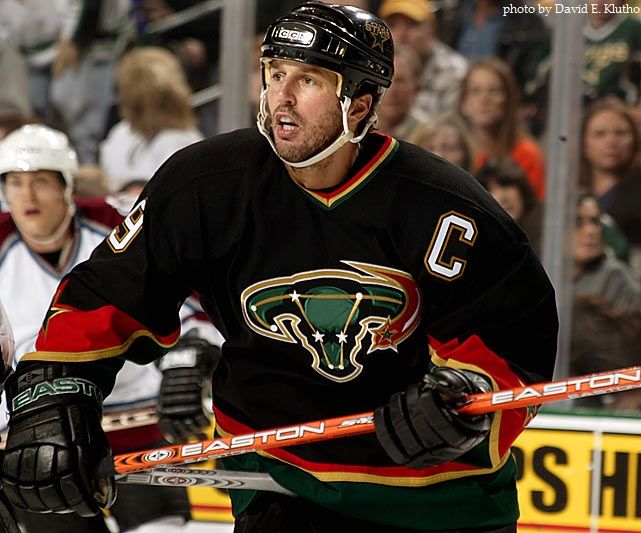
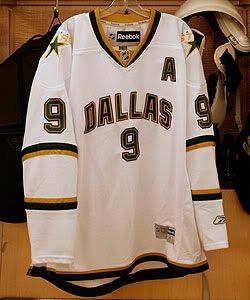
  • Mike Modano always looked good in North Star green, so when the Dallas Stars put him in this tragic alternate jersey, it certainly didn't seem right. Ironically, I picked up one of these Stars alternate jerseys the other day for a mere $90. While some may question my sanity for this, I'm trying to decide whether Modano should appear on the back or go with Brendan Morrow. Thoughts on this one, readers? Maybe Lehtinen?
  • Sports Illustrated posted a fabulous collection of photos today of all the current NHL goaltenders' masks. There are some absolutely fabulous designs on a few masks, and some really personal marks that make them entirely unique. Some of my favorites? Kari Lehtonen's Chuck Norris mask makes me laugh. I love the old masks displayed on Joey MacDonald's mask. The right side of Jonathan Bernier's mask brings back memories of Kelly Hrudey and Erik Ersberg. Pekka Rinne's predator-in-a-goalie-mask design is pretty neat. Jason LaBarbera shows off his love for pro wrestling. Ty Conklin brings back the Blues Brothers. James Reimer is all about Hockey Night In Canada.
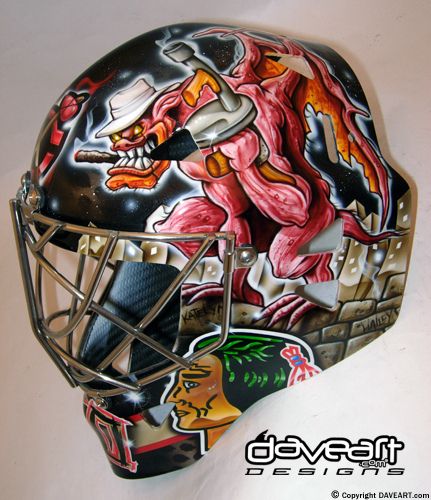
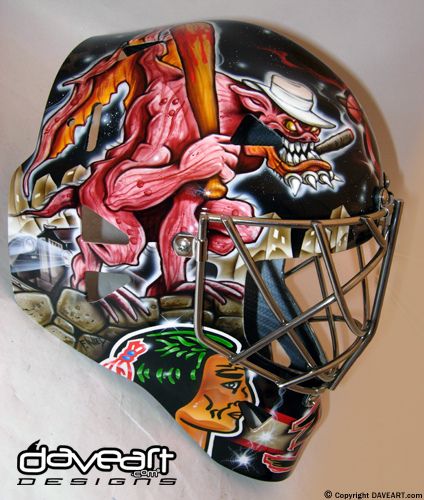
  • The one mask that SI forgot to include is the alternate mask worn by Marty Turco when the Blackhawks wear their alternate jerseys. Being that the jerseys resemble that of what the Hawks wore in the 1930s when gangsters played a large role in Chicago, Turco's "Gangsta Gargoyle" mask is highly appropriate in terms of it being paired with the alternate uniform.
  • OPPORTUNITY: Since school is eating up a ton of my time that I normally spend blogging, if anyone is interested in submitting articles for HBIC like you did in September, please contact me via email. This is a blog "of the people, by the people, for the people", so if you have something hockey-related you want to get off your chest, send me an email today! Or in the near future! Or whenever you like!
That's a quick Thursday update as I clear a bunch of stuff off my desktop and email. I encourage anyone who wants to guest post to contact me. You'll get full credit as the writer of the article, and I definitely enjoy reading other people's ideas and opinions. The best part is that you contribute only as much as you like and only as often as you like. I'm still writing, but I occasionally need some time to deal with homework. That's where you come in.

Give it a thought, HBIC readers, and contact me if you're interested. I was very impressed with the last round of HBIC guest posts, and I think this feature will continue as we move forward with this blog.

Until next time, keep your sticks on the ice!

Thursday, January 6, 2011

There's nothing worse for a male than taking one to the berries. Getting kicked in the grapes is an age-old trick that can reduce a male to a puddle in mere seconds, and too often it happens to men when they are least expecting it. You've probably seen it a thousand times on video replay shows and "America's Funniest Videos", but when it happens to you, it is less than funny. In fact, if hit hard enough, you feel like you want to vomit. Thanks to the Canadian boys' spectacular collapse at the World Junior Hockey Championships, I believe that all Canadian hockey fans have the same feeling that many men have had after taking a swift kick to the gonads. And this pain will be felt for some time. We're talking swollen and bruised after this latest heartbreak.

Up 3-0 heading into the third period, Canada was twenty minutes away from their sixteenth gold medal. Russia, looking like a team that had been battered and bruised, suddenly turned the tables on Canada with speed, skill, and a swagger not seen since the days of the Soviet Union.

They deked. They juked. They shot. They scored. And they absolutely destroyed a country's confidence in their selected heroes. And it hurt. It hurt bad.
However, Canadians shouldn't be surprised by this. After all, the majority of these Russians came over to play during the recent CHL Subway Series, and won four of six games against the Canadian Hockey League. It's the first time that the Russians took the series, and they literally shocked a number of CHL All-Star teams with their skill and tenacity. The Canadian World Junior squad - those same players who played in the CHL Subway Series - should have known that this Russian squad was more than what it appeared on paper.

Instead, Canada took its foot off the gas pedal when it had built a comfortable lead through 40 minutes. In other tournaments, this might have been acceptable as the Russians may have decided to fight another day, but these Russians decided to push back. Just as they did during the CHL Subway Series. And no one, according to all the reports filed by news media, saw this coming.

Russia was down late against Finland. Russia won.
Russia was down late against Sweden. Russia won.
Russia was down late against Canada. Russia won.

Anyone see a trend there?

These Russian kids aren't that bad. In fact, despite their poor showing through the round-robin, they actually got better as the tournament progressed. The one thing that this Russian team did better than anyone else in the latter stages of this tournament is that they outworked their opponents.

That last statement feels really weird to write because the Russians haven't outworked anyone since players like Federov, Bure, and Mogilny were junior players. In recent history, players like Yashin, Afinogenov, and Kovalchuk thought that they could win games based on talent alone. They got steamrolled by Canada at the Olympics when the "best of the best" Russian players were on the ice because they didn't put the work in to get the results.

This Canadian loss will sting for a while. And not because we lost. That happens to all teams, and I accept that. No, this one will sting because we got outworked by a team that traditionally relies far too heavily on talent and not heavily enough on hard work. We got beat by a better team... for the second year in a row.

The Canadian identity of hard work over talent was lost in the last 20 minutes of the World Junior Championship gold medal game. And it will take at least a year to earn that credence back for Hockey Canada's Under-20 team. That, readers, is what hurts.

Until next time, keep your sticks on the ice!

Friday, December 3, 2010

With the emerging trends in the NHL of teams keeping and developing their good, young talent on a regular basis, Hockey Canada is beginning to find itself in a quandary, albeit a very good one. The World Junior Championships are a hallmark event for the Canadian hockey body in which they have seen unparalleled success from the rest of the world. A lot of this has to do with the excellent development programs in the Canadian Hockey League, but this is leading NHL teams to keep their high draft picks on their rosters in order to develop that talent at a faster rate. Because of this, the Canadian World Junior team sees its roster missing a lot of its top-tier talent every Christmas.

While this may sound like a complaint, it's not. It's great to see players such as Taylor Hall, Tyler Seguin, and Jeff Skinner suiting up for Canada, but the NHL is a business and the teams need to continue to develop their talent if they wish to remain competitive. While sending young players to the World Junior Championships would be a nice luxury for some teams, reality sometimes limits what teams can do.

The luxury that Hockey Canada has in this country is that Canada is deep in hockey talent thanks to a phenomenal major junior system and a passion for the game. Canada will have some solid returning players to man their blueline as Ryan Ellis, Calvin de Haan, and Jared Cowen will return for Canada. Up front, there is only one returnees, but there is some significant talent, and Team Canada's strength will be depth.

The return of Brayden Schenn to the Brandon Wheat Kings yesterday opens all sorts of doors for Hockey Canada. Schenn had spent considerable time with the NHL's Los Angeles Kings and the AHL's Manchester Monarchs before being returned to the Wheat Kings before his 10-game option ran out. This, of course, gives Team Canada a big boost as Schenn will be the lone returnee, but the Los Angeles Kings feel this is the best way for Schenn to develop as they have the talent to compete without keeping Schenn in their lineup.

"My candid opinion would be sure, that would be a great thing to be able to go play for Canada in the world juniors like that," Kings' GM Terry Murray told the Times. "It’s great competition and valuable experience."

Add in other notable draft picks such as Erik Gudbranson (Florida), Ryan Johansen (Columbus), Brett Connolly (Tampa Bay), and Zack Kassian (Buffalo, 2009) shows that Canada will have some solid talent assembled in Buffalo. For Kassian, it's a chance to show the team that drafted him that he's ready to make the jump from Windsor in the OHL to the bright lights of the NHL. So while the blue-chip names like Hall, Seguin, and Skinner remain with their NHL clubs, Team Canada still has themselves a very competitive roster.

Canada's major test will most likely come from the Americans once again. Team USA had nine players returning from their gold medal team one year ago for their evaluation camp, including goaltender Jack Campbell, defensemen Cam Fowler and John Ramage, and forwards Ryan Bourque, Jerry D'Amigo, Chris Kreider, Jeremy Morin, Kyle Palmieri and Jason Zucker. Fowler, though, appears to be staying with the NHL's Anaheim Ducks, but the other eight men have every opportunity to make the team and defend their gold medal.

It's a credit to the NCAA and the USHL for helping to develop young men in America into solid hockey players in the same way that the CHL does in Canada. These two developmental leagues are putting America on the map as a World Junior Championship power when they weren't even considered an also-ran as recently as a decade ago. Because of their work, there are a lot of excellent American-born players in the NHL, and that trend should continue with the work these two leagues are doing.

It should be an interesting camp in Toronto, Ontario for the Canadians as they prepare for the 2011 World Junior Championships. While the star power may not be there, Canada has a number of top-tier players who should provide a lot of exciting moments during the holiday season!

Until next time, keep your sticks on the ice!

Friday, November 19, 2010

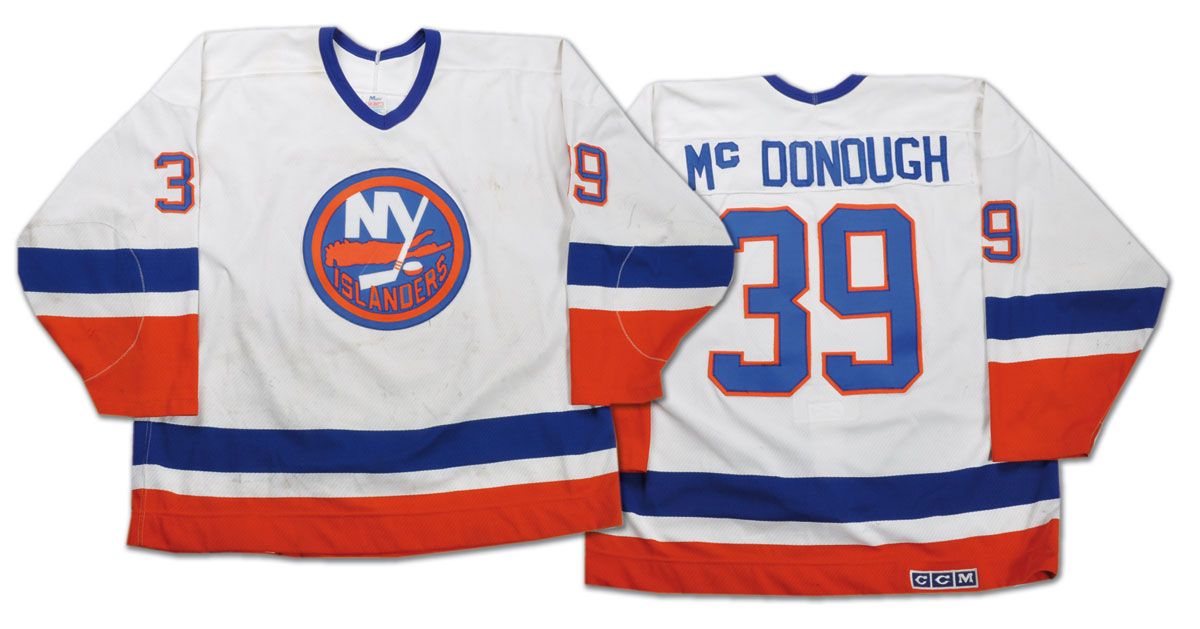
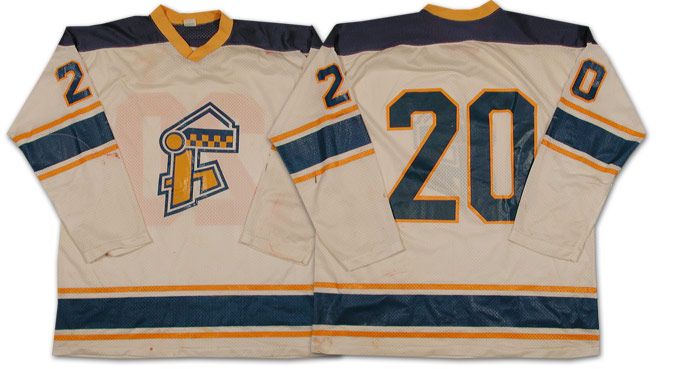
We're back today with another round of images from the Classic Auctions website. I was very impressed by what the site had to offer last time on their current round of auctions, so I went back through the archives to see if I could find some more interesting stuff. Needless to say, the archives are a treasure chest of historical items and, of course, there are a ton of NHL sweaters and jerseys that should be examined for details. With that, we have another edition of the Classic Auctions images today as we look at a number of uniforms once more.
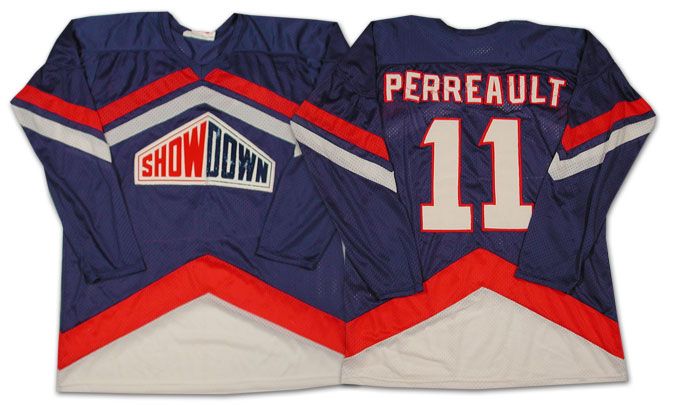
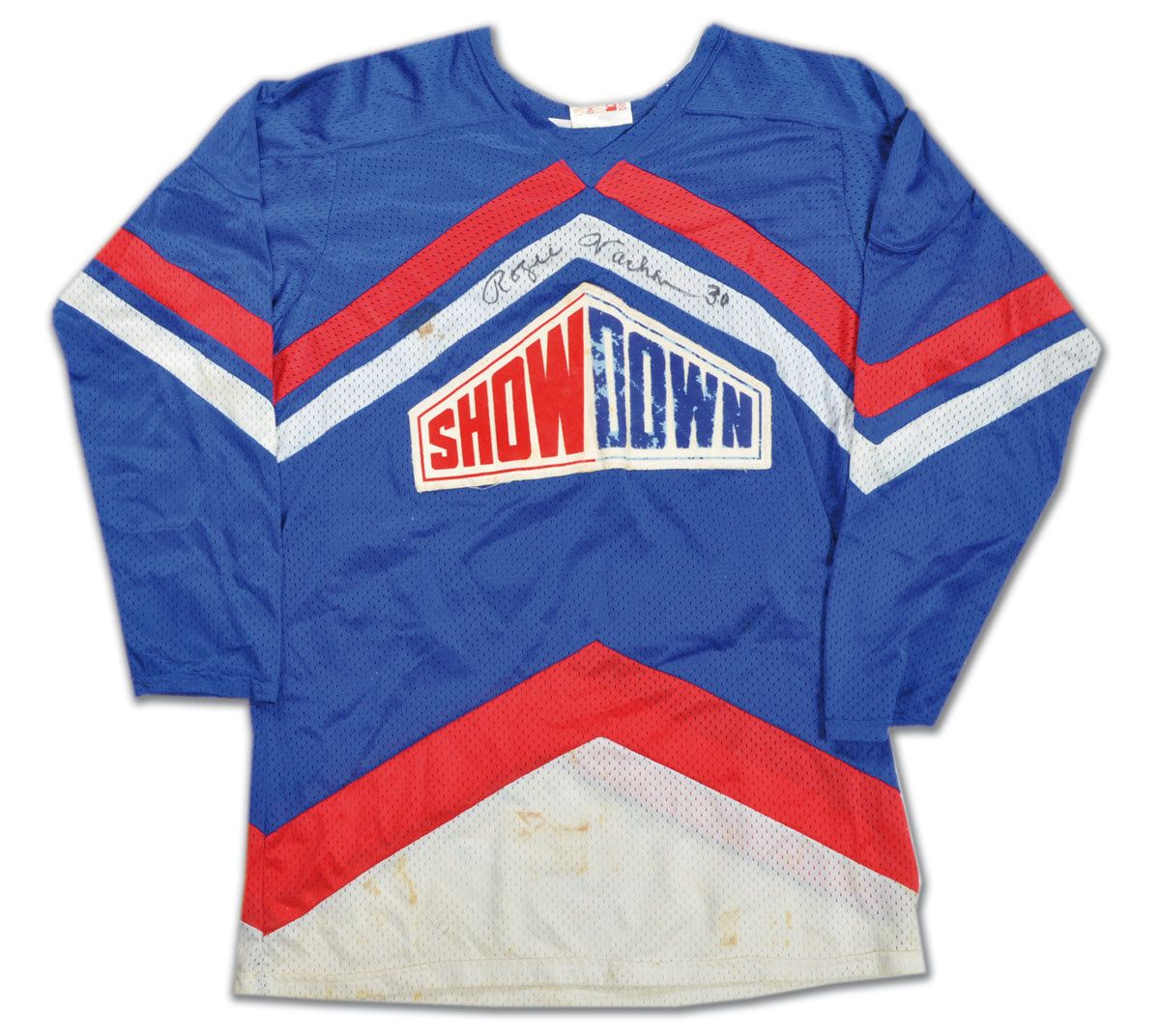
  • As we saw in the most recent set of Classic Auctions images, there was an NHL Showdown segment that used to air between periods that featured a few NHL stars that went head-to-head for cash and bragging rights. I've found more players who were a part of this now. It appears that Gilbert Perreault of the Buffalo Sabres participated for at least one season in the Showdown, and he wore a sweater similar to that of Rogie Vachon! Could they have been teammates in their respective Showdown?
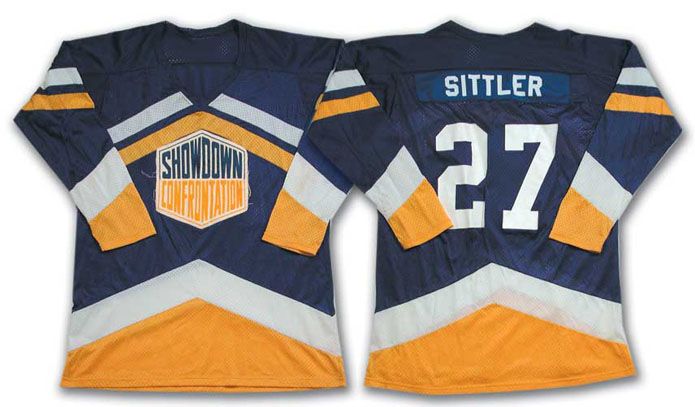
  • Another player who participated was Toronto's Darryl Sittler. However, his sweater is significantly different in terms of colours than those of Perreault and Vachon, so I'm guessing he played in the NHL Showdown in a different season.
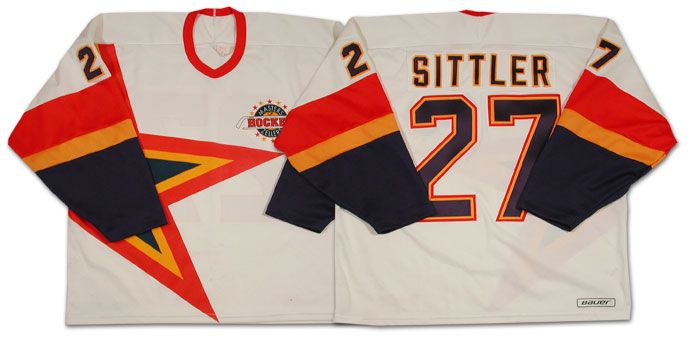
  • Another Darryl Sittler jersey that the Classic Auctions website had up for auction was a Sittler "Masters of Hockey" uniform. I've never seen or heard about this before, so I had to refer to the information on the website. "As part of an important Zellers promotion, Darryl Sittler, along with many other Oldtimers, participated in the 'Masters of Hockey' program. This white hockey [was] uniform produced by 'Hattem'". Nothing like an old promotional jersey for a department store promotion!
  • In the article about the New York Rangers' new alternate uniform, I had stated that there was precedence for the Rangers wearing "New York" diagonally on their uniforms thanks to their 9/11 tribute uniforms. However, there is even more precedence that shows the Rangers wearing "New York" for a much longer time on the road. Here is Bobby Carpenter's 1986-87 New York Rangers road uniform. Obviously, they wore these for at least one season, and, upon further research, they actually wore the "New York" road jerseys from 1978-1987. Lots of precedence!
  • I've rarely seen the patch worn, but there is no doubt that the Toronto Maple Leafs wore the King Clancy patch on their uniforms during the 1986-87 season. Thanks to the auction, we can now clearly see that the Leafs wore the King Clancy patch above the TV numbers on their sleeves on the road that season.
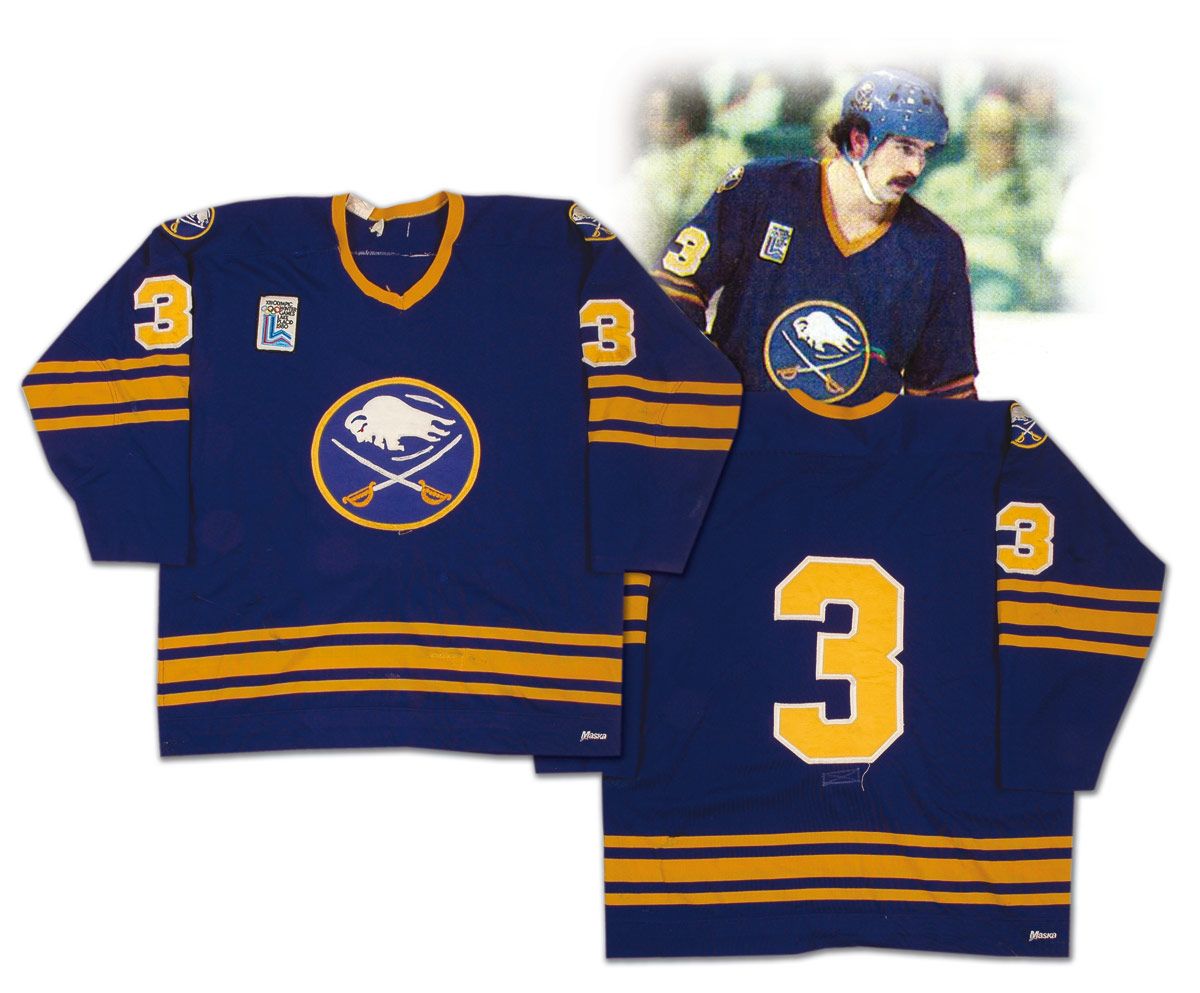
  • Some of the patches worn before photography became a major aspect of the NHL world are much more difficult to find, especially affixed to an NHL uniform. The Lake Placid patch worn by the Buffalo Sabres is one such patch, but this Richie Dunn sweater from the 1979-80 season shows it clearly affixed on the right shoulder. Notice that there are no names on the Sabres' uniforms as of 1980? I had never noticed before that either.
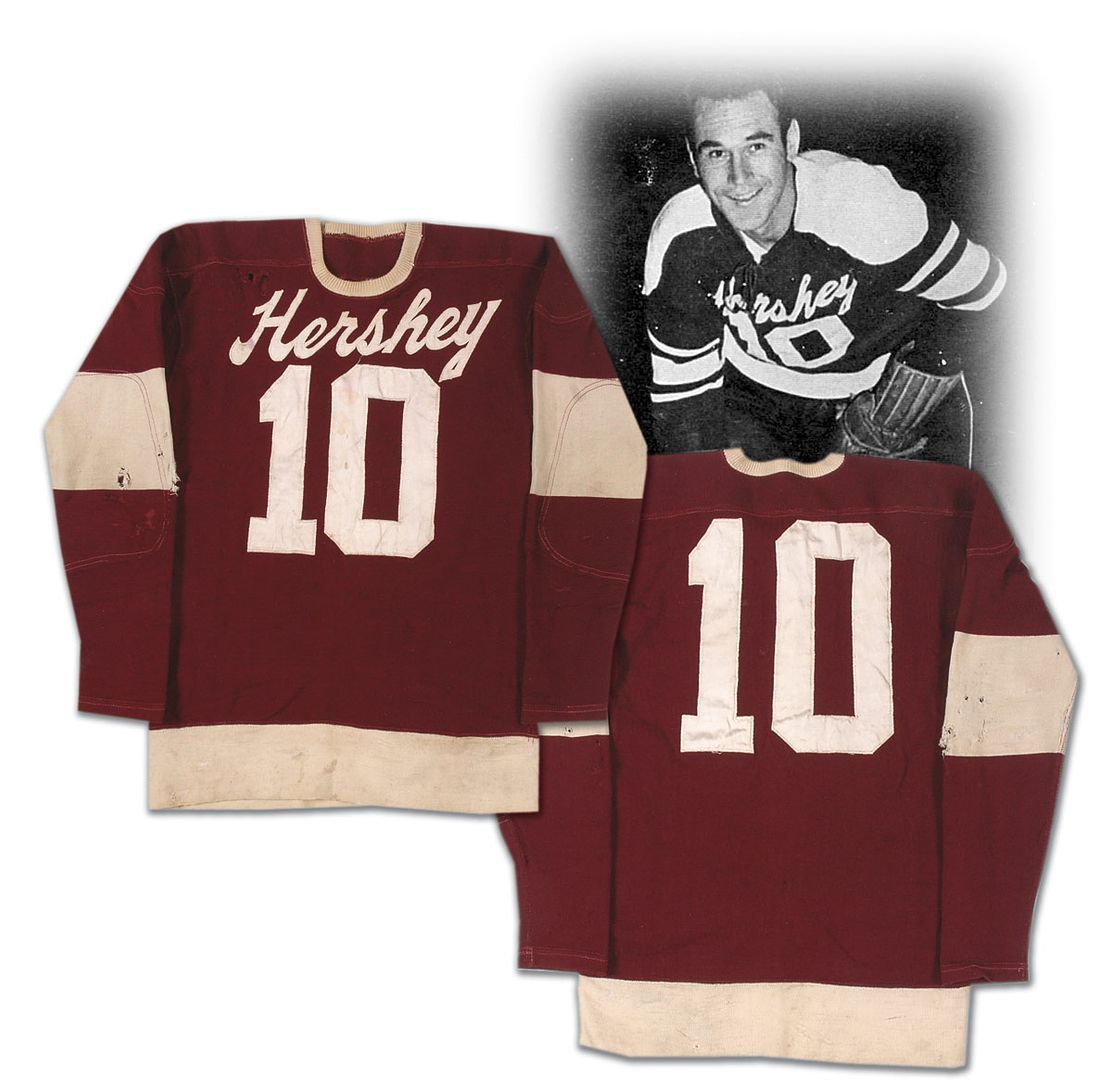
  • Heading into the AHL, we find a trend that seems to have been reproduced in the NHL with the introduction of the Rbk EDGE uniforms. I've never liked the idea of having front numbers on a hockey sweater, but the Hershey B'ars decided that front numbers were fine for a hockey sweater as far back as the 1940s! Here is a sweater that was worn by Mark Marquess as a member of the Hershey B'ars that has the city name over top of the front number. More precedence for a current trend, perhaps?
  • The Detroit Red Wings have a gorgeous jersey due to the colours and the logo. I cannot deny this. However, history shows that the logo routinely was off-centered on the Red Wings sweaters. One such example comes from the 1937 Jimmy Orlando sweater. As you can see, the center of the wheel was used as the focal point for the logo, and that caused the wing to be significantly off-center.
  • In Part One of this series, I discovered a startling trend in the 1980s that showed floating portions of names on a number of teams. Today, there appears to be some sort of discrepancy in terms of how names are displayed on at least one team. I had made mention of Brad McCrimmon's floating "C" in 1988, but I discovered an Al MacInnis uniform from the 1980s that has no floating letters! What gives? Why the change? MacInnis' first game in a Flames uniform came in 1981-82, so we at least have a start date as to when the floating letters may have started, and it had to be after the '81-82 season.
  • Because I miss the uniform and the team, here is Wendel Clark's Quebec Nordiques uniform from the 1994-95 season. Man, I miss that uniform. It's gorgeous!
  • In other lost uniform news, here is Gerry Ehman's 1967-68 Oakland Seals uniform. Does anyone miss the colour green in hockey? I sure do. Why can't more teams go with a bold green instead of these near-black colours?
  • Next, we have the second wave of California's Seal teams as we get a chance to see Joey Johnston's uniform from the 1970 California Golden Seals. I'm not all that fond of this colour scheme, but the yellow uniform is definitely bold. Much like their name, the Golden Seals certainly were living it up in goldenrod.
  • We have a 1979-80 Atlanta Flames uniform worn by Gary Unger. That's still a great uniform, and I'm glad that the Calgary Flames have gone back to those great colours. Yellow-on-red is a very striking uniform... and the lack of black is entirely refreshing!
  • Take a good look at this 1976-77 Colorado Rockies uniform worn by Michel Plasse. See how small the front logo is? Compare that to the 1981-82 uniform worn by Tapio Levo. There's a significant difference in the sizes between the two uniforms. It's almost as if the Rockies were telling everyone in 1976 that they weren't all that relevant.
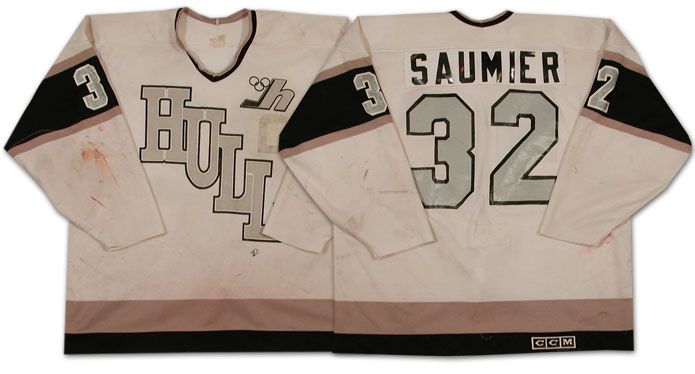
  • In the 1970s, the Hull Olympiques of the QMJHL wore some fairly vanilla uniforms. However, they changed that up in the 1980s by bringing out the black-and-silver colour scheme that became famous thanks to Wayne Gretzky's trade to Los Angeles. As you may have heard, Luc Robitaille played for the Olympiques and Gretzky owned part of the Olympiques, so Bruce McNall made the change to the new colour scheme due to Robitaille's suggestion to make Los Angeles more attractive for Gretzky. Now you have some visual proof of how this change came about thanks to Marc Saumier's uniform.
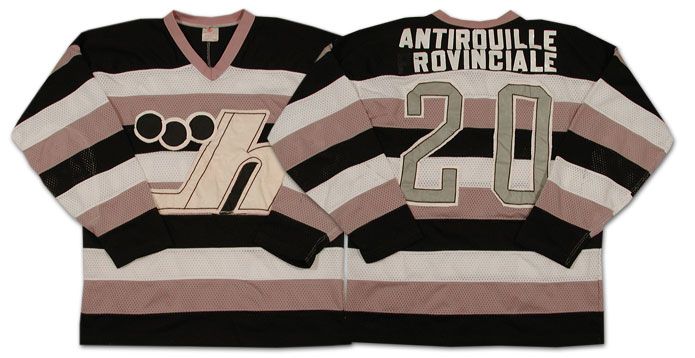
  • In 1985, the Hull Olympiques decided to roll out a different road uniform by wearing some awesome stripes! I love the stripes on this jersey, even if it looks like a black-and-white television's test pattern.
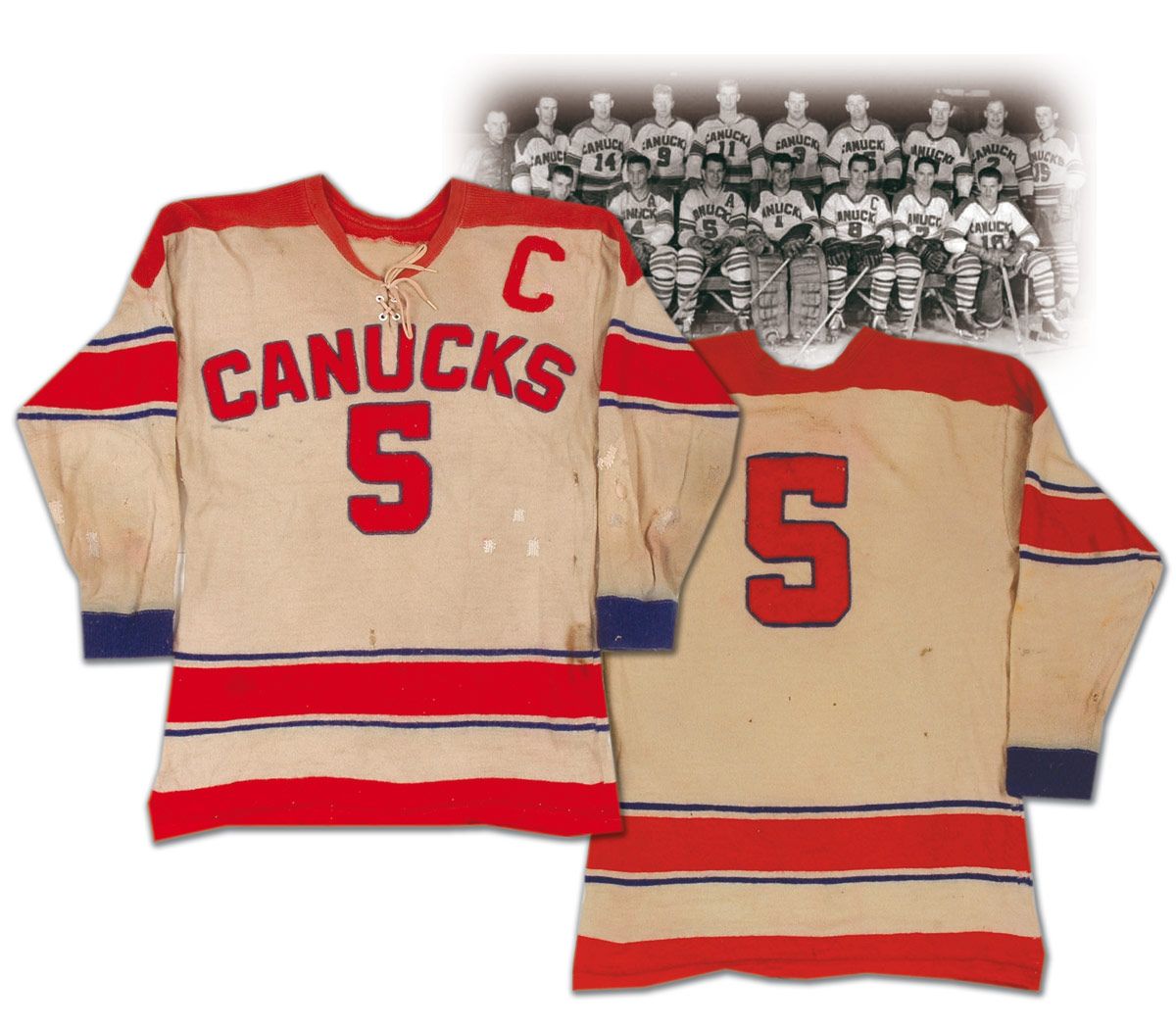
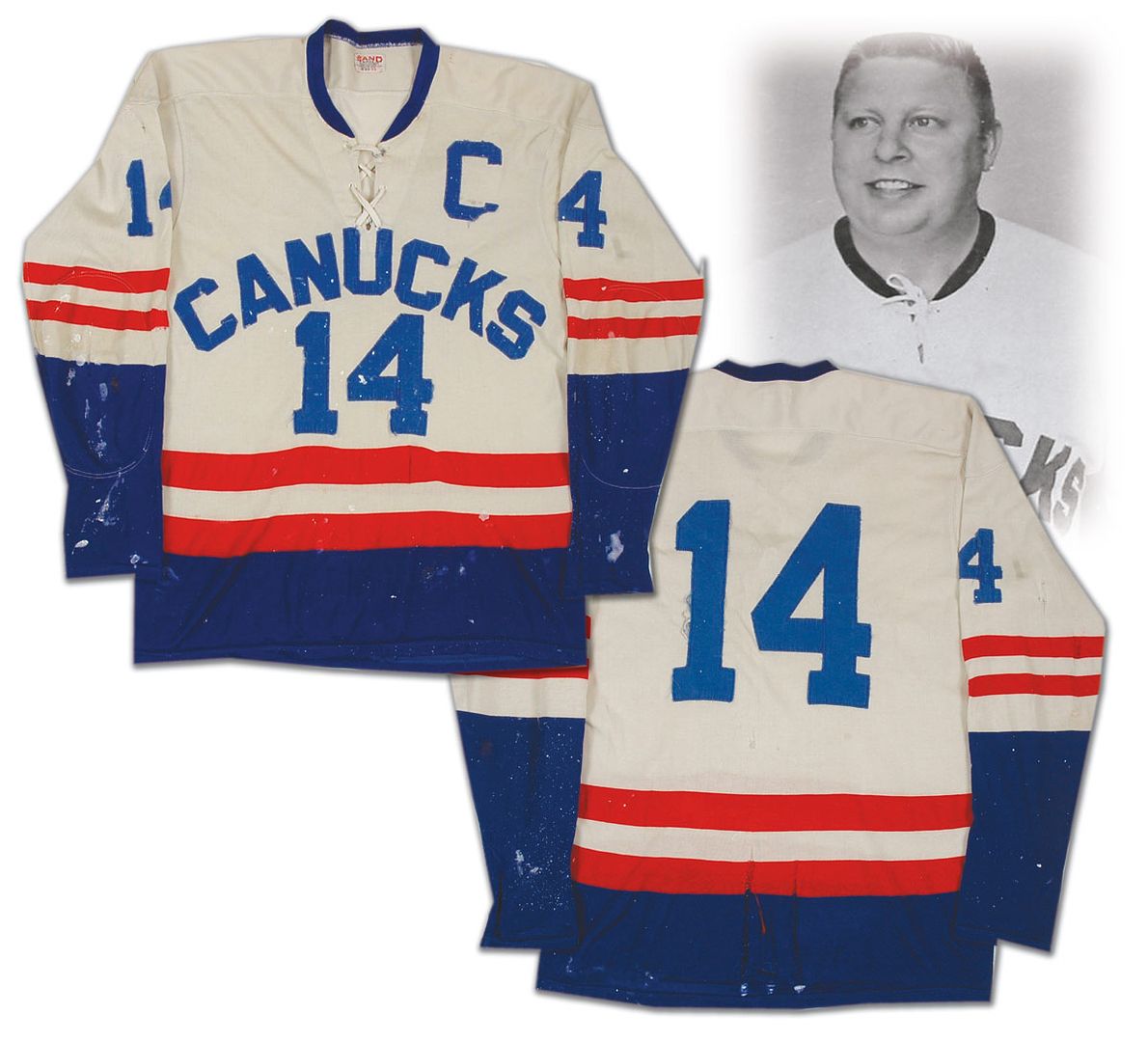
  • The WHL gets a mention on this one as we get to see the Vancouver Canucks in their original form. The WHL Canucks wore this uniform in the 1950s, and they went with a colour change in the 1960s. Of course, Vancouver received an NHL franchise in 1970 so these jerseys weren't needed any longer, but there is some precedence to the Canucks wearing a name on the front of their uniforms. It seems that the trend of front numbers was more of a minor-league thing through the 1940s, 1950s, and 1960s, though. Take note, NHL. MINOR-league.
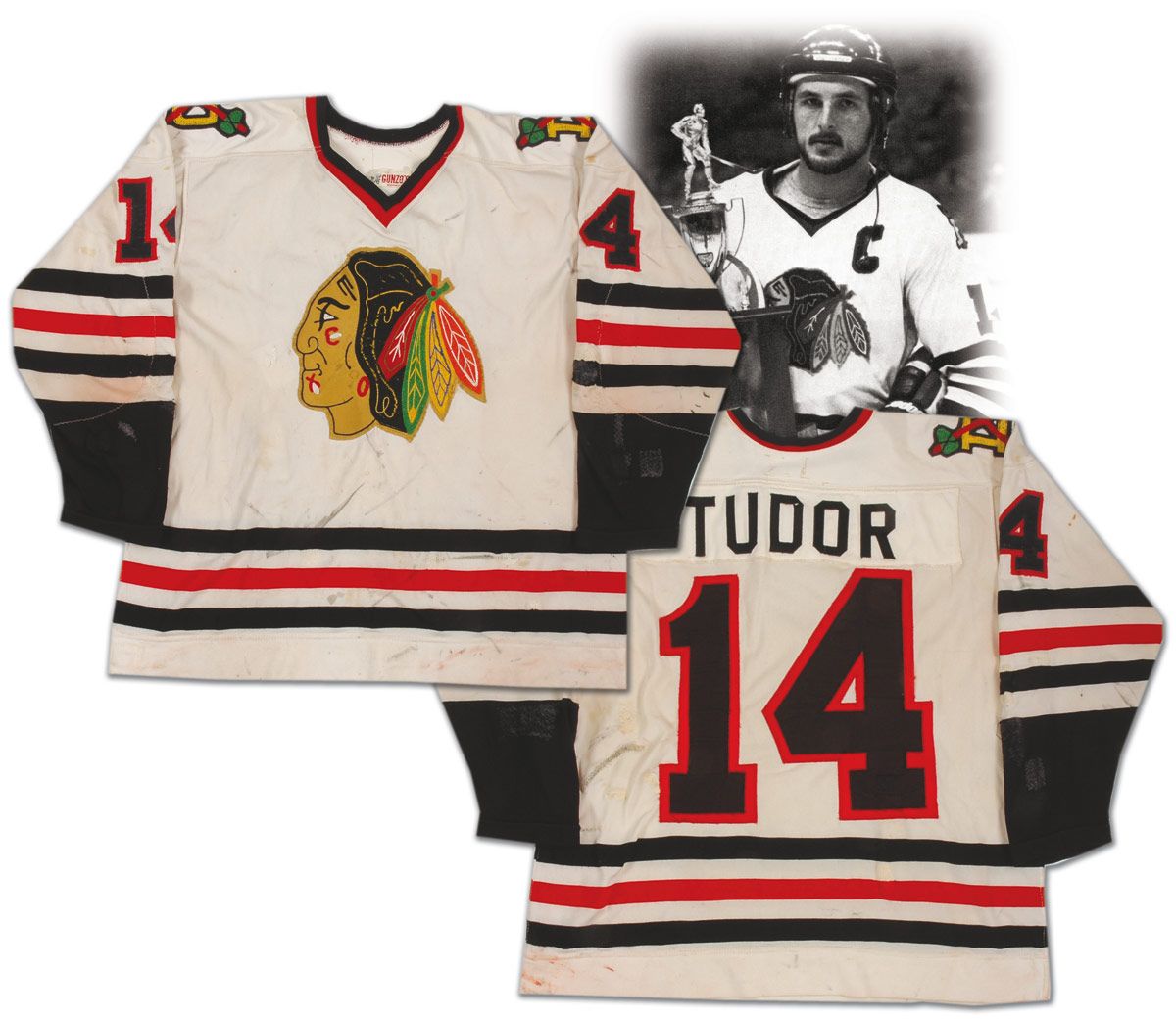
  • It has been well-documented that NHL teams often name their minor-league affiliates after their own NHL franchise name. The Sherbrooke Canadiens, the St. John's Maple Leafs, and the Albany Devils are some well-known examples. Here is Rob Tudor's jersey from the 1978-79 season. If you inspect that jersey closely, you'll see two tomahawks crossed over a "D" on the shoulder. This is a Dallas Blackhawks uniform from the Central Hockey League!
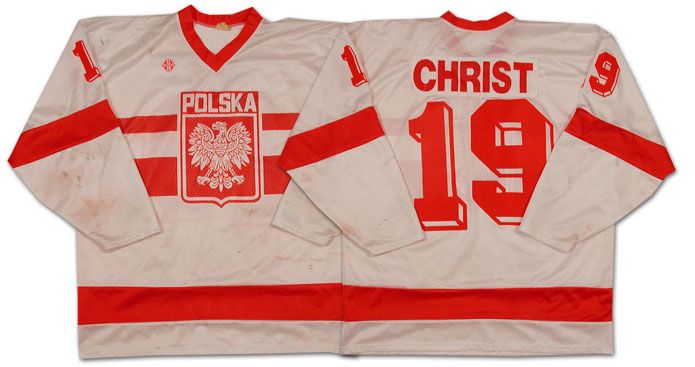
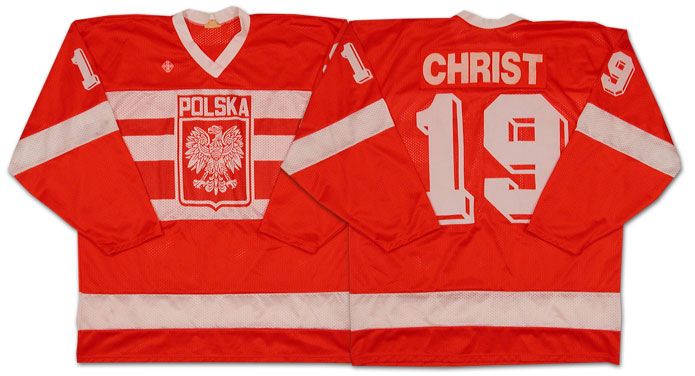
  • International jerseys are always interesting. The 1988 Winter Olympics saw Poland compete in Calgary as a part of the ice hockey competition. One member of that team was a player by the name of Jerzy Christ. Yes, that is his real last name. He was born in Katowice, Poland, and played center for his home country. The highlight of his international career was when he scored both Polish goals in a 2-1 victory over reigning World Champion Czechoslovakia at the 1986 World Championships in Moscow, Russia!
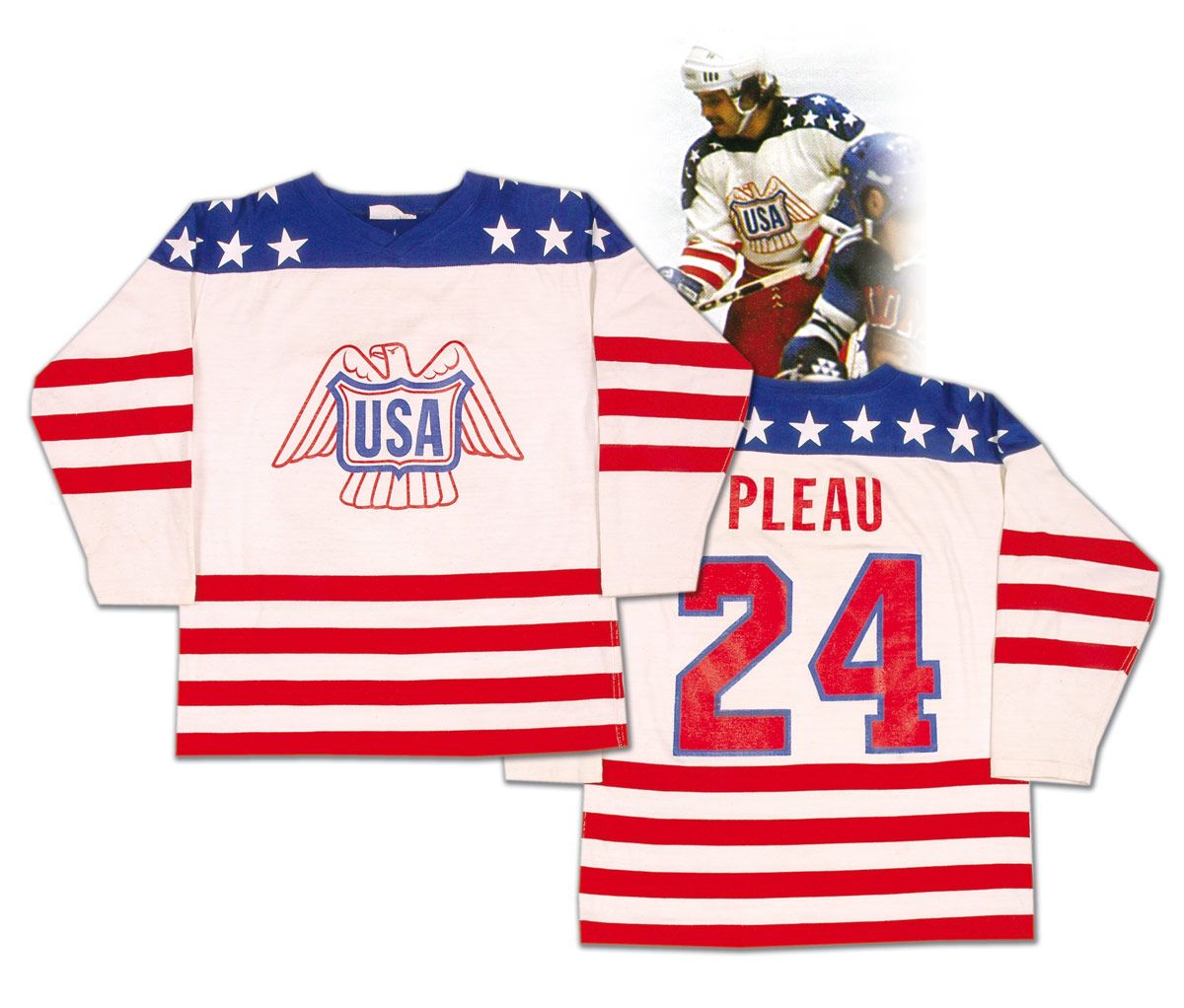
  • Love this 1976 Team USA sweater. Larry Pleau wore this uniform at the 1976 Canada Cup where Team USA finished 1-3-1 and in fifth-place. Regardless of their standing, they wore a gorgeous sweater, and it really feels like a patriotic American uniform.
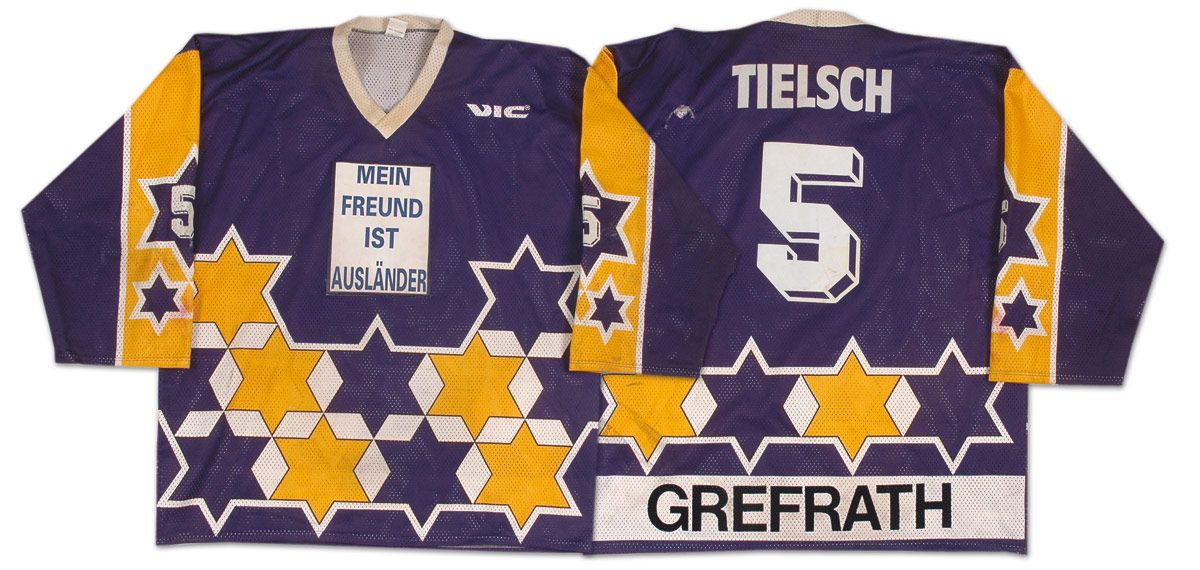
  • We'll close this look at interesting jerseys with a glimpse into German hockey. Grefrath, a German city, played in the second-division of the German Eishockey League in the early-1990s, and wore these uniforms while on the ice. As you can see, there's no logo, but a message where the logo should be. Using a handy translator, the message states, "My friend is a foreigner" or "My friend is an alien". Is this the first time any team has ever used their uniform to convey a written message to its fans? Weird idea.
So there you have it, kids. Lots of good looks at uniforms, and there was some weird and wacky stuff seen. The Classic Auctions website is a great place to find some incredible hockey history, and I encourage you to poke around their website if you're interested in some cool hockey memorabilia.

Until next time, keep your sticks on the ice!

Thursday, November 4, 2010

There have been a great number of excellent hockey players that have come out of the province of Manitoba. Legends such as Terry Sawchuk, Bobby Clarke, Turk Broda, and Billy Mosienko are some of the men who have made the province proud with their long careers and many successes in the NHL. Others such as Jonathan Toews, Nigel Dawes, Eric Fehr, and Duncan Keith are still writing chapters into their own histories that will one day make Manitobans proud of their achievements. The stories that are rarely talked about, however, are those of the career minor-league players who have given their lives to various cities around the globe with little or no fanfare outside of those cities. Credit goes to Mr. Bob McKenzie of TSN.ca who wrote an excellent article about one of these men, and a native Manitoban.

It all started with the Chill in Columbus, but it wasn't long before he was a Riverfrog in Louisville and then an Icecap in Raleigh. Twice.

He was an Admiral in Milwaukee, a Riverman in Peoria. Twice. A Viper in Detroit, a Griffin in Grand Rapids. Twice, in two different leagues. A K-Wing in Kalamazoo. Four times, in four different leagues. A Giant in Belfast. Twice. A Bandit in Jackson, a Fury in Muskegon and a Jackalope in Odessa.

By our count, it's been 12 cities, six leagues (American, International, East Coast, United, Central and British), 904 regular-season minor pro games and counting and more bus miles than you could possibly imagine in the 16th pro season for 38-year old Kory Karlander, the oldest active player in the ECHL.

"The years kind of creep up on you and that's true for me," the Kalamazoo K-Wing centre from Melita, Man., says. "It's my 16th pro season and if anyone asks why I still do it, I guess the answer is pretty obvious...I love what I do. It's never stopped being fun for me."

If the name sounds vaguely familiar, it should. Kory's uncle, Al Karlander, played 212 NHL games with the Detroit Red Wings in the early 1970s, after being drafted out of Michigan Tech by the Wings in the second round of the 1967 amateur draft and added another 269 games in the WHA with the New England Whalers and Indianapolis Racers.

Kory's dad Ken, along with Al, came from Lac La Hache in the Cariboo region of British Columbia though they attended and played hockey at the famed Notre Dame College in Wilcox, Sask.

"My dad and my uncle used to hitch-hike all the way (1,600 kilometres) from Lac La Hache to Wilcox at the beginning of every school year," Kory says of a story he likes to regale his younger teammates with each season. "When my Uncle Al went to Michigan Tech for his first year of college, he was hitch-hiking from Lac La Hache to Houghton, Mich., and he phoned then to say he was on his way and they told him he was already a week and a half late, that he should have been there already. I guess he was having a tough time getting a ride."

With bloodlines like that, we shouldn't be too surprised that Kory Karlander is still grinding it out in a minor pro hockey odyssey as he heads towards age 40.

The ECHL is no longer the dead-end loop it used to be. It's two rungs below the NHL, one below the well-respected American Hockey League and there's a fair bit of traffic between the AHL and ECHL. It's not unheard of for ECHL grads - Chad Larose and Alex Burrows come immediately to mind - to make it to the NHL. That said, there are three types of players in the ECHL. A limited number on the way up, many who think they still have a chance to be on the way up and those just marking time, collecting somewhere between the league minimum of $410 per week ($370 for rookies) and the $850 weekly that the veteran Karlander gets from the K-Wings, as well as a housing allowance that helps take care of Karlander's mortgage on his permanent residence in Grand Rapids, Mich., about an hour from the rink in Kalamazoo.

"I obviously haven't gotten rich playing hockey but I've done well enough to help support my family," Karlander says. "I've got a lot of memories. I wouldn't trade any of it for anything. I love playing the game."

Karlander is married. His wife Shelly is a registered nurse who works in Grand Rapids and that obviously helps the family's financial picture. Kory and Shelly have a three-year-old son, Karsten, and Shelly has two sons of her own, 15-year old Ethan and 23-year old D.J., who attends Ferris State University. Karlander admits it takes a very understanding wife to allow him to follow his hockey-playing dreams and he couldn't do it without Shelly's support.

It is not lost on Karlander that he has a 23-year-old stepson who is older than many of his K-Wing teammates.

"That's pretty funny when you think about it," Karlander says.

The average age in the ECHL this season is 24.4. There are 18 players age 30 or older in the league, so it's not as if Karlander is the only thirty-something still kicking around.

In fact, K-Wing teammate Sam Ftorek, the son of former NHL coach and WHA scoring star Robbie Ftorek, is 36 and the second oldest player in the league.

"It's nice to have some company my own age," Karlander says of Ftorek.

Mind you, age is a matter of perspective. Karlander played the last two seasons before this one in Odessa in the Central Hockey League and he was a veritable kid compared to the elder statesman in the CHL.

Jeff Christian, a former London Knight who was a second-rounder of the New Jersey Devils in 1988, is 40 and still playing in the CHL with the Mississippi River Kings, having logged 1,259 regular season games and counting as a pro, including 18 games in the NHL. Ex-Hull Olympique defenceman Guy Dupuis, a Detroit Red Wing third-rounder in the 1988 draft, is also 40 and a fixture with the CHL's Fort Wayne Komets, with 1,379 regular season games and still counting.

Small wonder then that Karlander still feels like a kid, who has no plans to hang 'em up just yet.

"As long as I've got a place to play, why not?" he says. "I've always thought to get to 1,000 (regular season) games would be special. If I stay healthy and I am able to play next season, I'll hit it. That's a goal, for sure."

He hasn't given any thought to playing into his 40s but he's not ruling it out either.

It's been years now since he's thought about playing a game in the NHL, the dream that keeps many in the minors going. It was probably about five years ago, while playing for Grand Rapids in the American League, that his hopes were raised to a realistic level only to come up short and realize that if it didn't happen then, it wasn't going to happen.

"It was my second tour of duty in Grand Rapids and, like it is now, that was Detroit's affiliate," Karlander recalls. "Detroit ran into a real rash of injuries and a lot of guys were getting called up. I was off to a real good start that year, a point a game, and I really thought there was a chance I might get up for a game but it never happened. That was the closest I ever got. Once that moment passed, I knew that was it for me (as far playing a game in the NHL). Having played more than 300 pro games, I had to get veteran status in the AHL and with no NHL experience, I knew the writing was on the wall for me (playing in the AHL regularly) and that's probably when the (NHL) dream died."

But he still enjoyed playing the game for the game's sake. He won a UHL, aka U-Haul, championship in 2006 with Kalamazoo, one of two championships (the other was in Belfast with the Giants) on his resume.

Karlander plays the game now the way you would expect a 38-year-old to play it. Wisely. He moves well for a senior hockey citizen but is usually on the right side of the puck and uses his guile and experience to read plays both offensively and defensively. I watched him in a pair of games recently against the Florida Everblades and he won just about every face-off he took. He's always been good on the draw and killing penalties.

"You know why he wins so many face-offs, don't you?" my (then injured ECHL player) son told me as we watched the game together. "Because he's probably taken more faceoffs than any man in all of professional hockey. Think about it, 16 pro seasons, playing mostly in leagues where they only have three lines. I bet you he has the unofficial world record for most face-offs taken by a still active player."

Karlander laughs at the recounting of that story and doesn't disagree.

"I have taken an awful lot of face-offs and if you talk to me, I'm not sure I'd ever admit to losing one," he says, laughing. "I actually became a lot more valuable player when they changed the rules to put all the face-offs in the offensive zone after a penalty. Face-offs have become a lot more important so I find myself on the ice taking them a lot more. It's been great."

Being around the kids has helped keep Karlander young, too.

He says he gets a hybrid of respect, reverence and ridicule for being 38 and still playing a young man's game.

"The kids are really great, for the most part," he says. "They'll ask me a lot of questions about the game or what it was like and they're genuinely interested. And they're really respectful when it comes to things like taking a seat in the bus. They're always saying, 'I'm not in your seat, am I?' But they also like to have some fun at my expense and that's fine and I kind of contribute to it. I should know better. They were talking about XBox 360 the other day and I mentioned that I was underprivileged as a kid because my parents wouldn't buy me an Atari or Nintendo, the best we had was a Commodore Vic 20 and they really had a good laugh at that. My idea of video games is Space Invaders and Asteroids.

"One guy said to me, 'Hey, you've been around so long you have the seen the entire evolution of the hockey stick.' Stuff like that is pretty funny."

One can only imagine the stories Karlander has from 16 years in the low minors.

"Yeah, you could say I'm like Reg Dunlop I (of Slap Shot fame)," he says. "Lots of stories, not many you can print."

He remembers playing for Raleigh in the old ECHL in a game in Las Vegas, which was the first arena he'd ever played at where they had a video scoreboard. As he was being introduced skating onto the ice as part of the starting lineup, he looked up to see himself on the scoreboard screen. He was so mesmerized by the technology and seeing his visage on the scoreboard that he took a header over the red carpet that was laid out for the anthem singer.

"Definitely the most embarrassing moment," he says.

Great memories, for sure. He no doubt knows where a lot of minor league bodies are buried, but also where to find a lost pay cheque or two, notably in the Kalamazoo dressing room he now calls home. He's played more games in Kalamazoo than any other city and knows every nook and cranny of the room.

"They have the benches in the dressing room bolted to the wall and the seats flip up to store your stuff underneath," Karlander says. "There's a space though between the wall and the bench and I can't tell you how many times I've dropped my pay cheque down that crack. Once it goes in, there's no getting it back, so you have to get another cheque issued. I played with Marty Turco in Kalamazoo way back when. I know exactly where Marty sat and I know he lost at least one of his pay cheques down there the same as I did. I've often thought about getting the benches unbolted from the wall and getting that Marty Turco pay cheque out of there. I could get him to sign it. They wouldn't cash it now but it would be pretty good hockey memorabilia."

Karlander has played with plenty of guys who gone on to play in 'The Show', including Turco. When Karlander was in Grand Rapids five years ago, he played with Jiri Hudler, Tomas Kopecky, Joey MacDonald and even Curtis Joseph for a couple of games. In Belfast, he had ex-NHLers Paul Kruse and Dennis Vial on his team.

He cites Mark Reeds (now with Owen Sound in the OHL), with whom he won a championship in Kalamazoo, as the best coach he ever played for, but has a special place in his heart for his first pro coach, Moe Mantha, with the Columbus Chill in 1995-96. It was Mantha who may have had the most profound impact on a young kid fresh out of Northern Michigan University.

"Moe inspired me and taught me what it was to be a pro hockey player," Karlander recalls. "Moe said just because you're getting a pay cheque to play hockey doesn't make you a pro hockey player. He said being a pro was about accountability and playing the game the right way. He gave us a motivational booklet to start the playoffs and there was a quote on one page that is something to the effect of, it's easy to work hard and do your job when you hear of the roar of the crowd but it's a lot more difficult to do the hard work when there's no one there to see you or cheer you on. That's always stuck with me. I had that page laminated and I hang it somewhere I can always see it. In the summer, it's on the squat rack when I'm working out.

"I guess, if anything, that's the message I try to pass along to the kids I play with now. Be a pro. Respect the game. Our captain (24 year old) Wes O'Neill noticed that (36 year old) Sam (Ftorek) was unloading the bus and Wes apologized to me and said he'll make sure that never happens again, but you know what, if Sam or me unloading the bus makes some kid think twice before he complains about getting stuck with the job next time, well, that's a good lesson for that guy to learn. For me, playing the game now is all about how you conduct yourself. Being the age I am, you're going to get a certain amount of unconditional respect just for being old, but I still want to earn it."

So Karlander will just keep on playing. And when no team in no league will have him any more, only then will he hang 'em up, hopeful that he'll be able to coach at the pro level and impart the wisdom of the ages on more young kids.

"I still like to compete," he says. "I still like to play. I just love this game."


I really appreciate a story like Mr. Karlander's being told. If playing was only about making it to the NHL, there would be a lot of unhappy hockey players across the globe right now. Instead, Mr. Karlander shows that he's happy, doing very well, and still playing the game he loves so dearly.

If there is one thing we can teach children today, it's that you don't have to be rich and famous to enjoy doing the things that you love. Lots of people would like to be rich and famous, but they really only make up about 5% of the world. If given the opportunity to live Mr. Karlander's life, I'd jump at it in a heartbeat because he sounds like he really loves what he does.

What really makes it great is that he is teaching kids and young hockey players about life lessons. One has to work hard, earn other people's respect, and never give up to be successful at anything one does. If one does that, one will be a rich person until the day he or she quits. Those are the lessons that all kids should be taught, and Mr. Karlander lives and breathes those lessons daily on top of doing something that he loves day in and day out.

Wouldn't it be great to find a job like that? It's a great story from a great Manitoban kid who is still living his dream. And that's the lesson that needs to be told to all hockey players regardless of age - never give up on the dream!

Until next time, keep your sticks on the ice!

Friday, October 8, 2010

I'm busy at work tonight, so I won't be write some long-winded article, but that doesn't mean I can't find others who have. Because I'll be excommunicado for the evening (and into tomorrow), I've done some blog-walking to collect some of the greatest article from the past week off various websites. I haven't alerted any of these people about my blog-walking, but I liked the articles they wrote, and I feel that they should get some credit when it comes to their writing - even if that credit is from just a fellow blogger. And if these articles inspire you in some way to begin writing your own blog, that's good too. All I know is that blog-walking is a good way to gauge the thoughts of the sport, and hockey is a sport that really produces a vast number of opinions. Let's start blog-walking!

  • Anyone But Detroit has his predictions for the Colorado Avalanche, the team he follows. I'm a little shocked at the Peter Mueller prediction as I think Colorado still has high hopes for the kid, but the Shattenkirk prediction of 20+ games is probably right.
  • Canes Country has an excellent Canes-centric recap of the win over the Wild in Helsinki, Finland. I have to say that Jeff Skinner might be the darkhorse in the Calder Trophy race, but he looks good on the ice. Carolina might have another young stud for a long, long time.
  • Down Goes Brown offers up a quiz to see how your team will fare this season. As usual, the always-hilarious DGB takes the edge off worrying about your team and, instead, provides some much needed laughter.
  • Five For Howling points out the fallacy in the "Not Going to Surprise Anyone" argument about the Coyotes. Mr. Hair makes a good point in how professionalism trumps the "night off" comments made by some sportscasters. Good read, and very thought-provoking.
  • Jewels From The Crown finds a bit of a twist regarding the rules that allow NHL clubs to send US junior-aged players straight to the AHL. Players like Jarred Tinordi and Jeremy Morin can now play in the AHL despite them being younger than 20. Windsor Spitfires' GM Warren Rychel feels that the CHL will now need to be proactive in trying to keep elite-level American talent. What a tangled web we weave!
  • Uni Watch Blog is always a great source of information, but Paul Lukas has his annual team-by-team breakdown of uniform changes over on ESPN.com's Page 2. Also posted this morning was his annual goaltender equipment update. Two great pieces of information for those of you looking to update your versions of NHL11.

There's a quick update of the stories I've been reading the last couple of days. There are some great articles in there, and you should take a peek at a few of those articles, if not all of them. I'll be back tomorrow at some point!

Until next time, keep your sticks on the ice!

Thursday, September 23, 2010

I spent a night in the city of Des Moines, Iowa and I have to say that I feel this city deserves the bright lights of hockey more than it has received in the past. The AHL has tried a few different faces here while the CHL and USHL have both stopped by for a taste of the Iowa capital. There has been one team that has been a consistent performer on the ice, though, and that is the team that will occupy most of this article. Granted, this team has also spent the most time in Des Moines, but we'll look at a few teams that have barnstormed their way through the most populous city in Iowa as well.

In 1969-70, the Minnesota North Stars shifted their CHL franchise from Memphis, Tennessee to Waterloo, Iowa, establishing the Iowa Stars. This is the first edition of the Iowa Stars, and, while not in Des Moines, needs to be touched upon from a historic standpoint.

The Stars only played one season in the CHL, but they were fairly successful. They posted a record of 35-26-11, making the playoffs in their first season in Iowa. They boasted future NHL greats in Rick Dudley and Marshall Johnston, and were led in scoring by Mike Chernoff and Bill Orban, both of whom scored 75 points in 1969-70. A young John Muckler was the GM of the Iowa Stars, and Parker MacDonald coached the squad.

The Adams Cup Playoffs were two rounds, and the Stars squared off with the Tulsa Oilers in the first round. Iowa jumped out to a 3-1 lead, but Tulsa battled back in Game Five to cut the deficit. However, Game Six saw goaltender Fern Rivard stand out as he led the Stars to a 4-0 win, helping the team earn the victory in six games.

The Adams Cup Final had the Stars against the Omaha Knights, but the series was far from similar to the previous one. Omaha and Iowa split the first two games, and then it was all Omaha for the next three games. After all was said and done, the Omaha Knights had downed the Iowa Stars in five games.

While it seemed the franchise had fared pretty well in its first season, the news behind the scenes wasn't as pretty. The North Stars decided that hockey in Iowa wasn't as profitable as they thought it would be, and uprooted the franchise from Waterloo to Cleveland, Ohio.

According to this website, the North Stars had every intention of making hockey work in Iowa if it was profitable. "Speaking for the North Stars," Muckler stated, "it was our feeling and good intention that this thing should become a success and obviously it never did.

"I would have to agree that a 30 percent increase in business next year, as suggested, would be possible, but it would still leave $130,000 cushion for us to make up. At Cleveland we will have none of this."

With that, the CHL days in Iowa would come to a screeching halt. However, hockey would return years later to the Iowa capital. With the return of hockey came an established commitment to winning.

In 1979, the US Olympic team, coached by the legendary Herb Brooks, visited Des Moines to play the St. Louis Blues in an exhibition game. After the game, concerned citizens and parents of hockey players asked Brooks how to keep the youth hockey program intact after it was announced that the Metro Ice Sports Arena may be sold. Brooks' advice was simple: get a permanent hockey tenant for the building.

In 1981, that tenant was found as the Des Moines Buccaneers took to the ice in their first season in the USHL, the Junior-A system in the United States. They finished in second-place in their inaugural season, and this would prove to be a harbinger of the Bucs' future success. However, it would take them a decade of building before they would bring home victory to Des Moines.

In 1991-92, the Buccaneers saw dramatic improvement as they finished the season with a 35-11-2-0 record. Jamie Adams led the team in scoring with 92 points, and head coach Bob Ferguson had his team ready for the postseason. They rolled through the playoffs, winning the Clark Cup as champions of the USHL, and then captured the Gold Cup as the top Junior-A squad in the United States! Des Moines saw its first two championships in the same season!

In 1993-94, the Buccaneers won the Anderson Cup for being the top regular-season team in the USHL at 36-12-0, but they fell short in the playoffs. The USHL Triple Crown still eluded the team, but they had captured all three championship statuses within three seasons under Bob Ferguson.

In 1994-95, the Buccaneers put it all together. They went an incredible 38-5-5 in the regualr season to capture the Anderson Cup as the top USHL team. After steamrolling the USHL in the regular season, they continued their dominance in the USHL Playoffs by winning their second Clark Cup in team history. The Buccaneers took their dominance into the National Championship and won their second Gold Cup, capturing the team's first Triple Crown in history! Brad Frattaroli led the team in scoring with 72 points, and was one of six Buccanneers to record more than 60 points. Balanced scoring and solid goaltending resulted in major success for the team!

The Buccaneers have also captured the National Championships in 1997-98 and 2005-06, making them a four-time US Junior-A Champions, but their staying power is what has made them a part of Des Moines. They consistently produce high quality players, including 2009 Dallas Stars' draft pick forward Alex Chiasson, Florida Panthers' goaltender Scott Clemmensen, Carolina Hurricanes' forward Erik Cole, New York Islanders' forward Kyle Okposo, and St. Louis Blues' forward Peter Sejna.

In 2005, Howard Baldwin and Bob Schlegel took the dormant Louisville Panthers franchise, and relocated it to Des Moines, Iowa. The new team signed an affiliation agreement with the Dallas Stars, and the Iowa Stars were born in the look of their NHL affiliate.

In the 2005-06 season, the Stars posted a 41-31-0-8 record under Dave Allison, leaving them fourth-place in the seven-team AHL West Division. They did qualify for the playoffs in their first season, though. Toby Petersen led the team in scoring with 73 points, while Loui Eriksson showed his NHL mettle by leading the team with 31 goals.

In the opening round of the AHL Calder Cup Playoffs, the Stars met the Milwaukee Admirals who had finished fourth overall in the AHL that season. Milwaukee and Iowa split the first two games before Milwaukee won Games Three and Four in Iowa. With their backs against the wall, the Stars went to work. They won Game Five by a 5-1 score, and went into Game Six in Milwuakee and won Game Six by a 4-2 score. However, the bottom would fall out in Game Seven as the Admirals downed the Stars by a 4-1 score to close out the series. The Stars showed that they could run with the top teams in the AHL by scaring the Admirals, and they took that determination into the following season.

The Stars looked to improve their standing in 2006-07, but found themselves in the same spot as the previous season as they finished in fourth-place in the AHL West Division. Dave Allison led the team to a 42-34-3-1 record, and Junior Lessard led the team in scoring with a mere 52 points. However, eight players scored 30 or more points that season, and the Stars idea of defensive hockey would help them in the playoffs.

The Stars opened the AHL Calder Cup Playoffs against the West-leading Omaha Ak-Sar-Ben Knights. The two teams split the opening games, but Iowa took a stranglehold on the series after winning the first two games in Des Moines. Omaha won Game Five by a 3-2 score in overtime in Omaha, but Iowa closed out the series in Game Six with a 5-2 score to give the Stars their first AHL Playoff series victory.

The Stars moved on to play the Chicago Wolves in the second round. The Wolves wasted no time in establishing their dominance, winning the three of the first four games of the series by a combined score of 23-8. Iowa's 5-4 victory in Game Two made up for half of their offence. The Stars fired back in Game Five with a 5-1 victory, but the Wolves closed out the series in Game Six with their own 5-1 victory. Again, hope was high for the Stars after closing out the season with some excitement.

The 2007-08 season was not the culmination of two seasons worth of building excitement. The Stars finished eighth in ultra-competitve AHL West Division, missing the playoffs for the first time in their existance. Dave Allison led the team to a 35-37-5-3, and Marty Sertich led the team in scoring with just 52 points. Tobias Stephan had a solid season statistically, but the team's defence-first philosophy couldn't score enough to put them on right side of the scoreboard most nights.

In February 2008, with the Iowa Stars looking like they would miss the playoffs, the Dallas Stars announced that they would be starting their own AHL franchise based in Cedar Park, Texas at the start of the 2009-10 season. Because of this, the Stars pulled their affiliation from the Iowa franchise. However, the Anaheim Ducks were in need of an AHL affiliate, and they signed an agreement with the Iowa franchise for the 2008-09 season.

With the change in the affiliation, the Iowa Stars reinvented themselves as the Iowa Chops, a desperate attempt to "illustrates Iowa’s agricultural heritage" as per Kirby Schlegel, CEO of Schlegel Sports, who owned the franchise. Look, I still can't believe they named the franchise as "Chops", but there is a history in Iowa of that term. Let's take a look at the Chops' legacy.

Gord Dineen was hired to coach the Chops in the 2008-09 season, and he led them to seventh-place finish in the AHL West Division with a 33-33-0-14 record, finishing just ahead of the San Antonio Rampage. TJ Trevelyan led the team in scoring with just 47 points. They missed the playoffs, and really were looking forward to the 2009-10 season.

However, hard times fell on the franchise. In May 2009, the Ducks abruptly ended the affiliation agreement after the Chops failed to make contractual payments as part of their agreement. Following that, the Chops franchise was involuntarily suspended by the AHL's Board of Governors after it was discovered that the club "had used the franchise as collateral to obtain a loan in March, 2008, from a North Carolina branch of Wachovia Bank", according to the Des Moines Register newspaper. Those funds, $1.99 million, had been used to cover operating costs, something that the AHL strictly forbids. As a result, AHL CEO David Andrews suspended the franchise for the 2009-10 season for violating the league's constitution. As such, AHL hockey would come to an immediate end in the Iowa capital, and the USHL's Des Moines Buccaneers would remain as the only hockey franchise in Des Moines.

So there is some hockey history from Iowa. Lots to digest, but there has been some very good NHL talent that has passed through the state of Iowa and, specifically, Des Moines. I have a few days left on my whirlwind tour of the US Midwest, so check back in when possible for more info!

Until next time, keep your sticks on the ice!

Monday, September 20, 2010

After spending a day in the fine city of San Antonio, it occurred to me that hockey hasn't known the city of San Antonio for any length of time. They have had three professional hockey teams in the history of their city, and the current AHL team known as the Rampage is the highest level of hockey that city has seen. With the growth of hockey throughout the state of Texas in the 1990s after the arrival of the Dallas Stars, cities that never knew hockey suddenly found a home on the hockey map. San Antonio was one of these cities, and their inclusion to both the IHL and AHL made sense geographically. However, there was one team before the IHL and AHL arrived in town, and we'll start with at this point in our examination of San Antonio's hockey history.

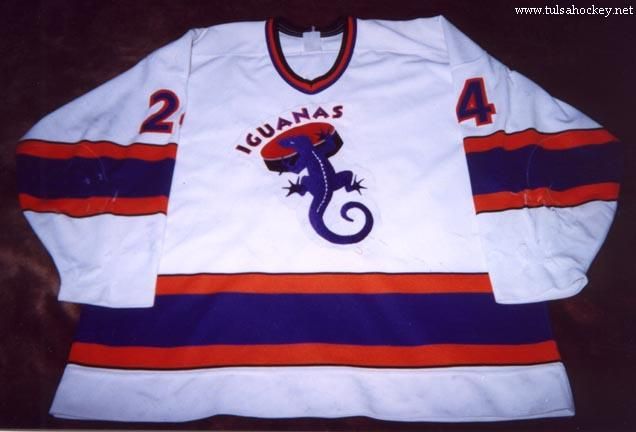
The Central Hockey League saw its first expansion team join the league in 1994 when the San Antonio Iguanas joined the league for the 1994-95 season. The team started with former Minnesota North Star Bill Goldsworthy as their head coach, but he only spent ten games behind the bench, going 5-4-1. Goldsworthy stepped down after being diagnosed with AIDS in November 1994, the first professional hockey player to acknowledge having the disease. In 1996, Goldsworthy passed away due to complications from the disease, and his gravesite is located in Lakewood Cemetary in Minneapolis, Minnesota.

After Goldsworthy announced his early retirement, he was replaced by John Torchetti. Torchetti guided the Iguanas to a 37-22-7 mark, good for second-place in the seven-team CHL. Paul Jackson would lead the team in goals with 51, and Brian Shantz would lead the CHL in assists with 80 and in points with 119. With the top four CHL teams making the playoffs, the Iguanas would meet up with the Tulsa Oilers in the playoffs in their first season.

The two teams battled through seven games. Only Games One and Six would be decided by less than three goals, and those two games went to overtime. Tulsa won both of those games - Game One was a 6-5 overtime win, while Game Six was a 5-4 overtime win. The other five games were all significant wins with margins of three goals or more. The series would flip back and forth before San Antonio wrapped up the series in the seventh game by a 6-1 score at the Freeman Coliseum in San Antonio. Their win gave them a berth in the CHL Final!

The Iguanas would face-off against the CHL regular-season champions in the Wichita Thunder. The Thunder would win Games One and Two before the Iguanas cut the deficit in half on home ice with a 5-2 win in Game Three. The Thunder would rally back to push the Iguanas to the brink, but the Iguanas staved off elimination in Game Five with a 6-2 victory. Game Six, however, saw the Iguanas fall 9-4 to Wichita as the Thunder captured the first Ray Miron President's Cup. John Torchetti won the Commissioner's Trophy as coach of the year at the conclusion of the season.

The Dallas Freeze would drop out of the CHL in 1995-96, leaving only six teams to compete for the championship. The Iguanas would finish in second-place for the second straight season, ending the campaign with a 39-17-8 record. Brian Shantz would have an outstanding season for the Iguanas, leading the team in goals with 56, and leading the league in assists with 85 and in points with 139. It appeared that the Iguanas were set to make another run at the CHL Championship.

The Iguanas would host the Memphis RiverKings in the opening round of the CHL Playoffs. The series was split 2-2 through four games, but the Iguanas poured on the heat in Games Five and Six, winning them 4-2 and 6-3, respectively. The six-game series win put the Iguanas into the CHL Final for the second consecutive season!

The Iguanas would meet the Oklahoma City Blazers in the final. The Blazers finished as the top-team in the CHL in 1995-96, so the Iguanas faced the same uphill battle as they did in the previous season. The Blazers would jump out to a 3-1 series lead, but the Iguanas were a determined bunch. They won Game Five in Oklahoma City by a 6-4 score before returning home to win Game Six by a 5-4 score in overtime. However, Game Seven saw the Blazers capture the Ray Miron President's Cup on home ice as they downed the Iguanas by a 4-2 score. Again, the Iguanas came up short, but they had been bridesmaids in their first two seasons of existance - not too shabby at all!

John Torchetti wouldn't be behind the bench for the Iguanas to start the season in 1996-97, but he was still in San Antonio. Torchetti took an assistant coaching position with the IHL's San Antonio Dragons as they began play in San Antonio. Instead, Dale Henry would guide the team through the first 36 games. Henry's reign would be cut short as he posted an abysmal 9-24-3 record in those 36 days, and he decided that he would rather help the team on the ice. He resigned his position as coach and took a seat on the bench as a player while Ric Seiling stepped behind the bench. Seiling would go 17-12-1 down the stretch, but it wasn't enough to get the Iguanas into the playoffs. They would finish the season in last place in the East Division with a 26-36-4 record.

Dale Henry played 23 games that season for the Iguanas, posting 12 goals and 19 points after his brief coaching stint. Paul Jackson led the Iguanas in goals (44), assists (46), points (90), and PIMs (391). Yes, you read that last stat correctly - leading scorer with nearly 400 PIMs! He would finish second in the league in PIMs and seventh in goals. Not a bad season's worth of work!

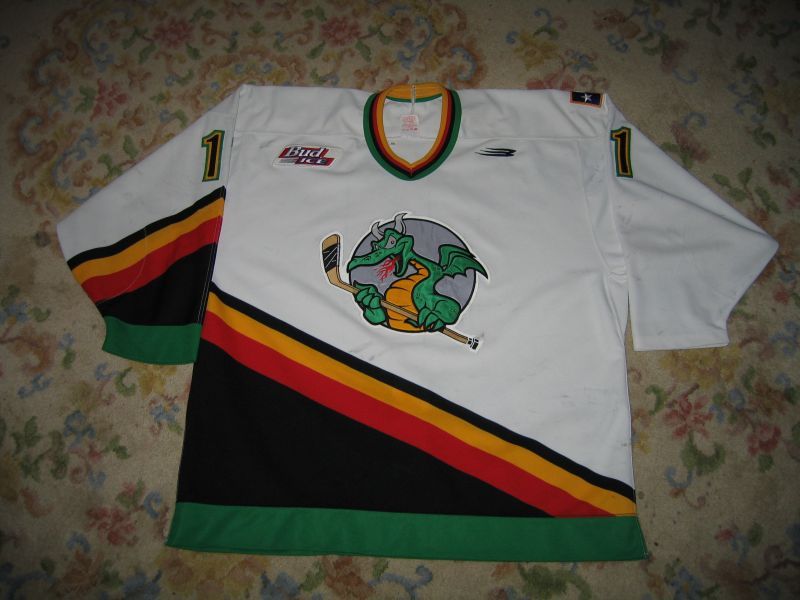
However, the Iguanas found themselves in a bit of a bind when another reptilian team took up residence in San Antonio in 1996. The IHL decided to set up shop in San Antonio after moving the Peoria Riverman franchise to Texas, and the Dragons took flight for the 1996-97 season. At first, the Iguanas and Dragons shared Freeman Coliseum, but the Dragons eventually forced the Iguanas out of their home. The Iguanas decided to suspend operations over the 1997-98 season while the IHL tested the waters in San Antonio.

The IHL Dragons lasted all of two seasons in San Antonio - not quite the lasting power that the IHL wanted. However, they had some success in their two-year existance. Head coach Jeff Brubaker hired former Iguanas' coach John Torchetti to help behind the bench, and the 1996-97 Dragons posted a record of 45-30-0-7. Daniel Shank led the team in all the major stats with 33 goals, 58 assists, and 91 points. He was also second on the team in PIMs with 293 minutes in the sin bin! David Littman and Bruce Racine split the goaltending duties fairly evenly.

The Dragons finished their first season in first-place in the Midwest Division. That finish gave them a first round date with the Chicago Wolves. In the best-of-five series, the Dragons were more than the Wolves could handle despite three of four games being decided by one goal, and San Antonio advanced with a 3-1 series win.

The Dragons would run into their cross-state rivals in the Houston Aeros in the second rund of the Turner Cup Playoffs. Houston jumped out to a 3-0 series lead before San Antonio picked up a 2-1 win to force a Game Five. The Aeros didn't let it go any longer, though, as they closed out the series with a 4-3 win to secure the 4-1 series win.

The 1997-98 season saw only one in San Antonio as the IHL's Dragons no longer had to share the Freeman Coliseum. The Dragons, unfortunately, would not survive past this season as they ran into financial problems. Despite being the better draw compared to the Iguanas, the Dragons simply couldn't make it work.

The 1997-98 season was certainly not the best way to go out, either. John Torchetti left the Dragons to take the head coaching job of the Fort Wayne Komets, and the carousel of coaches in San Antonio began. The Dragons stumbled through the season, posting a 25-49-8 record. Along with the Quebec Rafales, they were the only two teams to miss the Turner Cup Playoffs that season in the sixteen-team IHL. The Dragons were the worst team in the IHL in the 1997-98 season, closing out their existance with nothing more than a whimper. Once the season came to a close, the franchise folded due to their money problems.

Daniel Shank was clearly the star of the team once again in this season-to-forget. Shank finished 34 points ahead of the next closest scorer on the Dragons, Micah Aivazoff. Once again, he led the Dragons in goals with 39, assists with 43, and points with 82. The carousel of goaltenders saw six men dress for the Dragons. Scott Bailey played in 37 games, sporting a record of 11-17-3, a GAA of 3.73, and one shutout. Statistically, Eldon "Pokey" Reddick was the best goaltender that season. He played in 17 games for the Dragons, going 5-9-1 with a 3.13 GAA, a .900 save percentage, and one shutout.

With the Dragons extinct, the Iguanas returned to the ice in the CHL for the 1998-99 season. Their one-season time-out didn't seem to ruin their fan support. Head coach Todd Simpson led the team to a 37-26-0-7 record, good for second-place in the CHL's Western Division and a playoff spot. Johnny Brdarovic led the team in goals with 56 and points with 115, while goaltender Ken Shepard backstopped the team with a 16-11-2 record, a 3.64 GAA, and one shutout. Brdarovic was also named as the CHL's Rookie of the Year in 1998-99.

The Iguanas squared off with the Wichita Thunder in the opening round of the playoffs, and they showed that hadn't missed a beat. Wichita opened the series with a 3-2 ovetime victory, but the Iguanas rattled off three straight wins to clinch the series by a 3-1 margin.

In the second round, the Iguanas ran into an old nemesis as they matched up against the Oklahoma City Blazers. The Blazers finished first in the Western Division, so this was also a divisional rivalry between these two clubs. Unfortunately, the comparisons run short when looking at the series as the Blazers dismantled the Iguanas in a four-game sweep. Despite the loss, the Iguanas made a pretty good return to San Antonio!

Chris Stewart would take over behind the bench for the 1999-2000 season, but his first season didn't fare very well. Despite leading the Iguanas to a 33-32-5 record, the team missed the playoffs. Brian Shantz led the team in scoring with 109 points, 79 of which were assists!

Stewart would guide the Iguanas to another second-place finish in the Western Division and to the playoffs in his second season on the strength of a 42-21-0-7 record. A familiar name in Johnny Brdarovic would return to San Antonio to claim his team's scoring title. Brdarovic scored 29 goals and added 56 assists to lead the Iguanas in scoring just two seasons after leading the Dragons in scoring.

The Iguanas faced off against the Topeka Scarecrows in the first round. Much like their last trip to the playoffs, they allowed the Scarecrows to draw first blood with a 4-2 win before rattling off three straight wins to secure the 3-1 series win.

The second round was reduced to a best-of-five series, and the Iguanas and Blazers would clash again in this round. San Antonio took Games One and Three to go up 2-1 on the Blazers, pushing their rivals to the brink. However, the Blazers hammered the Iguanas 5-2 in San Antonio to push the series back to Oklahoma City. There, the two teams battled to a 1-0 score through overtime. However, the Blazers were the team to score, and San Antonio went home empty-handed once more thanks to the Blazers.

Stewart would be the first coach to last three seasons with the Iguanas, and he guided the club to a second-place finish in the Southeast Division on a 40-16-8 record in 2001-02. Blair Manning would lead the club in scoring with 77 points.

The Austin Ice Bats - the Iguanas' in-state rivals and first-place in the Southeast Division - were the Iguanas' opening-round opponents. While the two teams split the first two games, the Ice Bats took the next two games to close out the Iguanas' season with a 3-1 series loss. Not quite the finish they were looking for, but the Iguanas had larger issues at hand.

The San Antonio Spurs and the Florida Panthers had annouced a partnership to bring an AHL franchise to San Antonio's SBC Center in May 2002. Because the Iguanas' lease had expired, they had to look at the Alamodome as a possible place to play their home games. However, the search for an ownership group to purchase 25% of the team fell through, and the team had to cease operations without suitable ownership.

This, of course, opened the door for the San Antonio Rampage to be born, and the AHL moved into the SBC Center as the San Antonio Spurs and Florida Panthers launch an expansion team to be stocked with Panthers' prospects. The AHL franchise was awarded to the Spurs/Panthers ownership group on May 6, 2002. Before the team had been named, however, the group made a shrewd decision in hiring John Torchetti as the first head coach of the AHL franchise on May 31, 2002. Torchetti would return to San Antonio as part of the third professional hockey franchise in the history of the city.

On Jume 3, 2002, the Spurs announced that the AHL franchise would be named as the "Stampede", and would feature a rampaging bull with a blue, black and silver color scheme. The blue came directly from the Panthers while the silver-and-black are the colours of the Spurs. However, the Spurs made a second announcement just eleven days later stating that the AHL franchise would be named as the "Rampage", but all logos and the colour scheme would remain the same. On September 14, 2002, the Rampage unveiled their jerseys to the public just weeks before their first pre-season game against the Houston Aeros on October 4, 2002.

The Rampage haven't seen very much success in their eight seasons, but they started off fairly well. They opened their franchise history on October 12 in Milwaukee against the Admirals with a 6-2 loss. October 18 saw the Rampage record their first victory, a 5-4 win over the Utah Grizzlies. Their first home win in the brand-new SBC Center happened on November 7, 2002 when they defeated the Cincinnati Mighty Ducks by a 4-3 score. Filip Novak is selected as the team's first AHL All-Star, playing for PlanetUSA. Jeff Toms led the team in goals with 30 and scoring with 63 points in their inaugural season.

With a 36-29-11-4 record, the Rampage qualified for the Calder Cup Playoffs in their first season. They would match up against the Norfolk Admirals, but the series wouldn't last long as the Admirals swept the Rampage out of the playoffs. While their first season showed promise, this season would be one of two where the Rampage played past the last regular season game.

Since their inaugural season, the Rampage have made the Calder Cup Playoffs twice. They made the playoffs in their first season, as seen above, and in 2007-08 under the watchful eye of Greg Ireland who guided the team to their best finish at 42-28-3-7 thus far. The team finished fifth in the eight-team West Division, and met up with the Toronto Marlies in the opening round of the Calder Cup Playoffs. Despite falling behind 3-2 in the series, the Rampage pushed the Marlies to seven games before falling in Game Seven by a 2-1 score.

The Rampage have had some highlights, though. On February 14, 2005, Jay Bouwmeester represented the Rampage at the AHL All-Star Game for Team Canada. On June 30, 2005, the Spurs bought out the Panthers to become the sole owners of the Rampage. They hired the front office and coaching staff of the Utah Grizzlies to run their team after the Grizzlies had decided to pull out of the AHL. In early August of 2005, the Spurs announced that they had come to an agreement with the Phoenix Coyotes to be their AHL affiliate.

December 1, 2005 saw the San Antonio Rampage host the Cleveland Barons in the AHL's 30,000th regular season game. The game featured two NHL goaltenders as both Vesa Toskala of Cleveland and Brian Boucher of San Antonio took to the nets. Both goaltenders battled to a scoreless draw into the shootout. Karl Goehring replaced Boucher in the Rampage net for the shootout, and stopped four of five shots to post his first win as a member of the Rampage while giving the Rampage the victory in the 30,000th AHL game.

September 7, 2006 marked a new look for the Rampage as they changed their uniforms to reflect their affiliation with the Coyotes. The new colour scheme is black, gray, and silver, and the primary chest logo on the jersey has just the bull's head, replacing the full Rampage logo. Not that this should be a major piece of news, the Rampage also were afflicted with the Rbk EDGE jersey in 2007.

The Rampage will continue to write history this season as they begin their ninth AHL season. While the history of hockey has been short in San Antonio and there have been no championships to speak of yet, hockey appears to be thriving in the Texas city. Having both the Texas Stars and the Houston Aeros as in-state rivals should only help to fuel the rivalry that burns in the Texas winter!

Until next time, keep your sticks on the ice!

Sunday, September 5, 2010

It's funny to think that the DeVos family thought they could move the Kansas City Blades five hours down I-35 to Oklahoma City at the turn of the millenium. I mean, essentially all they were going to do was add the letter "O" to the KC Blades' logo, and all was good. However, hockey in Oklahoma City remained strong thanks to the unwillingness of the CHL's Oklahoma City Blazers to pull up their roots, and there will be a higher level of hockey played in OKC with the AHL's Barons opening their season on October 9 in the city. Hockey in Oklahoma City has always been strong as long as it has remained a part of this community, and tonight HBIC will look at the Blazers and the Barons in terms of their success within the state of Oklahoma.

The founding of the new-look Blazers in 1992 coincided with the refounding of the Central Hockey League. However, there was a previous incarnation of the Blazers that played in the CHL, and the older Oklahoma City Blazers is where we'll start.

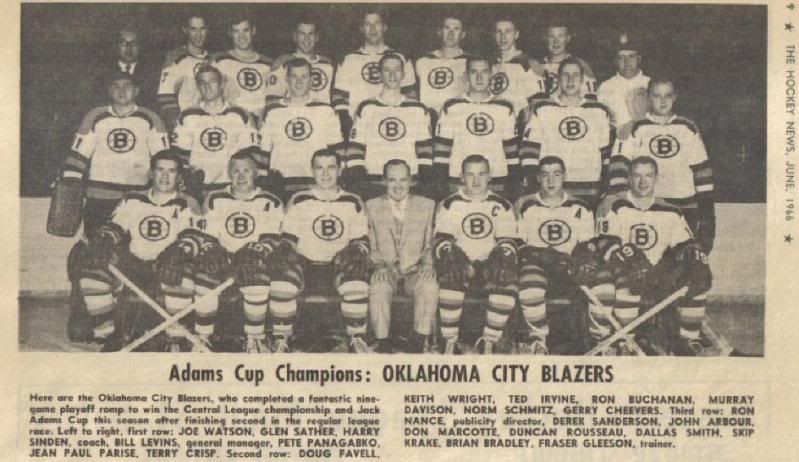
The Blazers started in 1965 in Oklahoma City as a farm team for the Boston Bruins. They were originally founded in Minneapolis as the Minneapolis Bruins in 1963, but the Bruins shifted them south to Oklahoma City in 1965.

The founding of the Central Hockey League in 1963 was done by the Original Six NHL teams as they needed a replacement for the folded Eastern Professional Hockey League. From that, five teams emerged: the Minneapolis Bruins (Boston), the Indianapolis Capitals (Detroit), the Omaha Knights (Montreal), the St. Louis Braves (Chicago), and the St. Paul Rangers (New York). Only Toronto didn't add a team in 1963, but they joined via the Tulsa Oilers in 1964 to compete with the other teams.

The Blazers were an extremely popular team in the CHL thanks to the Bruins stocking th lineup with up-and-coming stars. Bruins legend Harry Sinden was the first coach of the Blazers, and many well-known players came through the system: Bernie Parent, Reggie Leach, Gerry Cheevers, Doug Favell, Wayne Cashman, and JP Parise to name a few.

The Blazers finished in second-place in 1965-66 with a 31-26-13 record. They played in the 8832-seat Fairgrounds Arena, and routinely had crowds over 8000 fans. They played fairly conservatively in 1965-66, and that style really paid off in the CHL Playoffs. In their first season in Oklahoma City, the Blazers captured the Adams Cup! They were led in scoring by Rudy "Pete" Panagabko who scored 21 goals and added 42 assists in 70 games. Phil "Skip" Krake led the team in goals with 24 that season, and Gerry Cheevers was the starting goaltender.

The following season, the Blazers improved on their standing with a 38-23-9 record, and ended up first overall in the six-team CHL. The Blazers powered through the playoffs to capture their second consecutive Adams Cup, becoming the first team to do so in the CHL! Former NHL head coach Terry Crisp led the team in scoring in 1966-67 with 31 goals and 42 assists in 69 games. Ron Buchanan played in a mere 56 games, but still led the Blazers in goals with 34 on the campaign. Doug Favell and Gerry Cheevers were the starters on most nights, but Oklahoma City hockey fans got their first glimpses of a young Bernie Parent in net that season. Other notable names on the Blazers' roster that season included Wayne Cashman, Jean Provonost, Glen Sather, JP Parise, Dick Cherry (Don Cherry's younger brother), Derek Sanderson, and Ted Irvine. Quite the assembly of talented players there!

While the Blazers woul never capture the Adams Cup again, they did advance to the finals twice more. Their affiliation with the Boston Bruins came to an end in 1971-72, leaving them without a parent team to stock their lineup. However, they returned in 1973-74 after the Toronto Maple Leafs revived the affiliation. Through the Leafs, Oklahoma City fans got to see players such as Mike Palmateer and Dave "Tiger" Williams. The success that they had with the Bruins, however, would not follow in their affiliation with the Leafs, but they did lose in the finals once and got bounced in the semi-finals twice in their three seasons with the Leafs at the helm.

From 1977 through to 1982, the team would be affiliated with the WHA's Houston Aeros, the NHL's Minnesota North Stars, and the NHL's Calgary Flames, but the Blazers would not advance past the CHL quarter-finals. Due to rising salaries and increased costs, the CHL folded in 1982 when three of its teams closed its doors, including the Oklahoma City Blazers.

With the CHL being re-incarnated in 1992, the league quickly founded a franchise in Oklahoma City as a way to capitalize on the history and intrigue that hockey once had in the city. Bill Levins and Ray Miron decided that central ownership would be the best way to guarantee that the league succeeds in the early going, and they founded teams in six cities: the Oklahoma City Blazers, the Tulsa Oilers, the Wichita Thunder, the Memphis RiverKings, the Dallas Freeze, and the Fort Worth Fire. By keeping the league in a relatively small geographical range, they could control costs and keep the teams and league profitable.

Thanks to a very good team, the new Blazers drew 8000 fans regularly to games, and were one of the most successful minor-pro franchises in hockey. In 17 seasons, they missed the CHL Playoffs once three times, and only finished with a losing record once. Head coach Doug Sauter had a nearly rockstar following for his coaching record as he did for his facial hair. Twice, the Blazers brought home the CHL Championship, and the Blazers set an unprecendented CHL record of finishing first overall seven consecutive seasons. Not bad, eh?

In 1995-96, it took all seven games, but the Blazers knocked off the San Antonio Iguanas to win the CHL Championship. Goaltender Jean-Ian Filiatrault was spectacular through the season, going 30-7-2 in the regular season before leading his team to the championship. Filiatrault was named CHL MVP in the playoffs. George Dupont led the team in scoring through the regular season, picking up 28 goals and adding an astounding 83 assists while racking up 274 PIMs! Basically, if he wasn't scoring, he was sitting in the penalty box! Joe Burton led the team in goal-scoring with 66 markers, while Doug Lawrence led the team with an amazing 346 PIMs.

The Blazers returned to glory in 2000-01 when they needed just five games to dispose of the Columbus Cottonmouths in the CHL Final. The Blazers went 48-19-0-3 during the season, led by their goaltending once again. Rod Branch started 41 games, and finished with a 26-12-2 record, a 2.50 GAA, a .913 save percentage, and three shutouts. He was named as the Playoff MVP after leading the Blazers back to glory!The video below shows Branch wearing #67 between the pipes:

While the Blazers were certainly a success story on and off the ice for the CHL, there were problems behind the scenes as the Blazers and Oklahoma City were battling over arena lease costs. Oklahoma City, it seems, was interested in upgrading to an AHL franchise while Blazers simply wanted to exist.

According to Robert Przybylo of NewsOK.com, "[t]he Blazers did not renew their lease with the Ford Center after months of negotiations. According to city documents, the city and SMG were going to grant the Blazers a three-year renewal, but the Blazers have retracted the deal."

While it sounds like the team and the city were amicable, you had to wonder how much the lease was going to cost when Blazers assistant general manager Josh Evans stated, "It is not economically feasible for us to go on at this point".

With the end of the Blazers' run in Oklahoma City after seventeen years, they leave the CHL with a few records. Joe Burton and Hardy Sauter are the CHL's first and third all-time career leading scorers, respectively, and Burton is the fourth leading goal-scorer in minor-league hockey history. Burton is now managing an ice rink near his home, while Sauter is the head coach for the Idaho Steelheads. Pretty impressive, but a let-down for hockey fans as a team with considerable history is sent into hockey purgatory.

On October 9, we'll see a new chapter of Oklahoma City hockey being written as the Edmonton Oilers move their AHL affiliate into town, and the Oklahoma City Barons begin play. While it seems as though the Oilers' cupboards are bare, there is hope that the Barons will be competitive as the Oilers have already signed Alexandre Giroux and could send Jordan Eberle to the team. Here's hoping that the Barons get off to a good start to bring back the hockey enthusiasm in OKC!

Until next time, keep your sticks on the ice!