Replace these every slider sentences with your featured post descriptions.Go to Blogger edit html and find these sentences.Now replace these with your own descriptions.This theme is Bloggerized by Lasantha - Premiumbloggertemplates.com.
This is featured post 2 title
Replace these every slider sentences with your featured post descriptions.Go to Blogger edit html and find these sentences.Now replace these with your own descriptions.This theme is Bloggerized by Lasantha - Premiumbloggertemplates.com.
This is featured post 3 title
Replace these every slider sentences with your featured post descriptions.Go to Blogger edit html and find these sentences.Now replace these with your own descriptions.This theme is Bloggerized by Lasantha - Premiumbloggertemplates.com.
This is featured post 4 title
Replace these every slider sentences with your featured post descriptions.Go to Blogger edit html and find these sentences.Now replace these with your own descriptions.This theme is Bloggerized by Lasantha - Premiumbloggertemplates.com.
This is featured post 5 title
Replace these every slider sentences with your featured post descriptions.Go to Blogger edit html and find these sentences.Now replace these with your own descriptions.This theme is Bloggerized by Lasantha - Premiumbloggertemplates.com.
I had visions of writing an article today on the shootout, and how this added bonus at the end of tied games send the fans home with a feeling of satisfaction or defeat. After all, hockey is a sport that prides itself on entertainment value, and no one really likes to go home unfulfilled after spending $500 on tickets, food, and souvenirs. Instead, I changed my focus once I came across an article that spoke of the longest shootout in hockey history, and one that network executive in North America would probably grumble about if it happened here.
We go back a few weeks to the Deutsche EisHockey Liga where the visiting Straubing Tigers played EHC München on December 22, 2010. Not much was out of the ordinary as the teams closed out the regulation sixty minutes tied 4-4. 4999 fans awaited the standard overtime period, and saw the two teams remain tied after the extra frame. So, as we see in most games today, a shootout was on-deck in this game.
The two goaltenders, Sebastien Elwing for München and Dimitri Pätzold for Straubing, have probably faced a number of penalty shots in practice, and I know some teams enjoy having a shootout competition at the end of practices as a little fun. I'm guessing both goaltenders have seen their fair share of penalty shots and shootout moves in their careers.
That being said, the game on December 22 may have doubled the amount of shootout attempts they have faced in their careers in one game. The shootout between Straubing and München went an incredible 21 rounds! The hockey game, including the shootout, lasted nearly three hours for the fans, players, coaches, and officials - a timeframe almost unheard of for professional hockey games.
There were goals in the third round of the shootout as Straubing's Justin Mapletoft and München's Martin Buchwieser each scored on their attempts to keep the shootout knotted at 1-1. Christian Wichart and Tobias Draxinger scored again in the fourteenth round to keep the shootout even at 2-2.
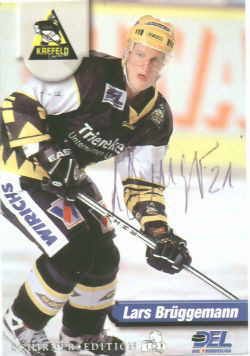
München captain Stéphane Julien appeared to score in the seventeenth round, but the goal was waved off by referee Lars Brüggemann after the video replay showed the puck did not fully cross the goal line. 34 skaters in, two goals, no winner yet. Will this game ever end?
As an aside, Lars Brüggemann is an interesting fellow. He is a former player from the DEL, and has now turned his sights on officiating in the German Elite League. Brüggemann played one season in the QMJHL with the Hull Olympiques in 1993-94, recording one goal, three assists, and 93 PIMs over 58 games. He left for the DEL after that season, but returned to North America to play in the ECHL three years later. He suited up with the Jacksonville Lizard Kings in 1997-98, scoring one goal, six assists, and spending 91 minutes in the penalty box over 49 games. The rest of his career played out in Germany. But back to this story....
Neville Rautert and Andy Canzanello exchanged goals in the eighteenth round, and both Martin Buchwieser and Tobias Draxinger scored again in the twentieth round as the two teams remained knotted at 4-4 through the shootout. But things were about to change in the 21st round.
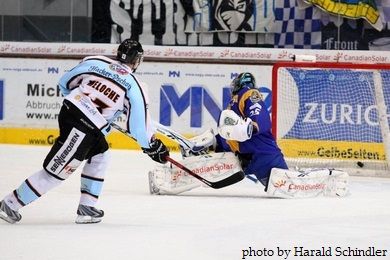
Straubing’s Éric Meloche, who played for the Pittsburgh Penguins and Philadelphia Flyers in the NHL, blasted a slapshot past Sebastien Elwing to put Straubing up by a 5-4 score. The game came down to Stéphane Julien, but the München captain was stonewalled Dimitri Pätzold as Straubing won the shootout by a 5-4 score and the game by a 5-4 score after 21 rounds of shootout.
The longest shootout in IIHF competition was 13 rounds between Belarus and France at the 2002 IIHF U-20 Championship. Belarus eventually won the game on Dmitri Mialeshka's goal in the 25th round as Belarus downed France. The NHL's longest shootout is still remembered between the New York Rangers and Washington Capitals from November 25, 2005. I mean, how could anyone forget this goal?
Eric Meloche's name is the answer to the trivia question: Who scored the goal to end hockey's longest shootout in history?
It is with great interest to the rest of the hockey world that the NHLPA introduced Donald Fehr as their new Executive Director yesterday afternoon. The 62 year-old negotiator put off retirement to join the NHLPA as they prepare for upcoming negotiations in 2011 with the NHL. Fehr previously held the position of MLBPA Executive Director for 24 years, and won several major cases against MLB with regards to collusion and replacement players. And perhaps most infamously for Canadians, Fehr successfully led the MLBPA in a strike that canceled the 1995 World Series when the Montreal Expos were on top of the Major League Baseball standings. Because of this, you'll have to forgive Canadians when they feel a little hesitant towards the appointment of Fehr as the top man in the NHLPA.
I'll be honest: I don't know very much about Donald Fehr simply because I don't really follow baseball as closely as I probably should. I do know that Fehr's name sometimes irks MLB's owners, so there's probably a good reason that hockey owners have a little apprehension over Fehr's appointment.
To introduce Canadians to Mr. Fehr, the CBC, specifically Elliotte Friedman and Ron MacLean, presented an excellent piece this evening on Mr. Fehr, and I was very curious as to how he would come off on this piece. I'll have my thoughts below, but this 13-minute clip should bring to light a little bit of Mr. Fehr's personality for Canadians who may not be as knowledgeable about him as our American neighbours. Marvin Miller ran the MLBPA from 1966 to 1982, and transformed the MLBPA from an also-ran union into one of the United States' most powerful unions in history. Some of Miller's accomplishments included getting arbitration introduced into baseball, eradicating the "reserve clause" in baseball and introducing full free agency, and getting baseball's minimum salary to increase 1268% from $19,000 to $241,000. Clearly, he was a dynamo, and Fehr worked under him until he took over in 1985. However, under Miller, Fehr also witnessed three strikes that crippled baseball in the early-1980s.
To me, it sounds like Mr. Fehr understands the global game of hockey better than the men who preceded him in the NHLPA. In his interview with MacLean, he addresses the European market where hockey is already being played and is somewhat thriving, he addresses the international game in terms of IIHF's stance on the Olympics and the World Championships, and he gets that there is a large percentage of the NHL that comes from overseas. That's something that I think the NHL is interested in exploring, and it sounds like Mr. Fehr has a grasp of wanting to explore those markets in both a growth role and a financial role.
It also sounds like Mr. Fehr is an advocate for the players, and will keep players informed of what is happening during negotiations. There was some rumbling from players about the lack of transparency at the top of the NHLPA in the last few years, and there was certainly a sense of "traitorism" when Bob Goodenow agreed to the 24% rollback in salaries. Mr. Fehr, without being confrontational, said exactly what the players want to hear: we'll keep you informed as to what is happening in the negotiations, and we'll bring you to the negotiating table if you have questions about what is being put forth. That, to me, sounds like crystal clear transparency, and that has to please the players.
It remains to be seen what Mr. Fehr will accomplish as the top man in the NHLPA as he starts in his role in the NHLPA, but his interview leaves me thinking that he's going into these new CBA negotiations with the players' wants and needs in mind while being respectful of the owners' wishes in order to prevent another work stoppage in the NHL. As a fan, I can honestly say that hearing this sentiment is a relief when negotiations in the past seemed like a shootout at the OK Corral.
While his name is pronounced "fear", I'd say Mr. Fehr is all about fair right now. And for the NHL, NHLPA, and the fans, that's all we want to see in these new negotiations.
The Globe & Mail, one of Canada's daily national newspapers, has a number of excellent writers at its disposal. One of those writers is Mr. Bruce Dowbiggin. Today, Mr. Dowbiggin's column sounded surprisingly like an excerpt from the NHL Commissioner's various speeches about NHL participation at the Olympics. It is worth pointing out, though, that Mr. Dowbiggin is framing this article very well, and makes a case for why the NHL should be compensated in some way if they are releasing the players they have under contract to the Olympics.
Now don't get me wrong here: I love Olympic hockey. Besides the national pride on the line, there's always a good chance to see a surprising upset, a highlight-reel play, or a show-stopping save. Olympic hockey is fun, fast, and exciting, and the reason it is this way is due to the talents of the men on the ice.
And there's the rub: the NHL employs the best hockey players on the planet, and they get little to nothing in return except a few headaches.
As Mr. Dowbiggin writes,
"The Olympic TV impact is negligible in most of the American burgs where Bettman has hawked franchises, the elite players are exhausted by the travel and it punishes the NHL regional broadcasters who must go on hiatus at a time when hockey has the stage almost alone to itself in February.
"Plus, the NHL gets bupkis in return. As it stands now, the panjandrums of the International Olympic Committee and International Ice Hockey Federation are telling the league to butt out, they’ll be the ones to collect the cash. They’ll also tell you what uniforms teams can wear, how often you’ll play and probably how much luggage you’re entitled to bring.
"It’s a one-sided deal, one not reflecting the NHL’s leverage: the world’s best hockey players."
If you were the owner of an NHL team and you allowed your best players to head over to Sochi, Russia in 2014, what kind of return do you get besides a little national pride? And how does the IOC repay you if your superstar - say, Ovechkin or Crosby - ends up with a season-ending injury during his participation at the Olympics?
Mr. Dowbiggin even points out that the NFL may be pushing the Super Bowl into the Winter Olympics' normal window of time by expanding its season to an eighteen-game schedule. If you're a hockey fan, you want the NHL players there to give the Olympic hockey event some meaning, especially if they are competing against the largest annually televised sporting event. Otherwise, it should be business as usual for NHL teams, and the players watch the national teams from North American soil.
My feelings are that the teams should allow their players to represent their countries. Much like the transfer fees that the respective sport federations demand in Europe, the NHL should turn the tables on those federations and demand compensation for their stars.
After all, if the federations' arguments are that they trained and developed the players that the NHL teams are drafting, the same excuse can be used against them: NHL teams are training and developing those players into stars. If the Russian National Hockey Federation can demand payment from an NHL team, the same can be done by the NHL teams to the federations that demand that payment.
While many other sixteen and seventeen year-old boys are off discovering the joys of a first job, a first car, and many other firsts this summer, there are some who have traveled to Slovakia where they are representing Canada on the ice. The Ivan Hlinka Tournament is currently being played in Piestany, Slovakia - where the Canadians have made memories once before - but the U-18 team is currently making the country proud as they march towards a gold medal. Canada is looking at a semi-final game already after having cruised through the round-robin portion of the tournament. We'll take a look at how they got to the semi-finals, and who they will be playing.
Canada opened the round-robin on Monday with a 6-3 defeat of Sweden. It didn't look very good in the middle frame as Sweden had built a 3-1 lead over the team in red, but the Canadians stormed back with five unanswered goals to secure the victory. Daniel Catenacci had a pair of goals in the win, but head coach George Burnett felt that the team needed this kind of win to prepare them for the rest of the tournament.
"We had a good start, we scored the first goal early but I think we ran into some lessons-to-be-learned," Burnett stated matter-of-factly to The Canadian Press. "We took seven stick penalties so we've got to tidy that up.
"Most of them were from being on the wrong side of the puck or trying to use your stick to check which doesn't work well in events like this, so they got some power-play goals. But we made some adjustments in the second period... and we got some good transition turnovers from some back pressure which was essential against a team that plays with the puck possession that these guys do and we turned some of those into goals."
Canada's winning ways wouldn't get any time off as they entered Tuesday with a date against Switzerland, a team who seems to play its best hockey against the Canadians. Canada went up 2-0 just 2:34 into the game, and never looked back as they led 2-1 after the first period, and 6-2 after the second period. Ryan Nugent-Hopkins recorded a hat trick against the Swiss, and Brett Ritchie notched a pair in pacing Canada to the win. Tyson Teichmann made 21 saves for his second victory of the tournament. Coach Burnett liked what he saw from his team on Tuesday.
"Our game was better today so I think I can comfortably say that we've gotten better every day since camp," Burnett told The Canadian Press in a phone interview. "That's the big challenge – that you try to be better every day."
It was discovered that several of the Team Canada players have been suffering with the flu, so their Wednesday game against the host Slovakian team may have proved tougher than the Slovaks' 0-2 record showed. Canada fought through the illness, and prevailed with a 6-1 victory over Slovakia. Boone Jenner scored twice in the victory, and it was far more lopsided than the exhibition game that these two teams played. Canada squeaked by with a 3-2 overtime win in that game last Saturday.
The big win for Canada also allowed the Canadian coaching staff to sit a few of the players who had been suffering from the flu. Ryan Nugent-Hopkins and defenceman Ryan Murray were given a chance to watch the third period from the bench as they look to rebound from the flu bug for their semi-final game.
With the standings settled after the round-robin, there were a few surprises to report:
Monday saw Finland defeat the Russians by a 3-2 score after a shootout. It was not the way that the Russians wanted to start, and it put them behind the eight-ball.
The Russians rallied on Tuesday to beat Team USA by a 6-5 score in overtime. While Russia needed a regulation win, any win was better than no win at all.
The Americans finished first in Pool A after defeating the Czech Republic 3-2 on Monday and by defeating the Finns 5-2 on Wednesday. That overtime loss to the Russians wouldn't come into play in terms of tie-breaking scenarios after all.
The Czechs, on the other hand, beat the Russians on Wednesday by a 3-2 score. That bumped the Russians out of the medal round, and into the fifth-place game. That game against Finland, who will play for seventh-place, was definitely a massive loss.
The standings are as follows:
Group A
Team
W
OTW
L
OTL
GF
GA
PTS
USA
2
0
0
1
13
10
7
Czech Republic
2
0
1
0
9
8
6
Russia
0
1
1
1
10
11
3
Finland
0
1
2
0
8
11
2
Group B
Team
W
OTW
L
OTL
GF
GA
PTS
Canada
3
0
0
0
19
7
9
Sweden
2
0
1
0
17
10
6
Switzerland
1
0
2
0
11
15
3
Slovakia
0
0
3
0
6
21
0
That means that Finland and Slovakia will battle for seventh-place, and Russia and Switzerland will battle for fifth-place. The medal round sees Team USA take on Sweden for a berth in the gold medal game, while Canada tangles with the Czech Republic for the right to play for gold.
Canadian head coach George Burnett thinks that the Czechs will be a good test for his squad on Friday. "They're a very competitive team, they really pressured hard,” Burnett told The Canadian Press. "There's no passive play at all. It was very aggressive and it's nice that we know that now.
"I'm sure there'll be a home crowd contingent as well."
That "home crowd contingent" Burnett speaks of is the crowd in Breclav, Czech Republic. The medal-round game shifts to the Czech Republic, providing the Canadians with a little more adversity to deal with in their quest for a gold medal. If they continue to play well, though, they should be able to advance to the gold medal game on Saturday.
All in all, it appears that several Canadian sixteen and seventeen year-old boys will return from Europe with some hardware this summer. All that remains to be seen is which colour of medal they return with. That being said, the hardest game lies in front of them on Friday against the Czech Republic. GO CANADA GO!
There were a lot of interesting developments today in hockey as the San Jose Sharks basically gave long-time Shark goaltender Evgeni Nabokov his walking papers, while the Boston Bruins dealt an underwhelming Dennis Wideman and the fifteenth overall pick in this year's draft to Florida for Nathan Horton and Gregory Campbell. But that's not why I'm here today. Sure, the Sharks got a little worse, the Bruins got a little better, and the Panthers are apparently giving Horton what he wants. Instead, it's time to give credit where credit is due on this blog, and I'm looking directly at the Hockey Hall of Fame.
The Hockey Hall of Fame has pushed aside amateur and international players for the sexier option of NHL players that bring notoriety. There are many NHL players deserving of the honour of being in the Hockey Hall of Fame without doubt. But there are a large number of players who deserve to be in the Hall of Fame who have not suited up in the NHL, and it appears that the Hockey Hall of Fame is finally changing its tune towards one group of individuals. Especially when its home page states that it is "[h]ome to hockey's greatest players".
Let's go back to July of 2007 where I blasted the Hockey Hall of Fame regarding their lack of recognition given to the phenomenal female players on planet today. Some of these women are trailblazers in their building of their countries' respective programs, and deserve a spot in the Hall of Fame not only for their playing abilities, but their leadership, courage, and dedication to the sport of hockey.
Looking forward, it was announced in March of 2009 that women, for the first time in the Hockey Hall of Fame's history, would be eligible to be voted into the Hall of Fame. Thanks to the Hall of Fame's wisdom, two women will be eligible for induction into the Hockey Hall of Fame per year from this year forward. The women's game, thought to be at risk in future Olympic years, should point to this day as the first day where women's hockey is given the same respect as the men's game.
There are literally dozens of women players who deserve to be in the Hockey Hall of Fame, but the two women voted into the Hall of Fame today are extremely well-known in North America for their efforts in growing the women's game within their respective countries of birth as well as on the international stage. Canada's Angela James and USA's Cammi Granato will be the first women to have their faces molded in bronze and hung alongside the many men voted into the Hockey Hall of Fame before them.
While the Hockey Hall of Fame has always maintained that women have always been eligible, it was nearly impossible for their careers to be compared to the men who played in the NHL. As a hockey fan, it makes me proud that the women's game is getting equal billing after decades of living in the shadow of men's hockey.
However, not everyone shares this sentiment. The comments on the TSN website are absolutely disgusting and highly misogynistic in their nature. Overlooking the spelling and grammar mistakes, you would think that these people are from the 1800s where women couldn't vote or own property.
Says "cbrcbr":
"I have a MAJOR PROBLEM with totally inferior Women Hockey Players being selected for entrance to our now lost so called Hockey Hall Of Fame .To me it is now thye CANADIAN HOCKEY HALL OF SHAME.There are at least 30 Former NHL players and Builders who have been waiting for many years for admission.TYPICALLY CANADIAN,WE HAVE TO BE OUR VERSION OF POLITACULLY CORRECT.Our Juinor A teams would beat any Canadian team of the past and or present.All American Hiockey leage Teams and European Leage teams would do the same. I am Appauled no more NHL Hockey for me."
It's funny that "cbrcbr" feels that most any men's team can beat the Canadian national women's team. After all, the AAA teams from Alberta are having their asses handed to them by the Canadian women. These AAA players are the next NHL players, the next Junior-A players, and the next European League players. Yet they are getting hammered by a non-checking women's team. But the women aren't that good, apparently.
"Acesup" jumps in with this beauty comment, showing vast intelligence and hockey savvy:
"HHOF is the wrong place for the ladies. They should be in the IIHF hall of whatever they have. To push aside legitimate NHL players to include them is wrong, wrong, wrong."
I forgot how the Hockey Hall of Fame is strictly for NHL players. Perhaps that's how Vladislav Tretiak got in there - his phenomenal NHL numbers. What's that? He never played in the NHL? Oh, right! It's not the NHL Hall of Fame, it's the HOCKEY Hall of Fame. My bad!
"Scorp0232" feels that Canadian history is being smeared by keeping out a former Maple Leaf:
"Putting these women in the hall is ludicrous.Paul Henderson scores the most important goal in Canadian hockey history and he can't get in and yet they vote these 2 ladies in."
When did the Hockey Hall of Fame become the Canadian Hockey Hall of Fame? In the grand scheme of things, the Henderson goal is an iconic moment in Canadian history and Canadian hockey history. There's no denying this. But what significance did it have on the Americans? The Swedes? The Czechs?
Henderson's goal is already an enshrined moment in the Canadian Sports Hall of Fame, but a player like Henderson is not even close to being worthy of having his face in bronze on the wall. He didn't even score 500 points in the NHL, let alone score 500 goals. If his one claim to fame is "the goal", then John Slaney should also be in the Hall of Fame. And he's not going there either.
Frostyice, who apparently is not married, hates women, and feels all women should be back in the kitchen, thinks that the women should be kept separate from the men:
"Please create a seperate hockey hall of fame for Women as most of us don't really consider Womens hockey a Sport. If Someone wants to watch Womens hockey or read about it they could go there."
I'm going to guess that "Frostyice" is one of those bandwagoners who claim Canadian supremacy when the Canadian women win a gold medal or World Championship, but complain about the game. Should sledge hockey be kept separate from the Hockey Hall of Fame too? After all, it's different. As far as I can tell, it's not the "Hockey Hall of Fame for People Who Have Male Sex Organs". It's open to all hockey players, regardless of gender.
Angela James was a dominant force in women's hockey throughout the 1970s and 1980s. Long regarded as the Wayne Gretzky of the women's game, the argument against James, and Granato for that matter, being inducted into the Hall of Fame is that she played against vastly inferior opponents during her heyday. There is validity to this argument, but James' induction into the Hockey Hall of Fame is less about her point totals, and more about what she did for the game of women's hockey in Canada.
Cammi Granato deserves her induction for the same reason: she literally grew the game through her actions in the United States. While her older brother, Tony, went on to play in the NHL, Cammi broke down barriers at Providence College by shattering every scoring record the school had seen. She's the idol of current players such as goaltender Chanda Gunn.
Granato was the building block of the US Women's Program in the same vein that Mia Hamm was for US Soccer and Jennie Finch was for US Softball. She literally was the face of US Women's Hockey for 15 years, and is a major reason why the US Women's Hockey Team is a powerhouse on the world scene.
There is no doubt that both of these ladies scored at a torrid pace when they played the game. In fact, Granato is still the leading scorer, the leading goal-scorer, and the leader in games-played for her country after retiring. However, it was their actions that allowed the game to explode onto the North American sporting world, and this is the primary reason their inclusion to the Hockey Hall of Fame is deserving.
If Wayne Gretzky is credited with growing the sport in the state of California and into the Sunbelt in the southern United States, James and Granato are responsible for growing the sport in two entire countries. Name one player currently in the Hockey Hall of Fame that has had that kind of effect on the game of hockey.
Bobby Orr? Wayne Gretzky? Gordie Howe? Maurice Richard?
If those four men grew the sport of hockey in North America through their skill, scoring, and charisma, then Cammi Granato and Angela James are long overdue for induction into the Hockey Hall of Fame. Regardless of their scoring prowess, these two retired hockey players had more impact on their sport than 99% of the men currently in the Hockey Hall of Fame.
If you ask me, that's entirely the definition of what it means to be a great hockey player.
There's no doubt that this year's IIHF Men's World Hockey Championship had its share of controversy and intrigue. From an IIHF staff member ripping NHL players who decline invitations to the tournament to IIHF boss Rene Fasel issuing an apology to Sidney Crosby for being singled out as one of those players, the IIHF saw a little egg on its face in terms of attracting big names to the event. However, there were some good stories as well as the host Germans set a world record for attendance at a hockey game en route to beating the USA in the tournament's opening game, and then proceeded to thrill their fans throughout the tournament with their play. Today's championship final featured two teams that had a number of their best players in the line-up, and two teams that have a long history of battles at the IIHF Men's World Hockey Championship and throughout international hockey history.
The biggest name that appeared on the Czech Republic's roster was 38 year-old Jaromir Jagr. Jagr has never been one to shy away from representing his country on the world's stage, but he opened the tournament in an unhappy mood after finding that some of the more prominent Czech names in hockey had decided to sit the tournament out. Jagr, who may have been slightly annoyed at being one of a few marquee names on the team, saw his team fall to Switzerland and Norway by identical 3-2 scores in the preliminary round. It was the first time a Czech team had lost to Norway on the international scene in 73 years!
"It's the national team — we didn't really have any success lately and a lot of guys said no in our country," Jagr said on May 10. "Probably the top 25 guys said no and I think it's too much. I understand the guys are injured or they feel tired after the season, but look at guys like Ovechkin or Kovalchuk.
"I think you've got to be a little bit more proud of your country."
With Jagr calling out those who didn't show up, he may have also called out the players around him, and the Czech Republic team responded. After being in a bad situation with two losses, the Czechs won their next four games, beating Latvia, Canada, Finland, and Sweden to earn a berth in the IIHF World Hockey Championship Final.
The team that they would face would be a juggernaut through the IIHF World Hockey Championship again this season. The Russians went 8-0 through the games leading up to the championship final, outscoring their opponents by a 31-9 margin over those eight games. They beat, in order, Slovakia, Kazakhstan, Belarus, Germany, Denmark, Finland, Canada, and Germany again to advance to the final. Surprisingly, the two games against Germany were the closest that Russia came to losing as both goals were one-goal victories.
After all was said and done, Ovechkin, Kovalchuk, and head coach Vyacheslav Bykov had continued their dominance at the the IIHF World Hockey Championship as they had strung together an impressive 27-game win streak over the last three years in winning the last two IIHF World Hockey Championship tournaments. Eight players were looking to three-peat at the IIHF World Hockey Championship, so the Russians had motivation.
Today, the Russians faced the Czech Republic in the 2010 IIHF World Hockey Championship Final. 19132 fans packed Lanxess Arena in Cologne, Germany to see these two hockey powers square off for world hockey supremacy. Semyon Varlamov got the start for the Russians while Tomas Vokoun got the nod for the Czechs in net.
Just twenty seconds into the first period, the upstart Czechs took the lead. Jakub Klepis converted a feed from Jaromir Jagr, and the Czech Republic led 1-0.
The announcer gets way too excited just :20 in.
The Czechs, unable to match firepower with the Russians, played a fairly conservative period, but also killed three Russian powerplays in taking the 1-0 lead into the intermission. Vokoun made 13 saves in the first period, while Varlamov saved seven of eight shots.
Another goal was scored at the 18:13 mark of the second period. Czech captain Tomas Rolinek made it 2-0 off a pass from Karl Rachunek after Russians Alexander Ovechkin and Sergei Fedorov collided in the offensive zone, turning the puck over at the Czech blueline.
Apparently, they checked upstairs to ensure it wasn't in off Rolinek's skate.
After Ovechkin nearly ran into Alexander Semin, he literally jumped into Sergei Fedorov. Fedorov didn't even see the hit coming. With the goal, the Czechs took a 2-0 lead into the dressing room after forty minutes. Vokoun had stopped all 25 shots he had seen thus far, while Varlamov had stopped 16 of 18 shots. With one period to play, the unthinkable was on the minds of everyone.
I'm not going to say much about the penalty-filled six minutes that closed the game, but here are the last two minutes of the final of the IIHF World Hockey Championship. Russia starts this sequence on a two-man advantage, trailing by a 2-0 score. Intrigue? Intensity? You betcha. With 36 seconds to play, Pavel Datsyuk scored for the Russians, with assists to Ilya Kovalchuk and Sergei Gonchar.
Thirty-six seconds are a lifetime in hockey, so there was still enough time for Russia to tie the game. However, the Czechs, playing the same conservative, defensive hockey they had used against the other hockey powers, used up the remaining time to claim their first IIHF World Hockey Championship in five years!
In winning, the Czechs snapped the 27-game win streak by the Russians and held Alexander Ovechkin scoreless in the final game. Ovechkin actually finished the game as a -2, and his unintentional check on teammate Sergei Fedorov led to the game-winning goal by Tomas Rolinek.
Remember what I've been preaching for a while now about how hard work beats talent every night? Jaromir Jagr essentially echoed that in his post-game interview.
"This was probably the biggest surprise in hockey history," Jagr said to Lucas Aykroyd. "They had stars and we had guys who play in the Czech Republic, but this shows that talent doesn't matter - you have to work hard."
Kids, if you're reading this, live by that mantra. Talent will only get you so far. Hard work will always get you further. Jaromir Jagr, one of the greatest players in the world, believes in that, and you should too.
Russian forward Pavel Datsyuk was voted as the best forward in the tournament by the IIHF Directorate. Finnish defenceman Petteri Nummelin was voted as the best defenceman, while German goaltender Dennis Endras was voted as the best goaltender. Nummelin and Datsyuk were named as tournament all-stars as well, along with German defenceman Christian Ehrhoff, Russian forward Evgeni Malkin, and Swedish forward Magnus Paajarvi Svensson. German goaltender Dennis Endras was also a tournament all-star, and was also named as the IIHF World Hockey Championship MVP! Congratulations to all these men on their excellent tournaments!
The final rankings in this tournament are as follows:
Czech Republic
Russia
Sweden
Germany
Switzerland
Finland
Canada
Denmark
Norway
Belarus
Latvia
Slovakia
USA
France
Italy
Kazakhstan
Because of their finish at the bottom of the pile, both Italy and Kazakhstan are relegated to the Division I Men's Hockey Championship next season, being replaced by Austria and Slovenia in Slovakia for the 2011 IIHF Men's World Hockey Championship.
And finally, I was a little disappointed by the seventh-place finish by the Canadians, but they battled hard in every game. Without a doubt, the loss of Ryan Smyth, aka Captain Canada, took a lot of energy and grit out of the Canadian line-up, but I thought Ray Whitney stepped up admirably in Smyth's absence.
I just want to mention the Hockey Canada online store where you can find all of Hockey Canada's merchandise. They have some pretty cool shirts, including a few that are reduced in price, and it's the best place to find a Team Canada jersey if you're not in the Great White North. There's also a button on the right-hand side for convenience in case you want to do a little Hockey Canada shopping in the future!
Congratulations to the Czech Republic on their World Hockey Championship victory, and to all the teams for a fantastic tournament! A big thanks to Julia for the heads-up on the Hockey Canada online store as well, and keep your eyes peeled for a Team Canada contest coming up in the future!
While I'm sure there won't be a referendum or a call-to-arms over Team Canada's Under-18 showing at this year's IIHF World Championship, there will be flags raised and concerns brought forth after Canada found itself digging the puck out of its net far too often this year. The 2010 Canadian Under-18 team finds itself in the relegation round after they posted a 1-3 record for fourth-place in Group A at the World Championship. For our best kids coming up, this trip to the relegation round will not be taken lightly by the executives at Hockey Canada, and, if they were to be relegated, it would border on a national tragedy.
Canada played poorly in their exhibition games, and that play carried over into the tournament where they were outclassed by some of their opponents. A stunning opening-game 3-1 loss to Switzerland was followed up by a lackluster 5-0 beatdown by the Americans. Canada hammered host Belarus by an 11-3 score, but found itself outskated and outscored by the Swedes in a 5-4 loss today.
When asked about his team's efforts, head coach Guy Carbonneau shared his thoughts with The Canadian Press.
"I just have the feeling that they thought everything was going to be easy," Carbonneau said on Sunday. "And that wasn't the case."
I've repeated this numerous times about Canadian hockey teams on this site, and apparently my broken record imitation isn't sinking in. When Canadian teams feel that they have more talent than other teams, they stop working hard. We saw it at the 2010 Winter Olympics, we saw it at the World Junior Championships, and we saw it again in this tournament.
The only team that has consistently put forth a concerted effort in the last few years, in my view, has been the Canadian National Women's Team, and they have reaped the rewards that go along with their hard work. I don't care how much talent a team has in any league or competition because the one mantra that holds true is the same one that coaches preached to me when I was playing hockey:
HARD WORK WILL BEAT TALENT EVERY NIGHT.
I don't understand why Canadian teams seem to think that it's a given that they will be playing in a championship game. The gap between Canada and the countries who used to roll over for them has closed considerably in almost every nation's respect. The nations we used to beat soundly have caught up to us, and are now delivering the beatings we used to put on them.
The reason for this? They have improved by learning systems and developing better players. Canadian players seemingly think that they can go through the motions and find themselves playing for gold. That isn't the case any longer nor should that have ever been the case. Carbonneau said nearly the same thing after the loss to Sweden.
"I think they're starting to realize that they need to get mad at themselves and not at the rest of the world, or at the other teams," Carbonneau said of his team. "I think the other teams are just playing their games, and I think there's been a lot of frustration in our game."
So rather than heading to Minsk to play for a medal, the Canadians will now travel to Bobruisk, Belarus looking to avoid a ninth- or tenth-place finish which would relegate them out of the Division-I Championship. Canada will play Slovakia on Thursday, and needs to win to remain relevant for next year's tournament. Otherwise, this ball of yarn could come unraveled in a hurry if they lose to the Slovaks.
I'm not saying this has been coming for a long time, and I cannot pinpoint where this team went wrong per se. Perhaps Carbonneau didn't push them hard enough. Perhaps this team simply took their opposition for granted.
Whatever the case may be, it's time for the coddling to stop. Someone needs to kick this program in the rear so that Canada finds itself working harder than every other nation out there. After all, talent + hard work = great results.
I've waited a little bit to bring you this edition of Teebz's Book Club, but it's certainly worth the wait. With the 2010 Winter Olympics underway in Vancouver, and today being the first day of the men's hockey tournament at those Olympics, TBC is proud to bring to you Canada's Olympic Hockey History: 1920-2010, written by Andrew Podnieks and published by Fenn Publishing Company. This book brings to life all of Canada's Olympic hockey teams with colour photos of each team's uniform and excellent looks at some black-and-white photography of the teams in action. The stories explain in great detail exactly what the each of the teams were forced to overcome in representing the team, as well as information on the teams that Canada faced in each Olympiad.
Andrew Podnieks has written more than 50 books on hockey, including Honoured Canadiens, Celebrating the Game, and Lord Stanley's Cup. Mr. Podnieks has played a major role in researching international hockey for various institutions including the Hockey Hall of Fame, the IIHF, and Hockey Canada. The Canadian author has provided Hockey Canada all of the statistics and historical info on all of Canada's teams at of the IIHF major tournaments since 2003. You can check out his website, which features all of his books, by clicking here.
The book starts in 1920 when the sport of ice hockey was admitted as an Olympic sport. The first team profiled is the Winnipeg Falcons, Canada's team chosen to travel to Antwerp, Belgium and represent all of Canada after winning the Allan Cup. The story of trip, the reasons for including hockey at the Olympics, the rules of play at the first Olympiad featuring hockey, and a system of elimination called the "Bergvall system" are all explained in this first chapter. And that all occurs over ten pages. Of course, there are some gorgeous photos in here of the Falcons and some of the awards they received, so just flipping through the opening pages were quite amazing.
Perhaps one of the more interesting chapters in the book are the eleven pages covering the 1972 and 1976 withdrawal of the Canadians from the men's hockey tournaments in Sapporo, Japan and Innsbruck, Austria. It's a great examination at how the Summit Series and the Canada Cup came to be over what appeared to be the IIHF's favouring of the Soviet and European teams. Again, there are a number of gorgeous photos of the Canadian teams in their distinctive 1970s uniforms, and the information brought forth by Mr. Podnieks is quite interesting in its conclusions.
Where this book is worth its weight in gold (excuse the pun) is in the amazing photography that Mr. Podnieks has included. Every single year that is featured in the book has a number of photos of the team. These included on-ice game photos, official team photos, and include images of the opposing teams as well. Some of the more impressive photographs are those of the rarely-seen teams: Austria of 1984, USSR of 1964, the 1952 Edmonton Mercurys of Canada, and the 1932 Americans. Gorgeous sweaters and jerseys are shown throughout the book in the photos, and Mr. Podnieks needs to be commended on his thorough visual experience in this book.
Mr. Podnieks also does a tremendous job in his thorough literary examination of the Olympic teams. He covers both the men's and women's teams, and provides a large number of stories to complement his detailed accounts of each team's trials at the Olympics. There is a huge amount of information compiled on the 256 pages of this book, and the work done by Mr. Podnieks is absolutely outstanding.
In combining the excellent photography with his in-depth research and solid writing, Mr. Podneiks turns in a gold medal effort. Canada's Olympic Hockey History: 1920-2010 is the perfect historical look at Canada's Olympic teams both in visual and literary terms, and is an excellent way to kick off the Olympic hockey tournaments in 2010. Because of his outstanding work, Mr. Podnieks certainly is deserving of the Teebz's Book Club Seal of Approval, and I highly recommend checking out this book for all of your Canadian Olympic hockey historical information.
Yesterday saw the women's hockey event kick off at the 2010 Winter Olympics in Vancouver. Canada played Slovakia, and were followed by the Swiss battling Sweden. There's no doubt that there are three or four different levels of talent in the women's field at the hockey event. The elite teams are generally well-known, and then there are the bronze medalists. Of course, that leaves a number of teams as either tournament fodder or afterthoughts, but these women are proud to represent their country on the biggest stage that they'll ever see. The problem is that the two elite teams generally put up blowout scores when playing the teams outside their talent levels. Today, we look at how the Olympics can keep the games fair for everyone while still providing the entertainment needed to have this Olympic sport as a viable TV event.
The two elite teams in the world are Canada and the USA. These two teams have won gold and silver every year except 2006 where the Americans brought home a bronze medal. The World Championships always feature these two teams in the final, and there is a strong belief that the 2010 Olympic Final will also feature these two teams based upon their overall records and their past performances.
Canada opened their 2010 Winter Olympic Games with an 18-0 trouncing of the Slovakian team. The Canadians ended up outshooting the Slovaks by a ridiculous 67-9 margin as Meghan Agosta and Jayna Hefford had hat tricks for the ladies in red-and-white. This is the very first appearance at the Olympic Games for the Slovakian women's national team, but I'm sure they didn't want this kind of result in their first game at the Olympics.
On the other side, the Americans opened against China earlier today, and the Americans had their way with the Chinese ladies as they won by a 12-1 score. The Americans outshot China 61-7. A third period powerplay goal by Haijing Huang beat Brianne McLaughlin, but it was 10-1 at that point. The Americans did face a very good goaltender in Yao Shi, who made a spectacular save on Julie Chu, but the Americans were just too much for the Chinese women. Jenny Potter had a hat trick for the Americans in the win.
First, we need to see the differences in how the countries stack up in numbers alone. The Canadians and the Americans have a significant lead in terms of the numbers of registered females playing the game, giving them a much deeper pool of talent to choose from. You can see from the following numbers just how big the advantage is. Here are the 2009 stats, as provided by the IIHF's website:
Canada - 85,309
USA - 59,506
Sweden - 3612
Finland - 3527
Switzerland - 735
Slovakia -288
Russia - 278
China - 166
Not so pretty when you consider those numbers. It takes 23 players to fill out a roster. That means approximately 14% of the 166 women in China are representing that country in the Olympics this year. You can see why the top two teams are essentially the best in the world based on the numbers alone. They continually have players pushing each other to be better, and there is always someone else who can take someone's place.
The question was posed today during the IOC-VANOC joint briefing about introducing the possibility of a mercy rule. IOC director of communications Mark Adams said that the topic has not been brought up between the IOC or VANOC, and it sounds as though the idea may not gain much favour.
"It's an interesting idea," Adams offered to The Canadian Press. "I'm not sure it would have been good last night. I enjoyed watching the game."
I watched the full game myself, but I can't help to think that it wasn't much fun being on the Slovakian side of the ice. While I was into the game for the first period, starting the second period with a 7-0 lead makes cheering for the Canadians a little tougher for me. Adams tried to buoy any of the negativity as best he could.
"Clearly if you're on the losing side of a hiding, it's never much fun," Adams, who was at the game, stated. "But I'm sure they had a great experience and I'm sure they're thankful to be Olympians.
"You know these things happen in all sports, at all levels. They're a good team but clearly yesterday Canada were the better team - by a long way."
So how can the Olympics make the competition better? There has to be some way to encourage these teams who don't have the numbers back home like Canada and the USA to build their programs and promote growth. While the IOC has their own problems to worry about, I think it's time for the IOC to bring the Hockey Canada and USA Hockey to a conference to help these other countries.
Sweden and Finland are well on their ways to building solid programs, and some of their top players are being trained in the NCAA at prestigious hockey schools as you read this. That will only help their programs, but we need more. The Russian Ice Hockey Federation only has 278 women registered in hockey. China, a country with over a billion people, only has 166 registered women.
For two of the more populous countries in the world, Russia and China should hit the ground running. While both countries are still slightly to moderately oppressive in the area of women's rights and women's liberation, both countries need to start getting their women's hockey programs built. Outside of Canada, USA, Sweden, Finland, and Switzerland, the bottom-three teams in the Olympic tournament have to start growing their programs.
How can we make the Olympics fairer in terms of reducing the number of blowout games? We all need to chip in and help out. Keep encouraging girls and young women to follow their hockey dreams. Donate any old equipment to local hockey programs so they can give it to someone that needs it. Go see your local women's hockey teams play. And, by all means, speak to local hockey executives about encouraging the growth of women's hockey in your area.
The best way to improve the game is to get more people involved. Women's hockey will only get better with time and more involvement. After all, Slovakia qualified for their first Olympic Games. In Sochi in 2014, there may be another team that makes its first-ever appearance.
It's rare when one has the chance to see two national teams square off at any time. It's even rarer when those two teams feature the best players from that country at any one time. I was lucky enough to be witness to two of those very teams this week. The MTS Centre welcomed the Winter Olympic teams of both Switzerland and Belarus to Winnipeg this week as the two teams squared off in an Olympic men's hockey exhibition series. And it turns out that one of these two teams likes its chances to be the "darkhorse" at the 2010 Winter Olympiad.
"We’re going to be the upset team," Switzerland’s Olympic men’s hockey coach Ralph Krueger told Allan Besson of the Winnipeg Free Press. A bold prediction, to be sure, but one that the Swiss Olympic team can surely pull off if they play well.
The Swiss come into the 2010 Winter Olympics looking to build on a solid effort here in Winnipeg. The Belarussians pulled off a minor upset on Tuesday night when they upended the Swiss by a 2-1 score in overtime, but the Swiss responded on Thursday afternoon when they blew out Belarus with a 6-2 game.
Thomas Deruns beat legendary Belarussian goaltender Andrei Mezin just 2:32 into the game on Thursday, and the Swiss never looked back. Of course, Andrei Mezin was the Belarussian goaltender who recorded the win against Sweden in the 2002 Salt Lake City Winter Olympics. Tommy Salo will never forget that day.
The Swiss have solid AHL talent if nothing else. Hnat Domenichelli, Tobias Stephan, Yannick Weber, Luca Sbisa, and Andres Ambuhl all have played or are currently employed in the AHL. Mark Streit, Jonas Hiller, and David Aebischer all have extensive NHL experience, so the Swiss aren't the fresh-faced team that some expect them to be.
While no one expects Belarus to shock the world, all it takes is one game. While it appeared that Andrei Mezin's best days may be in the rear-view mirror, goaltending partner and KHL teammate Vitali Koval of Dynamo Minsk looks like he could engineer an upset in a game. Koval was spectacular in the Belarussian overtime victory despite some sloppy play by the Swiss, and, in a short tournament like the Olympics, all the Belarussians need is for Koval to steal one game. Of course, the Kostitsyn brothers and Ruslan Salei were not in town for these two games, but they will undoubtedly be the leaders for this Belarussian team.
Honestly, I'm excited for the 2010 Winter Olympics to start, and I plan on watching as many hockey games as possible, including the 2010 Paralympic Sledge Hockey tournament. Canada is a favorite in all three events - men's, women's, and sledge tournaments - and I'll be cheering them on throughout the entire Olympiad.
A couple of notes to consider:
The IIHF doesn't play with the trapezoid behind the net like the NHL does. For goaltenders, this means that pucks can be played in the corners. Does that give goaltenders like Martin Brodeur an advantage, or does having him play under the NHL's rules suddenly make this option a disadvantage?
If you're watching the Opening Ceremonies tomorrow, keep your eyes peeled for several hockey players as flag-bearers. Aleksey Morozov is carrying the flag for Russia; Jaromir Jagr gets the honour for the Czech Republic; and, Zigmund Palffy will carry the Slovakian flag for his country. Jack Johnson of the USA will walk with the other athletes, but he is not carrying the flag.
Lucas Aykroyd has an excellent article on the number of jerseys and the amount of work needed for the hockey tournament. Honestly, the amount of work being done by volunteers and Olympic staff is insane. Huge thanks go out to these men and women for their tireless effort and work.
Speaking of jerseys, did you catch the goaltender's number in this picture? #66 is Ronnie Rüeger of the Kloten Flyers. Kind of an odd number for a goalie, no?
Ok, that's all for today. Saturday will feature a special look at all of the countries participating in the men's hockey event as I team up with Uni Watch Blog's Phil Hecken for a look at each country's fashion sense. Tune in for that as it looks to be a very interesting take on each country's jerseys.
Congratulations to Team USA. This was a victory celebration that they should have had on December 31, but I believe the wait until today is well worth the heartbreak felt during their last game of 2009. John Carlson's goal in overtime gave the Americans a 6-5 victory over the Canadians after the Canadians had mounted a furious comeback to tie the game in the third period. Throughout this tournament, however, it has been evident that Team USA has been gaining momentum, and it culminated in the biggest of prizes tonight.
Let me say this once more: the better team won tonight.
If it wasn't obvious in the New Year's Eve game, Canada simply cannot match speed with the Americans. Given their knack for sniping goals as well, the Americans posed a major threat to Canada in the round-robin, and followed that effort up by upsetting the favored Swedes in the semi-finals before knocking the Canadians off their pedestals. Throughout it all, they got timely goaltending, superb defensive play, showed off an excellent transition game, and racked up goals in taking down the two favorites in the tournament in successive games.
The better TEAM won tonight.
Look, there's no secret that Canada's junior hockey system produces some of the finest players on the planet. We have this extensive junior hockey program that stretches from coast to coast to coast, and the World Junior Championship is the biggest stage for the all-stars of that league to come out represent the Canadian Hockey League. When they pull on that Hockey Canada logo, the expectation is a gold medal and nothing less.
I'm ok with having high expectations. After all, why play the games if you're not trying to win, right? The problem is that this tournament has become a joke in terms of Canada vs. everyone else.
With the win by the Americans tonight, it's time that this country faces one cold, hard fact. We, as Canadians, think our players can skate with swagger just because of their pedigree. We think that they have an automatic berth in the gold medal game due to their nationality. We think that they will cruise through the teams that other countries send because they are the best of the best.
That one cold, hard fact? Despite all the skill that we assemble on paper, it's the best TEAM that wins.
Canada could go up and down their roster throwing names and numbers at you in terms of matching player for player in this tournament. There is no question that Canada's depth would allow them to field two or three teams for this tournament if they really wanted. The problem is that the best players from this country do not always make the best team. We saw that at the 2006 Winter Olympics when Canada finished seventh, and we saw it in Saskatoon tonight when Carlson ended the game with a wrist shot past Martin Jones.
The same pinching Canadian defensemen allowed the same speedy American attack to get past them, turning plays into odd-man rushes as the Americans blazed down the ice. Once they hit the Canadian blue line, the skill of the Americans was put on display, and they finished at a high rate of success. If this sounds like déja vu from the New Year's Eve game, it felt like Groundhog Day watching this game.
I do want to point out that the Canadians could have simply folded their tents after falling behind 5-3 with thirteen minutes to play. Instead, Canada seemingly willed their way back into this game, led by Saskatchewan-born Jordan Eberle's two goals late in the third period to tie the game.
I cannot fault the Canadian players for making mistakes. That will happen. But it just felt like they made the same mistakes over and over again, and were not learning from them. The Americans, on the other hand, adapted to changes and played as a cohesive unit when faced with mounting pressure. That is the sign of a close-knit team, and it shows that every player on the American roster has an immense amount of trust and respect for his teammates.
"I said 'If you guys were to tell me at the beginning of the tournament that we'd be here right now going into overtime right now for the gold medal, anyone in the locker-room would have taken it,'" Carlson said to TSN's Ryan Rishaug about the pep talk he gave to his teammates. "So I think the camaraderie really helped and we really pulled together there and squeaked out a win."
Isn't that what a team essentially is - a camaraderie?
If I'm Hockey Canada, I start looking for a full-time head coach and coaching staff like they had when Pat Quinn wasn't coaching in the NHL. This staff would be able to scout players as part of their jobs all season long in the CHL, NCAA, and other leagues before making decisions on who should be on the roster. This isn't to say that Willie Desjardins didn't do a good job. But if Hockey Canada wants to establish dominance at this tournament and distance itself from Hockey USA's advancing program, it needs someone at the helm to steer this ship for 365 days every year.
Secondly, the emphasis on speed and skill - in that order - should be paramount. Far too often, it appeared that Canada simply couldn't open the floodgates and score at will. They struggled against the American collapsing defensive system, and didn't have the speed to catch the Americans when a turnover occurred. If Canada wants to skate with Sweden and the USA, they need to be in the race. Canada's level of skill is unquestionably one of the best in the world, but skating needs to be emphasized as much as skill like it was in the early-1980s when the USSR skated circles around NHL players and international squads. How did we catch the Soviets? We started to play more like them, creating a hybrid of speed, skill, and hitting that changed hockey in the 1980s.
Isn't that what Canadian hockey is best known for - speed, skill, and physical play? When asked tonight what the difference between this USA squad and other American teams that had more talent, head coach Dean Blais had a short, but poignant, response: "We played Canadian hockey". And that's a compliment to how we go about selecting our players and having them bond into a team.
I want to say that I am extremely proud of the juniors on the Canadian team. They provided some excellent hockey highlights over the last couple of weeks, and they literally came up a goal short in their quest for six gold medals. In no uncertain terms am I going to fault the Canadians when they came so close and made everyone in Canada hold their collective breath for the last five minutes of the third period and into overtime. They played hard and they played well, but they were beaten by a better team tonight.
But I do want to congratulate Team USA, the best TEAM at the 2010 IIHF World Junior Championship. They played relentless, aggressive hockey, battled hard in their own zone, and got outstanding goaltending down the stretch. The gold medal is certainly earned, and you deserve the honour for you efforts.
Buffalo, New York may become an honourary Canadian city for three weeks next year. However, I'm sure that the defending champions in Team USA will have something to say about that. May the best team win!
There's only one game remaining for several teams at the 2010 World Junior Championship in Saskatoon, Saskatchewan, and that means that we're about to see some hardware handed out. Canada defeated Switzerland earlier today by a 6-1 score, giving Canada one of the two spots in the gold medal game. Tonight, the Americans eliminated the Swedes by defeating them in the semi-final by a 5-2 score, and that gives us an all-North American final. The bronze medal game will see Sweden battle Switzerland. And just for kicks, both Austria and Latvia cannot catch either the Czech Republic or Slovakia, so they will be relegated for next year's tournament.
Canada looked much better in the third period tonight after head coach Willie Desjardins blasted the leadership group for their undisciplined play. Canada responded with three workman-like goals on their way to the 6-1 win. It is this kind of quiet efficiency and teamwork that will help Canada in the gold medal game on Tuesday night. A sixth gold medal is not out of the question whatsoever.
However, the upstart Americans have everything to play for.
The 2011 World Junior Championship will be held in Buffalo, New York, and this gives Hockey USA a glorious opportunity to build some momentum for the upcoming tournament. Even if the Americans come out on the wrong side of the score, they can use the result as fodder for next year.
They will play the "underdog" role as well as anyone. It's no secret that Canada is favoured to win the tournament on home soil after having won the last five World Junior Championships. The Americans were said to be young and inexperienced, but this is a team that has bonded extremely well. They proved that in the New Year's Eve game against Canada when the heavily-favoured Canadians needed a shootout to down the Americans.
Full credit has to be given to USA head coach Dean Blais and his staff for preparing this young squad for the challenges they faced. Blais has had a pile of success at the NCAA level, giving him the opportunity to become an associate coach with the NHL's Columbus Blue Jackets. He decided to take the General Manager and Head Coach position with the USHL's Fargo Force in 2007, allowing him to see some of the best young players that the country offered. Clearly, Mr. Blais is the right man for the job when you consider his resumé and this year's results.
It should be a great game on Tuesday between these two North American rivals. I'm already looking forward to it.
As for the relegation, Austria and Latvia will be replaced by Germany and Denmark in Buffalo next year. Germany went undefeated in the Division 1A Under-20 Championships while Denmark's only blemish came at the hands of the Germans.
While things may change between now and next year's tournament, Germany's Tobias Rieder might be the player to watch coming out of Germany. The 16 year-old from EV Landshut scored four goals and added two assists in five games, recorded a +7, and scored a game-winner in the Division 1A tournament. He might be a player to keep an eye on at next year's tournament for the Germans due to his age and draft eligibility.
The schedule for the remaining games at the 2010 World Junior Championship is as follows:
5th-place game @ 9PM EST on Monday - Russia vs. Finland.
Bronze-medal game @ 4PM EST on Tuesday - Sweden vs. Switzerland.
Gold-medal game @ 8PM EST on Tuesday - Canada vs. USA.
I'll be tuning in on Tuesday night. And I'll even go on record as saying that this game is one that shouldn't be missed. Canada's playing for an unprecedented sixth-straight gold medal while the Americans want to defend a gold medal on their soil next year. It should be a beauty!
This post has little value aside from being a random collection of things that have been bouncing around in my head lately. While all of these thoughts have to do with hockey, some are pictures, some are my own commentary, and others are pure random thoughts. I'm not going to waste a lot of time with this pre-amble, so let's get going.
Canada's shutout streak at the World Junior Championships ends at 177:25. That is a new record for one team at the World Junior Championships, but it finally came to an end on a Slovakian powerplay goal by Richard Panik. Well done, Canada!
Canada defeats Slovakia tonight by an 8-2 margin. The US trounces Latvia 12-1. The New Year's Eve tilt between the two North American teams will be for first place in Pool A as both teams sit 3-0. And both teams seem to be foaming at the mouth for this game.
Sweden took control of Pool B with a convincing 4-1 victory over Russia today. Magnus Paajarvi-Svensson had a goal and two assists for the Swedes as they move to 3-0. The loss drops Russia to 2-1, and they square off against the Czech Republic on Thursday. Sweden and Finland also tangle on Thursday, but it appears the Tre Kronor will win Pool B.
Several Olympic teams have been announced, although none are set in stone as of yet. According to the IIHF rules, the Olympic rosters don't have to be set until the night before the competition begins. That means that other players could be swapped in for injured players as we get closer to February. If you're interested in examining who is playing for what country, here are the rosters for Russia, Sweden, Latvia, Norway, Slovakia, and Belarus thus far.
Dan Shaughnessy of Sports Illutrated takes a stab at why the Winter Classic is beginning to look better and better each New Year's Day. If you are sick of the "Corporate Dollar Bailout Bowl" and the "Taxpayer Relief Fund Bowl" in the NCAA featuring two football teams that are barely above .500, you'll like what Shaughnessy has to say.
One guy who isn't going to the Olympics this year? Dominik Hasek. Tomas Vokoun, if his ear can hold up, will be the starter for the Czech team according to head coach Vladimir Ruzicka. It's probably for the best if Hasek doesn't play. The last time he went to the Olympics, he blew out a hip. He'll be 44 years-old, and there just aren't that many doctors that can perform successful hip replacement in the Czech Republic from my research (I kid! I kid!).
Check out this picture of Glenn Hall sitting in his stall in the Black Hawks locker room. The little amount of padding alone is ridiculous when considering some of the shots that Hall faced in his record-setting 551 consecutive starts in both the regular season and playoffs. I'm also fond of that Black Hawks garbage can.
I have nothing but appreciation for this picture of Mike Milbury covered in New York Islanders Fisherman colours and logos. I'd buy that jacket at full price right now if I could find one that fits me.
If I could find a Cleveland Barons jersey that looked as good as this one, I'd mortgage the house for it. I don't know why, but those Ohio-outlined sleeve numbers are the epitome of a unique uniform idea.
Tomorrow is the last Antler Banter of 2009, and we'll have the HBIC Year-In-Review on Thursday and Friday when I'll be somewhat incapacitated. There have been some incredible stories from this past year, and I think they need to be re-examined in the YIR.
With it being Christmas Eve, I thought it might be appropriate to speak about my favorite part of the holiday season. Some people get excited for the presents and the festivities, but the one thing that I honestly look forward to every Christmas is the World Junior Championships. This is some of the best hockey you'll ever get to see, and the majority of the players are future NHL players. The rivalries between the Canadians, Russians, Americans, Swedes, Finns, and Czechs are still there, and each year provides a little more fodder for the battle, and a little more drama to the tournament.
But since it doesn't start for another two days, I thought I'd have a little fun with a traditional holiday practice that a lot of families still do. Ladies and gentlemen, here is the HBIC version of 'Twas the Night Before Christmas. Enjoy!
'Twas the night before Christmas when all through the league Not a player was stirring, not even Kris Versteeg.
To the top of the pool! Be a defensive wall! Now score a goal! Block a shot! Defeat them all!"
As dry leaves that before the wild hurricane fly, When they meet with an obstacle, raise their game high,
So up through the standings the players they flew, With a slew of big goals, and defensive play too.
And then, in a twinkling, I heard the crowd roar, Five straight gold medals, and we want more.
As I drew in my head, and the excitement grew, Down the length of ice Taylor Hall flew.
He was dressed all in red, from helmet to his skates, The Hockey Canada logo on his chest looked great.
A big defenseman he carried on his back, But with his speed and strength broke away from the pack.
His eyes - how they twinkled! His dimples, how merry! His cheeks were like roses, his nose like a cherry!
His droll little mouth was drawn up like a bow, And his teeth were clenched, as white as the snow.
The shaft of the stick he held tight in his hands As the cheering grew from the crowd in the stands.
He had a gleam in his eye as he deked to the left, before juking to the right with a move so deft.
Hall was alone by himself with a wide-open net As the goalie guessed wrong, his fate having been met.
A wink of his eye and a twist of his head, Hall scored the goal, and put this game to bed.
He spoke not a word, but thanked his teammates roundly, A sixth gold medal after beating the world soundly.
And laying his medal inside of his stall, He was thankful to be a part of it all.
This is my guess, and with solid reason, A sixth gold medal in this holiday season.
So get ready for hockey for the next two weeks, World Junior Championships are so sweet!
Happy Holidays to all my readers, and thanks for making my year so great! I'll have a full preview of the World Junior Championships tomorrow as the tournament kicks off on Boxing Day here in Canada, and December 26th for those without Boxing Day.
 RSS Feed
 Twitter


 9:30 PM
 nintendo
 I had visions of writing an article today on the shootout, and how this added bonus at the end of tied games send the fans home with a feeling of satisfaction or defeat. After all, hockey is a sport that prides itself on entertainment value, and no one really likes to go home unfulfilled after spending $500 on tickets, food, and souvenirs. Instead, I changed my focus once I came across an article that spoke of the longest shootout in hockey history, and one that network executive in North America would probably grumble about if it happened here.