Showing posts with label relocation. Show all posts

Tuesday, March 8, 2011

I've had a number of people email me over these last few days as the situation surrounding the Phoenix Coyotes nears the boiling point. I've said it before and I'll say it again right here: I'm not going to comment on any team moving to any other city without seeing the moving trucks heading out of town. Could I make comments? Of course. However, it's far better to not let speculation, innuendo, and rumour whip people into a frenzy when nothing may come of it. Besides, I still have a team that I'm passionately following, and I think that the AHL's Manitoba Moose are perfect for a city of Winnipeg's size. So let's tone down the Phoenix-to-Winnipeg chatter for the next few weeks, and let's focus on some more important hockey news.

First, some great news out of Toronto where the efforts to raise funds for the Pat Burns Arena has now broken through the seven-figure mark! The Stanstead, Quebec arena should not only wear Burns' name as a tribute to the NHL coaching legend, but all that he embodied should be a part of that arena. There still is some work to be done, though, as the city of Stanstead has to raise the remaining $1.2 million to reach the goal needed to put this arena on the map. Good job in getting halfway there! You're almost there!

Next, I received an email with a very impressive link in it, and I want to give some credit to Mr. Mark Divver for his work in researching Alton White's career at Providence as a member of the AHL's Reds. As you may remember from my January 29 article last year, Alton White was the first black player to record a hat trick in professional hockey and the first black player to record a 20-goal season as part of the WHA! Mr. Divver has taken a small part of Mr. White's hockey career and expanded on it wonderfully in his article. Thank you, Mark, for sending me a link to your excellent work!

Lastly, there was a very scary hit in the NHL tonight, and one player looks like he may not return until next season. Let's go back to January 8, 2011 where Montreal's Max Pacioretty and Boston's Zdeno Chara appear to be developing quite the rivalry.
Pacioretty scores the overtime winner, appears to shove Chara, and then a fracas breaks out. Fast-forward to tonight's game, and it appears this rivalry just crossed the line.
Wow. Listen to what NESN's Andy Brickley says in his commentary on the play:
"You cannot finish your check. You gotta release him... when that puck is chipped by. Chara's gotta let him go there. And not only does he ride him into the boards, he puts him into that dangerous spot and that is a defenceless position for Pacioretty."
I fully agree with Brickley's assessment on this one. Pacioretty was trying to go wide, and Chara was trying to slow him up. That's a textbook case of interference, but the fact that he was destroyed by the stanchion only makes this look a lot worse.

The good news is that Pacioretty was awake when they finally got him off the ice on a stretcher, so that's positive. He did spend approximately five minutes on the ice, so there is certainly some concern as to his long-term health. It's a scary situation, but I'm not sure that anything can be done in this situation in regards to punishing Chara. This is the kind of hockey play that coaches teach everywhere.

Personally, I'd like to see a game or two for Chara just for the NHL to send a message to the players that this kind of play, while a normal hockey play 99 out of 100 times, needs to be controlled. Thoughts on this one, readers?

Until next time, keep your sticks on the ice!

Tuesday, February 1, 2011

Today is a fairly significant day in hockey history and NHL history. If you've been circling February 1 on your calendar for nearly two decades, you know one of two things: (1) it's most likely a birthday or anniversary you should remember, or (2) it's the anniversary of the appointment of Gary Bettman as NHL Commissioner. Both could be fairly important to you if you're Mark Recchi, Patrick O'Sullivan, or Tommy Salo as all three men celebrate their birthdays today, but I'm more concerned with the last 18 years in the life of Gary Bruce Bettman on this anniversary of his appointment as NHL Commissioner.

There is a lot that we can pin on Gary Bettman in terms of taking the game to new lows. Let's review some of the problems that the game has seen over the last 18 years. And this list could grow exponentially if we do this review on a market-by-market basis.
  • The FoxTrax puck. That debuted in 1996 at the 46th NHL All-Star Game in Boston. Surprisingly, Fox somehow made it last until the first game of the 1998 Stanley Cup Final. I'm pretty sure no hockey fan will let Bettman live this one down.
  • After seeing the San Jose Sharks join the NHL for the 1991-92 season, Gary Bettman goes on a tear, allowing expansion franchises to pop up in any major market with a covered arena. Since February 1993, we've seen franchises pop up in Anaheim, Miami, Nashville, Atlanta, Columbus, and Minneapolis. We also saw Minneapolis lose their original team to Dallas, Quebec City lose their team to Denver, Hartford lose their team to Raleigh, and Winnipeg lose their team to Phoenix. Outside of the Wild, are any of those teams making money?
  • Fans have endured two work stoppages as the NHL players went on strike for the start of the 1994-95 season, and we saw the entire 2004-05 season wiped out due to the owners locking out the players. And we're staring down the barrel of the guns again as the CBA expires at the conclusion of the 2010-11 season.
  • Fans and players were absolutely outraged at the NHL's decision to walk away from ESPN and set up shop on the unheard-of Outdoor Life Network. While OLN transitioned into Versus, NHL coverage in the US is still rarely found on widespread cable television, and the league has been slow to recover any television revenue and television airspace since walking away from the "World Wide Leader".
Again, we could probably spend an hour or six listing all of the problems that the NHL has seen over the last 18 years, but these are, in my view, some of the more glaring problems that the NHL has seen. However, not all is bad, and Gary Bettman and his team have done some absolutely positive things as well.
  • The NHL Winter Classic is now the showcase event every year for the NHL in the US. Before the Winter Classic, the NHL had nothing to celebrate in the lower forty-eight, and people had no reason to tune in. The Winter Classic, if nothing else, has brought fans back and attracted new fans to the sport.
  • The NHL, unlike the other three major sports, have embraced and endorsed new technology. The NHL has branched out to fans via Twitter, Facebook, and YouTube to give the game more access to the techno-savvy fans, and fans of the game have responded in kind by blogging, tweeting, and Facebooking all sorts of information and photos. Hockey has taken advantage of the social media craze like no other sport.
  • The NHL introduced some changes that have opened up the game for offensive stars after watching them suffer for years. No longer is obstruction and interference a way of life, the two-line pass is ancient history, and the shootout allows for more creativity and excitement in the game. If anyone thinks that the game is worse now than before the 2004-05 canceled season, they simply aren't watching the same game I am.
  • While moving at a snail's pace, the NHL is slowly gaining on Major League Baseball and the NFL in terms of attracting and retaining fans. While there is no chance that the NHL will ever knock those two sports off the mountain in the US, any gains are certainly positive. Through its agreements with Versus and NBC, the NHL is inching its way back onto the sports landscape in the US. While it's taking a lot longer than promised, Bettman is doing what he was initially hired to do.
Of course, there are still some major issues that the NHL needs to tackle, and they would be well-advised to solve these issues as soon as possible. No sports league on the planet is perfect, of course, but solving these major issues will put the NHL in a very good position to continue to make inroads in the southern US while holding strong in the northern US markets and Canada.
  • The NHL needs to find a way to protect players' heads. The debates about head trauma will continue until the end of time until someone finally puts his foot down and says "enough". If the Canadian Hockey League can institute a no-contact rule on checks to the head, and they still produce some of the best players in hockey history, it seems like a no-brainer (excuse the pun) for the NHL to follow suit.
  • The NHL needs to continue to work with the players in terms of coming to an equitable agreement for both sides. The NHLPA is unhappy with the escrow amounts while the NHL brags of record profits, so there will have to be some bargaining done on both sides in order for labour peace to continue.
  • The NHL needs to continue to make itself available to the fans. The fans love players with personality - Paul Bissonnette ring any bells? The NHL and NHLPA need to keep that connection with the fans. I've always maintained that the NHL players are the most accessible athletes of the four major sports, and there's no reason for this to stop. Maintain and build that relationship with the fans, and they'll reward you for it.
  • The NHL needs to continue, if I can continue this trend, to work with its partners. NBC, CBC, HBO, Versus, TSN, and Sirius XM all have major stakes in producing high-quality NHL broadcasts, and these relationships need to continue on all fronts. Spreading the NHL far and wide across many networks means that the game reaches more and more people, and there's no better way to attract new fans than to have them watch the game.
Overall, there have been turbulent times and happy times for the NHL through the 18 years that Gary Bettman has been at the helm of this ship. Going forward, there will be more problems and more joy as the league continues to grow and thrive. I'm not saying that Gary Bettman has been a savior for the NHL in any way, but you have to remember that things could always be worse than what they currently are.

Given those two options, I'll happily stay the course for the time being.

Until next time, keep your sticks on the ice!

Monday, October 18, 2010

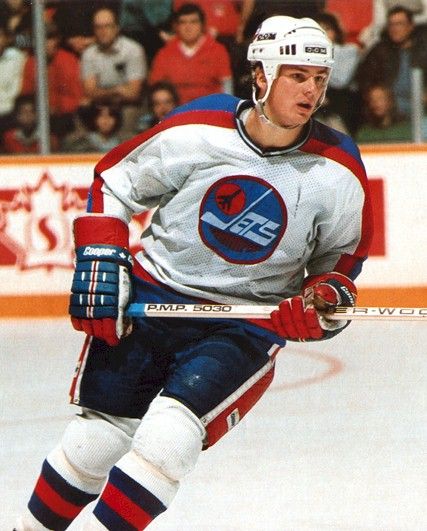
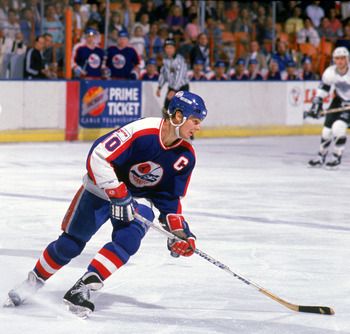
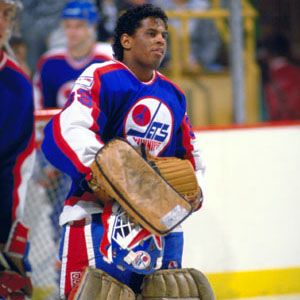
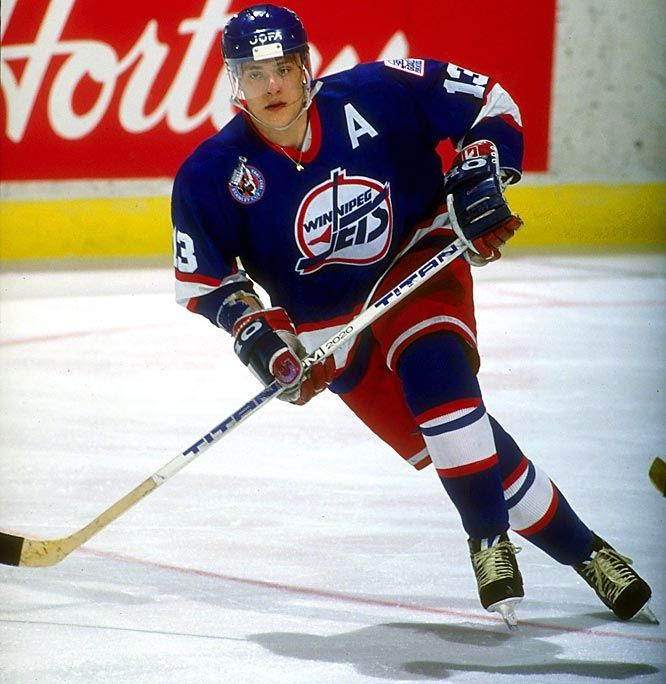
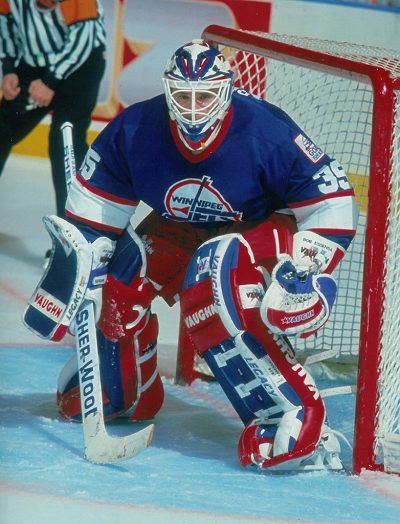
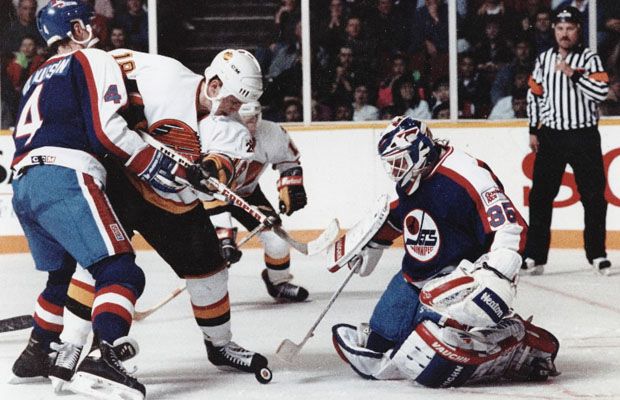
It's hard to believe, but today marks the day that saw the Jets leave Winnipeg and move to Phoenix, Arizona some fifteen years ago. While Winnipeg's name gets tossed around every time someone mentions a franchise with financial issues, it's still hard to believe that the Jets left fifteen years ago today. It honestly feels a lot longer to me, but maybe that's because I swore off the NHL for a year or two before she pulled me back in. However, fifteen years it is, and that's why I'm here today with a special article that someone has written.

I'd like to intorduce Jamil Karim, a writer for a local publication in downtown Vancouver, British Columbia called Good News Weekly. It was his email that reminded of this day, and his article is brief, but memorable. With Mr. Karim's article, I began to reflect on some of the players who suited up for the Winnipeg Jets.

  • The first superstar that Winnipeg got to know was Dale Hawerchuk. "Ducky" was a great scorer, and still is fondly remembered in Winnipeg for his scoring prowess and leadership.
  • Following in the great nickname trend, Eldon "Pokey" Reddick was always a fan favorite. The goaltender was a journeyman for most of his career, but had some memorable seasons with the Winnipeg Jets.
  • Teemu Selanne will always be remembered in Winnipeg. The "Finnish Flash" set the rookie record for goals and points in Winnipeg, and was always available for one more photograph with fans and one more autograph. Truly one of the most memorable Jets.
  • The man who assisted on more of Selanne's goals than any other player during Selanne's record-setting season was defenceman Phil Housley. Housley was a fantastic player while with the Jets, and really turned in some excellent numbers on an offensively-challenged team.
  • Another solid Winnipeg Jet defenceman was Teppo Numminen. Teppo was never the stand-out offensive star, but he always seemed to chip in and rarely took a shift off in the defensive zone. He was a mainstay on the Jets' blueline.
  • Tim Cheveldae will always be remembered when he arrived in Winnipeg. Unfortunately, his numbers led him out of Winnipeg as "Chevy" couldn't recreate the magic he had in Detroit.
  • Bob Essensa was so close to being a standout goaltender in the old Smythe Division, but he always seemed to be overshadowed by Fuhr, Ranford, McLean, and Vernon. Essensa was a pretty good goaltender, and really provided solid goaltending for the Jets.
  • We can't forget about where the "Bulin Wall" got his start. Nikolai Khabibulin was one of the Mike Smith-era Russian picks that actually worked out for the Jets. The other 100 or so Russian players selected by Smith really did nothing.
  • Keith Tkachuk was a very good power forward while in Winnipeg, even if his salary demands were a little ridiculous. Either way, when he put his mind to it, Tkachuk was one of the best at what he did so well - scoring goals.
  • Thomas Steen was the consummate professional, and always gave 100% while on the ice. The man deserves a statue in Winnipeg for the work he did and the positive promotion he gave the team and its players.
  • Tie Domi was the enforcer that Winnipeg needed during Selanne's magical rookie season, and the fans instantly took to the pugilistic professional. Domi's partner-in-crime would actually have a bigger effect on the team because...
  • Kris King would come to Winnipeg in the same trade that brought Domi to the Jets, and King would eventually become the captain of the Jets. King was an excellent leader, and he always got the troops to rally when they were at their lowest.
  • Who can forget about Randy Carlyle? The man left everything he had on the ice for the Jets, and then returned to Winnipeg to coach the AHL's Manitoba Moose. Again, an absolute professional in whatever endeavour he takes on.
  • I always thought Mike Eagles was a lunchbox type of player, but he was the one guy who didn't seem to mind the dirty work. If only all the players had his hustle and drive.
  • Another lunchbox guy was captain Troy Murray. Murray came over from Chicago, and instantly showed what the term "work ethic" means. Nothing that a little sweat energy can't cure.
  • Winnipeg has a Pepsi bottling plant in town, so it was always nice to see the team supporting a local company. From left to right, that's Tim Watters, Dale Hawerchuk, Laurie Boschman, and Scott Arniel enjoying a cold 7Up.

Fifteen years ago, the Jets left town. Hard to believe it's only been that short of a time, but, thanks to Mr. Karim, we get to relive a little history through videos and pictures.

Until next time, keep your sticks on the ice!

Wednesday, September 22, 2010

There is a lot that can be said for those who can accurately predict the future. While some prefer to read the fairly-generic horoscope each day in the local newspaper, others seek out mediums who may be able to catch a glimpse of the future. I am no cliarvoyant whatsoever, and all predictions I make are worth the money you pay for access to this site (E5). You'd be better off not listening to me, but HBIC will provide you with one man's vision of the 2010-11 NHL season. HBIC is proud to bring back Justin St. Louis with his predictions for this upcoming hockey season.

We met Justin last week when he took a look at five records that may never be broken. Justin and I are co-workers, and he's a devoted hockey fanatic. He has a miniture Stanley Cup on his desk, he never misses a minute of playoff hockey, and he even runs his own hockey pool! Details on that one below, but here's Justin with his look at the ten biggest questions of the 2010-11 NHL season.

Want to hibernate for the winter? Don't want to watch 1230 NHL games plus playoffs? Want to know what happens in advance? I have all the information here for you. I have peaked into the crystal ball and here it what it says will happen in the 2010-11 NHL season. Warning: best used when betting with someone else's money!

1. Will a Canadian team win the Stanley Cup?

No. Vancouver is the closest team this year but as has been the case since Montreal in 1993, Stanley will elude home soil again.

2. Which team will win the President's trophy?

Safe bet - Washington. They return the core group of players and have all the firepower of the US military. Ovie, Backstrom, Green lead the offence. There will be lots of shoot-outs this season in DC as the Caps go into the season with two unproven goaltenders. Hard to not see them as the class of the NHL again this year.
Mild bet - Vancouver. Lots to like with this group of players led by Hart trophy winner (and soon to be captain) Hank Sedin. Brother Daniel, Ryan Kesler, Alex Burrows and Bobby Lou in goal. Suspect defence could be the downfall.
Wildcard - LA Kings. Solid young team on the way up.

3. Who will win the Art Ross?

Safe bet - Sidney Crosby, Alexander Ovechkin.
Mild bet - Henrik or Daniel Sedin.
Wildcard - Ilya Kovalchuk.

4. Will the Blackhawks repeat?

No. They will be a good team but it takes so much to even get to the Stanley Cup tournament, much less win the sixteen games required to hoist the hardest trophy to win in sports.

5. Will the Winter Classic be "classic"?

Yes. Sid vs Ovie? Check. Backstrom vs Malkin? Check. Green vs Letang? Check. This has all the makings of a great day at Heinz Field.

6. What about the Leafs?

Safe bet - They will suck.
Medium bet - They will improve their standing from last season, but still miss the playoffs.
Wildcard - They make the playoffs.. barely. Even if they do, they are not Montreal and they will bow out in the first round.

7. Will the Jets return to Winnipeg be a headline this season?

Yes. There is a building and an ownership group in place backed by the richest man in Canada. This will happen prior to the start of next season. Whether it will be the Coyotes remains to be seen. If not there are other teams on the bubble right now - hello Atlanta?

8. Will the Nordiques return to Quebec City before 2011-12?

No. Even with the support to build a $400 million sports complex, the city is not ready to support the return... yet.

9. Where will NHL attendance be this year?

The league will tell you that it is up; the highlights will tell you that it is down. In this recession era I am not sure how teams like Atlanta, Nashville, Tampa Bay, or Florida will survive. Actually they won't - they will move. Eventually.

10. Does anyone else know that Sean Avery has his own website?

Seriously... www.seanavery.com.

West Playoff Seeds
1. Chicago
2. Vancouver
3. LA Kings
4. Detroit
5. San Jose
6. St. Louis
7. Phoenix
8. Calgary

East Playoffs Seeds
1. Washington
2. Pittsburgh
3. Boston
4. New Jersey
5. Ottawa
6. Buffalo
7. Philadelphia
8. NY Rangers

Conference Finals - Washington vs Pittsburgh; Vancouver vs San Jose
Stanley Cup Champion in 2010/11 - San Jose Sharks

There you have it - all you have to do now is sit back and watch.

For those that are interested, I have created a Fantasy league for hockey through Yahoo Sports. I made it as easy as possible and used their default rules. The first eleven teams entered there get in, and it is head-to-head for the season and set to auto-draft. Let's put the skills to the test, readers. This will only be open for readers of this blog so you don't have to worry about any ringers... in theory. Follow this link!

BRING IT!!


Great article, Justin, and some very good questions and answers! Thanks for the preview of some of the major stories of this season, as well as your predictions for the playoffs. We'll examine those at the end of the upcoming season to see how well your crystal ball sees the future!

I can't see Detroit finishing below Chicago this season, but I do feel that those two teams will be neck-and-neck for most of the season as they battle for the Central Division title. I think Buffalo will finish higher than Ottawa unless Alex Kovalev has a magical season. If he does, I see Ottawa finishing as high as fourth. My guess is that Ottawa finishes seventh, though, and matches up with Pittsburgh in the first round again.

As always, all predictions are guaranteed or your money back, kids! Settle in, and let's see how this season plays out!

Until next time, keep your sticks on the ice!

Wednesday, September 8, 2010

Having finally arrived in Houston, Texas on Monday night, I've spent the last few days just trying to stay cool. The heat combined with the high humidity makes the environment like a sauna as Sage C. said in the comments a couple of days ago. What strikes me as interesting is that Houston, for the size of the city it is, could very well be an NHL city. However, the similarities to Winnipeg, a former NHL city, are not that far off in terms of its hockey history. Both cities had WHA teams that were bitter rivals, both cities had IHL teams that were bitter rivals, and both teams have AHL teams that are bitter rivals. What makes this story great is that Houston still has a very strong hockey following despite their teams being shuffled through several professional leagues, and this passion of Houston's fans have made Houston a very attractive city for professional leagues.

We'll start with hockey's start in Houston way back in 1972. The WHA had awarded a franchise to Dayton, Ohio, and the Dayton Arrows were to begin play in 1972. However, owner Paul Deneau was less than thrilled with Dayton's lack of enthusiasm for a pro team combined with its lack of a suitable professional arena, so Deneau didn't waste any time in moving the franchise to Houston, Texas.

In retrospect, this might have been the best relocation in the history of hockey in terms of success for both the team and the owner. The newly-moved Houston Aeros would be a cornerstone for the WHA in terms of its success in the early going, and the team would be one of the most successful teams in the rogue league.

In 1972, the puck dropped for the Aeros as they were part of the six-team Western Division of the WHA's inaugural season. They would battle their way to second-place in the division on the strength of a 39-35-4 record. Gord Labossiere led the team in goals and scoring with 36 goals and 60 assists. Don McLeod and Wayne Rutledge nearly split the games, but Rutledge had the better record with a 20-14-2 mark and a 3.05 GAA compared to McLeod's 19-20-1 record and 3.56 GAA.

In the playoffs in 1972-73, the Aeros squared off against the Los Angeles Sharks. It took six games, but the Aeros advanced to the semi-finals against the Winnipeg Jets who had finished first in the Western Division. Winnipeg decimated the Aeros in the series, sweeping them out of the playoffs on their way to the WHA Final. While the first season for the Aeros didn't result in a parade, there would be big news made in coming seasons.

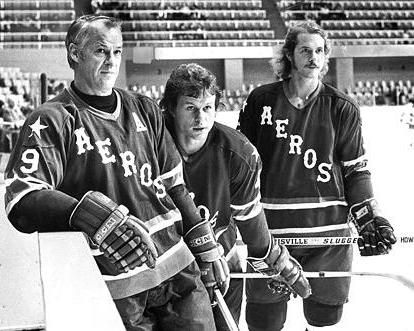
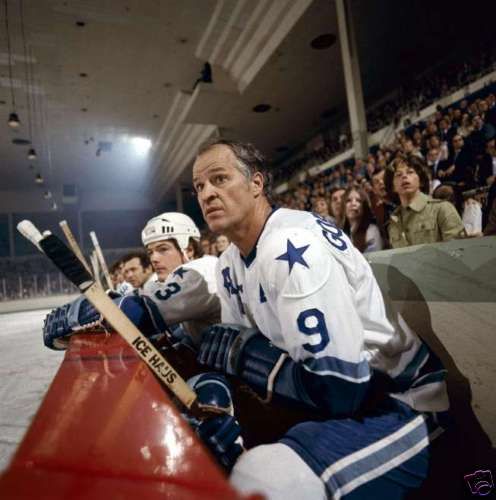
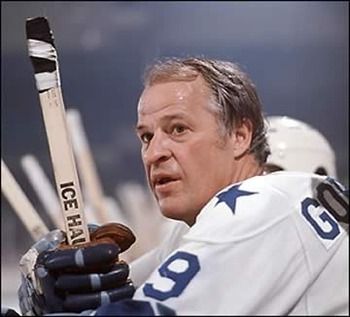
In the off-season of 1973, the Aeros decided to make a major player signing. They discussed the possibility of 45 year-old Gordie Howe, who had retired in 1971, of playing with his sons, Mark and Marty, in Houston. The elder Howe liked this idea, and he signed on to play with the Aeros for the 1973-74 season. It marked the first time that a father-sons combination had played together on the same ice in professional hockey.

The results were encouraging for the Aeros. Gordie Howe scored 31 goals and added 69 assists for a 100-point season, and the Aeros finished first in the Western Division and as the top team in the WHA with a 48-25-5 record. They matched up against the Winnipeg Jets in the first round, and handily swept the Jets aside in four games. They met up with the Minnesota Fighting Saints in the semi-final, and they were victorious in six games to advance to the WHA Avco Cup Championship.

There, they ran into an upstart Chicago Cougars club that had finished fourth-place in the Eastern Conference, and the Aeros proved they were the real deal. They hammered the Cougars in four games, outscoring them 22-9 in the series, and captured their first Avco Cup! Houston had its first professional hockey championship a mere two years after getting a pro hockey franchise!

Gordie Howe was named the winner of the Gary L. Davidson Trophy as the WHA MVP in 1973-74, and he would prove that the Aeros' success in that season was no fluke. His son, Mark Howe, was named the Lou Kaplan Trophy winner as the WHA's rookie of the year. Goaltender Don McLeod was named the winner of the Ben Hatskin Trophy as the WHA's best goaltender. 1973-74 was a great year for the Houston Aeros franchise!

1974-75 saw the Aeros roll over the WHA, posting the league's best record at 53-25-0 as they ended up first in the Western Conference again. Gordie Howe nearly duplicated his previous season as he scored 34 goals and added 65 helpers. But it was in the playoffs where the Aeros march to dominance really continued.

The top-ranked Aeros eliminated the eighth-ranked Cleveland Crusaders in five games. After dismantling the Crusaders, they trounced the San Diego Mariners in a four-game sweep in the semi-finals to give them a berth in the Avco Cup Championship to defend their title. However, there wasn't much defending as they tore through the Quebec Nordiques in a four-game sweep. The Aeros had captured their second consecutive WHA Championship, becoming the first WHA team to do so!

While there were less accolades for the players of the Aeros this season, Ron Grahame, seen here with the Bruins, did win the Ben Hatskin Trophy for leading the WHA in wins, shutouts and goals against average, as well as being named the WHA Playoff MVP after losing only one game on the way to another championship celebration. As a side note, Ron Grahame is the father of former NHL goaltender John Grahame!

The 1975-76 season was more of the same dominance as the Aeros plowed through the WHA's new 80-game schedule with a 53-27-0 record. The finished first in the Western Division, and tied with Winnipeg for the most points. However, Houston finished with one more regular-season win that Winnipeg, and were once again considered the top seed in the WHA. Gordie Howe was the model of consistency again, recording 32 goals and adding 70 assists in 78 games that season.

The WHA Playoffs saw the Aeros dispatch the San Diego Mariners in six games in the quarterfinals before eliminating the upstart New England Whalers in seven games. Whether the extra games took their toll or Houston simply wasn't as strong, the Winnipeg Jets ran over the Aeros in the Avco Cup Final in a four-game sweep. Disappointing to be sure, but the Aeros still had a lot in the tank.

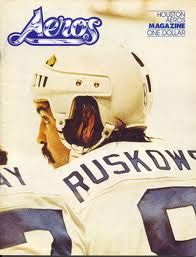
The 1976-77 season saw the Aeros dominate the WHA once more, posting a final record of 50-24-6. They were the top team in the Western Conference, and owned the best record in the WHA that season. Howe had a serious drop-off in production this season as he only appeared in 62 games, scoring 24 goals and 44 assists - the lowest totals in his WHA career. Terry Ruskowski led the team in scoring with 24 goals and 60 assists.

Houston rolled over the Edmonton Oilers in the WHA Quarter-Finals, beating them four games to one. In the semi-final, Winnipeg and Houston clashed once again, the two WHA rivals renewing their rivalry. Winnipeg won Game One on the road by a 4-3 score in overtime. From there, the home team won each game. Unfortunately, that means that Houston won Games Two and Five before their season came to an end at the hands of the Jets once more, this by a four-games-to-two margin. While there was disappointment over the Aeros' finish once more, there were much larger problems on the horizon.

Merger discussions were initiated in 1977 between the NHL and the WHA about moving the most successful teams into the NHL. The NHL, however, informed the WHA that they were not interested in expansion in 1977, and the conversation was laid to rest. The six most successful WHA teams - Winnipeg, Edmonton, Quebec, Cincinnati, New England, and Houston - decided to push the fact by applying to the NHL as a franchise, but the chatter died down with the approaching 1977-78 season after the NHL voted down the offer.

In Houston, the Howes were asked to defer some of their salaries as the team found itself in a financial crisis. The Howes balked at the offer, and the three men walked away from the Aeros. As free agents, they garnered offers from NHL and WHA teams, but it came down to two offers: the NHL's Boston Bruins and the WHA's New England Whalers. The Howes opted to stay in the WHA with New England thanks largely to the guarantees made by the Whalers franchise. As a result, Houston's biggest stars were now playing for the rival New England Whalers.

Without their stars, the Aeros struggled more than they had in the previous four seasons. They finished third overall in the one-division league with a 42-34-4 record. Andre Lacroix emerged from the shadows of the Howes, and posted 36 goals and 77 assists. He finished ahead of teammate Morris Lukowich by an incredible 38 points!

In the playoffs, they met up with the Quebec Nordiques, but it seems that the Aeros couldn't shake the playoff monkey off their backs. Despite finishing ahead of the fourth-place Nordiques, the Aeros fell in six games to Quebec. It maked the earliest exit from the playoffs for any WHA Aeros team, and April 23, 1978 marked the last game they played in Houston. The Aeros defeated the Nordiques 5-2 that night before getting shellacked 11-2 in Quebec City on April 25 to close out the series.

In the off-season, the NHL was willing to listen to the WHA about a merger, but they would only accept four teams rather than the six teams that the WHA wanted to promote. One of the conditions of the merger was that the WHA wanted all three Canadian-based teams included in the merger, meaning that there was one spot remaining in the merger for New England, Cincinnati, and Houston. The NHL was very interested in the Hartford-New England franchise, meaning that the future looked bleek for both Cincinnati and Houston.

However, Aeros owner Kenneth Schnitzer wanted an NHL franchise and proposed that his team be accepted as an expansion franchise outside of the merger. If that was not an option for the NHL, Schnitzer proposed that he be allowed to purchase a current franchise and relocate it to Houston. The NHL declined both of these offers made by Schnitzer, and the Houston Aeros franchise ceased to exist beyond July 9, 1978.

Phew! That's quite the history right there in those seven seasons! Houston's hockey legacy would be cemented with Gordie Howe stories and Avco Cup Championships, but we're not done there. 1994 saw professional hockey return to Houston as the IHL moved into town! However, we'll embark on that leg of the flight tomorrow as we look at the modern Aeros and the history they are currently writing.

Until then, keep your sticks on the ice!

Sunday, September 5, 2010

It's funny to think that the DeVos family thought they could move the Kansas City Blades five hours down I-35 to Oklahoma City at the turn of the millenium. I mean, essentially all they were going to do was add the letter "O" to the KC Blades' logo, and all was good. However, hockey in Oklahoma City remained strong thanks to the unwillingness of the CHL's Oklahoma City Blazers to pull up their roots, and there will be a higher level of hockey played in OKC with the AHL's Barons opening their season on October 9 in the city. Hockey in Oklahoma City has always been strong as long as it has remained a part of this community, and tonight HBIC will look at the Blazers and the Barons in terms of their success within the state of Oklahoma.

The founding of the new-look Blazers in 1992 coincided with the refounding of the Central Hockey League. However, there was a previous incarnation of the Blazers that played in the CHL, and the older Oklahoma City Blazers is where we'll start.

The Blazers started in 1965 in Oklahoma City as a farm team for the Boston Bruins. They were originally founded in Minneapolis as the Minneapolis Bruins in 1963, but the Bruins shifted them south to Oklahoma City in 1965.

The founding of the Central Hockey League in 1963 was done by the Original Six NHL teams as they needed a replacement for the folded Eastern Professional Hockey League. From that, five teams emerged: the Minneapolis Bruins (Boston), the Indianapolis Capitals (Detroit), the Omaha Knights (Montreal), the St. Louis Braves (Chicago), and the St. Paul Rangers (New York). Only Toronto didn't add a team in 1963, but they joined via the Tulsa Oilers in 1964 to compete with the other teams.

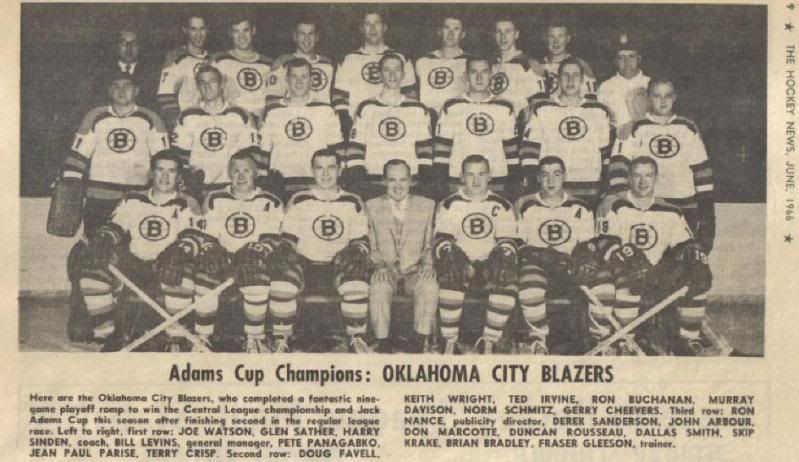
The Blazers were an extremely popular team in the CHL thanks to the Bruins stocking th lineup with up-and-coming stars. Bruins legend Harry Sinden was the first coach of the Blazers, and many well-known players came through the system: Bernie Parent, Reggie Leach, Gerry Cheevers, Doug Favell, Wayne Cashman, and JP Parise to name a few.

The Blazers finished in second-place in 1965-66 with a 31-26-13 record. They played in the 8832-seat Fairgrounds Arena, and routinely had crowds over 8000 fans. They played fairly conservatively in 1965-66, and that style really paid off in the CHL Playoffs. In their first season in Oklahoma City, the Blazers captured the Adams Cup! They were led in scoring by Rudy "Pete" Panagabko who scored 21 goals and added 42 assists in 70 games. Phil "Skip" Krake led the team in goals with 24 that season, and Gerry Cheevers was the starting goaltender.

The following season, the Blazers improved on their standing with a 38-23-9 record, and ended up first overall in the six-team CHL. The Blazers powered through the playoffs to capture their second consecutive Adams Cup, becoming the first team to do so in the CHL! Former NHL head coach Terry Crisp led the team in scoring in 1966-67 with 31 goals and 42 assists in 69 games. Ron Buchanan played in a mere 56 games, but still led the Blazers in goals with 34 on the campaign. Doug Favell and Gerry Cheevers were the starters on most nights, but Oklahoma City hockey fans got their first glimpses of a young Bernie Parent in net that season. Other notable names on the Blazers' roster that season included Wayne Cashman, Jean Provonost, Glen Sather, JP Parise, Dick Cherry (Don Cherry's younger brother), Derek Sanderson, and Ted Irvine. Quite the assembly of talented players there!

While the Blazers woul never capture the Adams Cup again, they did advance to the finals twice more. Their affiliation with the Boston Bruins came to an end in 1971-72, leaving them without a parent team to stock their lineup. However, they returned in 1973-74 after the Toronto Maple Leafs revived the affiliation. Through the Leafs, Oklahoma City fans got to see players such as Mike Palmateer and Dave "Tiger" Williams. The success that they had with the Bruins, however, would not follow in their affiliation with the Leafs, but they did lose in the finals once and got bounced in the semi-finals twice in their three seasons with the Leafs at the helm.

From 1977 through to 1982, the team would be affiliated with the WHA's Houston Aeros, the NHL's Minnesota North Stars, and the NHL's Calgary Flames, but the Blazers would not advance past the CHL quarter-finals. Due to rising salaries and increased costs, the CHL folded in 1982 when three of its teams closed its doors, including the Oklahoma City Blazers.

With the CHL being re-incarnated in 1992, the league quickly founded a franchise in Oklahoma City as a way to capitalize on the history and intrigue that hockey once had in the city. Bill Levins and Ray Miron decided that central ownership would be the best way to guarantee that the league succeeds in the early going, and they founded teams in six cities: the Oklahoma City Blazers, the Tulsa Oilers, the Wichita Thunder, the Memphis RiverKings, the Dallas Freeze, and the Fort Worth Fire. By keeping the league in a relatively small geographical range, they could control costs and keep the teams and league profitable.

Thanks to a very good team, the new Blazers drew 8000 fans regularly to games, and were one of the most successful minor-pro franchises in hockey. In 17 seasons, they missed the CHL Playoffs once three times, and only finished with a losing record once. Head coach Doug Sauter had a nearly rockstar following for his coaching record as he did for his facial hair. Twice, the Blazers brought home the CHL Championship, and the Blazers set an unprecendented CHL record of finishing first overall seven consecutive seasons. Not bad, eh?

In 1995-96, it took all seven games, but the Blazers knocked off the San Antonio Iguanas to win the CHL Championship. Goaltender Jean-Ian Filiatrault was spectacular through the season, going 30-7-2 in the regular season before leading his team to the championship. Filiatrault was named CHL MVP in the playoffs. George Dupont led the team in scoring through the regular season, picking up 28 goals and adding an astounding 83 assists while racking up 274 PIMs! Basically, if he wasn't scoring, he was sitting in the penalty box! Joe Burton led the team in goal-scoring with 66 markers, while Doug Lawrence led the team with an amazing 346 PIMs.

The Blazers returned to glory in 2000-01 when they needed just five games to dispose of the Columbus Cottonmouths in the CHL Final. The Blazers went 48-19-0-3 during the season, led by their goaltending once again. Rod Branch started 41 games, and finished with a 26-12-2 record, a 2.50 GAA, a .913 save percentage, and three shutouts. He was named as the Playoff MVP after leading the Blazers back to glory!The video below shows Branch wearing #67 between the pipes:

While the Blazers were certainly a success story on and off the ice for the CHL, there were problems behind the scenes as the Blazers and Oklahoma City were battling over arena lease costs. Oklahoma City, it seems, was interested in upgrading to an AHL franchise while Blazers simply wanted to exist.

According to Robert Przybylo of NewsOK.com, "[t]he Blazers did not renew their lease with the Ford Center after months of negotiations. According to city documents, the city and SMG were going to grant the Blazers a three-year renewal, but the Blazers have retracted the deal."

While it sounds like the team and the city were amicable, you had to wonder how much the lease was going to cost when Blazers assistant general manager Josh Evans stated, "It is not economically feasible for us to go on at this point".

With the end of the Blazers' run in Oklahoma City after seventeen years, they leave the CHL with a few records. Joe Burton and Hardy Sauter are the CHL's first and third all-time career leading scorers, respectively, and Burton is the fourth leading goal-scorer in minor-league hockey history. Burton is now managing an ice rink near his home, while Sauter is the head coach for the Idaho Steelheads. Pretty impressive, but a let-down for hockey fans as a team with considerable history is sent into hockey purgatory.

On October 9, we'll see a new chapter of Oklahoma City hockey being written as the Edmonton Oilers move their AHL affiliate into town, and the Oklahoma City Barons begin play. While it seems as though the Oilers' cupboards are bare, there is hope that the Barons will be competitive as the Oilers have already signed Alexandre Giroux and could send Jordan Eberle to the team. Here's hoping that the Barons get off to a good start to bring back the hockey enthusiasm in OKC!

Until next time, keep your sticks on the ice!

Saturday, September 4, 2010

Unknowingly as I dressed this morning for another day of travels on the open road through the United States of America, I happened to don the t-shirt sporting the logo of the defunct Colorado Rockies. My travels took me to Kansas City today where I am writing this article. How do those two things relate? Well, a gentleman approached me in my restaurant of choice, and informed me that the team I was wearing once played in Kansas City. While I let him regale me with the tales of how the Scouts moved to Denver to become Rockies before moving to East Rutherford, New Jersey to become the Devils, I realized that there have been various levels of pro hockey through Kansas City. And some teams actually did much better than the NHL team that once called this city home.

We'll start with the NHL era in Kansas City.

Kansas City was awarded a franchise in the last wave of NHL expansion to try to curb the WHA's growth. Along with Kansas City, a franchise was awarded to Washington, DC to begin play in 1974. June 8, 1972 was the day that the NHL came knocking on Kansas City's door, and Kemper Arena was built to house both the Scouts and the NBA's Kansas City Kings. The Scouts would eventually play in the Smythe Division as the NHL expanded to four divisions in 1974 when both Washington and Kansas City began play.

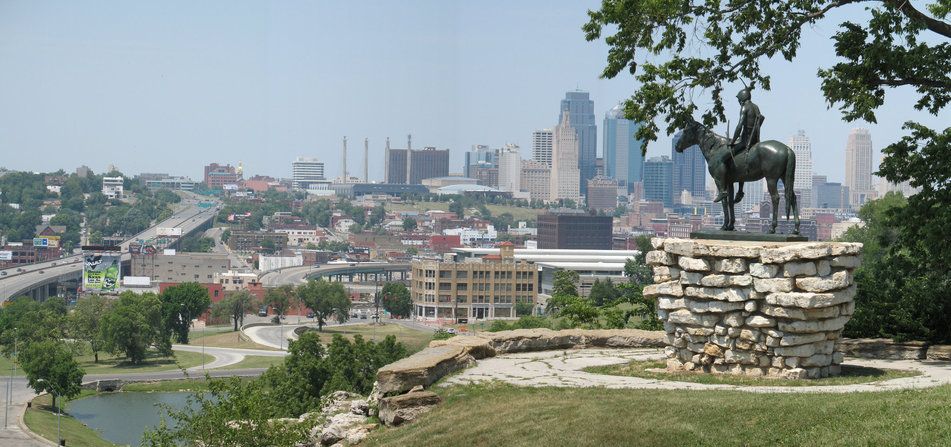
The team was originally going to be called the Mohawks - "Mo" from the Missouri postal abbreviation, and "Hawks" from Kansas' affinity to JayHawks. The Chicago Blackhawks put a stop to that name, stating that there was too much similarity between their name and the new Kansas City team name. Instead, the team chose "Scouts" in honour of the scout statue that overlooks the city. The logo reflected the statue as well, and it was nice to see hockey trying to honour the Native American peoples from this area once again.

This is where the good news ended for the Scouts franchise. The 1974-75 season ended in disappointment as there was little talent to draw from considering there were 32 NHL and WHA teams. The Scouts finished the season with a 15-54-11 record, good for fifth-place in the Smythe Division, but out of the playoffs. Wilf Paiement was a rookie for the Scouts in 1974-75, and he'd go on to have a solid NHL career. Captain Simon Nolet was named to the Campbell Conference All-Star Team, and head coach Bep Guidolin was called upon to coach the Wales Conference All-Star Team.

For as bad as their first season was, the Scouts were worse in their second season of existence. After starting the season respectably, the Scouts found themselves one point out of a playoff spot at Christmas. And then the wheels came off. And there was a fiery crash and burn. And nothing remained that was salvageable.

The Scouts went winless in sixteen games from December 30, 1975 until February 4, 1976 before defeating the Washington Capitals on Feburary 7. They then pulled off the nearly-impossible by going winless in their next twenty-seven games. All in all, the Scouts managed to go 1-35-8 in their final forty-four games to post a pitiful record of 12-56-12. Just one of the Scouts players and staff - Wilf Paiement - was called upon for the NHL All-Star Game, an indication of just how bad it was in 1975-76.

While both the Capitals and Scouts were pitiful excuses for professional hockey teams in their early goings, the Scouts also had problems drawing fans to their new 17,000-seat arena. They were averaging only about 8200 fans per game, and rising salaries were making the Scouts' bottom line look less and less appeaing. The 37 owners of the team decided to go on a massive season ticket campaign, but it only drew 2000 people to purchase season ducats. All said, they decided to sell the team to save their financial interests.

In two seasons in the NHL, the Scouts posted a record of 27-110-23 in 160 NHL games - hardly what NHL dreams are made of. They finished dead last in the Smythe Division both years, and twice had the second overall pick in the NHL Entry Draft. Wilf Paiement was their choice in 1974, and Barry Dean was the only other draft choice made by the Kansas City Scouts.

While the citizens and hockey fans of Kansas City would have to wait a few years for another hockey franchise to arrive, the IHL granted a franchise to the city in 1990, and it turned out to be a fairly successful run for Kansas City.

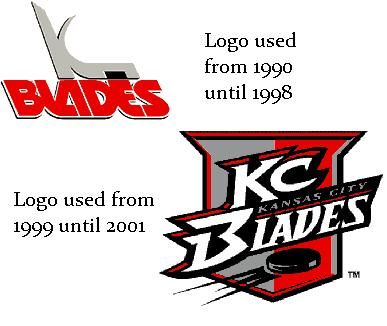
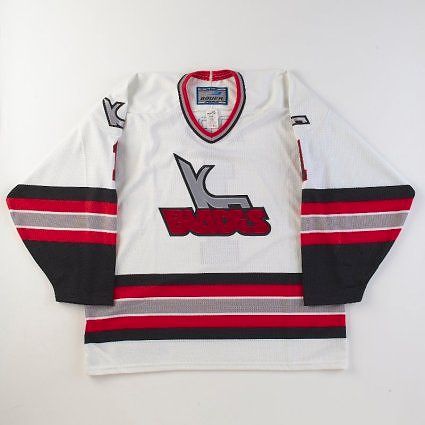
The suspended franchise of the Toledo Blades was purchased and moved to Kansas City by Russ and Diane Ross. While a "Name the Team" contest was held and ultimately chose the new team name as "Jazz", the Rosses rejected the name since there was already a "Jazz" team in Utah. The second most-popular choice was the Blades, and the Rosses stuck with that name. Thus, the Kansas City Blades were born!

In 1991, the Blades struck a deal with the San Jose Sharks to be their primary minor-league affiliate, and the Sharks would regularly stock the Blades with their up-and-coming players. This influx of talent into the Blades' lineup proved successful as the Blades went on to capture the 1991-92 Turner Cup under the tutelage of former NHL head coach Kevin Constantine. While the Blades would fall short in coming seasons, the 1991-92 team is still the only hockey franchise to bring back a championship on the ice to Kansas City.

Through pressure from the NHL to have its franchises align themselves with AHL teams as their primary affilates, the Blades and Sharks parted ways. During this same time, the Rosses decided to sell the team to the DeVos family. The DeVos clan also owned stakes in the Grand Rapids Griffins and the Orlando Solar Bears in the IHL, and a few owners felt that the DeVos family might be bordering on "conflict of interest". In 2001, the DeVos famly was involved with four of the eleven IHL teams!

The DeVos family didn't market themselves very well amongst the Blades' longtime fans. Changes were constant, and none seemed to bring back fans to Kemper Arena. After several seasons of losing money, the DeVos family looked at relocating the team to Oklahoma City which only further killed their popularity in Kansas City.

The move to Oklahoma City was blocked after the owners of the CHL's Oklahoma City Blazers refused to abandon their stake in Oklahoma City, and the IHL and the DeVos family could not reach an agreement with the Blazers. Once the news of relocation hit the news, the DeVos family was mercilessly booed at every appearance in Kansas City.

The Blades signed a deal with the Vancouver Canucks for two years at the start of the 2000-01 season to be their primary affiliate. Unfortunately for both teams, the IHL decided to fold due to rising costs, and the affiliation was cut short by one year. The Blades, like the Scouts, found themselves in limbo.

The teams from the IHL were considered in terms of joining the AHL, but AHL regulations stipulate that one owner can have a stake in only one team. The DeVos family, having interests in four teams, decided to promote their most successful team in the Grand Rapids Griffins, cutting loose the three other teams they were controlling: the Orlando Solar Bears, the Cleveland Lumberjacks, and the Kansas City Blades. Again, the people of Kansas City were screwed by the DeVos family.

While there was a Kansas City Outlaws team that played in the UHL, their history is about as long as the Scouts' history was. They didn't last long, and didn't come close to any sort of success. On April 15, 2005, the team suspended operations and folded. In one season in the UHL, the Outlaws posted a record of 28-45-7.

So there is a little history on Kansas City's modern hockey ventures. I'm not about to speculate on whether the city can support an NHL franchise, but they do have a shiny, new arena that is looking for a full-time tenant, and they were in talks with the Penguins about moving there when Pittsburgh was battling for a new arena.

What I do know is that it seems the people of Kansas City have been sold short a few times. If the Blades are any indication, hockey can work in Kansas City. Perhaps an AHL team would be a better fit?

Until next time, keep your sticks on the ice!

Sunday, August 15, 2010

As you're aware, I love hockey history. There are countless stories that have gone down in history that have been forgotten where today's hockey culture could learn a lot. I'm not sure why the NHL fails to recognize the efforts put forth by a number of players in the WHA, but it is what it is at the Hockey Hall of Fame, and I'll leave it at that. The stories that come out of that league about the way things were done behind the scenes, though, are close to being stories presented by Rod Serling on The Twilight Zone. Today is one such story, and it was reported in Sports Illustrated on May 28, 1979 by Reyn Davis. Enjoy the article, and I'll pick up some of the interesting points below.
  • "Joanne Hull was screaming at her husband: 'Why would you ever want to live in Winnipeg and play for that fat Jew?'" Wow. I'm not sure how many players' wives would negotiate with their husbands that way today, but Joanne Hull made it clear that she was not happy about Bobby Hull's dealings with Ben Hatskin.
  • "[I]t will live again next season when New England, Edmonton, Winnipeg and Quebec—the four hearty survivors of the 32 teams that at one time or another belonged to the "other" league—join the NHL". I'll be honest when I say that I didn't know that there were 32 franchises that once played in the WHA. And here we sit today with the NHL at 30 franchises and "struggling". Deja vu, anyone? More on this below.
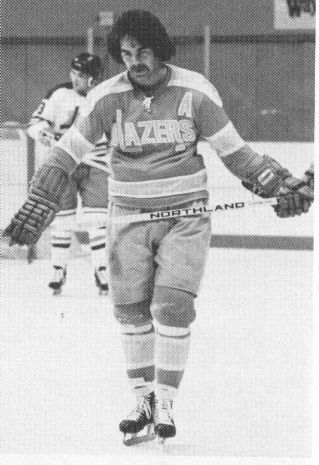
  • "Lured from the Boston Bruins by a $2.7 million contract with the Philadelphia Blazers, Sanderson played just six games for Philly before he became persona non grata because of his frequent disappearances". Sanderson was thought to be a big-time player in the same mold as Hull, but it seemed as though he didn't care about hockey in the least.
  • "One team had four names—New York Raiders, New York Golden Blades, New Jersey Knights and San Diego Mariners. Norm Ferguson was the captain and player representative of all four clubs. 'I remember the day I signed with the Raiders,' Ferguson says. 'It was April Fools' Day of 1972.'" 'Nuff said there, I suppose.
  • "When the Golden Blades couldn't meet their second payroll in 1973, the franchise was placed in receivership by the league and whisked off to Cherry Hill, N.J., just a step ahead of the bailiff." You are reading that correctly - the Golden Blades lasted exactly one two-week pay period before relocating. Ouch.
  • "There were no showers in the visiting team's dressing room, so the opposition had to dress at the Holiday Inn two miles up the road." This is in regards to the Cherry Hill Arena that the New Jersey Knights played in. No showers? That's inexcusable.
  • "Five Crusaders had their cars stolen out of the parking lot at the Arena, Wayne Muloin and Tom Edur both losing new Thunderbirds on the same night. Steve Thomas, the Crusaders' trainer, who often had to work at the Arena late at night, was mugged three times one winter." Who would want to see hockey in Cleveland with that kind of track record? Forget taking your kids to the game!
  • "A good travel agent was as valuable as a 40-goal scorer." The WHA travel schedule was simply brutal compared to the NHL of today. Because most WHA franchises were in "outposts" compared to their NHL brethren, the comment above proved true.
  • "[T]hose Jets are the last professional team to have beaten the Soviet National team". Those Jets are the 1977-78 Jets, regarded as perhaps the best team to have ever played in the WHA. Bobby Hull, Lars-Erik Sjoberg, Ulf Nilsson, and Anders Hedberg brought fans to their feet every time they were on the ice.
To put this in perspective, only four teams survived the NHL-WHA merger, if you can call it that: the Winnipeg Jets, the Edmonton Oilers, the New England Whalers, and the Quebec Nordiques. Those that didn't survive include "the New York Raiders, the New York Golden Blades, the New Jersey Knights, the San Diego Mariners, the Houston Aeros, the Philadelphia Blazers, the Vancouver Blazers, the Alberta Oilers, the Calgary Cowboys, the Minnesota Fighting Saints, the Chicago Cougars, the Denver Spurs, the Ottawa Civics, the Ottawa Nationals, the Toronto Toros, the Los Angeles Sharks, the Michigan Stags, the Baltimore Blades, the Cleveland Crusaders, the Minnesota New Fighting Saints, the Phoenix Roadrunners, the Cincinnati Stingers, the Birmingham Bulls, the Indianapolis Racers—plus the Calgary Broncos and the Miami Screaming Eagles, who never got on the ice, and San Francisco and Dayton, which were not around long enough even to get nicknames."

That's a pretty extensive list of teams that met their ultimate demise, considering that the WHA only existed from 1972 until 1979. As seen above, the New York Golden Blades only lasted two weeks before moving to New Jersey, while the Ottawa Civics only lasted one game before moving to Denver to become the Denver Spurs.

All in all, the WHA was a pretty crazy era in hockey, and it's full of great history. Thanks to Sports Illustrated's vault, we get to read about it and relive the insanity a little more.

Until next time, keep your sticks on the ice!

Tuesday, August 10, 2010

With the upcoming 2010-11 hockey season right around the corner, we're going to start seeing some teams debut their fashion ideas for the new season. The NHL, of course, has shown off some new threads for the upcoming Heritage Classic in Calgary, so it's no surprise that some AHL teams are also getting themselves ready for a new look this winter. We have two teams that have moved, so we'll take a quick peek at their new logos and fashions, and one well-established franchise decided to go in a different direction with their road uniforms.

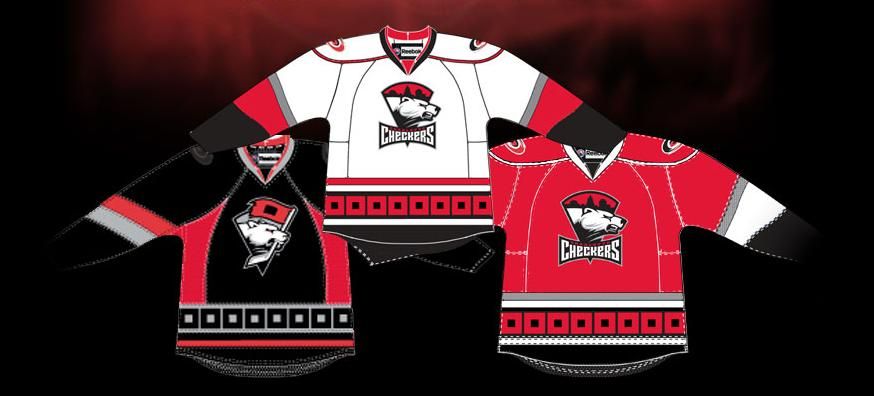
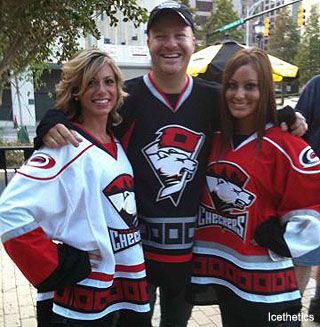
We'll start with the Charlotte Checkers. The AHL affiliate of the Carolina Hurricanes moves closer to home as they leave Albany, New York for Charlotte, North Carolina. The Albany River Rats will be replaced by another team, though, and we'll check them out below.

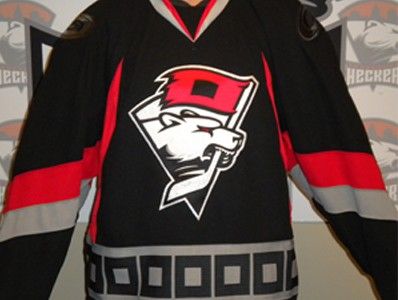
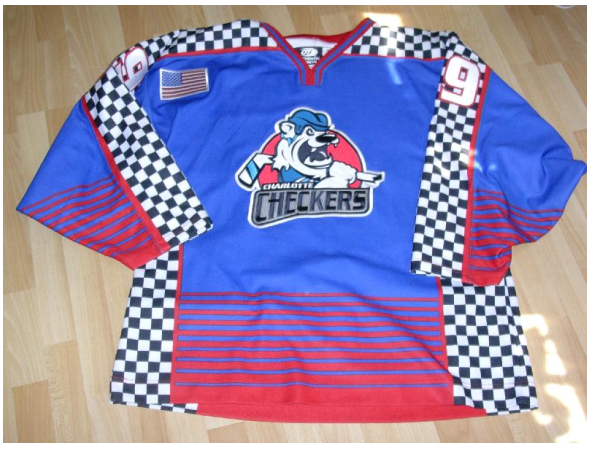
The jerseys that the Checkers will wear in their first season in the AHL look nearly similar to those of their parent Carolina Hurricanes. While the logo comes directly from the Charlotte' ECHL team - providing instant brand recognition within the Charlotte community - the jerseys are very Carolina-esque. The Checkers' logo is coloured to reflect the new affiliation with the Hurricanes, but the only major change that the Checkers made was to incorporate an alternate logo on the black alternate jersey. Otherwise, this is just a mash-up of the ECHL Checkers and the NHL Hurricanes.

The lack of creativity in this situation receives a thumbs-down. Minor-pro hockey gets a little slack for allowing creativity with their uniforms, but Charlotte brings no creativity or imagination to the table. And that's disappointing considering some of their more imaginative promotional jerseys in the past. The only good news? They don't have to change the logo on their home ice.

From Charlotte, we go back to Albany where the New Jersey Devils have returned home. Well, the minor-pro Devils have. After having established an agreement with the Lowell Lock Monsters in 1998, then establishing their own AHL team in the Lowell Devils in 2006 after the Rats came to terms with the Carolina Hurricanes to be their affiliate, the NHL Devils decided to move their AHL affiliate closer to home by transplanting the team in Albany, New York. As Albany lost their team to Charlotte, they gain back a very familiar group as the Albany Devils will begin play in 2010-11.

There isn't much to report from the jersey perspective except that the new logo will be featured on the front instead of the Lowell logo. Otherwise, there are no new jerseys as the Devils will continue to look like the NHL Devils, and the mandate from Lou Lamiorello is the same: no alternates.

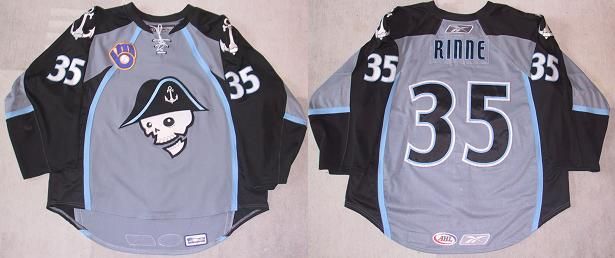
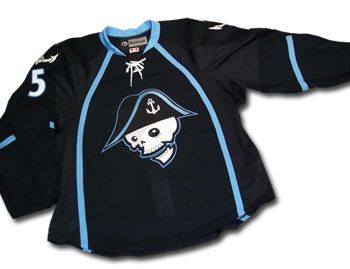
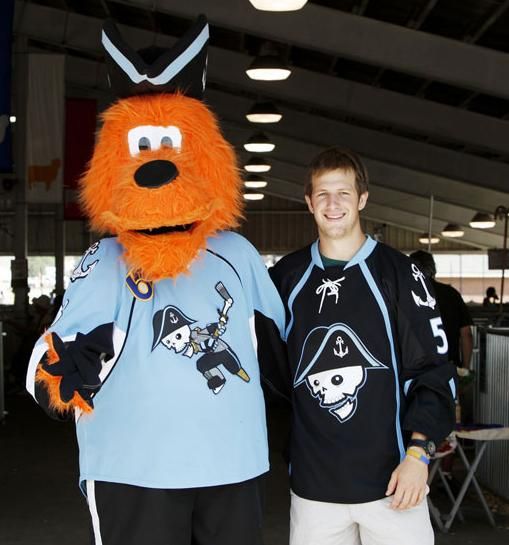
Lastly, we have a brand-new road jersey that will be worn by the Milwaukee Admirals this season. The Admirals, who wore gray last season on the road, will replace the somewhat-drab gray with black this season. You read that correctly: black.

As you may be aware, this writer has a serious issue with black hockey jerseys, specifically the number of teams that turn to black as a road or alternate colour. As much as I am aware of the Admirals' colour scheme containing black, they were quite unique with their road grays. The only saving grace this season is that they will still wear their baby blue alternates. Otherwise, thumbs-down to the black road jersey. It just isn't very creative.

There are your new looks for this season thus far. The AHL always sees some additional changes, so you never know what else may come about. The first Antler Banter report will be published in September once the Moose schedule is released, so look for it in the coming month!

Until next time, keep your sticks on the ice!

Saturday, August 7, 2010

Saturday will be a busy day for me. I have about a bazillion things on the go, but I still need to get this out. Saturday is "Funnies" day on HBIC, so these should tickle your funny bone a little bit while I'm out trying accomplish some stuff in my life. Also, please scroll to the end regarding prizes for the remaining people in the HBIC Hockey Pool. I have prizes assigned to everyone except one person, and I'll list my mailing dates. There are a bunch of packages sitting in my car right now that will be going out in the mail this week, so I'll update everyone. It's tough work being as busy as a bee!

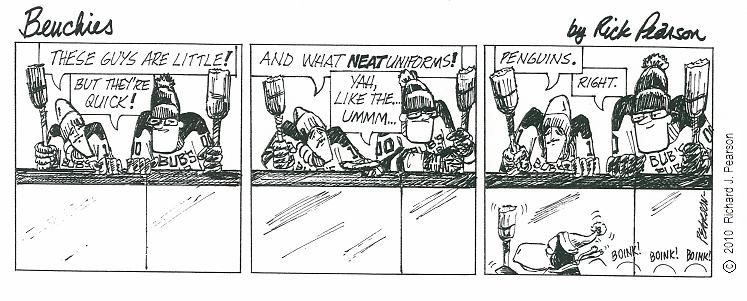
Benchies is a comic strip produced by Rick Pearson. Mick and Mike find themselves in all sorts of humorous situations, and hockey is just one of those situations where crazy things happen to the guys! You can find more of Mr. Pearson's Benchies every weekend on Uni Watch Blog where Mick and Mike get up to all sorts of hijinks!

Here is your Benchies for August 7, and Mick and Mike discover that sometimes a team can play for the logo on the front of their uniforms... kinda. And the boys are playing broomball!

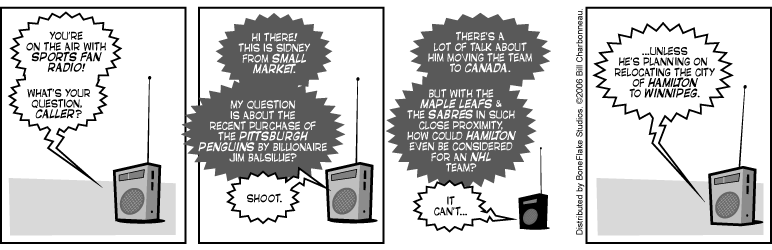
Small Market Sports is a comic strip produced by Bill Charbonneau where his cast of characters are always up to something. There's Carter (the baseball), Doug (the football), Dave (the sports radio), Nash (the basketball), and Wayne (the hockey puck). Named after the Great One, Wayne Gretzky, Wayne the puck is "a hot-tempered and slightly egotistical 'super-star' (in his own mind, anyway). As the ambassador to his sport, he is quick to defend the unrelenting jabs about the excessive violence that permeates his hockey. Even if he has to drop his gloves and knock some teeth in to do it." Mr. Charbonneau produces a new comic every Monday, Wednesday, and Friday about these characters, and you can find them on Small Market Sports!

Here is a Small Market Sports comic strip for August 7, and Dave takes calls regarding Jim Balsillie's plan to buy the Pittsburgh Penguins.


MAIL SERVICE: I will be sending out all the packages that have yet to be mailed by this Friday to all the recipients who have yet to receive their prizes. Some people have asked about shipping costs, and I want to say that there is absolutely no cost to you whatsoever. If I didn't want to run this contest for free, I wouldn't have. Therefore, the total cost to acquire and ship these prizes in my responsibility, and the total cost to you if you are a prize-winner is nil. Zilch. Zero. That being said, I hope the people who have received their prizes are happy with them thus far, and the next wave of packages to go out should take about 10-14 days to arrive. That means you should have your prize by the last week of August. Good?

Alright, I'm off again. Real-life calls.

Until next time, keep your sticks on the ice!

Thursday, July 8, 2010

It's Thursday, and there aren't a lot of major hockey stories that are dominating the headlines today. There's some basketball player who was holding a press conference to announce he signed a contract to play somewhere, but who really cares about basketball? There are more important things going on in the world of sports than some player making a mockery of his sport and league, so let's get off that island. We've got player news, uniform news, and a Russian who is all about the money, but has yet to show up when it really matters. We'll kick it off with that story. Let's go!
  • The Los Angeles Kings' saga of being in and out of the Ilya Kovalchuk sweepstakes sees the team out of the running again after they rejected agent Jay Grossman's counter-offer to the contract proposed by the Kings. Here's a quick tip for both Grossman and Kovalchuk: win something, and then ask for more money. Kovalchuk has yet to advance past the first round of the Stanley Cup Playoffs, yet he's asking for Gretzky/Lemieux money. Personally, I wouldn't pay it.
  • The Vancouver Canucks make a couple of appearances today, but we'll start with the retirement talk. A third banner will be raised to the rafters at the newly-named Rogers Arena this year as the Canucks have announced that Markus Naslund's #19 will be retired. Naslund captained the Canucks from 2000-2008, and is the franchise's leading scorer. Naslund was a major player in community initiatives, so this will be special for the city of Vancouver and Naslund himself. He joins former captains Stan Smyl and Trevor Linden as the only men to have their number retired by the Canucks, and the ceremony will go down on December 11, 2010.
  • The arena that the Canucks call home got itself a new name after General Motors decided to not renew their naming rights for this upcoming season. GM Place, affectionately known as "the Garage", will now be called Rogers Arena as the telecom giant puts its name on another sports facility. Rogers has the rights to the name on the Vancouver arena for the next ten years. GM, in their defence, will remain as a major sponsor inside the building as they push the Chevrolet brand.
  • The Canucks also showed off their 40th Anniversary throwback jerseys, complete with patch! Lots to like on this jersey: monsterous logo, 1970s-style captaincy letters, the "V" on the sleeve stripes, no names on the back of the jersey, and great hockey stripes. The hates? That damned Reebok logo, the curved hems at the bottom of the jersey, and tapered collar into the NHL shield logo. Look, I get the sponsorship angle in terms of having Reebok design these uniforms, but a throwback should "throw back" to the actual uniform. Overall, though, a very good design, and one I can endorse.
  • In the continuing TSN series that looks at the four Canadian municipalities that are on the NHL's radar for possible expansion or relocation, Winnipeg is tops of the three cities seen right now. Winnipeg's overall mark of "B" ranked them ahead of Hamilton, who scored a "D+", and Toronto, who scored a "D-". Quebec City goes tomorrow, but with no NHL-suitable arena at their disposal, it appears Winnipeg may be the best Canadian choice for the NHL by the standards set out in this study.
  • The Nashville Predators have their new captain after having dealt Jason Arnott to the New Jersey Devils. Defenceman Shea Weber has been annointed the new captain, and becomes the fifth captain in team history and the first captain that had been drafted by the Predators. Kudos to Weber as he is one of the best young defencemen in the NHL!
  • Montreal Canadiens defenceman PK Subban added some hardware to his mantle today as he was awarded the AHL's President's Award in recognition of his outstanding accomplishments for this past season. I've seen this kid play, and he is an outstanding skater with a knack for being in the right place at the right time. He was a first team AHL All-Star this year as well as being part of the AHL All-Rookie team, and he showed amazing talent all season long. A very deserving award for a highly-skilled player!
  • The rest of the AHL's award winners can be found on this page. Congratulations go out to Howard Dolgan of the Syracuse Crunch, Tom Mitchell of the Binghamton Senators, linesman David Butova, and the Chicago Wolves for their award wins!
  • The Hershey Bears went back to the future in bringing back defenceman Lawrence Nycholat for the 2010-11 AHL season. Nycholat spent last season with the Manitoba Moose where he suited up for 37 games due to injury. Nycholat won the 2006 Calder Cup with the Bears, and put up career highs with 13 goals and 57 points. As long as he remains healthy, this signing can make the already-dangerous Hershey Bears a whole lot scarier.
  • Lastly, the requests for comic strips has gone out, and we have a number of responses. On Saturday, I'll post the first-ever HBIC Funnies Page that will feature at least three hockey-related comic strips as well as blurbs about the strips and links to where you can read more. If you know of anyone else who wants their comic strips featured - professional artists or amateur doodlers are welcome - please put them in contact with me!
I'm doing a pile of coaching tomorrow, but I'll have some pretty cool stuff coming up this weekend. Make sure you hit this site up on both days as I plan to make both pretty memorable.

Until next time, keep your sticks on the ice!

Tuesday, July 6, 2010

I'm quite fond of the work that TSN has been putting in over the years in regards to their hockey coverage and hockey telecasts. They have picked up some impressive talent to further their efforts, and the overall product has improved exponentially in the last decade. Tonight, however, I'd like to spend a little time looking at their most recent project brought to light thanks to journalist Dave Naylor and his yeoman's work in asking "Why Not Canada". Mr. Naylor, with TSN as the delivery method, looks at the four Canadian locations that have been linked with NHL franchise relocation in the last decade, and the first city he tackled in this project is Winnipeg, Manitoba.

As you're probably aware, the True North Sports and Entertainment Group has expressed their interest in owning an NHL franchise, and NHL Commissioner Gary Bettman has stated that Winnipeg is an attractive choice should an NHL franchise became available for relocation. While it's far from being a "done deal", it appears that the work that Mark Chipman has done in Winnipeg has once again made the central Canadian city a possibility for the top hockey league on the planet.

Professor Norm O'Reilly, a highly-respected intellectual who taught at Stanford before moving to the University of Ottawa, ranked Winnipeg in several key categories that he deemed are vitally important in the viability of an NHL franchise. And, to be honest, I'm pretty impressed with Professor O'Reilly's candid and honest look at Winnipeg.

Here are Professor O'Reilly's rankings for Market Attractiveness:
  • Economy: B-
  • Demographics: C
  • Market size: C
  • Corporate presence: C+
Overall Score for Market Attractiveness: C+

Wow. Someone finally has the fortitude to actually put the pieces together for the rest of the country to read. Let's work through these categories with my takes.

Economy: The Winnipeg economy isn't bad, but it just isn't good. It's a coupon-clipping, penny-pinching town, and that's a great trait to have when trying to curb inflation and rising prices. It's not such a good thing to have when the MTS Centre will need to be filled to 90% capacity each and every night. People will spend money to see the NHL, but it's a tough sell for most middle-class families for forty-one games.

Demographics: Winnipeg doesn't have a sprawling community outside of its borders it can draw from, so the 700,000 people that live in Winnipeg will need to step up to make it happen.

The key demographic of persons aged 24-39 occupies approximately 19.7% of Winnipeg's population, but this number should come with an asterisk. The population in Winnipeg is aging rapidly, and the number of senior citizens is outgrowing the birth rate. The only reason Winnipeg's growth increases is due to immigration, and that's where the focus of the marketing will need to be directed in terms of attracting new hockey fans.

Market Size: Winnipeg is Canada's seventh-largest municipality in Canada, but it is limited by the fact that there's no Golden Horseshoe nearby like there is in Hamilton or Toronto. Again, the 700,000 people in Winnipeg will literally have to support this team. There won't be many who drive hours in a Manitoba winter from out of town for all forty-one home games.

Corporate Presence: While I feel that a lot of small companies were slighted by this ranking, it is very true that there are not a lot of global companies who call Winnipeg home. However, as Mr. Chipman stated, "We're very satisfied that there is a large and strong enough corporate base. The fact that we have all of our suites sold. We've got a waiting list of about 50. The size of the community is such you can get a real good sense of the corporate communities desire and appetite for a team."

While it might be true that there are a number of suites that are currently shared by two or more companies, this is true in other markets as well. Sure, the large markets sell their suites with no trouble, but there has to be some credit given to the businesses that are making the Manitoba Moose successful. The price tag may go up, but it appears the businesses in Manitoba are in the game for the long haul. Of course, the price tag determines who will buy in every scenario, and some of these smaller businesses may just determine that a suite is not worth it. Only time will tell how the supply and demand will pan out.

My view? The overall C+ rating might be a little low, but it's nearly on the mark. Again, I would have bumped up the corporate support mark a little, but I think Professor O'Reilly is pretty close to being correct in all his Stats Canada views.

Here are Professor O'Reilly's rankings for Franchise Viability:
  • Arena and Location: B+
  • Competition and Barriers to Entry: A
  • Potential Owner (Mark Chipman, David Thomson): A
Arena and Location: The downtown MTS Centre is a gorgeous facility that was ranked as the 39th-best venue on the planet in 2009. While the seating is just a shade over 15,000 for hockey, the arena is warm and intimate, and has successfully hosted a number of world-class hockey events since being built. It is certainly NHL-calibre on looks alone, but the seating would make it the smallest building in the NHL.

The location of the arena downtown has worked to revitalize the downtown area in Winnipeg, but the city has a long way to go to make the MTS Centre the "jewel" of the downtown area. Parking is always a sore spot with Winnipeggers, and that can't be overlooked.

Competition and Barriers to Entry: Zero. Winnipeg currently is home to the Manitoba Moose, and the Moose are owned by True North Sports and Entertainment. If that group was to acquire an NHL franchise, they would unload the Moose to a new city. Unlike Toronto, two hockey teams wouldn't work in Winnipeg, so the smaller crowd-drawing Moose would likely be sent packing.

Potential Owner: There is no denying that the Chipman-Thomson team would be a powerhouse in terms of its ownership group. The Manitoba Moose are consistently one of the best teams in the NHL in terms of earning the greenbacks, and it's no secret that David Thomson is Canada's richest man. However, both men are astute businessmen, and neither will be happy if crates of red ink are being delivered to the MTS Centre.

Winnipeg's Final Grade: B

A very fair grade, and one that should hit home for Winnipeggers. While a grade of "B" is nothing to be disappointed about, it also says that there is still work to be done if Winnipeg wants to join the country club again. When looking at the other three cities - Hamilton, Quebec City, and Toronto - Winnipeg will probably feel like the inferior little brother to these other cities.

I'm here to say that the NHL is definitely on the radar for Winnipeg, and that Winnipeg is certainly in the minds of the suits that sit at the NHL Offices. There is still a lot of work to do to make Winnipeg a better NHL market, but there's no doubt that the important factors - an NHL-suitable arena, viable ownership, and a hockey-mad fanbase - are definitely in place in Winnipeg.

Some of you who have been reading this blog for a while might seem surprised at this turn of face by me. As you may be aware, I have been beating the drum for a long time that Winnipeg is NOT an NHL city. After having learned a great deal about the negotiations that have gone on behind closed doors between the NHL and True North Sports and Entertainment, I'm simply saying that Mark Chipman and David Thomson are very serious about putting an NHL team into Winnipeg.

Because they are excellent and wise businessmen, though, there is nothing in place with the NHL that states that the Manitoba capital will be the first landing spot for a homeless NHL franchise. Chipman and Thomson will continue to do their research and due diligence in order to make the right decision for their business needs.

How many times can you say that about prospective NHL owners over the last twenty years? If nothing else, it's this business acumen that should have the NHL Board of Governors excited at the prospects of having Winnipeg back in the league. After all, it's not everyday you find a legitimate billionaire and one of Winnipeg's best businessmen willing to buy into your club. And all of this can be yours if the price is right.

Then it's up to Winnipeg to make sure that the team remains viable and profitable, and that's the biggest question mark in this entire equation.

Winnipeg back in the NHL? Possible, but it's going to take a lot of work. Then again, you don't get something for nothing, and that's an adage that all Winnipeg NHL fans should live by.

Until next time, keep your sticks on the ice!

Tuesday, June 1, 2010

If you've been reading this blog for some time now, you know that I'm a pretty big fan of the Quebec Nordiques. A lot of that is due to their gorgeous uniforms, and I'll maintain until I'm in the grave that they are the only NHL team that can wear that shade of blue and not be questioned for it. While the Nordiques never experienced the thrill of raising the Stanley Cup, they do have one WHA Avco Cup, won in 1977, to their name, and they had a number of excellent players roll through Quebec City: Joe Sakic, Guy Lafleur, Peter Stastny, and Peter Forsberg to name just a few.

You may also note, if you're a frequent reader, that I'm a sucker for hockey history. While the game has long been a mainstay in Canada, there's a lot of history that has either been left in the past or simply forgotten over time. In the case of the WHA, the NHL doesn't even recognize that it existed, let alone survived for seven years in competition with the NHL. Because of the NHL's unwillingness to recognize anything WHA, most of the WHA's history has been left behind.

Thanks to the National Film Board of Canada, we get to mesh two of my favorite things together today. Pierre Letarte, a French Canadian filmmaker, captured the Quebec Nordiques before their first WHA game in the history of their franchise in 1972in his film called "Just Another Job". There are some notable people that you see, but one of the most famous faces is the Nordiques' first head coach. That man is Maurice "The Rocket" Richard. Quebec would play against the Cleveland Crusaders in Ohio in their first WHA game, and we get to see the moments leading up to that historic first game.

The film is just over 27 minutes long, but I cannot tell you how much I enjoyed it. It's really worth the time, so, if you're reading this at work, watch it when you get home. I can't stress how good it is. Enjoy, and I'll continue after the film!
I'll admit that the intro in the movie is a little campy, but it's very 1970s. All in all, the story of the Nordiques is actually quite interesting.

The franchise was originally awarded to a group in San Francisco, and the team was named the "Sharks". Prior to opening the season, the group's funding fell apart, and the franchise was quickly sold to a group of six Quebec City-based businessmen, the same men who owned the highly successful Quebec Remparts junior franchise. One of those men, Paul Racine, spoke in the film as the President of the Quebec Nordiques.

Some things I noticed in the film? Check the forearm protection offered by the old gloves. The players didn't have to worry about a slash on the forearm because their gloves extended all the way to their elbows.

During the player's interview at the nine-minute mark, you can clearly see smoke rising in front of the camera. I believe that would be Maurice Richard's cigarette burning in an ashtray on the desk as he sat on the right side of the camera. That's right: smoking was still pretty accepted everywhere those days, and even more so in Francophone society.

The first game action seen is against the Philadelphia Blazers in their yellow-and-orange uniforms. That was from the WHA preseason. The strange part is that both teams are in their road uniforms. The Blazers wore yellow at home, while the Nordiques wore white at home. Colour-on-colour in hockey? Hardly heard of back in those times.
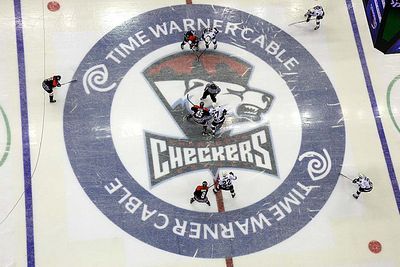
I loved the interview with the young man who designed the logo and uniforms. Honestly, the blue-and-dark-blue colour combo would have looked fantastic in my opinion, but the franchise wanted red. Once the Nordiques joined the NHL, eventually the only red would be seen on the logo.

Catch the numbers on the sides of the skates? That seemed to happen a lot in hockey in the 1970s. Why? I assume it was for the equipment manager to ensure that everyone's skates remained in pairs. Or for the players when they came to retrieve them.

Jean-Claude Tremblay, shown standing on the blueline and receiving a standing ovation, would be Quebec's most dynamic player in the 1972-73 season. Wearing number three and sporting the captain's "C", Tremblay would end up leading the Nordiques in scoring as a defenceman, putting up 89 points on the strength of 14 goals and a WHA-leading 75 assists.

Maurice Richard would surprisingly only coach two games, stepping down after leading his team to a win and a loss. Richard stated he wasn't comfortable as the coach, and resigned just two weeks into the WHA season, as stated in the film. Cleveland defeated the Nordiques by a 2-0 score on October 11, 1972 in the season-opener.

The Nordiques would get their first goal and win when they returned home for the home-opener against the Alberta Oilers on October 13. Normand Lacombe, a defensive defenceman, scored his first WHA goal, and went into the record books as the first player to score for the Quebec Nordiques. Quebec would go on to win their home-opener by a 6-0 score over the Oilers. Maurice Filion would be named head coach before their October 19 game against the New England Whalers.

Celebrating at the season's end wouldn't happen. The Nordiques missed the playoffs that first season, finishing with a 33-40-5 record for 71 points, three points back of the Ottawa Nationals for the fourth spot in the WHA's Eastern Division. Their fifth-place finish left the Nordiques on the sidelines as the playoffs began.

All in all, a very excellent look at one of the WHA's founding franchises. I really like the National Film Board of Canada's archives, and will bring more films to this blog as we progress through the summer months. This one, however, holds a special place on this blog.

There's nothing better than a night of hockey history.

Until next time, keep your sticks on the ice!