Showing posts with label World Championships. Show all posts

Tuesday, January 4, 2011

The World Under-17 Hockey Challenge wrapped up this evening in Winnipeg, Manitoba, and there was a ton of sensational hockey seen this week at the tournament. Goals, saves, hits, and drama were all part of the action over the last couple of weeks, and one team reigned supreme as Team Ontario downed Team USA at MTS Centre last night by a 5-3 score. The final was a great battle that saw Ontario jump out a lead and not look back, but the Americans made it interesting before an incredible penalty shot goal sealed the deal for Ontario.

First, we'll go to the goal. Mathew Campagna scored a goal that many Winnipeg Jets fans remember as "the Zhamnov". Of course, most people will associate it with Peter Forsberg, and that's fine too. There were probably players who pulled off this move many times before those two men began using it in the NHL. But Mathew Campagna of the OHL's Sudbury Wolves shows a whole lot of moxie on this penalty shot late in the third period of the gold medal game.
First off, the video is not mine. Someone graciously put it up on YouTube, and they are to thank for the video since TSN apparently won't allow its feed to be embedded on a website.

Secondly, the win by Ontario in a rematch of last year's finalists prevented the Americans from winning their second consecutive gold medal at the World U-17 Championships. Ontario went undefeated through the tournament, and was led by Sean Monahan of the Ottawa 67's. Monahan had two goals against the Americans, and also scored both goals in Team Ontario's 2-1 win over Team Quebec in the semi-final.

Thirdly, huge kudos go out to the 12,060 fans who saw the game at MTS Centre tonight as a new record was set for the gold medal game. This was a definite increase from the old record of 8,896 set at the 2008 World U-17 Challenge in London, Ontario. Winnipeg always seems to support Hockey Canada's endeavours, and this tournament saw Manitobans and Canadians come out in droves to support all of the Canadian teams in this tournament. Well done, Canada and Manitoba!

Most of these young men from across the eight teams will find themselves playing against each other at a higher level soon enough. Canada routinely has these players vying for World Junior Championship roster spots and World U-18 Championship roster spots. And, of course, some of the very good players will find themselves in the NHL one day.

Before that happens, these kids get to play some more hockey. They'll go back to their respective leagues and work towards an ultimate goal. However, Team Ontario can proudly display their gold medals as champions of the World U-17 Hockey Challenge!

Until next time, keep your sticks on the ice!

Thursday, December 30, 2010

Time certainly has flown this year as we're two days away from recycling those 2010 calendars hanging on walls and posted on desks. Hockey has seen some great things this year, and we've also lost some icons that made the sport much better with their presence. We've seen players emerge as superstars and we've seen superstars fall to below-average play. All of this is actually a statement about the game - it's fluid, and it's constantly changing and evolving through each shift, each game, and each season. Today, HBIC looks back on the first six months of the year, and the important stories that came from January to the end of June.

January Highlights
  • January 1: We start every year off right with the NHL's Winter Classic, and the January 1, 2010 game was certainly memorable as the Philadelphia Flyers visited the Boston Bruins in historic Fenway Park. What a great day of hockey!
  • January 2: Switzerland's World Junior Championship team pulls off a massive upset as they defeated Russia 3-2 to beat the Russians for the first time in history at the WJC.
  • January 5: The 2010 World Junior Championship is decided in overtime as American John Carlson ends Canada's streak with his goal to give Team USA the gold medal. Great game, and a very impressive showing by America's best young hockey talent.
  • January 21: If you've been following this blog, you know I'm a big fan of Frank McClelland's newest equipment invention. January 21 was the first time I was lucky enough to speak to Frank and bring to light what would eventually be his Skate Fenders product. A very interesting story to see how the plastic skate guards got started!
  • January 23: I arrive in Minneapolis for the US Pond Hockey Championships, and the weather was very un-winter for the tournament. Strange weather is nothing new on the prairies, but January is rarely a month known for rain. Great uniforms seen at the tournament, and a few great stories!
  • January 25: I express my disappointment with the NHL's stance on protecting its players after a major incident in the QMJHL.
  • January 29: I bring to light the story of Alton White, the first professional black hockey player to record 20 or more goals in a season as well as the first professional black hockey player to record a hat trick in a professional game. Since it happened in the WHA, no one seems to care that he doesn't get this recognition. But I do.
February Highlights
  • February 5: The hockey world stops for a few moments to grieve the loss of Brendan Burke, Brian Burke's son. Brendan worked as student manager for the hockey team while attending the University of Miami (Ohio), but made headlines when he announced to the world that he was a gay man. And I still believe in my words: "Being gay doesn't change who he is or how much respect I have for him. Nor should it change you."
  • February 13: Phil Hecken of Uni Watch Blog and I take a look at what each team will be wearing at the Olympics. Some uniforms are good. Others are not.
  • February 14: I discuss some of the ways that women's hockey at the Olympics can fix blowouts between the elite teams and the rest of the field. I still feel that getting more women involved from the other countries will make the game stronger.
  • February 21: Team USA plays a much more complete game in the round-robin at the Olympics and beats Canada soundly. I'm hard on Canada and praise the Americans. And this will only set up the inevitable.
  • February 28: The Goal. Need I say anything more? I take a look at the 2010 Winter Olympics as a whole, and celebrate "The Goal.
March Highlights
  • March 4: Frank McClelland returns with some updates on his Skate Fenders. I'm truly a fan of Mr. McClelland's and LSSU's work, and this product is something that players should really look into for their own health.
  • March 11: HBIC renews its commitment to the Vancouver Olympics by giving the sport of sledge hockey as much coverage as possible. I really like this sport, and there have been some excellent games as of late as a number of countries have improved in this sport.
  • March 18: One of the countries that has improved? Japan. They defeated the heavily-favoured Canadian squad by a 3-1 score in the semi-final to earn a berth in the gold medal final. If you haven't seen a game of sledge hockey in your life, you're missing out.
  • March 21: The 2010 Women's Frozen Four wrapped up in style as there were some incredible games played by the NCAA women. Congratulations go out to the University of Minnesota-Duluth Bulldogs who captured their fifth NCAA Championship!
  • March 30: The 2010 CIS Men's Hockey Championship wrapped up, and the Canadian collegiate champions are the Saint Mary's Huskies! Canadian collegiate hockey, while not as prolific as NCAA hockey, is certainly one of the places where NHL teams can find some hidden talent. There are lots of good players studying across Canada!
April Highlights

May Highlights
  • May 3: The KHL crowns a champion as Ak Bars Kazan won their second KHL Championship in consecutive seasons. While there are still major differences between the NHL and KHL, it appears that Kazan is becoming the "Detroit Red Wings" of the KHL.
  • May 7: I found a great article in Popular Science from 1935 about the game of hockey! It's a very good read with lots of pictures, but it goes to show that some magazines were covering hockey before it was popular!
  • May 14: A reader by the name of Chelsea sent me a great email about head trauma suffered by hockey players. She makes some excellent points in her email, and there are several NHL players who echo her sentiments.
  • May 23: The Czech Republic snaps the Russian's 27-game winning streak at the World Championships, and captured the World Championship title! Jaromir Jagr's reason for winning? "They had stars and we had guys who play in the Czech Republic, but this shows that talent doesn't matter - you have to work hard." Hard work, kids. I can't say it enough.
  • May 25: I still have no clue as to what happened to the Charlie Conacher Memorial Trophy that was awarded annually to an NHL player. Any ideas?
  • May 28: Damian Cox goes absolutely loopy with his suggestion that the Chicago Blackhawks change their logo because it's offensive. Cox stirring the pot? Nothing new.
June Highlights
So there are the highlights from the first six months of HBIC's 2010. I really had a great time writing this year, and the interactions with you, the readers, are what makes this so rewarding. I love reading other opinions and ideas, and I encourage you to continue to email, comment, friend me on Facebook, and whatever else you to do to send me your hockey thoughts.

More tomorrow as we review the year that was from July to December!

Until next time, keep your sticks on the ice!

Friday, November 19, 2010

We're back today with another round of images from the Classic Auctions website. I was very impressed by what the site had to offer last time on their current round of auctions, so I went back through the archives to see if I could find some more interesting stuff. Needless to say, the archives are a treasure chest of historical items and, of course, there are a ton of NHL sweaters and jerseys that should be examined for details. With that, we have another edition of the Classic Auctions images today as we look at a number of uniforms once more.
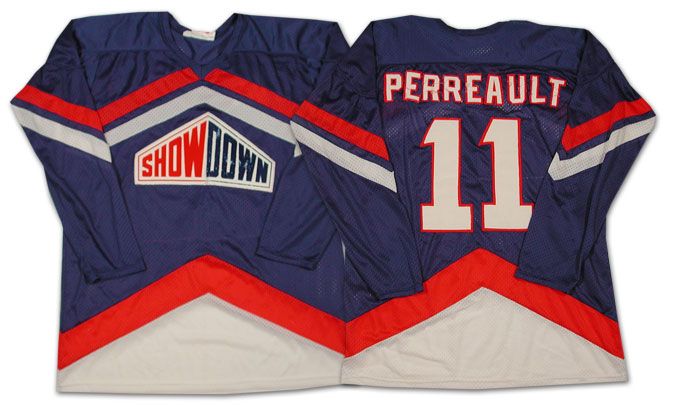
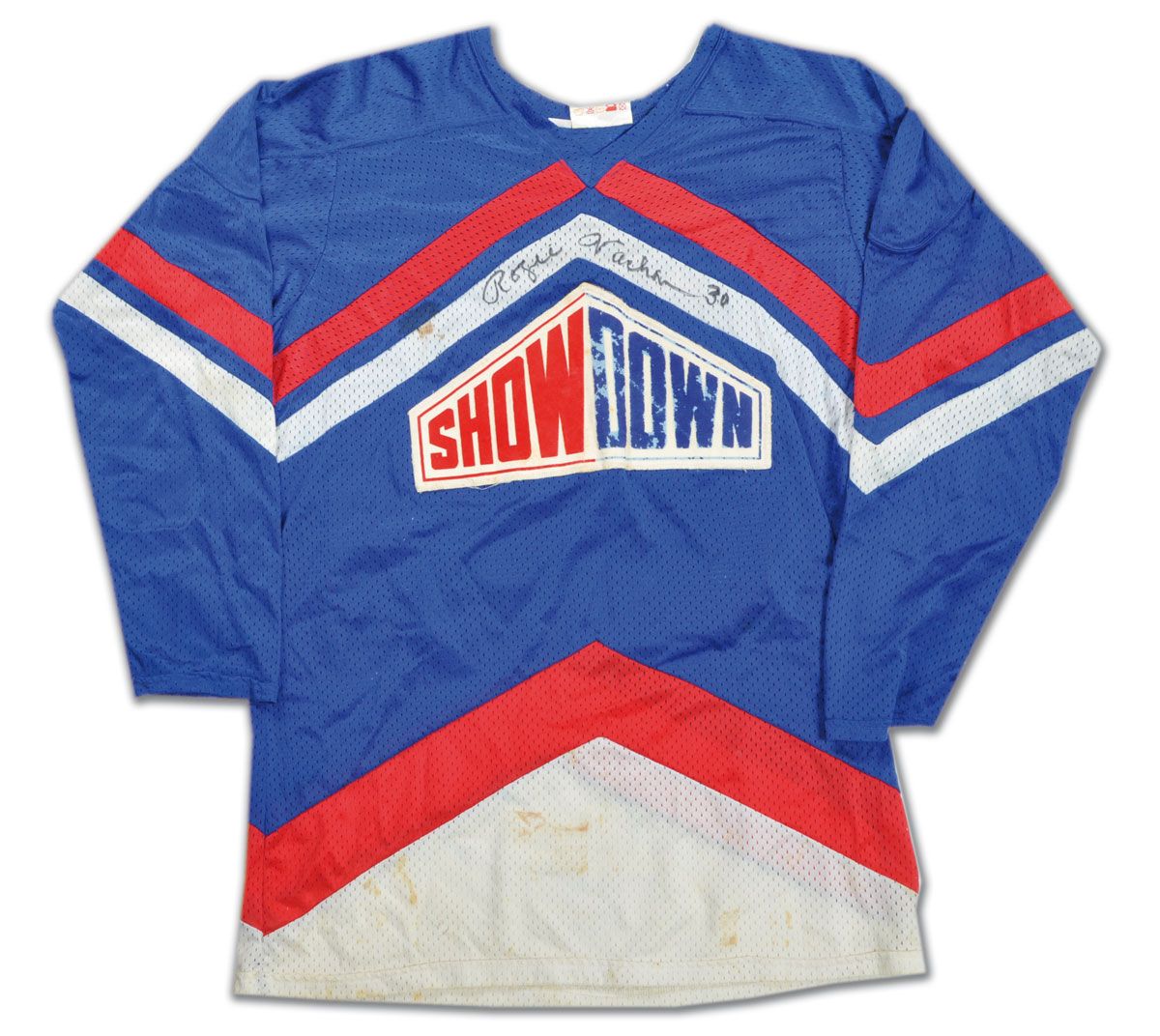
  • As we saw in the most recent set of Classic Auctions images, there was an NHL Showdown segment that used to air between periods that featured a few NHL stars that went head-to-head for cash and bragging rights. I've found more players who were a part of this now. It appears that Gilbert Perreault of the Buffalo Sabres participated for at least one season in the Showdown, and he wore a sweater similar to that of Rogie Vachon! Could they have been teammates in their respective Showdown?
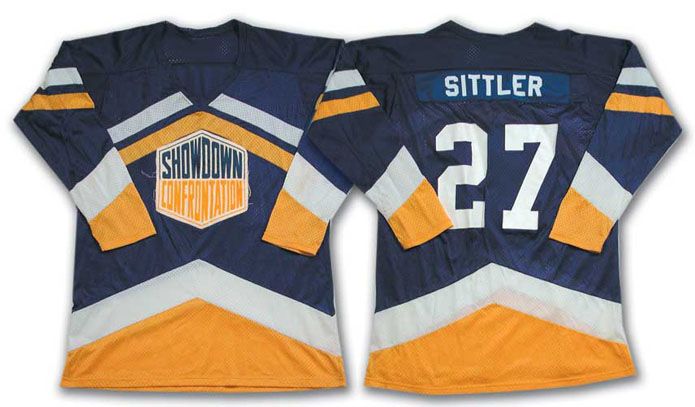
  • Another player who participated was Toronto's Darryl Sittler. However, his sweater is significantly different in terms of colours than those of Perreault and Vachon, so I'm guessing he played in the NHL Showdown in a different season.
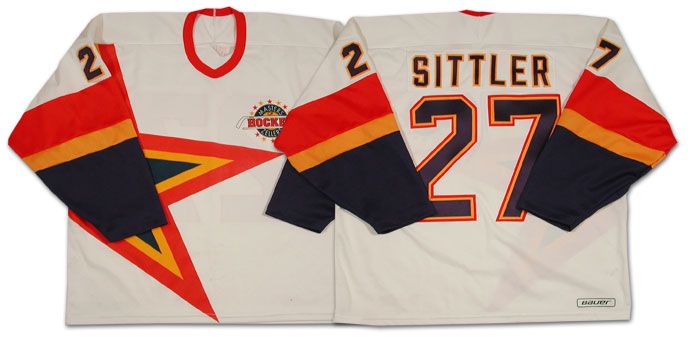
  • Another Darryl Sittler jersey that the Classic Auctions website had up for auction was a Sittler "Masters of Hockey" uniform. I've never seen or heard about this before, so I had to refer to the information on the website. "As part of an important Zellers promotion, Darryl Sittler, along with many other Oldtimers, participated in the 'Masters of Hockey' program. This white hockey [was] uniform produced by 'Hattem'". Nothing like an old promotional jersey for a department store promotion!
  • In the article about the New York Rangers' new alternate uniform, I had stated that there was precedence for the Rangers wearing "New York" diagonally on their uniforms thanks to their 9/11 tribute uniforms. However, there is even more precedence that shows the Rangers wearing "New York" for a much longer time on the road. Here is Bobby Carpenter's 1986-87 New York Rangers road uniform. Obviously, they wore these for at least one season, and, upon further research, they actually wore the "New York" road jerseys from 1978-1987. Lots of precedence!
  • I've rarely seen the patch worn, but there is no doubt that the Toronto Maple Leafs wore the King Clancy patch on their uniforms during the 1986-87 season. Thanks to the auction, we can now clearly see that the Leafs wore the King Clancy patch above the TV numbers on their sleeves on the road that season.
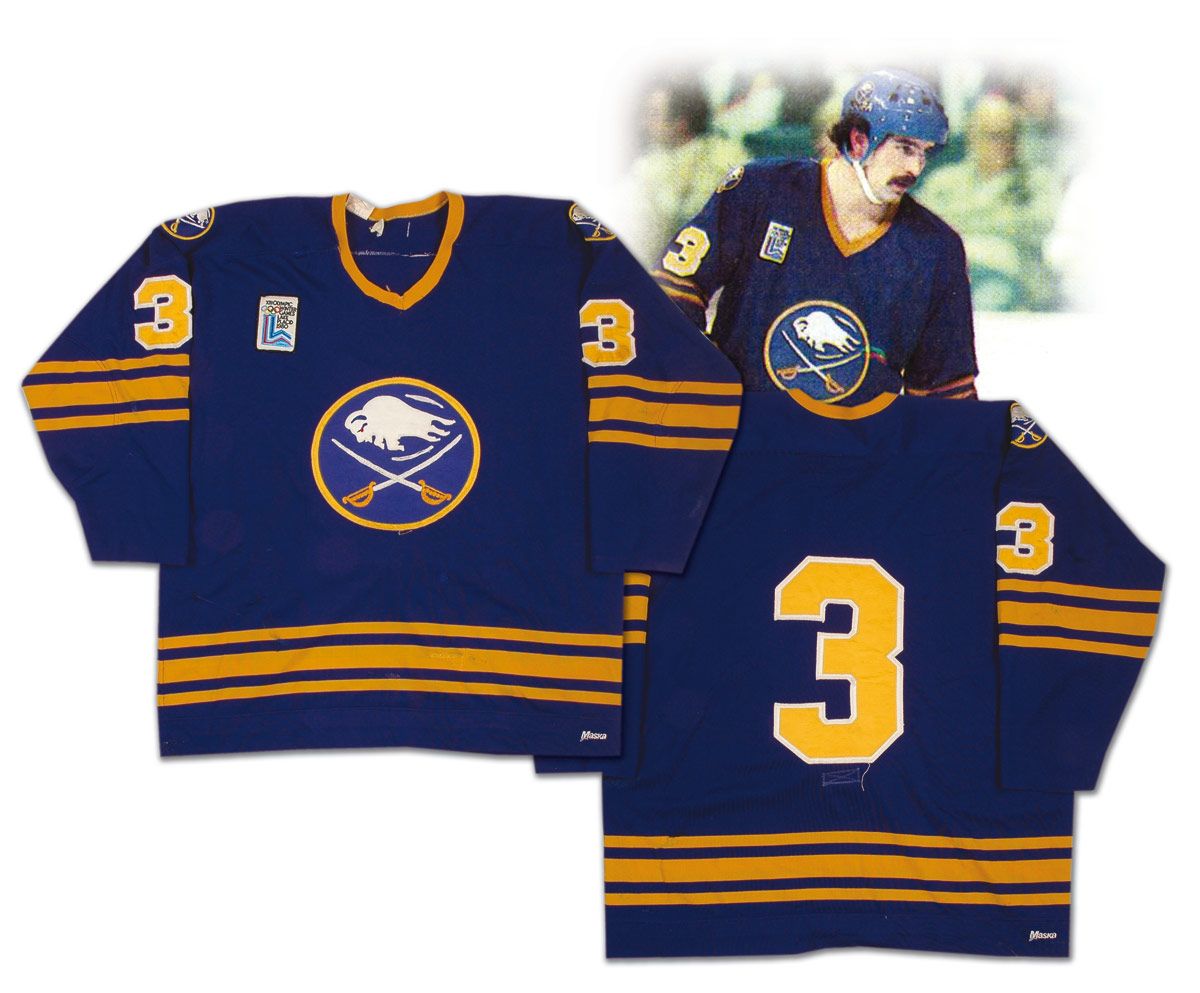
  • Some of the patches worn before photography became a major aspect of the NHL world are much more difficult to find, especially affixed to an NHL uniform. The Lake Placid patch worn by the Buffalo Sabres is one such patch, but this Richie Dunn sweater from the 1979-80 season shows it clearly affixed on the right shoulder. Notice that there are no names on the Sabres' uniforms as of 1980? I had never noticed before that either.
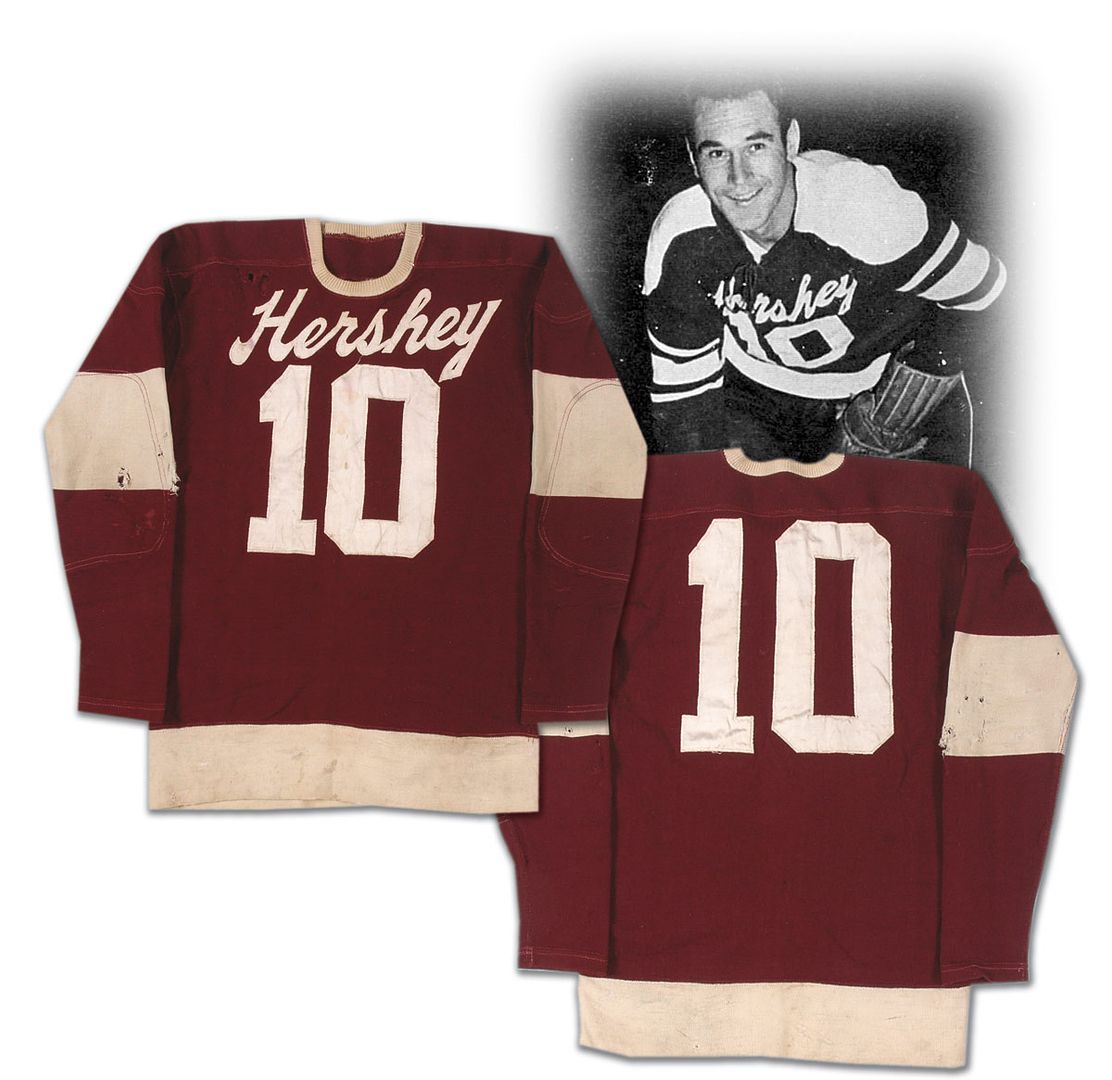
  • Heading into the AHL, we find a trend that seems to have been reproduced in the NHL with the introduction of the Rbk EDGE uniforms. I've never liked the idea of having front numbers on a hockey sweater, but the Hershey B'ars decided that front numbers were fine for a hockey sweater as far back as the 1940s! Here is a sweater that was worn by Mark Marquess as a member of the Hershey B'ars that has the city name over top of the front number. More precedence for a current trend, perhaps?
  • The Detroit Red Wings have a gorgeous jersey due to the colours and the logo. I cannot deny this. However, history shows that the logo routinely was off-centered on the Red Wings sweaters. One such example comes from the 1937 Jimmy Orlando sweater. As you can see, the center of the wheel was used as the focal point for the logo, and that caused the wing to be significantly off-center.
  • In Part One of this series, I discovered a startling trend in the 1980s that showed floating portions of names on a number of teams. Today, there appears to be some sort of discrepancy in terms of how names are displayed on at least one team. I had made mention of Brad McCrimmon's floating "C" in 1988, but I discovered an Al MacInnis uniform from the 1980s that has no floating letters! What gives? Why the change? MacInnis' first game in a Flames uniform came in 1981-82, so we at least have a start date as to when the floating letters may have started, and it had to be after the '81-82 season.
  • Because I miss the uniform and the team, here is Wendel Clark's Quebec Nordiques uniform from the 1994-95 season. Man, I miss that uniform. It's gorgeous!
  • In other lost uniform news, here is Gerry Ehman's 1967-68 Oakland Seals uniform. Does anyone miss the colour green in hockey? I sure do. Why can't more teams go with a bold green instead of these near-black colours?
  • Next, we have the second wave of California's Seal teams as we get a chance to see Joey Johnston's uniform from the 1970 California Golden Seals. I'm not all that fond of this colour scheme, but the yellow uniform is definitely bold. Much like their name, the Golden Seals certainly were living it up in goldenrod.
  • We have a 1979-80 Atlanta Flames uniform worn by Gary Unger. That's still a great uniform, and I'm glad that the Calgary Flames have gone back to those great colours. Yellow-on-red is a very striking uniform... and the lack of black is entirely refreshing!
  • Take a good look at this 1976-77 Colorado Rockies uniform worn by Michel Plasse. See how small the front logo is? Compare that to the 1981-82 uniform worn by Tapio Levo. There's a significant difference in the sizes between the two uniforms. It's almost as if the Rockies were telling everyone in 1976 that they weren't all that relevant.
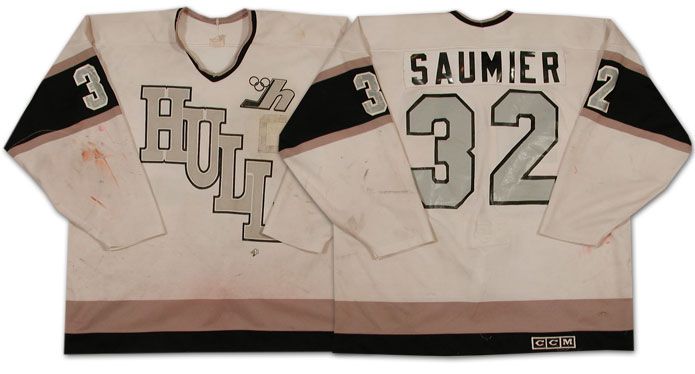
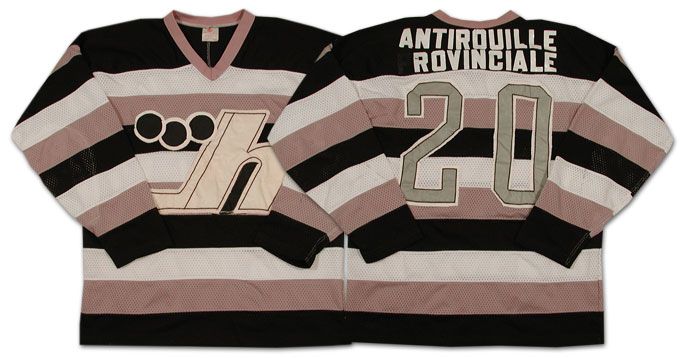
  • In the 1970s, the Hull Olympiques of the QMJHL wore some fairly vanilla uniforms. However, they changed that up in the 1980s by bringing out the black-and-silver colour scheme that became famous thanks to Wayne Gretzky's trade to Los Angeles. As you may have heard, Luc Robitaille played for the Olympiques and Gretzky owned part of the Olympiques, so Bruce McNall made the change to the new colour scheme due to Robitaille's suggestion to make Los Angeles more attractive for Gretzky. Now you have some visual proof of how this change came about thanks to Marc Saumier's uniform.
  • In 1985, the Hull Olympiques decided to roll out a different road uniform by wearing some awesome stripes! I love the stripes on this jersey, even if it looks like a black-and-white television's test pattern.
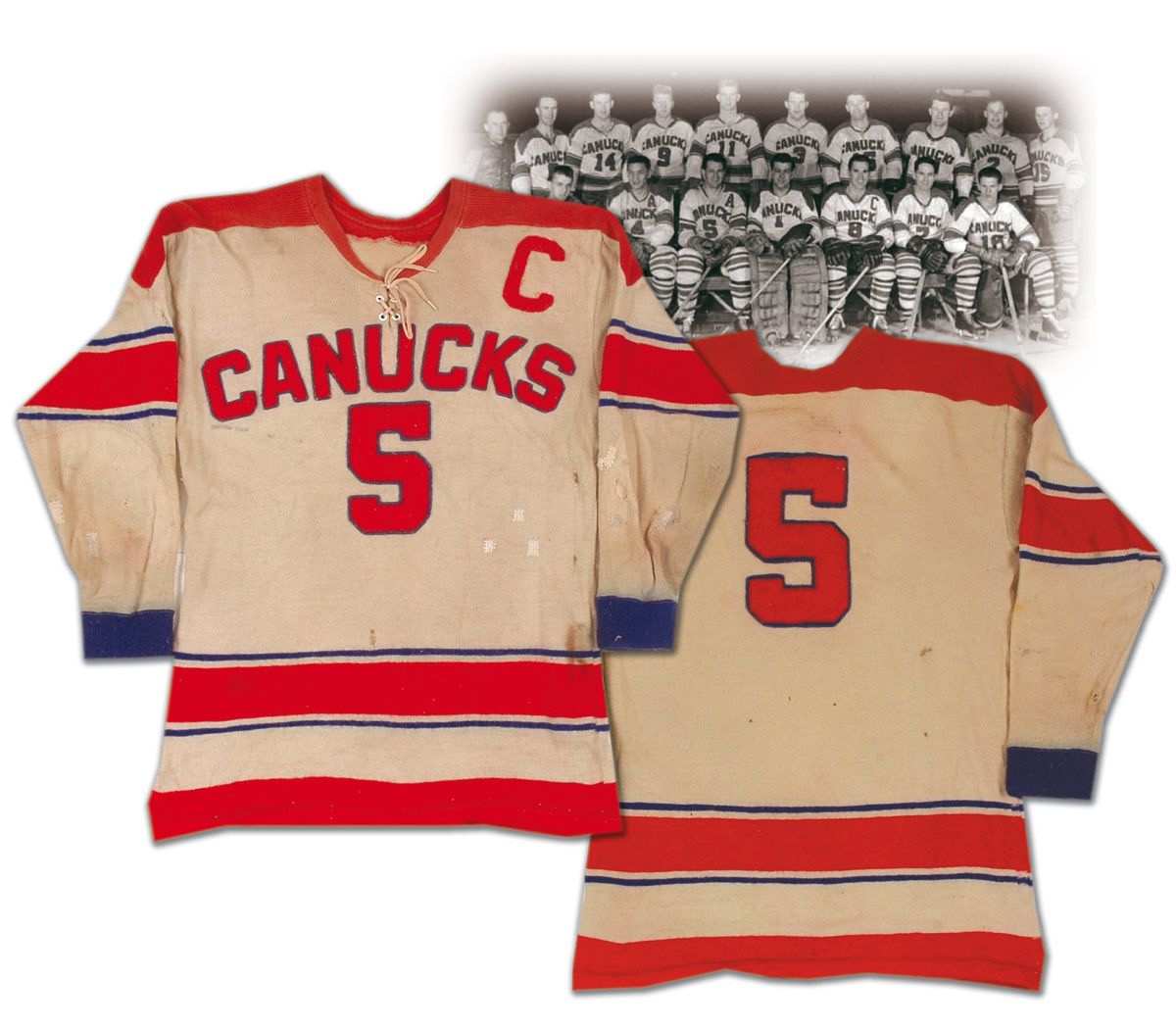
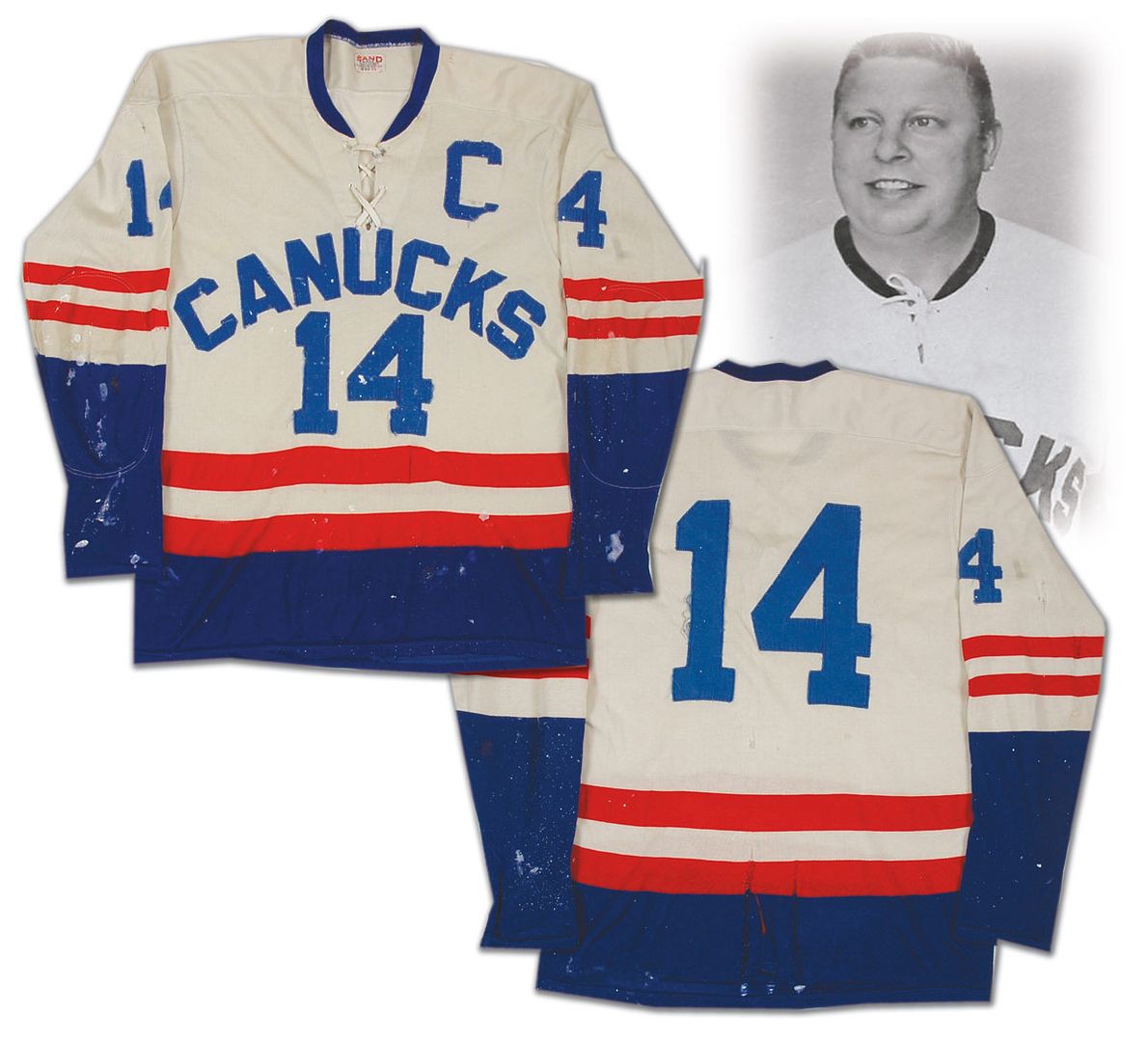
  • The WHL gets a mention on this one as we get to see the Vancouver Canucks in their original form. The WHL Canucks wore this uniform in the 1950s, and they went with a colour change in the 1960s. Of course, Vancouver received an NHL franchise in 1970 so these jerseys weren't needed any longer, but there is some precedence to the Canucks wearing a name on the front of their uniforms. It seems that the trend of front numbers was more of a minor-league thing through the 1940s, 1950s, and 1960s, though. Take note, NHL. MINOR-league.
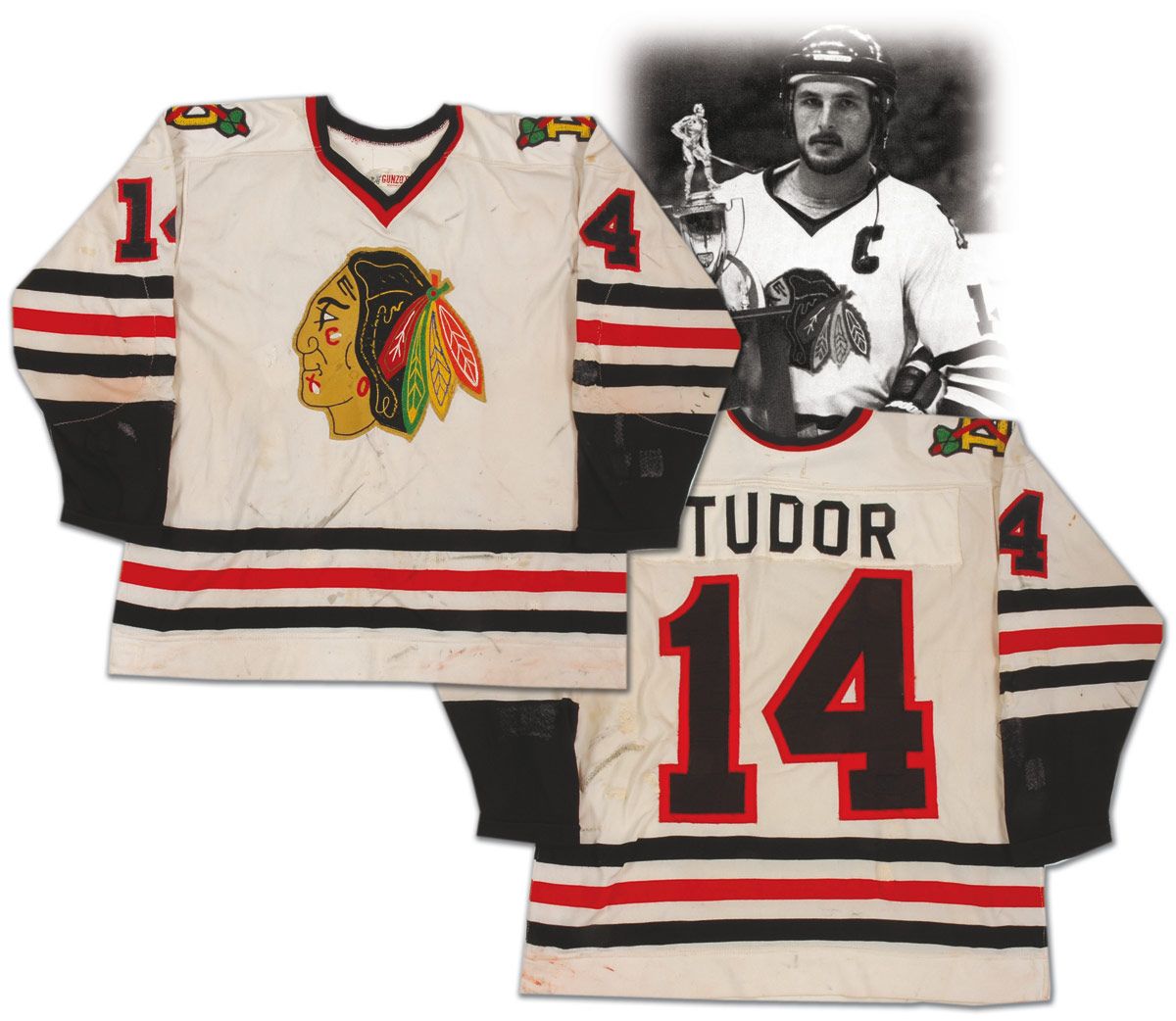
  • It has been well-documented that NHL teams often name their minor-league affiliates after their own NHL franchise name. The Sherbrooke Canadiens, the St. John's Maple Leafs, and the Albany Devils are some well-known examples. Here is Rob Tudor's jersey from the 1978-79 season. If you inspect that jersey closely, you'll see two tomahawks crossed over a "D" on the shoulder. This is a Dallas Blackhawks uniform from the Central Hockey League!
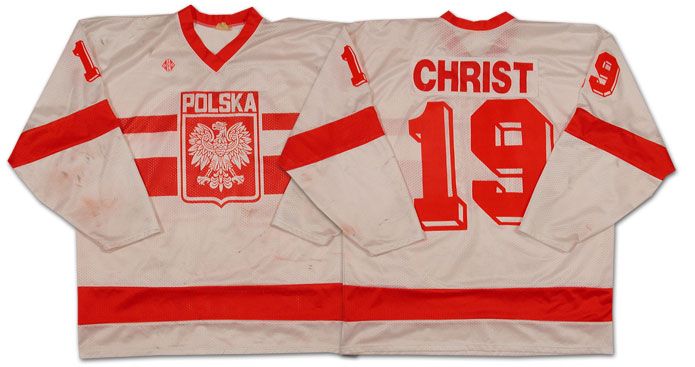
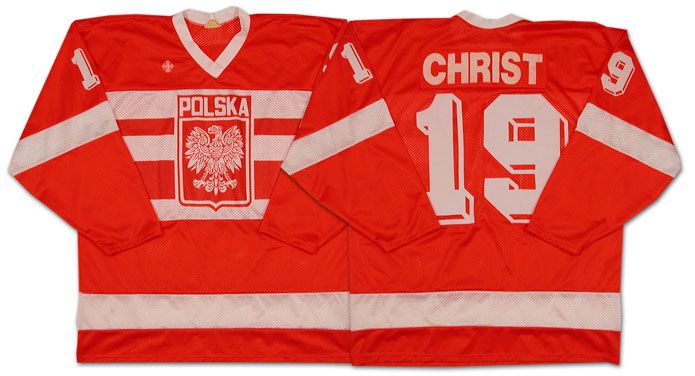
  • International jerseys are always interesting. The 1988 Winter Olympics saw Poland compete in Calgary as a part of the ice hockey competition. One member of that team was a player by the name of Jerzy Christ. Yes, that is his real last name. He was born in Katowice, Poland, and played center for his home country. The highlight of his international career was when he scored both Polish goals in a 2-1 victory over reigning World Champion Czechoslovakia at the 1986 World Championships in Moscow, Russia!
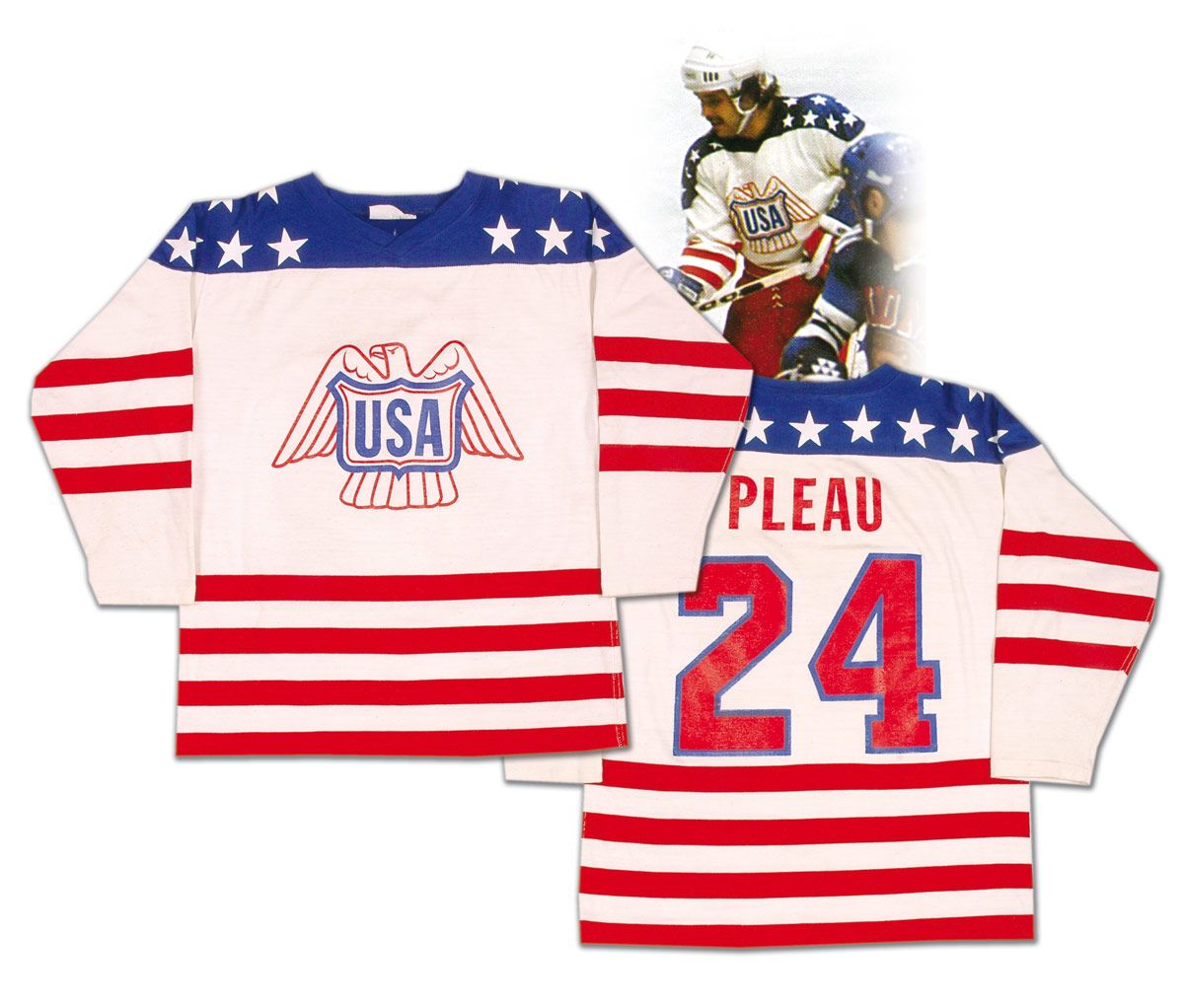
  • Love this 1976 Team USA sweater. Larry Pleau wore this uniform at the 1976 Canada Cup where Team USA finished 1-3-1 and in fifth-place. Regardless of their standing, they wore a gorgeous sweater, and it really feels like a patriotic American uniform.
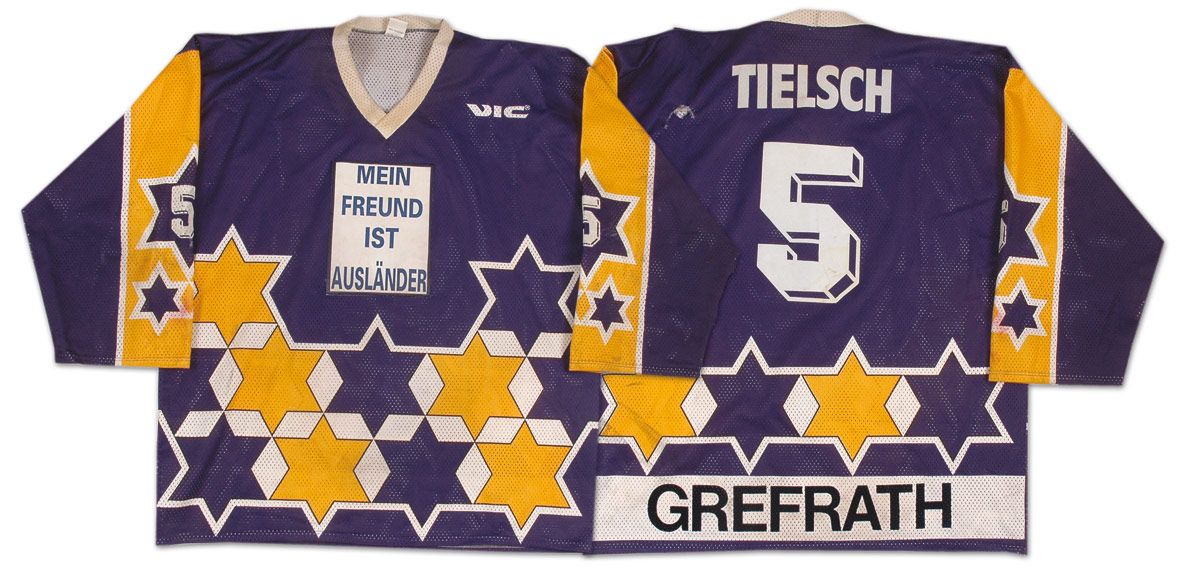
  • We'll close this look at interesting jerseys with a glimpse into German hockey. Grefrath, a German city, played in the second-division of the German Eishockey League in the early-1990s, and wore these uniforms while on the ice. As you can see, there's no logo, but a message where the logo should be. Using a handy translator, the message states, "My friend is a foreigner" or "My friend is an alien". Is this the first time any team has ever used their uniform to convey a written message to its fans? Weird idea.
So there you have it, kids. Lots of good looks at uniforms, and there was some weird and wacky stuff seen. The Classic Auctions website is a great place to find some incredible hockey history, and I encourage you to poke around their website if you're interested in some cool hockey memorabilia.

Until next time, keep your sticks on the ice!

Tuesday, November 2, 2010

We're back with another installment of photos and commentary as we continue to look through the Classic Auctions website. As we saw yesterday, there are a number of incredible old photos and many jerseys with some unique features on them that are being showcased on the Classic Auctions website. That being said, here is the second half of the Classic Auctions images with some of my commentary thrown in for good measure, but I want to start with something I found that is very cool and completely unheard of for me.

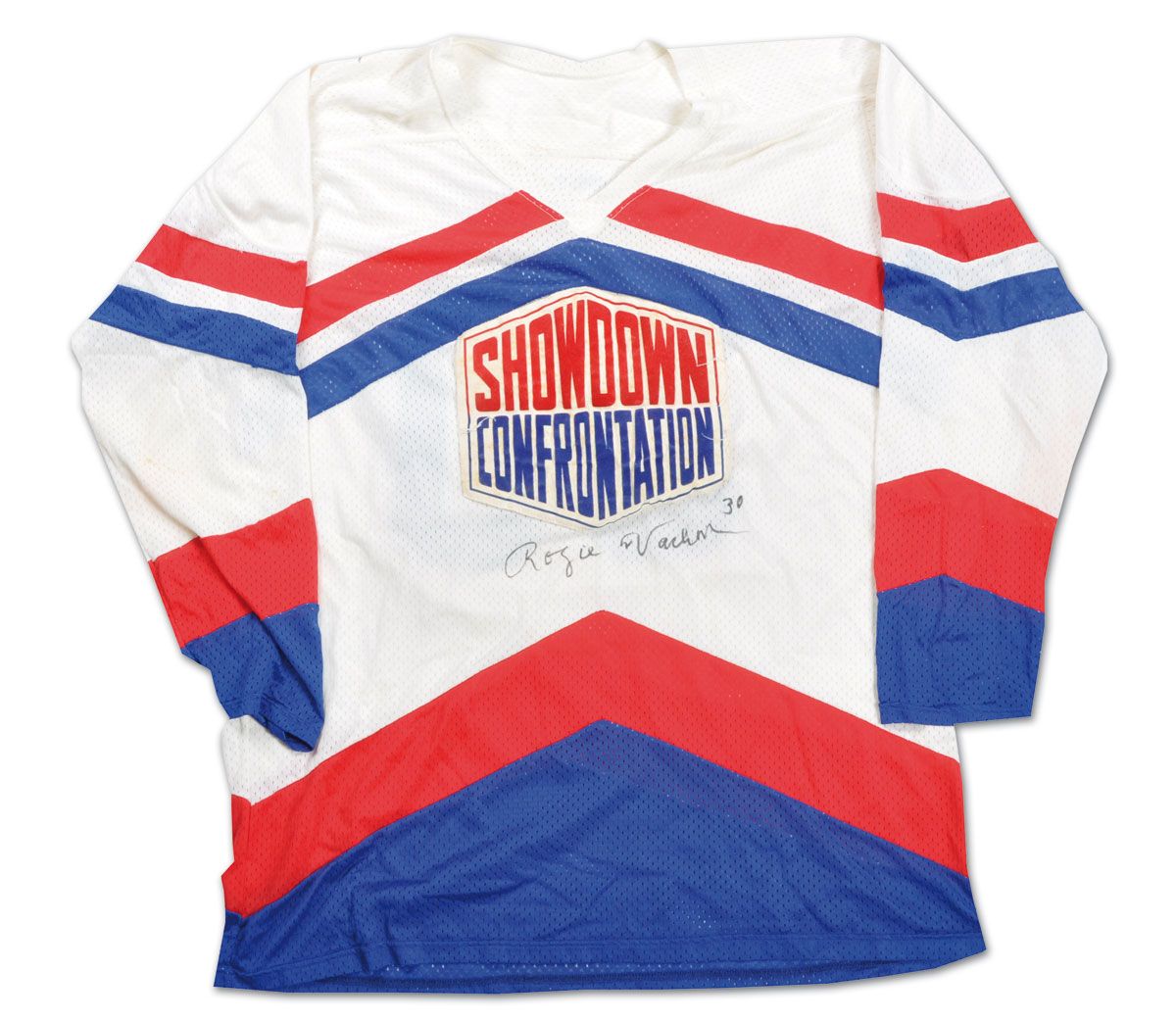
There's something to be said about some of the old promotional stuff that the NHL did to keep people in their seats. Does anyone remember the old "NHL Showdown" series between periods? Rogie Vachon was a participant, and he wore "Showdown" jerseys both at home and on the road. According to the Classic Auctions website, "Hockey broadcast intermissions throughout the 1970s featured the entertaining Showdown competition. Showdown began as a penalty shot tournament with NHL stars vying for cash prizes and bragging rights. Year-to-year variations such as skills contests, obstacle courses, and modified mini-games followed.... The L.A. Kings goalie's 'Fat Cats' won a 3-on-3 competition vs. Philadelphia goalie Wayne Stephenson's 'Sweathogs' to claim the $10,000 prize". Very interesting!

To prove that this isn't made up, here are the two parts of the 1978 Showdown between the Fat Cats and the Sweathogs.

Pretty cool, right? Why don't they do fun things like this now?

Anyway, let's take a look at some of the stuff found on the Classic Auctions website.
  • Rogie Vachon's Burger King jersey is up for grabs. If these jerseys weren't so damned expensive now, I'd totally add one to my collection.
  • Moving to another goaltender, if anyone thinks that the Bruins haven't been in Fenway Park in the past, they're totally wrong! That's goaltender Tiny Thompson standing between two members of the Boston Red Sox. Thompson is credited as being the first goaltender to stop the puck by catching it, and it appears he got some pointers from the BoSox players!
  • There's a good look at the 1926-27 Stanley Cup Champion Boston Bruins. The man pictured in the middle is Sprague Cleghorn. Two spots in on the right on the bottom row is a man synonymous with the Bruins. That's defenceman Edward Shore aka Eddie Shore! And the man in the suit in the top left? That's Manager Arthur Ross aka Art Ross!
  • One year later, the 1927-28 Stanley Cup Champion New York Rangers would be photographed. The key in the photo is the man on the second row, two in from the left right beside the bowl of the Stanley Cup. That is 44 year-old Lester Patrick who is listed as "Mgr. Coach", but appears in a uniform. Why is he in uniform? Patrick played in the NHL Playoffs as goalie for the Rangers after regular goalie Lorne Chabot went down with an eye injury!
  • We jump ahead to 1980-81 where the Philadelphia Flyers decided to change up the hockey world by wearing captaincy designations as white-on-orange-on-white. Another thing to note is how the sixes have that little piece missing as the loop closes on both the back number and the sleeve numbers. It's the first time I've noticed that on the Flyers' numbers for that era.
  • I've been critical of the teams that put their city names outside of their logo on the front of the jerseys (Dallas and Vancouver), but the 1986-87 St. Louis Blues did that with their team name. So, if you were to literally read the front of that jersey, Rick Meagher would have been playing for the Blues St. Louis Blues. Which sounds dumb.
  • I had asked before about the serifs on the Toronto Maple Leafs assistant captain designations from the 1980s, but have yet to receive an answer from anyone who hasn't basically said, "It is what it is". And they wore them both at home and on the road. However, I have now found that the serifs only appear on the alternate captain designations because Brad Marsh's last name doesn't have them despite the "A" on the front having the serifs. So what gives? What was the purpose of the serifs?
  • In keeping with the Maple Leafs, the 1950-51 Stanley Cup Champion Leafs received rings to commemorate their victory as the best team in the NHL. However, in keeping with Maple Leafs budgetary requirements at that time, the rings were quite simplistic and very plain. Not exactly a very memorable way to tell the world you were the best at what you did.
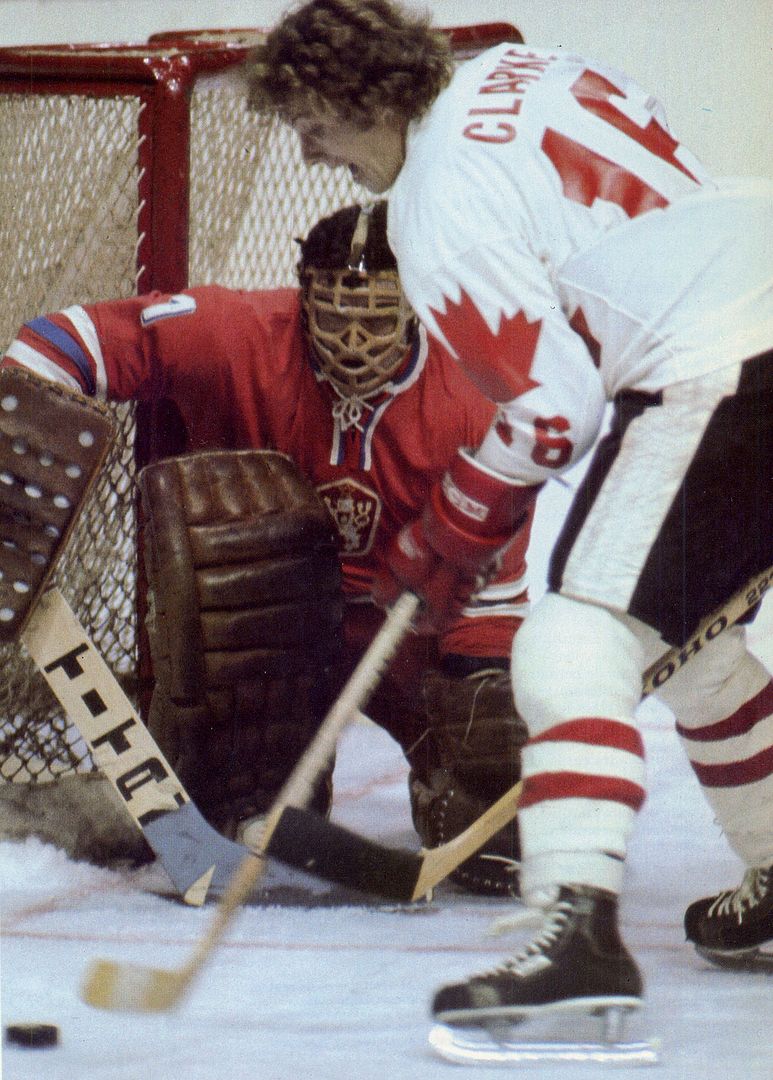
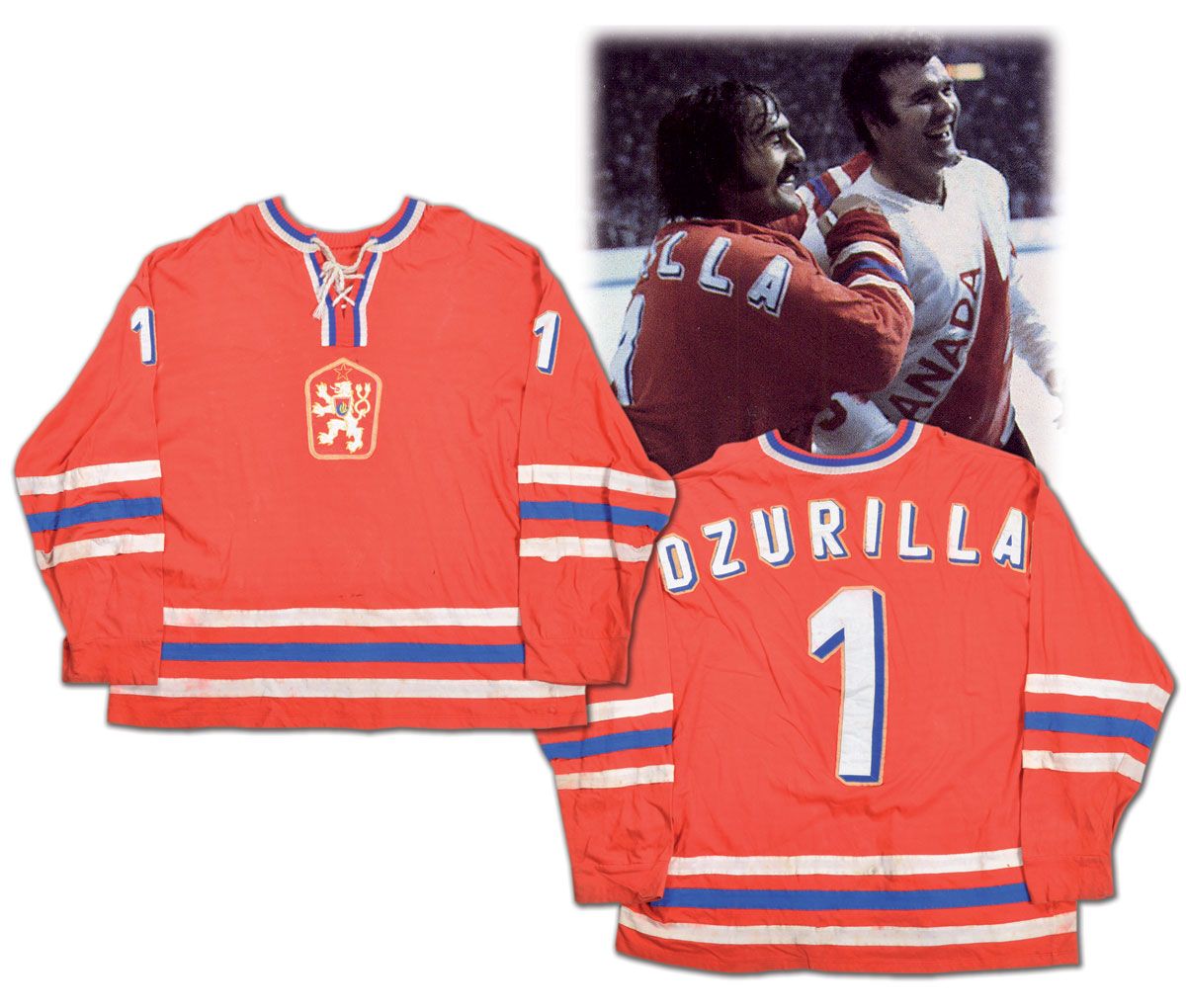
  • The 1976 Canada Cup saw a few of the world's hockey powers come together in the tournament. The Soviets were there as were the Canadians, but the Czechoslovakians were one of the better teams at the tournament. Backstopped by Vladimir Dzurilla, the Czechoslovakians played extremely well to finish with the silver medal behind Canada. They wore these simple yet gorgeous sweaters to compete in, and they certainly made an impact on the hockey world that September.
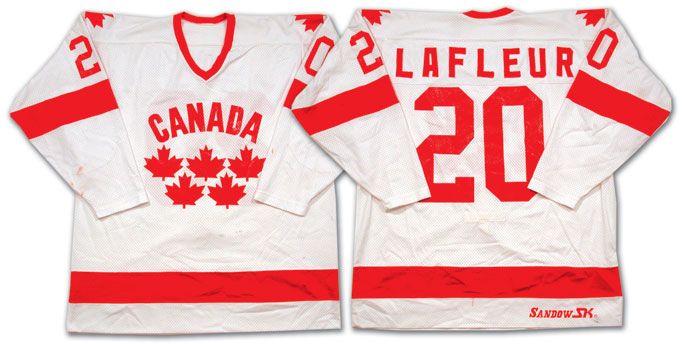
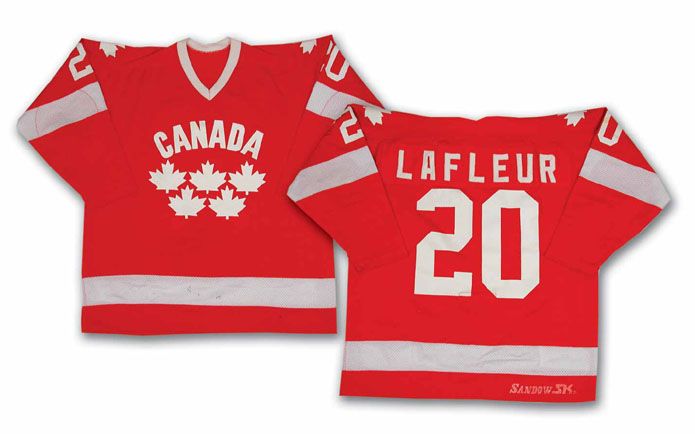
  • The idea of "less is more" is certainly prevalent in the international hockey world. After being stunningly eliminated in the opening round of the 1981 NHL Stanley Cup Playoffs, Guy Lafleur took his talents to the 1981 World Championships. It was there that Canada wore these uniforms when playing as the home team and these uniforms when playing as the road team. I have to say that I really like them, and Hockey Canada might want to look at a design like this if they ever run into another logo controversy at the Winter Olympics.
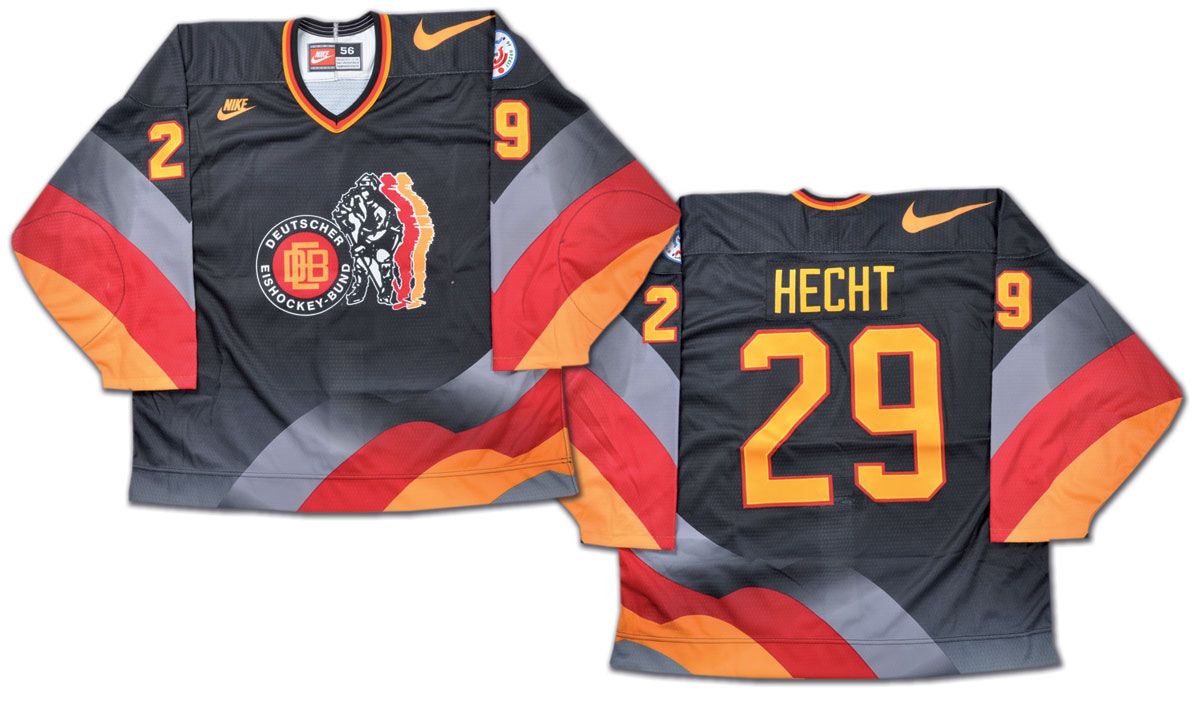
  • I'm not sure what Nike was thinking when they designed the German uniforms for the 1996 World Cup of Hockey. That's a horrendous design with the giant swoosh on the shoulders, the shadowed player in the middle of the uniform, and the wavy hem stripe. Thumbs down from this writer.
  • I wasn't aware of this, but Glenn Anderson's Hall of Fame induction night featured a horrific tribute jersey designed by sports artist Janet Deane. From the auction page, "Sports artist Janet Deane created this distinctive Anderson JAC (Jersey Art Collectible) jersey and brought a sample to the six-time Stanley Cup champion's Hockey Hall of Fame Induction ceremony in 2008. The Oilers great was so taken with the jersey that he collaborated with the artist to produce a limited edition of 300, of which this is number 236. Using Anderson's #9 Oilers jersey as a base, the artwork screened onto this "hockey card on a jersey" features highlights of Glenn's HOF hockey career, including his six Stanley Cup rings on the front of the upper left sleeve. Glenn has added his retired #9 to his blue marker signature on a JAC Hockey patch sewn on the bottom right front tail. The limited edition number "236/300" is written in fine blue marker on the right side of the patch. An "Anderson 9" patch, featuring the notation "Once an Oiler, Always An Oiler" and the team logo, is sewn on the left breast." Notice the part that I highlighted? Anderson actually commissioned her to make more of these! Seriously!
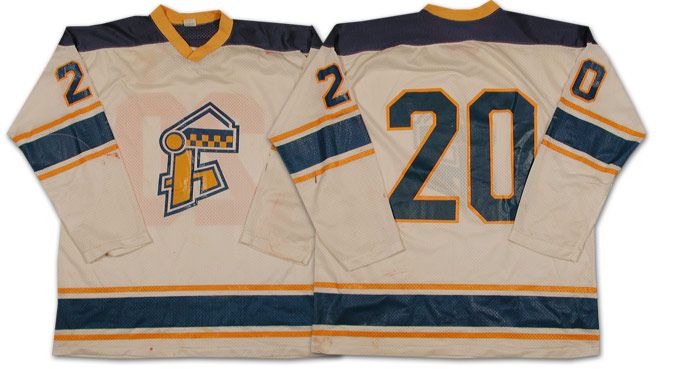
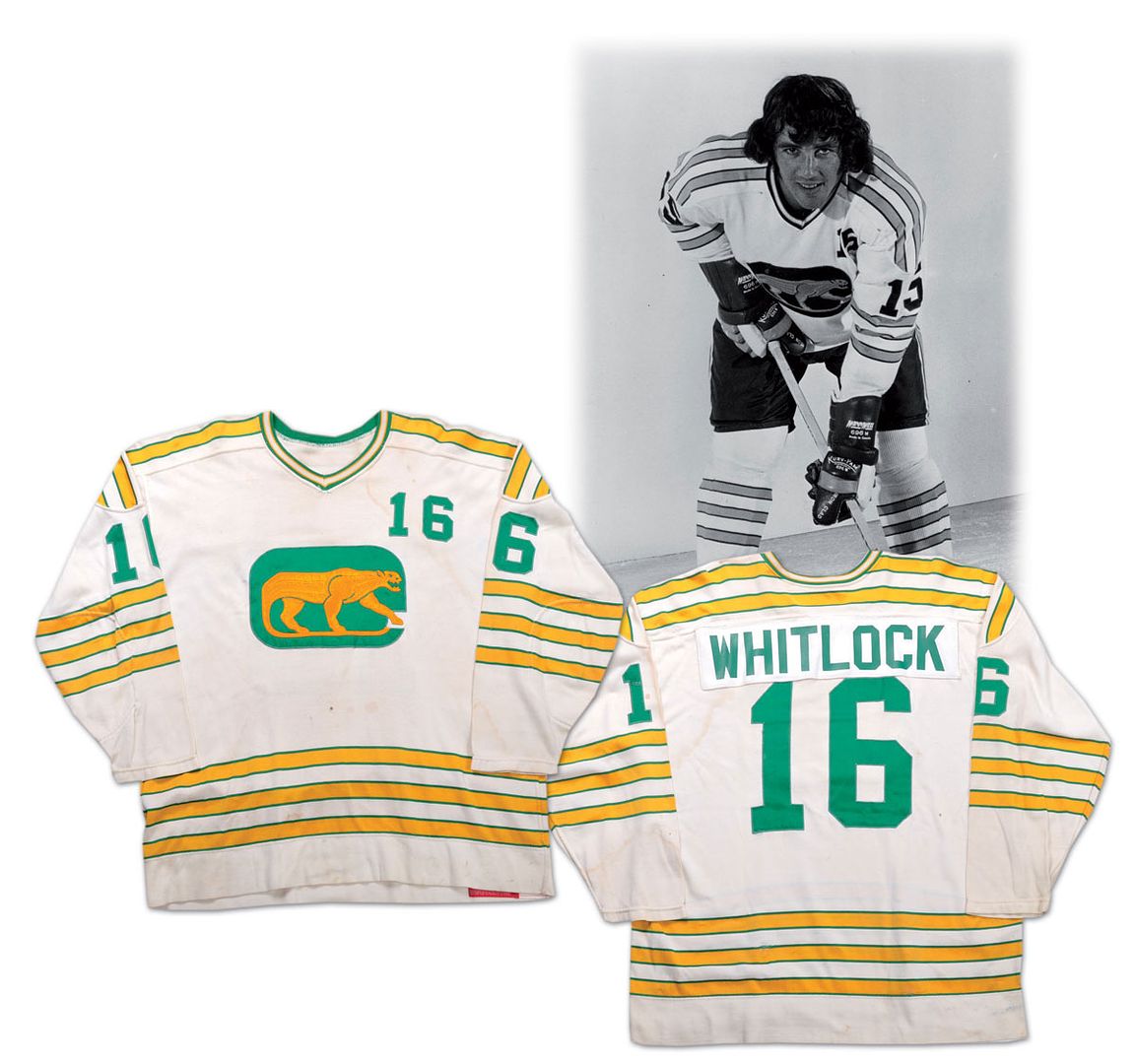
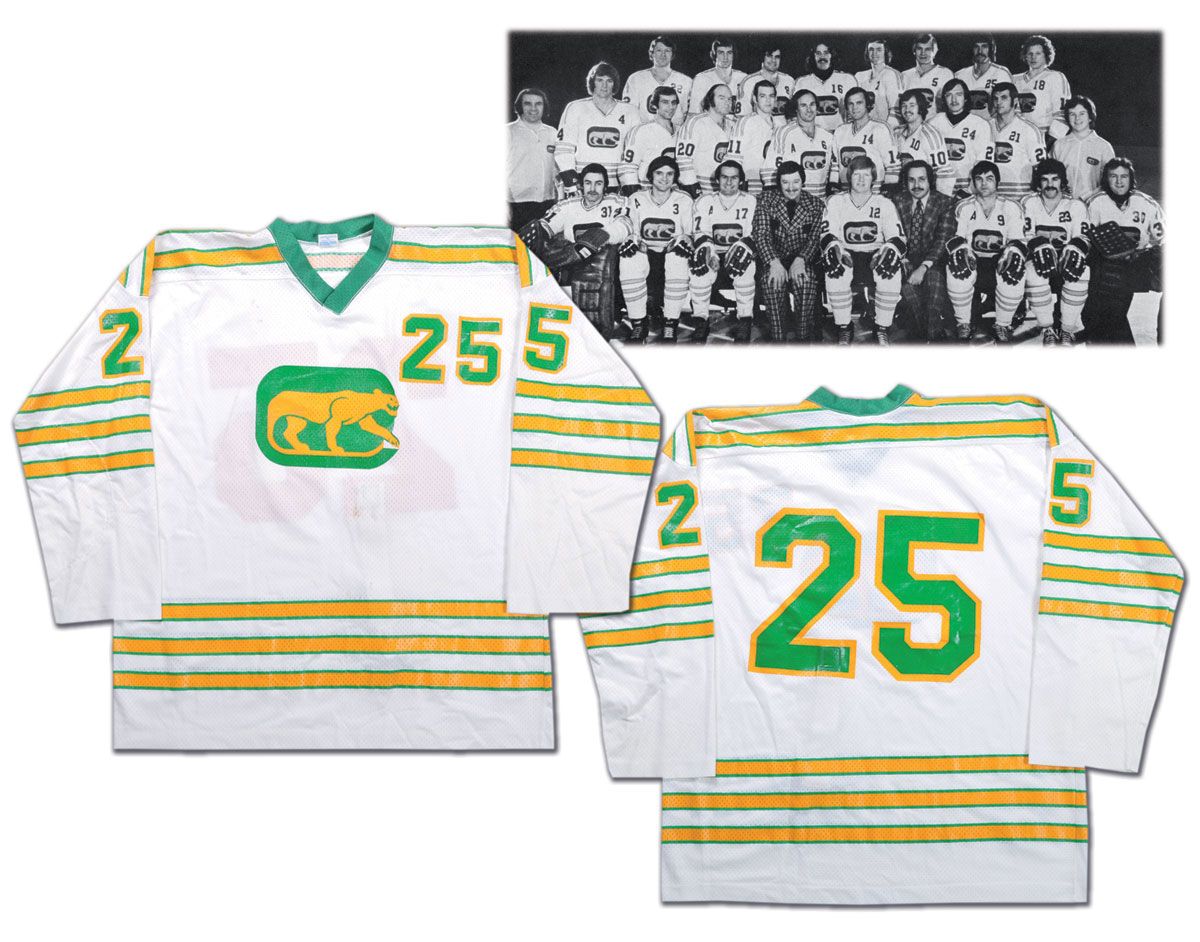
  • And we finish today by taking a quick look at the Chicago Cougars from the WHA. In 1972-73, you can see that the numbers on the jersey have no outline. Also, note the width of the logo and placement of the numbers on the front. By 1974-75, the Cougars had outlined the numbers in yellow, shrunk the logo down, and moved the numbers from above the top right corner of the logo to beside the right corner of the logo. Now, some may say that those are insignificant changes, but they are glaring changes to me. Anytime the logo becomes less important than the number on the jersey, your team has problems.
There is a second day of looks at items being featured on the Classic Auctions website. Again, I love all of the old, historical items featured on the site, and just cruising through the 1000 lots of items is like a trip down memory lane. I hope you found it interesting as well!

Until next time, keep your sticks on the ice!

Sunday, July 4, 2010

HBIC is always tries to remain aware of holidays and observances that affect the readers, and today is one of those days. July 4 is a big day south of the Canadian border as the citizens of the United States of America celebrate the anniversary of the biggest day in their country's existence: Independence Day. After defeating the British and gaining their independence, the colonies began organizing themselves into the red-white-and-blue, patriotic country it is today. It's with great enthusiasm that I wish all the best to my American readers on this Independence Day, and I hope your celebrations are fun, and with family and friends.

If I may, however, I would like to create a little topic of discussion if you'll permit. With the idea of great Americans on my mind, it has become a much more difficult decision as to who the greatest American-born hockey players are. There are so many excellent American-born players in the NHL, and we've seen some spectacular performances in international play.

In thinking about this, there are a large number of American players that need to be considered. I'll arrange this discussion by creating two lines of American-born players throughout the annals of time. There will also be one line for the best international players as well. Let's take a look at who I chose as being the best American hockey players.

Forward: Mike Modano
Forward: Joe Mullen
Forward: Brett Hull
Defence: Brian Leetch
Defence: Chris Chelios
Goaltender: Mike Richter

Mike Modano is the leading scorer in terms of American-born players in the history of the NHL. His inclusion is almost elementary with the number of international appearances he has made for USA. Add in the 1999 Stanley Cup ring into the mix, and Modano is a highly-decorated American hockey player.

Joe Mullen has to be included as he was the first American-born player to score 500 goals in the NHL, a benchmark used for Hall of Fame credentials. Mullen also won three Stanley Cups as a member of the Calgary Flames and Pittsburgh Penguins, and he was a major goal-scoring threat right through to the end of his illustrious career.

While there are always critics of Brett Hull's personality, there was no denying that he was the most lethal sniper in the NHL for the better part of four seasons. While Hull never won a Stanley Cup while scoring hundreds of goals in the early-1990s, the transformation of his game into a two-way forward in Dallas brought him a Stanley Cup ring in 1999, and he added another with Detroit in 2002.

Brian Leetch's inclusion was made easy by his amazing career in New York City. He was part of the 1994 Stanley Cup victory by the Rangers, and became the only American-born Conn Smythe winner that year. He has twice won the Norris Trophy as the NHL's top defenceman, and has inspired a large number of young hockey players with his play and his leadership.

There isn't much that needs to be said about Chris Chelios, but I'll try. 1983 NCAA Champion with the University of Wisconsin-Madison, played in four Winter Olympic Games, played in three Canada Cups, played in one World Cup, played in twelve NHL All-Star Games, and has won three Stanley Cups and three Norris Trophies. He's currently the oldest player still active in the NHL, has played the most games by an American player, and has suited up for three of the Original Six teams. Pretty impressive for the veteran of approximately 72 seasons.

Mike Richter did the one thing that Tom Barrasso, another American-born goaltender, could not. With Richter backstopping the 1994 New York Rangers, the goaltender became an icon in North America's largest market thanks to his performance in helping the Rangers capture the Stanley Cup. Richter was a household name in the USA while Barrasso was not. Because of his influence, Richter deserves the start.

What may be more important about all of these men is that they played in markets where hockey is taken very seriously. Modano started in Minnesota, and moved onto Dallas. Mullen played some of his best hockey in Pittsburgh. Hull put St. Louis into a higher echelon before joining Modano in Dallas, followed by a successful run in Detroit. Leetch and Richter were icons in New York during their careers. And Chelios has played in Detroit and Chicago where hockey can be life or death.

The second line of the NHL Americans are as follows:

Forward: Jeremy Roenick
Forward: Pat Lafontaine
Forward: Neal Broten
Defence: Phil Housley
Defence: Ken Morrow
Goaltender: Frank Brimsek

JR is the stuff of video gaming legend, and his real-life personality was pretty awesome as well. Not only could he score, but he could hit, skate, and was a leader for the Blackhawks. While he never captured a Stanley Cup, Roenick piled up the points during his career, and was always a fan favorite.

Pat Lafontaine never got the major chatter like some of his peers did, but he does have the highest point-per-game average of all American-born players in the history of the NHL. Lafontaine totaled up 1013 points in 865 games, averaging 1.171 points-per-game. Not bad at all, if you ask me. If it weren't for a spectacular run by Mario Lemieux, Lafontaine would have won one Art Ross Trophy.

Neal Broten will probably be questioned by a few people, but his inclusion is for what he did in the NHL. He was the first American-born player to record 100 points in a season, and he scored the game-winning goal that clinched the Stanley Cup in 1995 for the New Jersey Devils. He was the 1998 winner of the Lester Patrick Award for his contributions to hockey in the United States. Add on the fact that he was voted as the greatest hockey player from Minnesota, and he comes across as a pretty important player in the annals of American hockey greats.

Phil Housley is still the highest-scoring American-born defenceman in NHL history, and he's second all-time in scoring by American players. Having seen him play, he was one of the best skaters I've ever seen on NHL ice. Housley holds the record of being the player who has played the most games without winning the Stanley Cup - an unappreciated record to be sure. He played in seven NHL All-Star Games, and represented Team USA five teams.

Some may argue that other defencemen should be here in Ken Morrow's place, but there is no American-born player who has had the success that Morrow had at such a young age. By age 23, he had an Olympic gold medal and a Stanley Cup Championship to his name. Morrow would go on to win three more Stanley Cups during the Islanders' dynasty. Morrow didn't score a ton of points, but he was one of the best defensive defencemen to suit up during the early-1980s. In 1996, he won the Lester Patrick Award for his contributions to hockey in the United States.

The choice of Frank Brimsek over players such as John Vanbiesbrouck, Tom Barrasso, or Mike Karakas might come as a surprise, but you don't earn the nickname of "Mr. Zero" without being pretty good. He was the first American-born goaltender inducted into the Hockey Hall of Fame, and won two Stanley Cups which has him tied for the most amongst American-born goaltenders. His forty shutouts are the most by an American-born goalie with six of his forty blankings coming in his first eight NHL games, and he has two Vezina Trophies to his name.

Still with me? Those twelve men would be a pretty amazing all-time fantasy team, and every American should be proud of these men for their accomplishments. However, we're also going to take a look at the best international players that the United States has produced.

Forward: Jordan Schroeder
Forward: Cammi Granato
Forward: Mike Eruzione
Defence: Bill Baker
Defence: John Mayasich
Goaltender: Jim Craig

Jordan Schroeder, who is just beginning his pro career, eclipsed the 25-point Team USA all-time scoring record set by Jeremy Roenick at the World Junior Championships this past year. Schroeder has played in three WJCs, scoring 27 points with a Team USA-record 20 assists. Schroeder won a gold medal at the 2010 WJC. With his pro career just starting, it appears that Schroeder has a long career of international appears ahead of him.

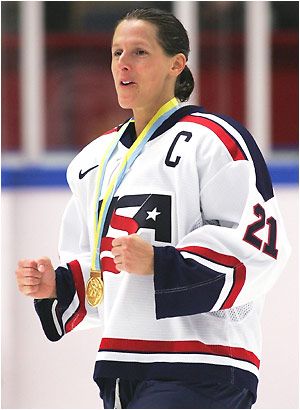
Cammi Granato's influence on the women's game has been instrumental in making the US Women's Hockey Program into an international power. She still leads Team USA in scoring, and has won an Olympic gold medal, an Olympic silver medal, one World Championship gold medal, and eight World Championship silver medals. She is the recipient of the 2007 Lester Patrick Award for her contributions to hockey in the United States, and will be one of the first two women to be inducted as players into the Hockey Hall of Fame in 2010.

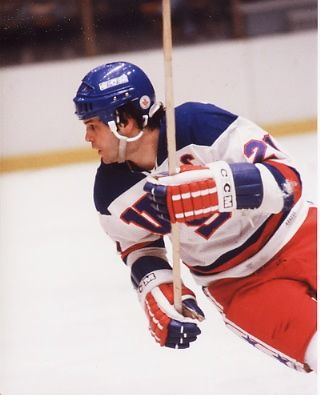
Mike Eruzione needs no introduction. His name is as big in the United States as Paul Henderson's is in Canada. Eruzione played in the 1975 and 1976 World Championships, but his big moment came during the 1980 Lake Placid Olympic Games. Eruzione scored the game-winning goal against the Soviet Union in the "Miracle on Ice" game that made him the most famous American hockey player for a long time.

Bill Baker is probably best known as the extra attacker who scored the tying goal against Sweden in 1980 at the Lake Placid Olympic Games. Baker's goal proved vitally important as the 2-2 tie against Sweden allowed Team USA to advance to the medal round where they would pull off the biggest victory in US Hockey history. Baker's Team USA jersey is currently displayed at the Smithsonian in Washington, DC. Baker also played at the 1981 World Championships and the 1981 Canada Cup.

John Mayasich was a sensational scorer at the international level for Team USA. In 1956, Mayasich scored a hat trick as a forward to lead Team USA over Canada by a 4-1 score, and capture the silver medal. Before the 1960 Olympic Games in Squaw Valley, Mayasich developed a slapshot that would have made Bobby Hull proud. In an exhibition game against Japan, Mayasich fired a slapshot from center that beat the Japanese goalie cleanly! With his return to the Olympics in 1960, Mayasich was shifted to defence so that Team USA could take advantage of his slapshot. Team USA defeated Canada, the Soviet Union, and Czechoslovakia on their way to the 1960 Olympic gold medal! Mayasich played in five World Championships, earning a bronze medal and an All-Star team berth at the 1962 tournament.

The goaltending choice came down to Jack McCartan's 1960 gold medal performance and Jim Craig's "Miracle on Ice" Olympics. However, the most memorable win in USA's history can't go unheralded. Craig went 6-0-1 in the 1980 Winter Olympics, including that historical win over the Soviet Union where he posted 39 saves in the 4-3 "Miracle" win. While his NHL GAA ballooned to 3.77 after leaving the US National Team, he posted an amazing 2.14 GAA in the 1980 Winter Olympics to lead Team USA to the gold medal!

There are my picks for the best American players in the NHL and at the international level. Again, I'll probably stir up more discussion than settle any debates, but that's what this exercise is all about. After all, nationwide celebrations bring people together, and that's what I'm celebrating here: the best American-born hockey players to ever suit up in the NHL and in a Team USA uniform!

Happy Independence Day, my American neighbours, and be safe on this Fourth of July!

Until next time, keep your sticks on the ice!

Sunday, May 23, 2010

There's no doubt that this year's IIHF Men's World Hockey Championship had its share of controversy and intrigue. From an IIHF staff member ripping NHL players who decline invitations to the tournament to IIHF boss Rene Fasel issuing an apology to Sidney Crosby for being singled out as one of those players, the IIHF saw a little egg on its face in terms of attracting big names to the event. However, there were some good stories as well as the host Germans set a world record for attendance at a hockey game en route to beating the USA in the tournament's opening game, and then proceeded to thrill their fans throughout the tournament with their play. Today's championship final featured two teams that had a number of their best players in the line-up, and two teams that have a long history of battles at the IIHF Men's World Hockey Championship and throughout international hockey history.

The biggest name that appeared on the Czech Republic's roster was 38 year-old Jaromir Jagr. Jagr has never been one to shy away from representing his country on the world's stage, but he opened the tournament in an unhappy mood after finding that some of the more prominent Czech names in hockey had decided to sit the tournament out. Jagr, who may have been slightly annoyed at being one of a few marquee names on the team, saw his team fall to Switzerland and Norway by identical 3-2 scores in the preliminary round. It was the first time a Czech team had lost to Norway on the international scene in 73 years!
"It's the national team — we didn't really have any success lately and a lot of guys said no in our country," Jagr said on May 10. "Probably the top 25 guys said no and I think it's too much. I understand the guys are injured or they feel tired after the season, but look at guys like Ovechkin or Kovalchuk.

"I think you've got to be a little bit more proud of your country."
With Jagr calling out those who didn't show up, he may have also called out the players around him, and the Czech Republic team responded. After being in a bad situation with two losses, the Czechs won their next four games, beating Latvia, Canada, Finland, and Sweden to earn a berth in the IIHF World Hockey Championship Final.

The team that they would face would be a juggernaut through the IIHF World Hockey Championship again this season. The Russians went 8-0 through the games leading up to the championship final, outscoring their opponents by a 31-9 margin over those eight games. They beat, in order, Slovakia, Kazakhstan, Belarus, Germany, Denmark, Finland, Canada, and Germany again to advance to the final. Surprisingly, the two games against Germany were the closest that Russia came to losing as both goals were one-goal victories.

After all was said and done, Ovechkin, Kovalchuk, and head coach Vyacheslav Bykov had continued their dominance at the the IIHF World Hockey Championship as they had strung together an impressive 27-game win streak over the last three years in winning the last two IIHF World Hockey Championship tournaments. Eight players were looking to three-peat at the IIHF World Hockey Championship, so the Russians had motivation.

Today, the Russians faced the Czech Republic in the 2010 IIHF World Hockey Championship Final. 19132 fans packed Lanxess Arena in Cologne, Germany to see these two hockey powers square off for world hockey supremacy. Semyon Varlamov got the start for the Russians while Tomas Vokoun got the nod for the Czechs in net.

Just twenty seconds into the first period, the upstart Czechs took the lead. Jakub Klepis converted a feed from Jaromir Jagr, and the Czech Republic led 1-0.

The announcer gets way too excited just :20 in.
The Czechs, unable to match firepower with the Russians, played a fairly conservative period, but also killed three Russian powerplays in taking the 1-0 lead into the intermission. Vokoun made 13 saves in the first period, while Varlamov saved seven of eight shots.

Another goal was scored at the 18:13 mark of the second period. Czech captain Tomas Rolinek made it 2-0 off a pass from Karl Rachunek after Russians Alexander Ovechkin and Sergei Fedorov collided in the offensive zone, turning the puck over at the Czech blueline.

Apparently, they checked upstairs to ensure it wasn't in off Rolinek's skate.
After Ovechkin nearly ran into Alexander Semin, he literally jumped into Sergei Fedorov. Fedorov didn't even see the hit coming. With the goal, the Czechs took a 2-0 lead into the dressing room after forty minutes. Vokoun had stopped all 25 shots he had seen thus far, while Varlamov had stopped 16 of 18 shots. With one period to play, the unthinkable was on the minds of everyone.

I'm not going to say much about the penalty-filled six minutes that closed the game, but here are the last two minutes of the final of the IIHF World Hockey Championship. Russia starts this sequence on a two-man advantage, trailing by a 2-0 score. Intrigue? Intensity? You betcha.
With 36 seconds to play, Pavel Datsyuk scored for the Russians, with assists to Ilya Kovalchuk and Sergei Gonchar.

Thirty-six seconds are a lifetime in hockey, so there was still enough time for Russia to tie the game. However, the Czechs, playing the same conservative, defensive hockey they had used against the other hockey powers, used up the remaining time to claim their first IIHF World Hockey Championship in five years!

In winning, the Czechs snapped the 27-game win streak by the Russians and held Alexander Ovechkin scoreless in the final game. Ovechkin actually finished the game as a -2, and his unintentional check on teammate Sergei Fedorov led to the game-winning goal by Tomas Rolinek.

Remember what I've been preaching for a while now about how hard work beats talent every night? Jaromir Jagr essentially echoed that in his post-game interview.

"This was probably the biggest surprise in hockey history," Jagr said to Lucas Aykroyd. "They had stars and we had guys who play in the Czech Republic, but this shows that talent doesn't matter - you have to work hard."

Kids, if you're reading this, live by that mantra. Talent will only get you so far. Hard work will always get you further. Jaromir Jagr, one of the greatest players in the world, believes in that, and you should too.
Russian forward Pavel Datsyuk was voted as the best forward in the tournament by the IIHF Directorate. Finnish defenceman Petteri Nummelin was voted as the best defenceman, while German goaltender Dennis Endras was voted as the best goaltender. Nummelin and Datsyuk were named as tournament all-stars as well, along with German defenceman Christian Ehrhoff, Russian forward Evgeni Malkin, and Swedish forward Magnus Paajarvi Svensson. German goaltender Dennis Endras was also a tournament all-star, and was also named as the IIHF World Hockey Championship MVP! Congratulations to all these men on their excellent tournaments!
The final rankings in this tournament are as follows:
  1. Czech Republic
  2. Russia
  3. Sweden
  4. Germany
  5. Switzerland
  6. Finland
  7. Canada
  8. Denmark
  9. Norway
  10. Belarus
  11. Latvia
  12. Slovakia
  13. USA
  14. France
  15. Italy
  16. Kazakhstan
Because of their finish at the bottom of the pile, both Italy and Kazakhstan are relegated to the Division I Men's Hockey Championship next season, being replaced by Austria and Slovenia in Slovakia for the 2011 IIHF Men's World Hockey Championship.

And finally, I was a little disappointed by the seventh-place finish by the Canadians, but they battled hard in every game. Without a doubt, the loss of Ryan Smyth, aka Captain Canada, took a lot of energy and grit out of the Canadian line-up, but I thought Ray Whitney stepped up admirably in Smyth's absence.

I just want to mention the Hockey Canada online store where you can find all of Hockey Canada's merchandise. They have some pretty cool shirts, including a few that are reduced in price, and it's the best place to find a Team Canada jersey if you're not in the Great White North. There's also a button on the right-hand side for convenience in case you want to do a little Hockey Canada shopping in the future!

Congratulations to the Czech Republic on their World Hockey Championship victory, and to all the teams for a fantastic tournament! A big thanks to Julia for the heads-up on the Hockey Canada online store as well, and keep your eyes peeled for a Team Canada contest coming up in the future!

Until next time, keep your sticks on the ice!

Sunday, April 18, 2010

While I'm sure there won't be a referendum or a call-to-arms over Team Canada's Under-18 showing at this year's IIHF World Championship, there will be flags raised and concerns brought forth after Canada found itself digging the puck out of its net far too often this year. The 2010 Canadian Under-18 team finds itself in the relegation round after they posted a 1-3 record for fourth-place in Group A at the World Championship. For our best kids coming up, this trip to the relegation round will not be taken lightly by the executives at Hockey Canada, and, if they were to be relegated, it would border on a national tragedy.

Canada played poorly in their exhibition games, and that play carried over into the tournament where they were outclassed by some of their opponents. A stunning opening-game 3-1 loss to Switzerland was followed up by a lackluster 5-0 beatdown by the Americans. Canada hammered host Belarus by an 11-3 score, but found itself outskated and outscored by the Swedes in a 5-4 loss today.

When asked about his team's efforts, head coach Guy Carbonneau shared his thoughts with The Canadian Press.

"I just have the feeling that they thought everything was going to be easy," Carbonneau said on Sunday. "And that wasn't the case."

I've repeated this numerous times about Canadian hockey teams on this site, and apparently my broken record imitation isn't sinking in. When Canadian teams feel that they have more talent than other teams, they stop working hard. We saw it at the 2010 Winter Olympics, we saw it at the World Junior Championships, and we saw it again in this tournament.

The only team that has consistently put forth a concerted effort in the last few years, in my view, has been the Canadian National Women's Team, and they have reaped the rewards that go along with their hard work. I don't care how much talent a team has in any league or competition because the one mantra that holds true is the same one that coaches preached to me when I was playing hockey:

HARD WORK WILL BEAT TALENT EVERY NIGHT.


I don't understand why Canadian teams seem to think that it's a given that they will be playing in a championship game. The gap between Canada and the countries who used to roll over for them has closed considerably in almost every nation's respect. The nations we used to beat soundly have caught up to us, and are now delivering the beatings we used to put on them.

The reason for this? They have improved by learning systems and developing better players. Canadian players seemingly think that they can go through the motions and find themselves playing for gold. That isn't the case any longer nor should that have ever been the case. Carbonneau said nearly the same thing after the loss to Sweden.

"I think they're starting to realize that they need to get mad at themselves and not at the rest of the world, or at the other teams," Carbonneau said of his team. "I think the other teams are just playing their games, and I think there's been a lot of frustration in our game."

So rather than heading to Minsk to play for a medal, the Canadians will now travel to Bobruisk, Belarus looking to avoid a ninth- or tenth-place finish which would relegate them out of the Division-I Championship. Canada will play Slovakia on Thursday, and needs to win to remain relevant for next year's tournament. Otherwise, this ball of yarn could come unraveled in a hurry if they lose to the Slovaks.

I'm not saying this has been coming for a long time, and I cannot pinpoint where this team went wrong per se. Perhaps Carbonneau didn't push them hard enough. Perhaps this team simply took their opposition for granted.

Whatever the case may be, it's time for the coddling to stop. Someone needs to kick this program in the rear so that Canada finds itself working harder than every other nation out there. After all, talent + hard work = great results.

Until next time, keep your sticks on the ice!

Friday, November 13, 2009

Hockey Blog In Canada is all about helping people get free stuff when it comes to the contests featured on this blog. I'm happy to help others, and the prizes are usually pretty awesome. At least they are in my opinion. Sure, they don't usually come with a pile of the greenbacks like you see to the left, but they are all worth something. In some cases, they could be worth a lot more than what I offer, but those contests are being run by multi-national conglomerates. And they have a much better marketing and PR payroll than I do. With that knowledge under your arm, let's wander into some of the contest updates.
Guinness "Be Remarkable" Contest

A young lady by the name of Amy won the opportunity to "be remarkable". She wanted to travel Canada and see Canada's Natural Wonders. That sounds pretty cool, and I'm sure the trip will be great. However, there's just one little problem.

What are Canada's Natural Wonders?

If you're on Facebook, you can vote for where Amy should visit. You can also meet the lucky Amy right here. I'm not on Facebook, so I cannot tell you anything about Amy or which destinations are up for the vote, but let's help her out.

Congratulations, Amy, and good luck in your travels!

Pepsi Cheer Contest

The voting is over, and Joan Buma's cheer was voted as the winner! You can hear the new cheer here. Oh, and while you're there, why don't you sign up for an opportunity to head over to Germany to catch the 2010 IIHF Men's World Hockey Championships? That would be one awesome contest win!

Again, this contest is open to Canadians only that are age 13 or older, so I apologize to my American readers. We'll have something you can enter down below.

Hockey Canada "Design-A-Mask" Contest

I'm a little late on this one, kids. And this one is for the kids.

Hockey Canada wants children and teens to submit their designs for a goalie mask that will be worn at this year's World Junior Championships by one of Team Canada's goaltenders. The categories are split into two: 12-and-under, and 13-to-18 years of age. The contest is only open until November 20, so I apologize for the tight timelines on this one.

Past winners have seen their masks worn by the likes of NHL first-overall selection Marc-André Fleury and gold-medal-winning netminders Jeff Glass, Justin Pogge, Steve Mason, and Dustin Tokarski.

As a bonus, if your child or teen submits an entry, please send it to me, and I'll post it on HBIC as well to get your child some artistic exposure. No design will be rejected - send them through to me and we'll check out Canada's up-and-coming mask artists!

Montreal Canadiens 100th Anniversary Contest

This one is all HBIC. With the 100th Anniversary of the Montreal Canadiens just around the corner, I want to give someone the opportunity to read a little bit about the NHL's most storied franchise by offering up a copy of Mike Leonetti's Canadiens Legends.

This book is a treasure trove of info on players from all of the eras in the Canadiens' history, and will surely be a favorite for the info as we approach the historic game. I'll even throw in a Montreal Canadiens keychain for the winner, compliments of the good people at WholesaleKeychain.com. Check them out for some solid stocking stuffers this Christmas!

Ok, to the contest. 10 questions. You need to answer them. The most right will get you the book and the keychain. If there is a tie, the prize will go to whoever sent in the most right answers first. That means speed and accuracy are paramount. So without further delay, here are your ten questions on the Canadiens.
  1. Goaltender George Hainsworth joined the Canadiens in 1926 at the age of 30. However, he wasn't assigned the normal goaltending number of #1 when he joined the team. What two numbers did Hainsworth wear prior to being given Georges Vezina's #1?
  2. Who were the first father-and-son to suit up for the Canadiens in their history?
  3. Who are the only two men to be the head coaches of both the Canadiens and their arch-rival Maple Leafs?
  4. Maurice "The Rocket" Richard didn't wear #9 when he first joined the Canadiens. What prompted him to change his number to #9, and what number did he previously wear?
  5. In the 1963-64 season, defenceman Jacques Laperriere won the Calder Trophy as the NHL's top rookie. Which Canadiens teammate came second in voting?
  6. Frank Mahovlich is best known for wearing #27. However, he joined the Canadiens in the midst of a roadtrip and was given another number for one game. What other number did Mahovlich wear in 1971?
  7. Henri Richard won 11 Stanley Cups in his career. He scored in his very first game in a Canadiens sweater as the Habs won 4-1. Who did they beat, and who gave up Richard's first NHL goal?
  8. Only one NHL player scored five goals in one game in the 1960s, and he was a member of the Montreal Canadiens. Who was the player, and what team and goaltender did he victimize?
  9. Guy Lafleur was always proud to be a Montreal Canadien, and he retired after the 1991 season. He scored his last goal in the NHL on March 30, 1991. What team did he victimize, and who was the goaltender to allow his 560th NHL goal?
  10. February 3, 1973 was a big game for Larry Robinson as Robinson scored his first NHL goal. What team was it against, and what former Canadien was the goalie to allow the goal?
There are your questions. They may be tough, but when you're looking at $50 worth of pictures and words, I expect some effort to be put forth. Nothing is free in this world, and I'm hoping you learn a little bit about the Canadiens before learning a lot more from Mike Leonetti's book.

Send your answers directly to me with the subject line of "Canadiens Quiz". If the subject line does not read as such, you will be disqualified without prejudice. Why? I'm not searching through emails for answers. The contest closes on Wednesday, November 18 at 11:59pm.

The person who has the most right in the fastest time will win themselves the book and the keychain. Everyone else will have to wait for the next contest.

That's all for today, kids! Get your entries in for all these awesome contests!

Until next time, keep your sticks on the ice!