Showing posts with label WHA. Show all posts

Saturday, March 12, 2011

There is no quantitative limit with regards to the respect and admiration I have for hockey history. There are so many great stories and so much fascinating imagery from the game that it should be celebrated as often as possible. Thankfully, Classic Auctions is holding another one of its fabulous sports memorabilia auctions, so I think it's time we revisit some of the great history seen in the game of hockey and some of the associated stories that have come along with these small glimpses into the annals of the game. Let's take a look at some of the more interesting pieces up for auction this time.
  • We'll start this look into hockey history with a glimpse back at a jersey from an all-star. Vaclav Nedomansky was chosen as a WHA All-Star in 1976, and he played on Team Canada for the game in Cleveland, Ohio despite being from Czechoslovakia! The reason for this is that the WHA chose players for their all-star teams based upon where they played rather than where they were born! The Canadian-based WHA teams sent players as part of the Canada All-Stars and the American-based WHA teams sent players as the United States All-Stars. In 1976, Toronto Toros' star Nedomansky and the Canadian WHA All-Stars beat the US WHA All-Stars by a 6-1 score on January 13 at Richfield Coliseum!
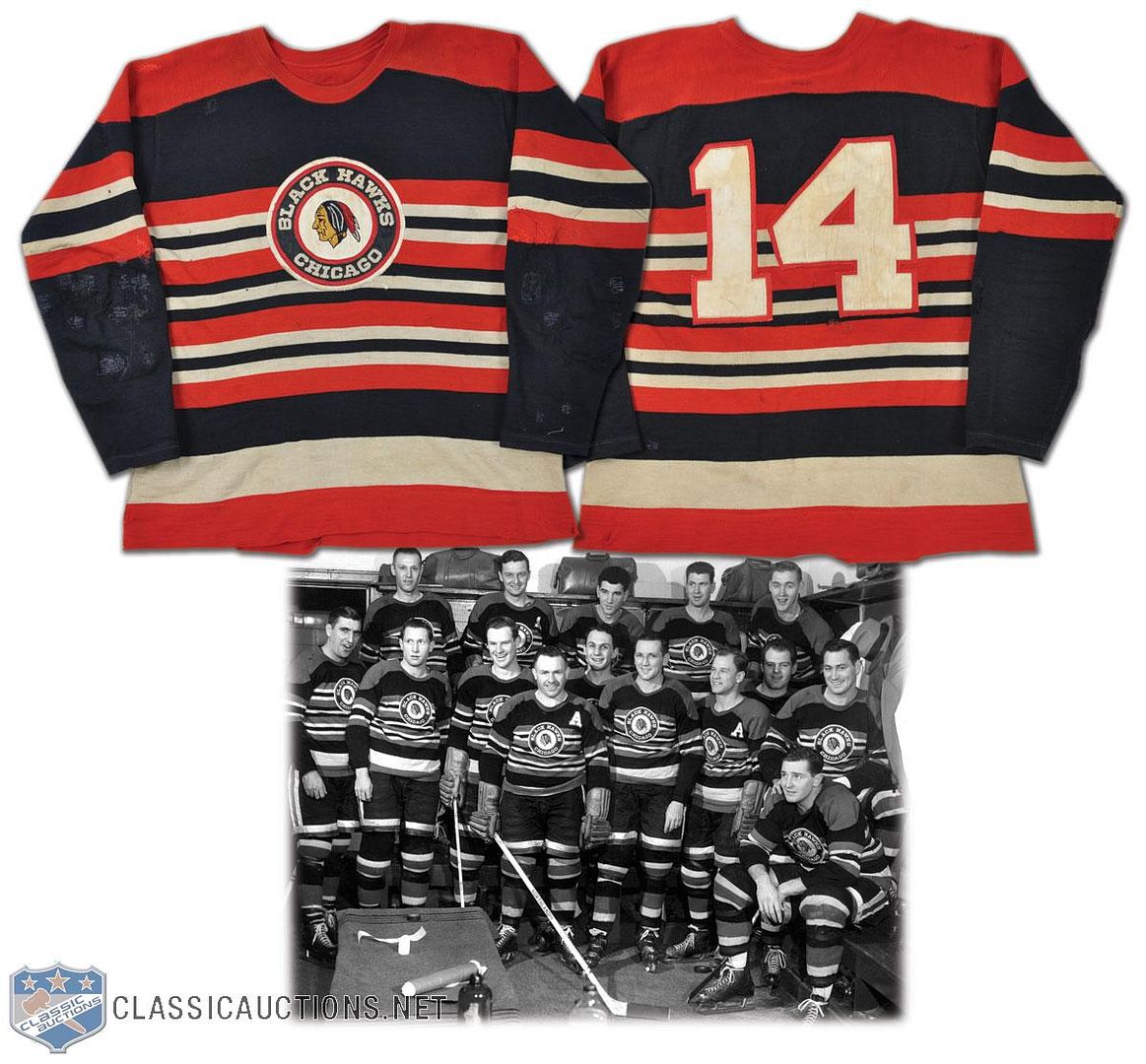
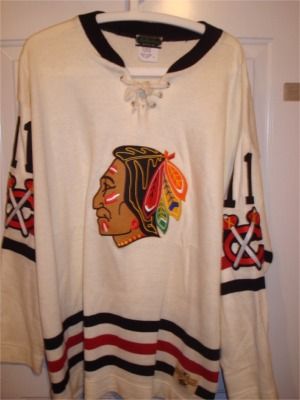
  • We move on to an Original Six team. I have to say that I am a huge fan of this Blackhawks sweater from the 1950s. The colours, the stripes, the logo, the font... it truly is a thing of beauty! If there was ever an opportunity to bring back a different alternate jersey for the Blackhawks, this one gets my vote.
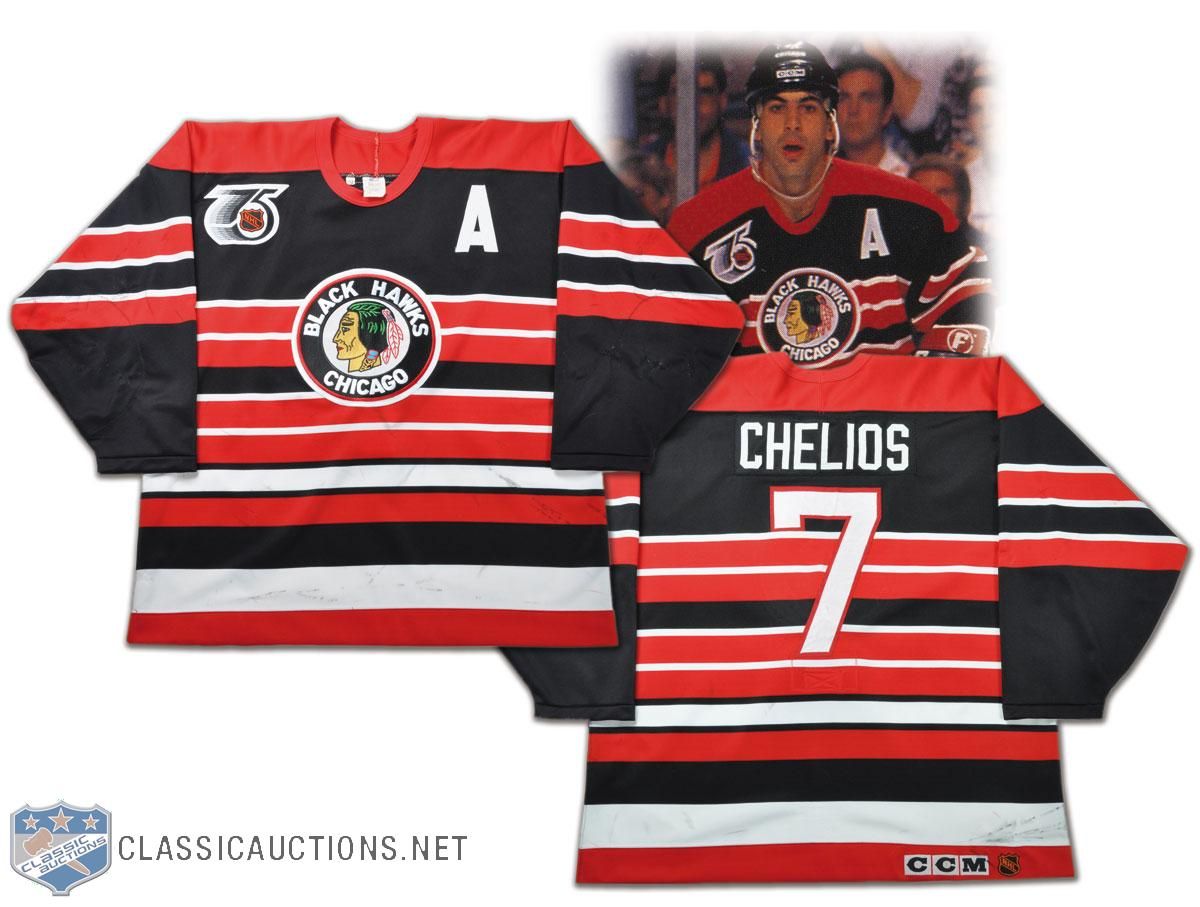
  • Strangely enough, the Blackhawks have worn this look closer to the future. In 1991-92, the NHL had the Original Six teams wear a throwback jersey, and the Blackhawks decided on a jersey that looked remarkably like their sweaters from the 1950s. Two things I don't like: the rear font they decided on, and the name on the back. The font is just too skinny, and if you're going to throwback to a previous incarnation, go all the way or don't go at all.
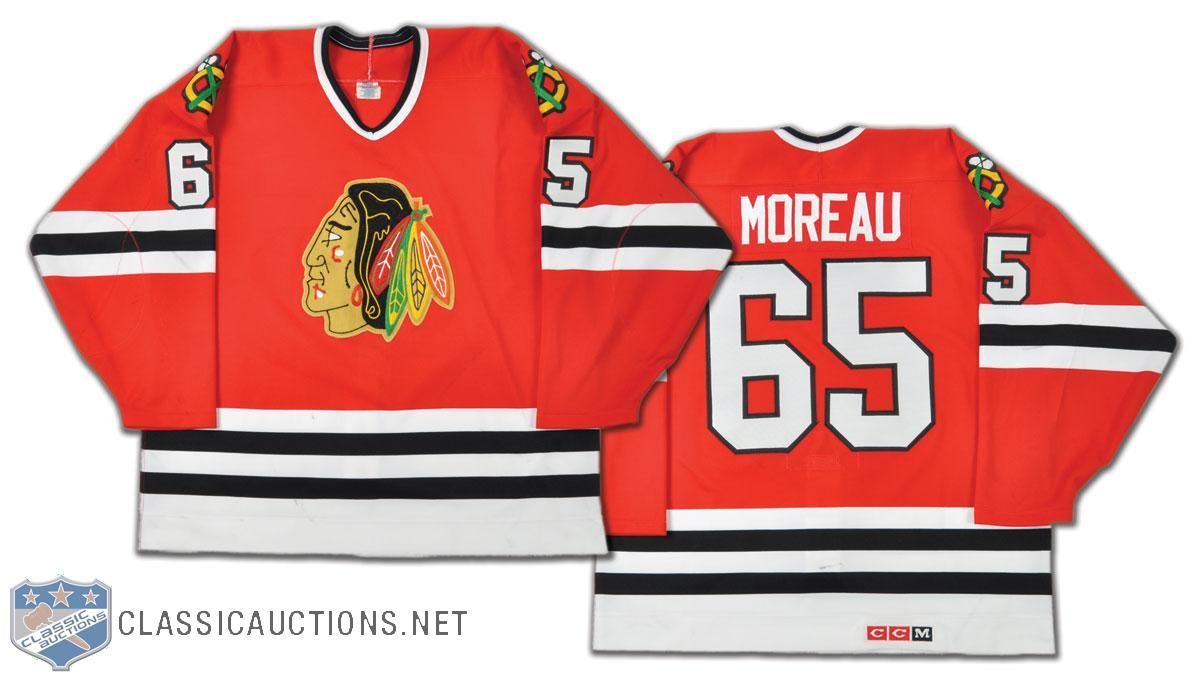
  • This is a rare find, but I'm always intrigued when I come upon a number that I've never seen a player wear. Ethan Moreau apparently wore #65 during the 1994 preseason! If you're a Moreau fan, this number is one of those rare finds - much like Joe Sakic's #88 jersey when he played with the Nordiques!
  • When you think of the Vancouver Canucks, does anyone else miss this look? I'm sorry, but as good as the current look is, there is still something about the skate logo that I truly miss about the Canucks. Maybe we'll see these beauties come back as an alternate one day? No one did yellow-orange-black like the Canucks did.
  • As much as I hated them as a Penguins fan, there is something magical about the red-white-and blue of the Capitals. But I do have one question about this Doug Jarvis jersey from the early-1980s: why are the hem stripes so huge? They literally go right to the logo which is mid-torso! That's a little crazy.
  • Just because there aren't enough Sutters in Calgary, here is more proof that the Sutter bloodline runs through the Flames. That's Shaun Sutter's jersey from the 1999-2000 season. Shaun is the son of Brian Sutter, and was drafted by the Flames when his dad coached there. Currently, Shaun serves as an assistant coach with the WHL's Regina Pats.
  • I've looked at this before, but there was something going on with the Philadelphia Flyers in the late-1970s and early-1980s. Check out the location of the captain's "C" on Bob Clarke's jersey from 1976-77. It's nearly in the middle of his chest! And it's still pretty close to his mid-line in 1980-81! What gives? Why is it so close to the middle of his chest?
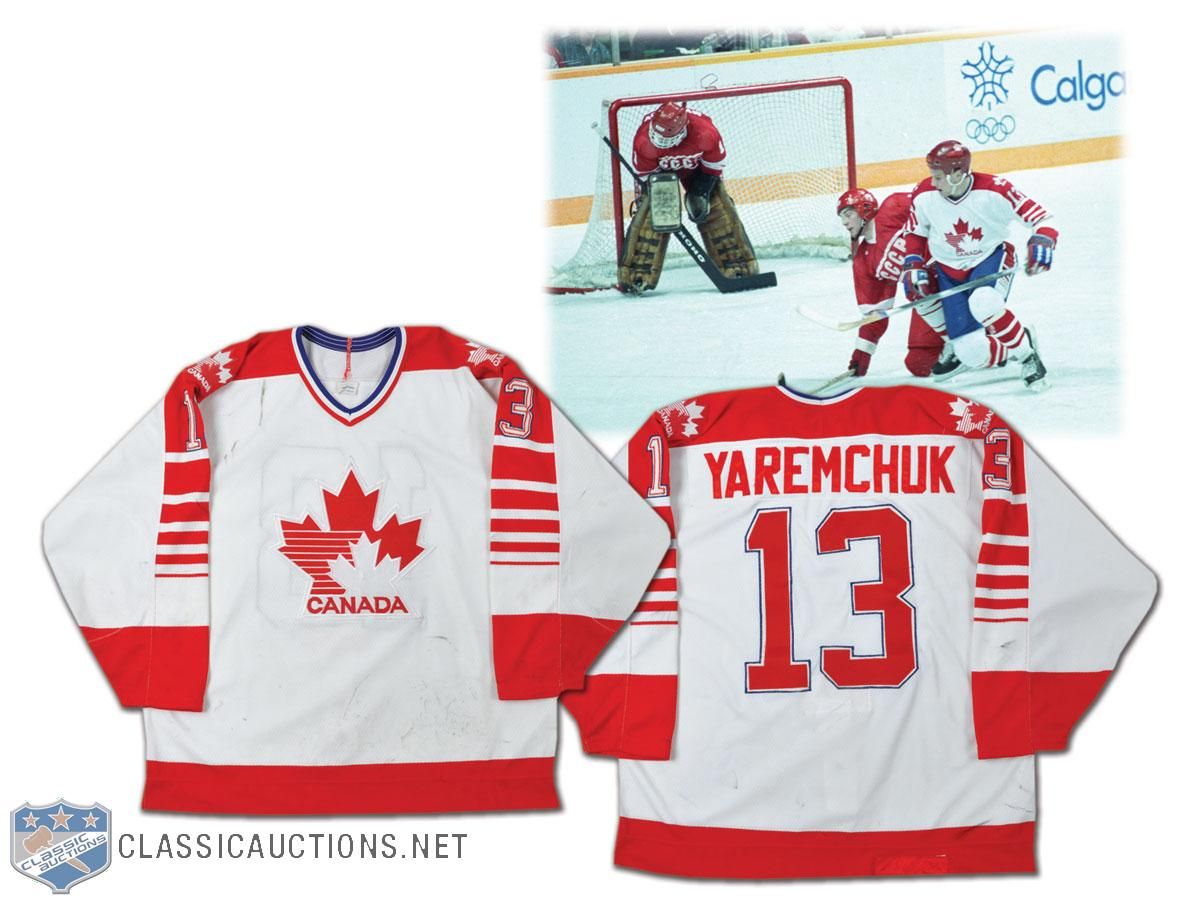
  • We move to the international scene. There's a big story surrounding the 1988 Canada Olympic jerseys that I wasn't aware of before reading the story on the Classic Auctions site. This is Ken Yaremchuk's jersey, and he played alongside NHL players like Sean Burke and Andy Moog as they prepared to represent Canada at the 1988 Winter Games in Calgary. Here's the kicker: "An embroidered CCM crest on the rear hem has been covered with a patch of red tackle twill, obviously to comply with advertising guidelines. Canada received a fine of $100,000 for refusing to wear uniforms made by Tackla at the Games". I never knew that! Corporate America already had a hold on the Olympic Games back then! How cool is that little gem of hockey history? I'm hoping your answer was "very".
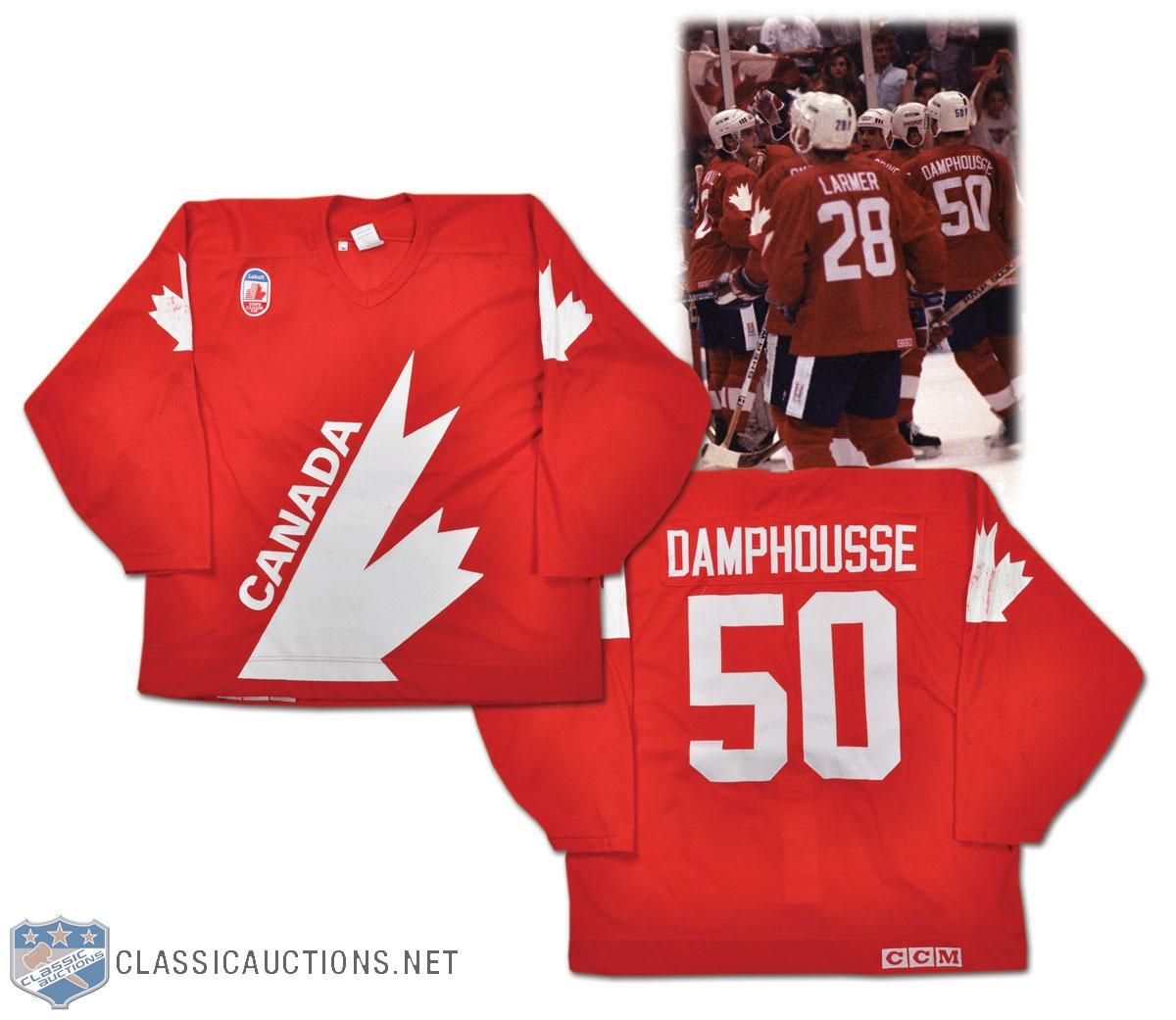
  • Here's a number that wasn't seen on the ice at the 1991 Canada Cup, but Vincent Damphousse played during the selection camp. He wore #50 through the camp as he worked to play his way onto the team, but he was cut days before the Canada Cup started. It's another one of those number cameos by a player who never wore #50 again. We'll see more of Damphousse later in this article as he has another jersey in this exposé.
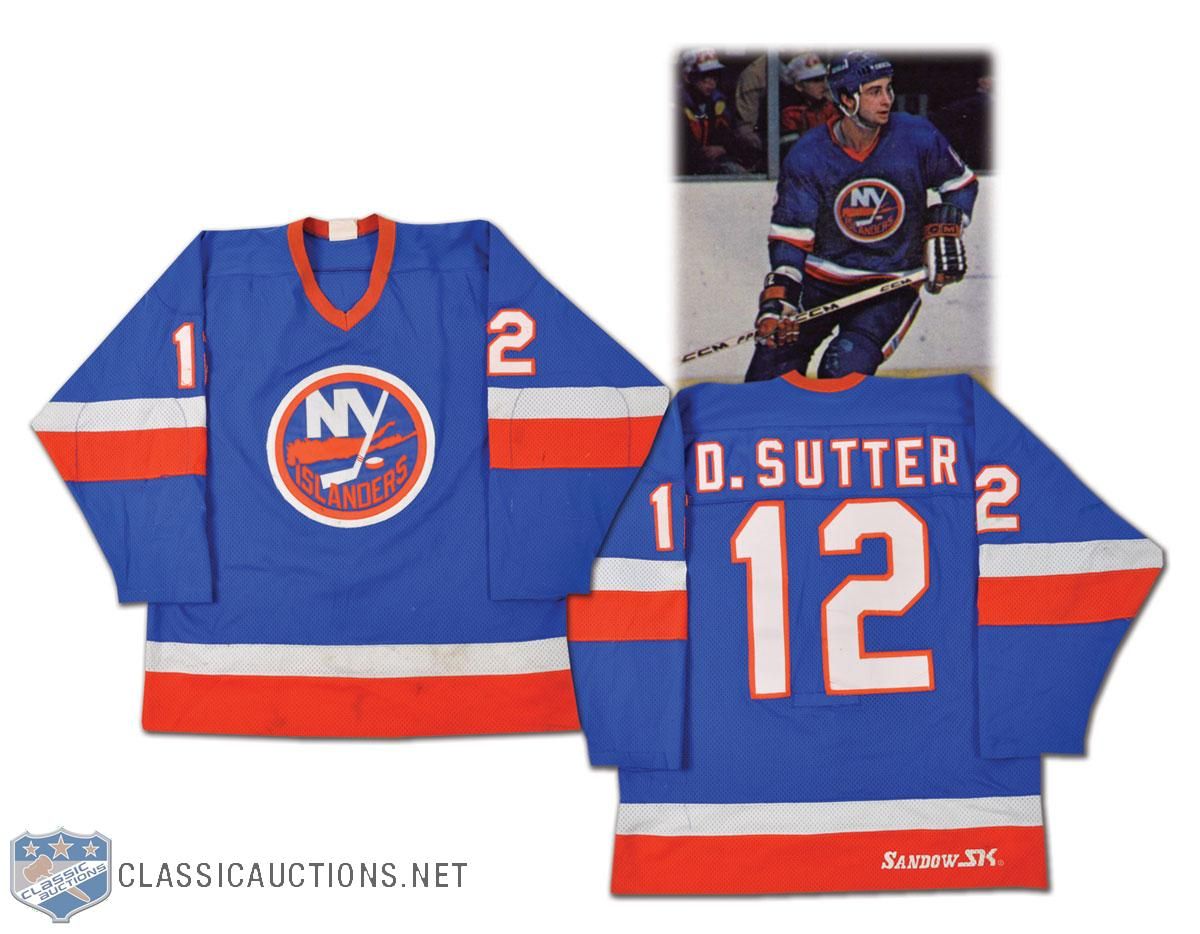
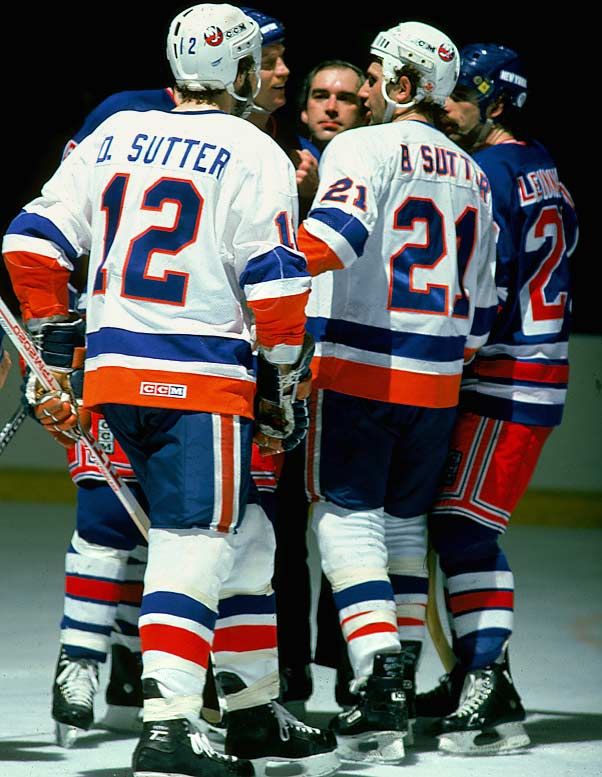
  • We mentioned a couple of Sutters already, so let's bring a couple more onboard in this article. We get a good look at Duane Sutter's jersey with the Islanders from '81-82, and I'm always a fan of the first initial on a jersey. However, as we look at this photo with both Duane and Brent Sutter in it, does anyone see a major difference in the lettering? Duane's appears as single-colour font while Brent's font is double-coloured. It appears this was corrected as of 1981-82.
  • With the Lightning changing their jerseys next season, it's always interesting to look back at some of their previous jerseys. Their inaugural jersey was interesting. Steve Kasper's jersey has that ridiculous font on it. I'm quite happy that it went the way of the dodo and was never seen again.
  • I have to say that I always loved the colours of the Minnesota North Stars. We get to see that gorgeous green colour of the North Stars jersey here on Basil McRae's uniform from the 1987-88 season. This is what Minnesota hockey looks like. Bring back the green!
  • Bob Rouse's jersey from his stint with the North Stars shows the addition of black to the colour scheme. This is how I think most people remember the North Stars. There were so many great memories of that Stanley Cup run in 1991 that ended at the hands of Mario Lemieux and the Pittsburgh Penguins in the final, but these great uniforms will stand out vividly in my mind.
  • The jerseys that the North Stars wore in 1991-92 really took leaps and bounds in the wrong directions with their "re-design". Nothing about that design even comes close to giving off that great North Star vibe, and it feels pretty bland as a hockey jersey. Little did the hockey world know that the "north" part would soon be a thing of the past.
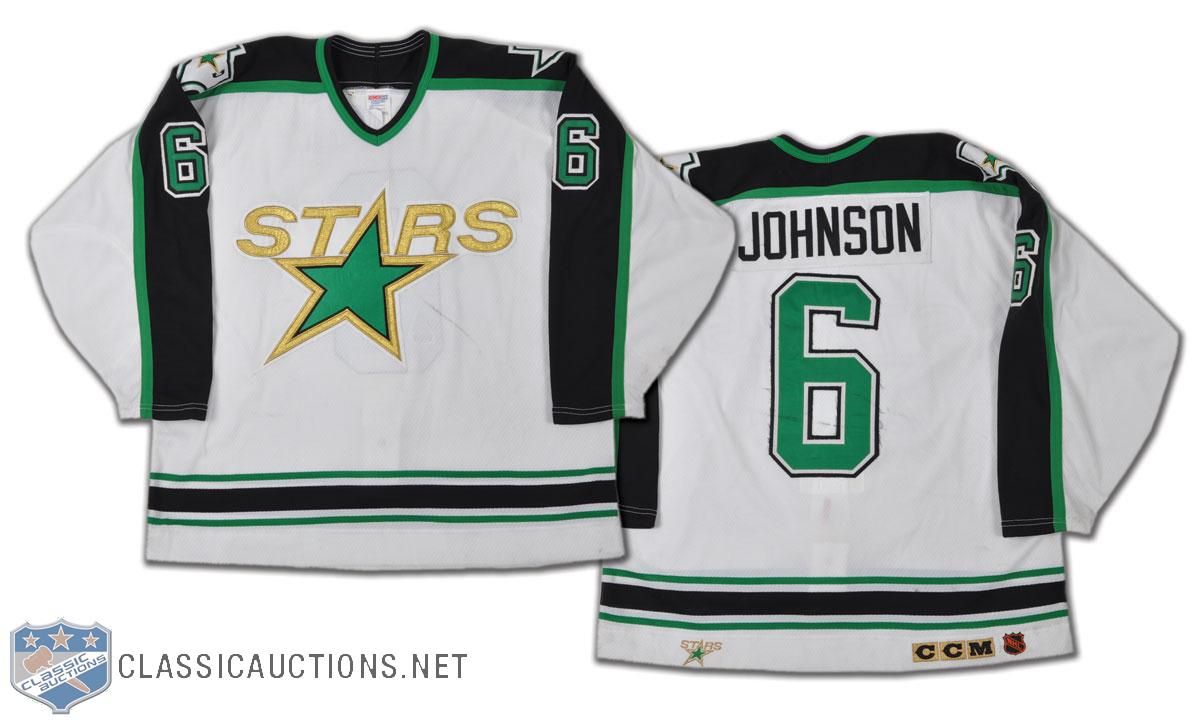
  • By 1993-94, the Stars would be playing in Dallas, and they would be wearing uniforms that seemed to have a lot in common with the earlier re-design. Note to self, fans: if your team suddenly begins to remove the parts of the uniform that make you distinctly unique like, say, part of the team name, I'd be suspicious.
  • Even the officials got in the act with some distinct designs. We've seen this image of Ron Ego calling a penalty in the WHA and discussed his red-striped officials jersey. I never scoured the internet for a picture with much intent because the referees seem to get lost in the shuffle of history. However, Wayne Mundey's referee sweater is a joy to behold!
  • The NHL officials showed that they wore the NHL colours for a long time as this official's sweater from the 1970s has orange numbering to match the NHL shield on the front! Wasn't it nice when NHL All-Star teams and NHL employees all represented the league by wearing the league's colours? The "good ol' days", I suppose.
  • The California Golden Seals seemed to miss the boat in the 1970s when they went pastel instead of staying true to their gorgeous green looks as the Oakland Seals. Bob Girard's uniform looks great, but it just doesn't have the same "pop" as the Oakland jersey does.
  • The 1975-76 Kansas City Scouts jersey is a nice blend of colours, but that logo really draws the eyes to it. That logo features chain-stitching, a favorite of Mr. Paul Lukas over on Uni Watch Blog. I'm not saying the colours should return in the same fashion, but I really think someone needs to come up with a new "Scouts" ensemble. Any takers?
  • Check out the logo on Nelson Pyatt's Colorado Rockies jersey from 1976-77. It looks a little off, doesn't it? That's because the Rockies didn't have their jerseys ready when the season started in 1976. The Kansas City Scouts had moved in the off-season before the 1976 season started to Denver, but they didn't have their jerseys ready in time for the start of the season. Thus the Rockies began the 1976-77 season with an odd-looking Rockies logo instead of their normal logos.
  • Speaking of another jersey that just doesn't seem right, here is a Penguins jersey from the late-1960s. The stripes being light blue just don't seem right after having seen them in yellow-and-black for so many years. Another of the jerseys lost in the annals of history, I suppose.
  • Don Maloney had an interesting career with the New York Rangers. While he wasn't officially the captain, he worked as acting captain whenever the Rangers saw their captain injured. Thus, he routinely is seen with the "C" on his sweater. However, Maloney is probably more well-known for his full name on the back of his sweater. I always thought that was pretty cool.
  • How many people remember Guy Lafleur's tenure with the Broadway Blueshirts? The original "Flower" laced up the skates with the Rangers for 67 games in 1988-89, netting 18 goals and adding 27 assists. I don't remember this, but Lafleur wore #44 while with the Rangers.
  • I found that the Detroit Red Wings did something as they evolved through the 1980s. In the late 1970s (and probably further back), the Red Wings used to use the wheel as the center point for their logo on their chests. The result? Greg Carroll's jersey looks seriously skewed because of the logo.
  • Another gorgeous throwback jersey from the 1991-92 season was worn by the Detroit Red Wings. Doug Crossman played with them that season, and the stripes make this jersey look amazing. This is still one of my favorite hockey jerseys of all-time.
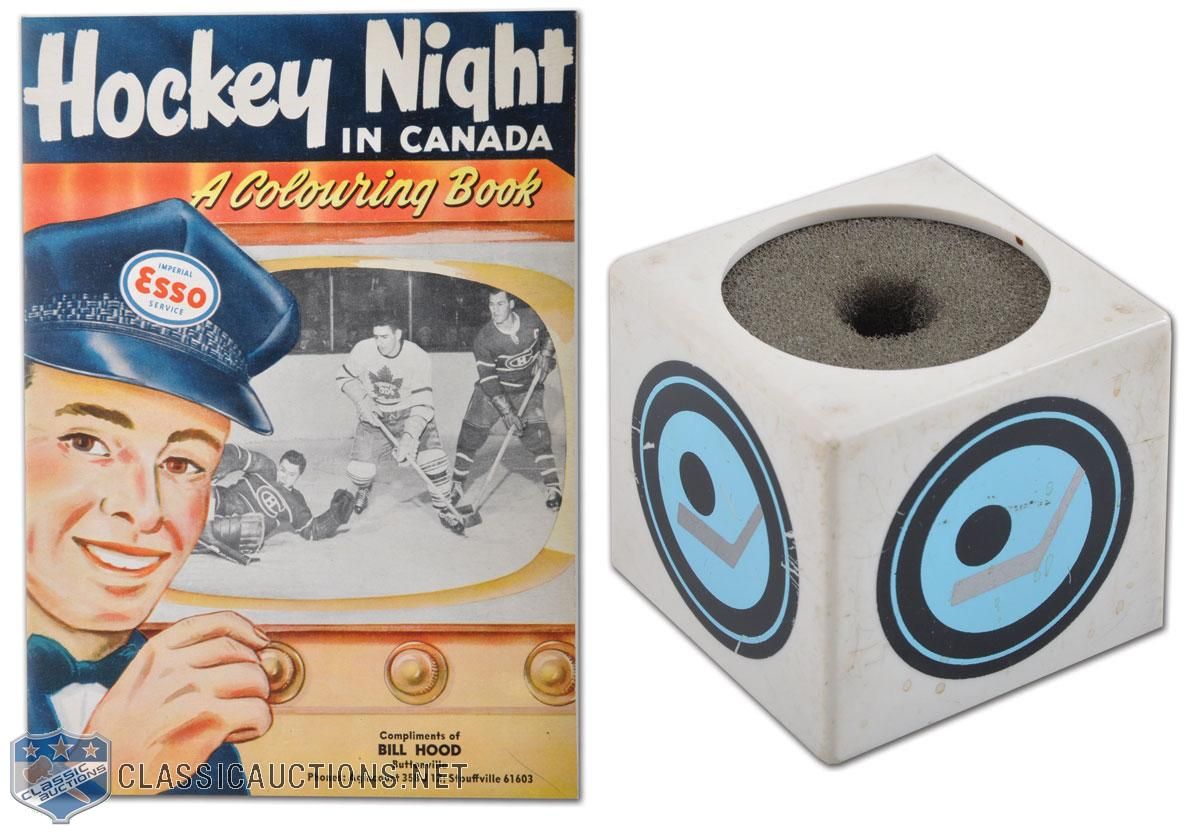
  • How cool is this Hockey Night In Canada microphone cover and book? Ok, the book isn't all that important, but how awesome would it be to have that microphone caddy? I might want one of those more than I want a fabled HNIC towel!
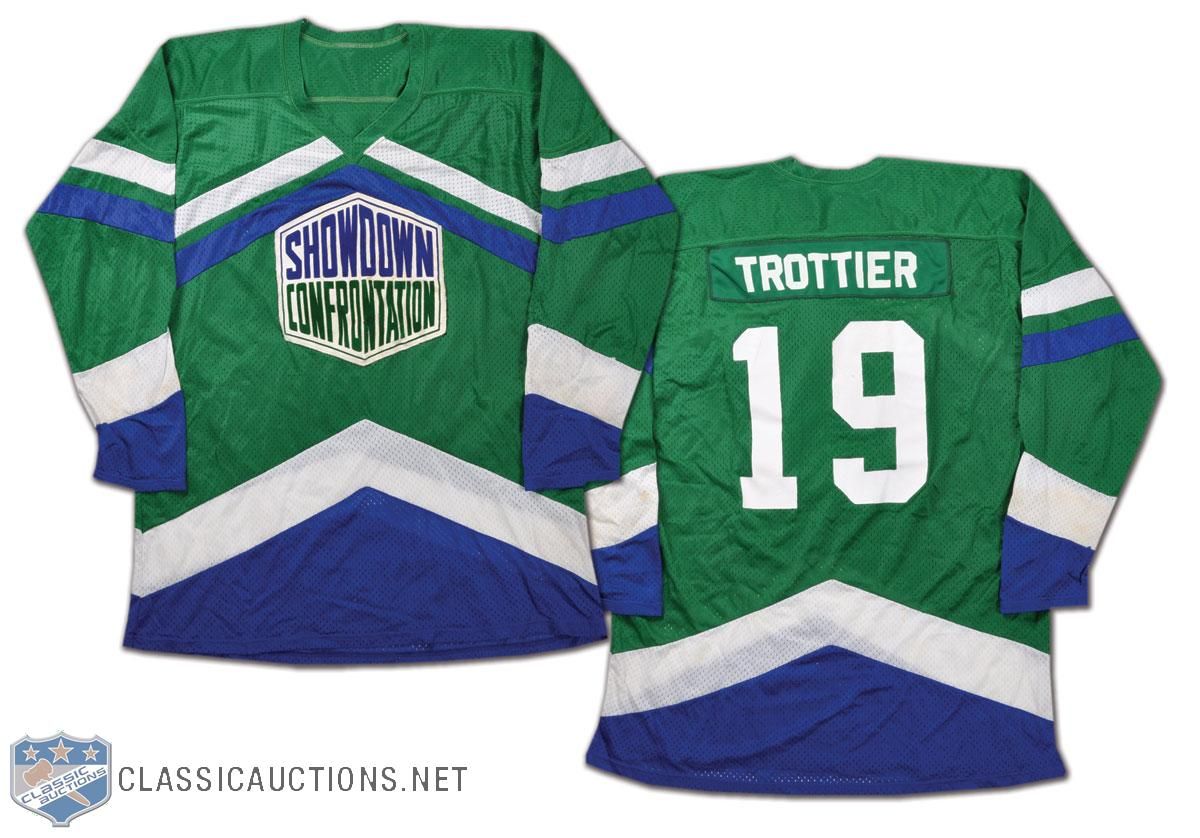
  • We've seen a number of the NHL Showcase Confrontation jerseys in the past, but there's another one in the auction this time around. Bryan Trottier's jersey is up for grabs this time, and I must admit that I really like the colours on this jersey. I may have to research these Showcase Confrontation games a little more!
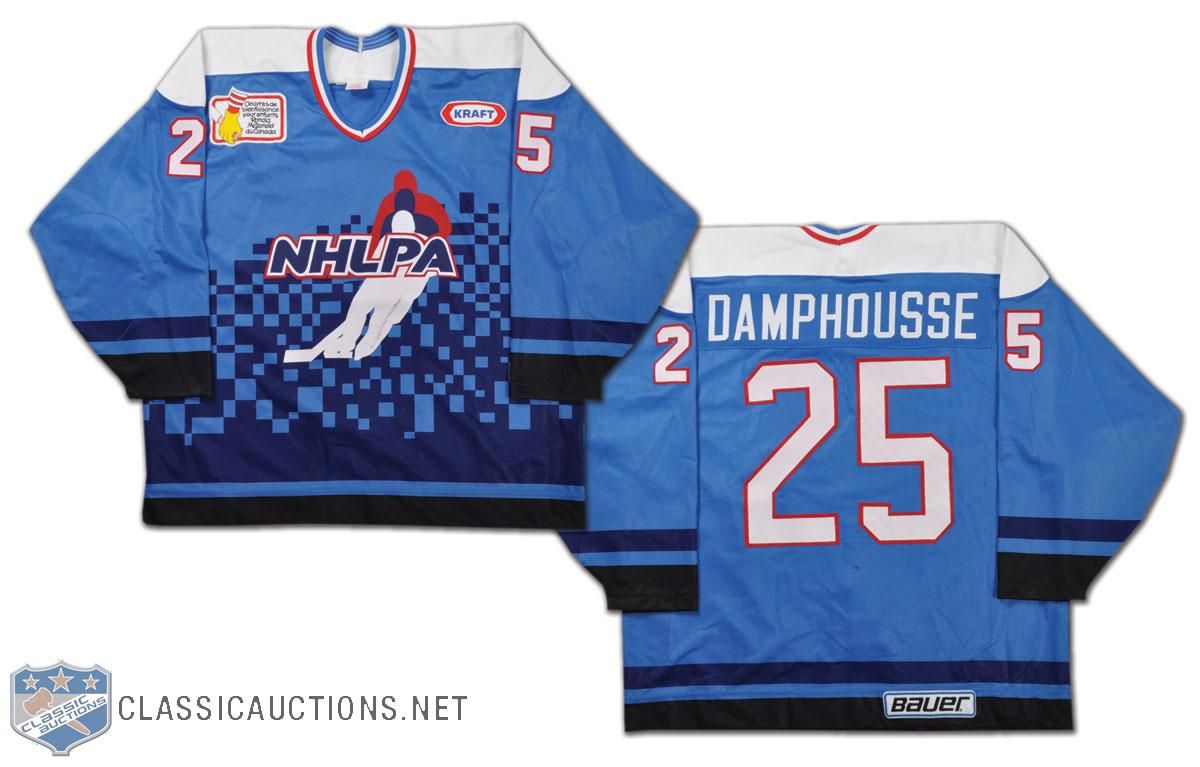
  • There are lots of people who saw the NHLPA 4-on-4 Challenge from Hamilton, Ontario in 1995, but there seems to be zero tape of these games online anywhere. During the strike, the players got together at Copps Coliseum in Hamilton to play some four-on-four hockey while representing their respective regions: Western Canada, Ontario, Quebec, and the USA. Vincent Damphousse was invited, and he played for Team Quebec at the event in this gorgeous NHLPA jersey. I want it!
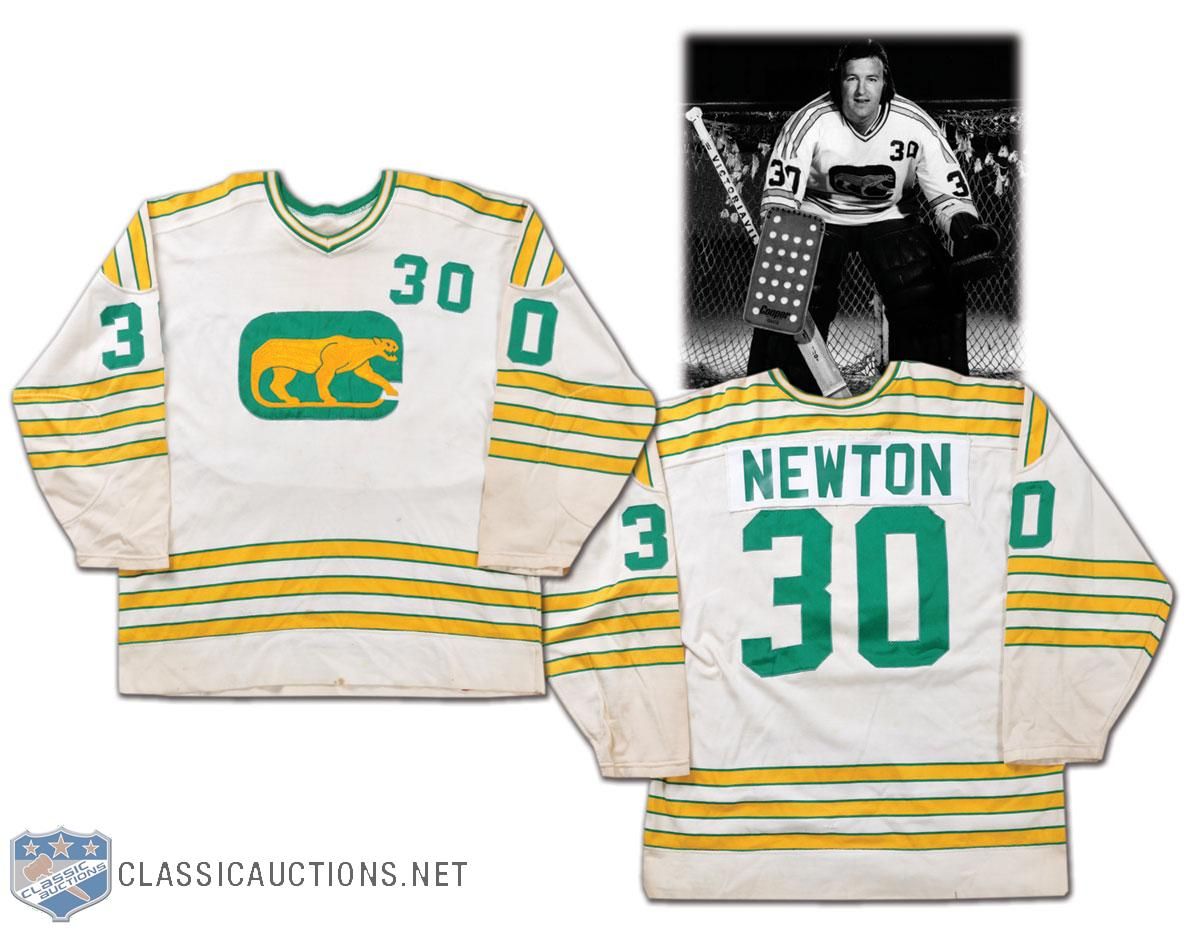
  • We started with the WHA, so let's end it with a few WHA sweaters as well. The original team with the number on the shoulder was the Chicago Cougars, and Cam Newton's jersey from 1973-74 shows the number clearly. I'm still not a very big fan of having the number on the front of the jersey in hockey, but it seems to have made a comeback with some of the NHL teams today.
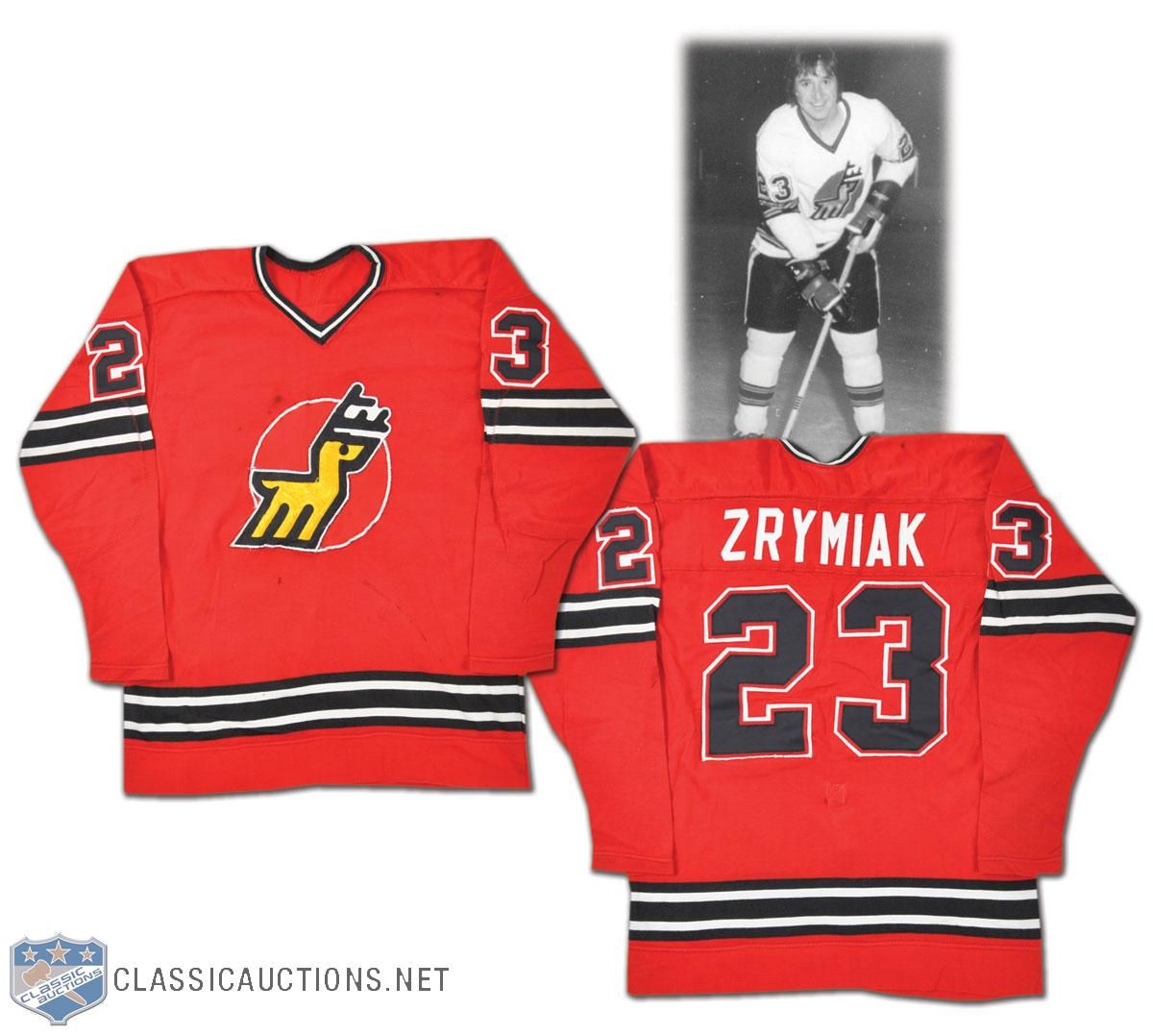
  • Journeyman defenceman Jerry Zrymiak bounced around the WHA for a while, but he played with the Michigan Stags for a while during the '74-75 season. I'm not sure about you, but the name "Michigan Stags" just sounds like a manly name. The colour is a little less manly, though. I love the Stags' logo, though.
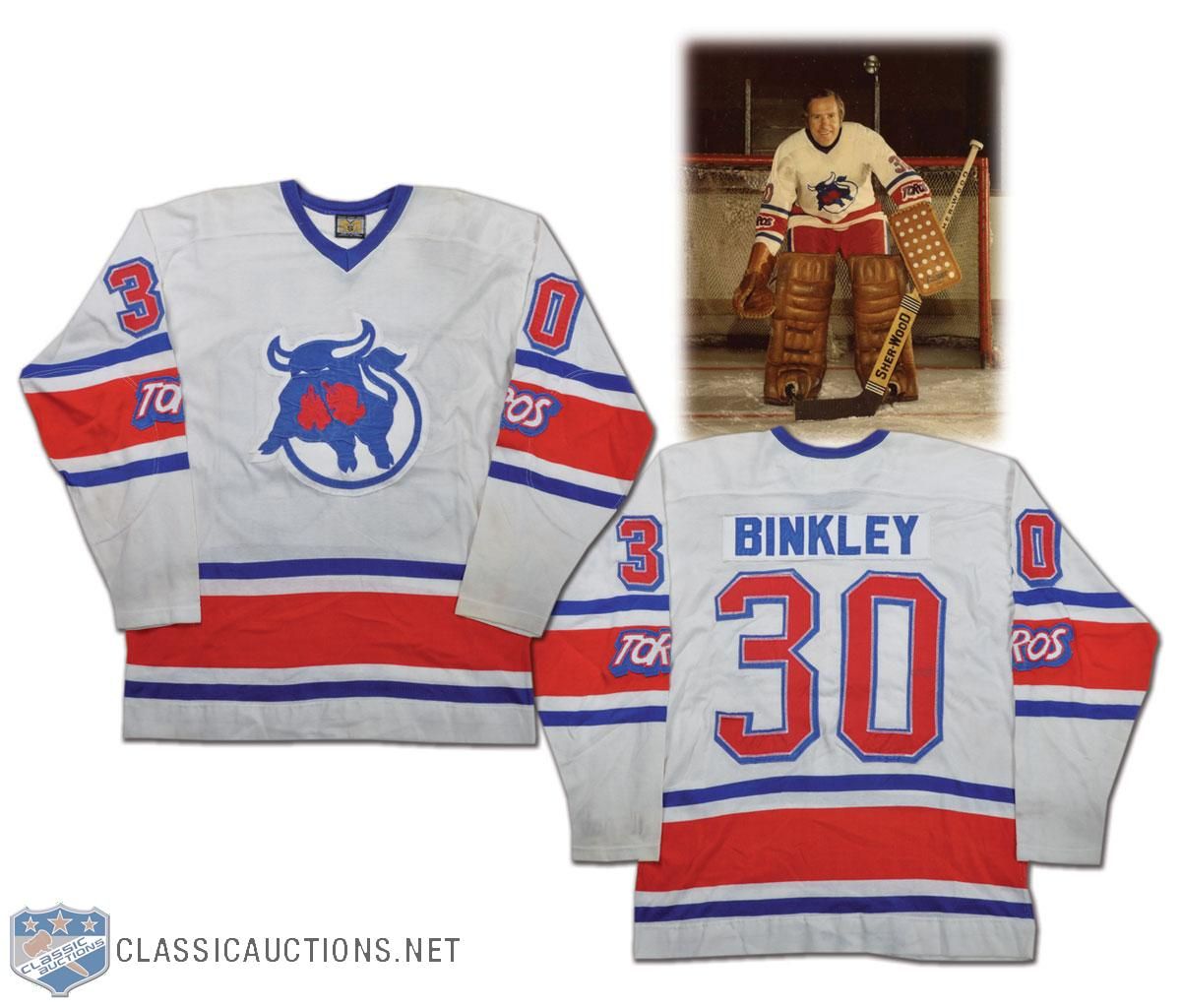
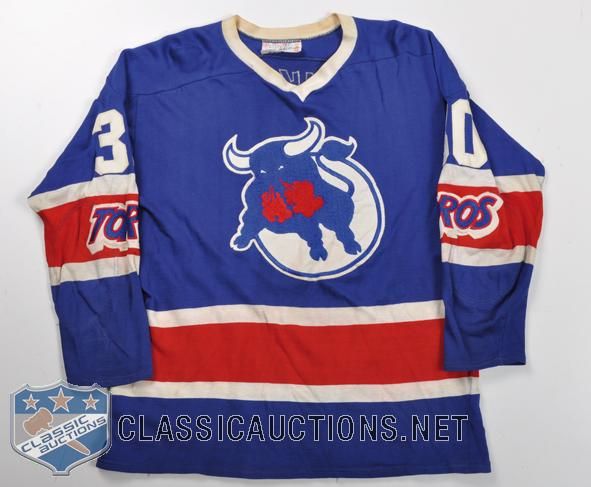
  • Les Binkley starred in net for the Toronto Toros in 1975-76. I like the colours of the Toros' jerseys, but the important part is the "Toros" mark on the sleeve stripe. That's a huge detail on these jerseys, especially when you consider that the team moved after the '75-76 season and became the Birmingham Bulls. Why is this important? Check out the similarities in the Bulls' jersey to the Toros' jersey. The only thing missing is the "Toros" wordmark from the sleeve!
There are a pile of incredible auction items available through the Classic Auctions website. I really would kill for that HNIC microphone cover or that Detroit TBTC jersey, but, being that I'm a poor college student, these luxuries will have to wait. If you're interested, get over to the Classic Auctions website ASAP!

Until next time, keep your sticks on the ice!
Tuesday, March 8, 2011

I've had a number of people email me over these last few days as the situation surrounding the Phoenix Coyotes nears the boiling point. I've said it before and I'll say it again right here: I'm not going to comment on any team moving to any other city without seeing the moving trucks heading out of town. Could I make comments? Of course. However, it's far better to not let speculation, innuendo, and rumour whip people into a frenzy when nothing may come of it. Besides, I still have a team that I'm passionately following, and I think that the AHL's Manitoba Moose are perfect for a city of Winnipeg's size. So let's tone down the Phoenix-to-Winnipeg chatter for the next few weeks, and let's focus on some more important hockey news.

First, some great news out of Toronto where the efforts to raise funds for the Pat Burns Arena has now broken through the seven-figure mark! The Stanstead, Quebec arena should not only wear Burns' name as a tribute to the NHL coaching legend, but all that he embodied should be a part of that arena. There still is some work to be done, though, as the city of Stanstead has to raise the remaining $1.2 million to reach the goal needed to put this arena on the map. Good job in getting halfway there! You're almost there!

Next, I received an email with a very impressive link in it, and I want to give some credit to Mr. Mark Divver for his work in researching Alton White's career at Providence as a member of the AHL's Reds. As you may remember from my January 29 article last year, Alton White was the first black player to record a hat trick in professional hockey and the first black player to record a 20-goal season as part of the WHA! Mr. Divver has taken a small part of Mr. White's hockey career and expanded on it wonderfully in his article. Thank you, Mark, for sending me a link to your excellent work!

Lastly, there was a very scary hit in the NHL tonight, and one player looks like he may not return until next season. Let's go back to January 8, 2011 where Montreal's Max Pacioretty and Boston's Zdeno Chara appear to be developing quite the rivalry.
Pacioretty scores the overtime winner, appears to shove Chara, and then a fracas breaks out. Fast-forward to tonight's game, and it appears this rivalry just crossed the line.
Wow. Listen to what NESN's Andy Brickley says in his commentary on the play:
"You cannot finish your check. You gotta release him... when that puck is chipped by. Chara's gotta let him go there. And not only does he ride him into the boards, he puts him into that dangerous spot and that is a defenceless position for Pacioretty."
I fully agree with Brickley's assessment on this one. Pacioretty was trying to go wide, and Chara was trying to slow him up. That's a textbook case of interference, but the fact that he was destroyed by the stanchion only makes this look a lot worse.

The good news is that Pacioretty was awake when they finally got him off the ice on a stretcher, so that's positive. He did spend approximately five minutes on the ice, so there is certainly some concern as to his long-term health. It's a scary situation, but I'm not sure that anything can be done in this situation in regards to punishing Chara. This is the kind of hockey play that coaches teach everywhere.

Personally, I'd like to see a game or two for Chara just for the NHL to send a message to the players that this kind of play, while a normal hockey play 99 out of 100 times, needs to be controlled. Thoughts on this one, readers?

Until next time, keep your sticks on the ice!

Sunday, January 2, 2011

The man to the left? Hockey legend. Chicago icon. Hall-of-Fame left winger. All three terms, plus many more, could be used to describe Bobby Hull. While the man's public life was certainly larger-than-life, his private life seemingly was kept guarded as he let his play on the ice do most of the talking. Thankfully, a new book has begun to pull back the curtains on Mr. Robert Marvin Hull as his life is examined in photographs in The Golden Jet, written by Bobby Hull and Bob Verdi, and published by Triumph Books. There are literally hundreds of photographs in this book of the big winger throughout his playing career, and some are fascinating in terms of what they show. That much being said, the pictures of Bobby Hull show just how fascinating this man is, and why he became the hockey icon that he is.

The story starts on January 3, 1939 when Robert Marvin Hull is born in Point Anne, Ontario as the fifth of what would eventually be eleven Hull kids. His father, Robert Hull Senior, worked for the Canada Cement Company, and played hockey for the plant and in a senior men's hockey league. Just as Bobby Hull would turn out to be, Robert Hull was an imposing figure on the ice with his large frame.

Bobby quickly learned to skate with the help of his sisters, Laura and Barbara, and would often be out on the outdoor rink owned by the Canada Cement Company all day and into the night, stopping only for meals. Like most children from his generation, Bobby was assigned chores to do by his parents, and Bobby would have them done by six or seven o'clock in the morning so that he could spend all day on the rink. He carried water for his mother, shoveled snow around the neighbourhood, and chopped wood as part of his daily routine, as well as walking several miles to school every day. Bobby's muscular figure began to develop early thanks to these work-intensive activities.

Under his father's direction on the ice, Bobby learned the important skills that made him such a dominating hockey player: stickhandling, shooting, skating, and protecting the puck. As he developed and began scoring at amazing paces through various league, a Chicago Blackhawks' scout heard of Bobby's exploits. Bob Wilson made the trek to Point Anne, Ontario where he signed Bobby Hull, with his family's permission, as a 13 year-old as a player under the control of the Blackhawks.

From the jumping point, we break into the vast treasure trove of images inside the book. There are small captions and little bits of info about each picture, and the images are literally worth a thousand words. One of the earliest pictures in the book is of Bobby tangling with Jean Béliveau of the Montreal Canadiens in 1957. The caption includes some info about the game and who is in the picture before this is written - "Another wardrobe note:when I came up the numbers were above the tomahawk on the sleeve. Later, that was reversed". How cool is that? Bobby Hull was a Uni Watch member back in the late-1950s!

There were a number of shots in The Golden Jet that can be found on the Internet, but there were a significant amount that I had never seen before. The one thing that I did find interesting, though, is that for a book named "The Golden Jet", there are absolutely no pictures of him in the book as a Winnipeg Jet! For a man who brought instant credibility to the WHA and the Winnipeg Jets with his million-dollar signing, perhaps the name of this book is slightly misleading. In no part of The Golden Jet do we find pictures of the Golden Jet.

I found that slightly disappointing, especially when you consider all of the accolades he amassed as a member of the Winnipeg Jets and the WHA. However, after reading through the credits, one finds that this book is copyrighted by the Chicago Blackhawks Hockey Team. And there's the reason why this is a book about Hull's time with the Blackhawks, and no other teams are represented by Hull.

That being known, The Golden Jet is still well worth the money spent on it, and there are a ton of old photographs that will surely make you smile if you love hockey history. There are so many great images that just the pictures would be worth the selling price alone. To make things even better, the book comes with a DVD produced by Blackhawks TV featuring highlights, interviews, TV commercials, and behind-the-scenes clips from the Blackhawks' video library! So not only do you get the stills of Hull's greatest moments, but you also get some live-action shots of Hull's greatest achievements as well!

Overall, The Golden Jet is very enjoyable to read, and the DVD features bring the package together nicely. While I would have loved to see at least a few WHA moments whereby the Golden Jet got his name, this Chicago Blackhawks production is certainly well-worth the money, and definitely deserves the Teebz's Book Club Seal of Approval! Pick up The Golden Jet at your local bookstore today!

Happy birthday, Mr. Hull, as I'm sure you'll be celebrating tomorrow! May the good times keep on rolling for you!

Until next time, keep your sticks on the ice!

Friday, December 31, 2010

We're back for the second half of Hockey Blog In Canada's Year In Review. Champagne, good food, and friends and family should be on the docket tonight, so HBIC will run through some of the highlights from the second half of the year. Yesterday, we took a look at the stories from January to June that attracted some attention, and we'll do the same today as we work through July to December. Happy New Year, everyone, and we'll be back in the normal fashion starting on January 1 with more hockey-related news and stories. Until then, all the best in the new year, and may health and happiness find you no matter where you are!

July Highlights
August Highlights
September Highlights
  • September 4: HBIC's month-long road trip through the midwestern US takes me through Kansas City, Missouri. Lots of good hockey history in that city, and I look at some of it.
  • September 5: The following day had me in Oklahoma City, Oklahoma. Great city, and some solid hockey history there. I really enjoyed my time in the city.
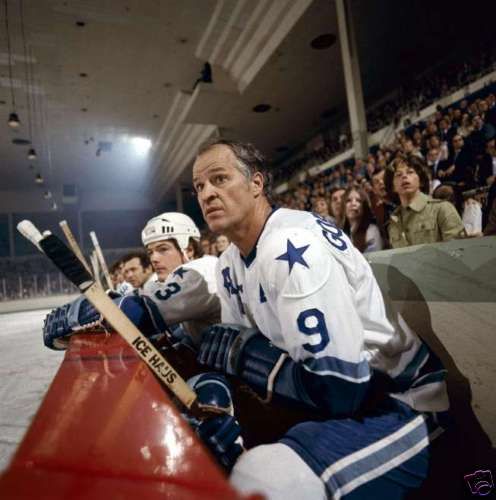
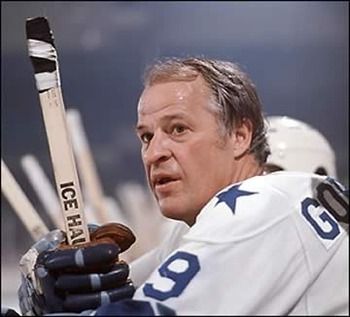
  • September 8: Houston's WHA era was interesting, and certainly has some very cool history behind it. The Howes, the flirting with the NHL, and their eventually dissolution are all covered in this piece.
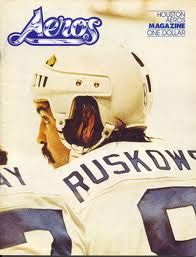
  • September 9: Houston's WHA Aeros led to the IHL's Houston Aeros being born in memory of the WHA franchise. Some more excellent hockey history here.
  • September 20: San Antonio is a gorgeous city, and I really enjoyed my time there. Because of my visit, I wrote a piece on San Antonio's hockey history.
  • September 23: My stop in Des Moines, Iowa was short, but I drove through the city rather than going around it. A lovely little city that has a solid hockey history attached to it.
  • September 29: The Whale return! Unfortunately for Hartford, the Whalers continue to not exist while the AHL's Hartford Wolf Pack will become the Connecticut Whale. I'm not impressed with these developments.
October Highlights
  • October 2: Washington shows off its uniform choice for the Winter Classic. While the jersey choice is highly appropriate, Reebok's lack of effort in recreating the uniform is more than disappointing considering the magnitude of the game.
  • October 17: Found some great viral video from France that features a guy showing people what it looks like when a player gets bodychecked into the boards. Hilarious!
  • October 29: The Penguins show off their chosen duds for the 2011 Winter Classic. It's kind of a mish-mash of former uniforms, but it gets a pass.
November Highlights
December Highlights
So there's another year down in the history of Hockey Blog In Canada. I'm really looking forward to next year already, and it starts with the 2011 Bridgestone Winter Classic tomorrow afternoon evening. Hunker down in front of the old cathode ray tubes, and enjoy some outdoor hockey from Sid the Kid and the Great Eight!

Until next time, keep your sticks on the ice!

Thursday, December 30, 2010

Time certainly has flown this year as we're two days away from recycling those 2010 calendars hanging on walls and posted on desks. Hockey has seen some great things this year, and we've also lost some icons that made the sport much better with their presence. We've seen players emerge as superstars and we've seen superstars fall to below-average play. All of this is actually a statement about the game - it's fluid, and it's constantly changing and evolving through each shift, each game, and each season. Today, HBIC looks back on the first six months of the year, and the important stories that came from January to the end of June.

January Highlights
  • January 1: We start every year off right with the NHL's Winter Classic, and the January 1, 2010 game was certainly memorable as the Philadelphia Flyers visited the Boston Bruins in historic Fenway Park. What a great day of hockey!
  • January 2: Switzerland's World Junior Championship team pulls off a massive upset as they defeated Russia 3-2 to beat the Russians for the first time in history at the WJC.
  • January 5: The 2010 World Junior Championship is decided in overtime as American John Carlson ends Canada's streak with his goal to give Team USA the gold medal. Great game, and a very impressive showing by America's best young hockey talent.
  • January 21: If you've been following this blog, you know I'm a big fan of Frank McClelland's newest equipment invention. January 21 was the first time I was lucky enough to speak to Frank and bring to light what would eventually be his Skate Fenders product. A very interesting story to see how the plastic skate guards got started!
  • January 23: I arrive in Minneapolis for the US Pond Hockey Championships, and the weather was very un-winter for the tournament. Strange weather is nothing new on the prairies, but January is rarely a month known for rain. Great uniforms seen at the tournament, and a few great stories!
  • January 25: I express my disappointment with the NHL's stance on protecting its players after a major incident in the QMJHL.
  • January 29: I bring to light the story of Alton White, the first professional black hockey player to record 20 or more goals in a season as well as the first professional black hockey player to record a hat trick in a professional game. Since it happened in the WHA, no one seems to care that he doesn't get this recognition. But I do.
February Highlights
  • February 5: The hockey world stops for a few moments to grieve the loss of Brendan Burke, Brian Burke's son. Brendan worked as student manager for the hockey team while attending the University of Miami (Ohio), but made headlines when he announced to the world that he was a gay man. And I still believe in my words: "Being gay doesn't change who he is or how much respect I have for him. Nor should it change you."
  • February 13: Phil Hecken of Uni Watch Blog and I take a look at what each team will be wearing at the Olympics. Some uniforms are good. Others are not.
  • February 14: I discuss some of the ways that women's hockey at the Olympics can fix blowouts between the elite teams and the rest of the field. I still feel that getting more women involved from the other countries will make the game stronger.
  • February 21: Team USA plays a much more complete game in the round-robin at the Olympics and beats Canada soundly. I'm hard on Canada and praise the Americans. And this will only set up the inevitable.
  • February 28: The Goal. Need I say anything more? I take a look at the 2010 Winter Olympics as a whole, and celebrate "The Goal.
March Highlights
  • March 4: Frank McClelland returns with some updates on his Skate Fenders. I'm truly a fan of Mr. McClelland's and LSSU's work, and this product is something that players should really look into for their own health.
  • March 11: HBIC renews its commitment to the Vancouver Olympics by giving the sport of sledge hockey as much coverage as possible. I really like this sport, and there have been some excellent games as of late as a number of countries have improved in this sport.
  • March 18: One of the countries that has improved? Japan. They defeated the heavily-favoured Canadian squad by a 3-1 score in the semi-final to earn a berth in the gold medal final. If you haven't seen a game of sledge hockey in your life, you're missing out.
  • March 21: The 2010 Women's Frozen Four wrapped up in style as there were some incredible games played by the NCAA women. Congratulations go out to the University of Minnesota-Duluth Bulldogs who captured their fifth NCAA Championship!
  • March 30: The 2010 CIS Men's Hockey Championship wrapped up, and the Canadian collegiate champions are the Saint Mary's Huskies! Canadian collegiate hockey, while not as prolific as NCAA hockey, is certainly one of the places where NHL teams can find some hidden talent. There are lots of good players studying across Canada!
April Highlights

May Highlights
  • May 3: The KHL crowns a champion as Ak Bars Kazan won their second KHL Championship in consecutive seasons. While there are still major differences between the NHL and KHL, it appears that Kazan is becoming the "Detroit Red Wings" of the KHL.
  • May 7: I found a great article in Popular Science from 1935 about the game of hockey! It's a very good read with lots of pictures, but it goes to show that some magazines were covering hockey before it was popular!
  • May 14: A reader by the name of Chelsea sent me a great email about head trauma suffered by hockey players. She makes some excellent points in her email, and there are several NHL players who echo her sentiments.
  • May 23: The Czech Republic snaps the Russian's 27-game winning streak at the World Championships, and captured the World Championship title! Jaromir Jagr's reason for winning? "They had stars and we had guys who play in the Czech Republic, but this shows that talent doesn't matter - you have to work hard." Hard work, kids. I can't say it enough.
  • May 25: I still have no clue as to what happened to the Charlie Conacher Memorial Trophy that was awarded annually to an NHL player. Any ideas?
  • May 28: Damian Cox goes absolutely loopy with his suggestion that the Chicago Blackhawks change their logo because it's offensive. Cox stirring the pot? Nothing new.
June Highlights
So there are the highlights from the first six months of HBIC's 2010. I really had a great time writing this year, and the interactions with you, the readers, are what makes this so rewarding. I love reading other opinions and ideas, and I encourage you to continue to email, comment, friend me on Facebook, and whatever else you to do to send me your hockey thoughts.

More tomorrow as we review the year that was from July to December!

Until next time, keep your sticks on the ice!

Sunday, November 21, 2010

As you're probably quite aware, I love hockey history and quirky facts from the fastest team game known to man. There are lots of places to find these tidbits of information, but it's always handy to have a book full of interesting anecdotes and quips about the game of hockey. Admittedly, I could probably sit and read a book of historical and interesting hockey facts for hours. Because of that, Teebz's Book Club is proud to present Peter Puck's Big Book of Hockey, written by Brian McFarlane and published by HB Fenn and Company. Peter Puck, the "Poke-Check Professor", takes a front-and-center role in presenting some historical, unusual, and interesting stories from the game of hockey, and it's this look at hockey through the eyes of the affable Peter Puck that we get Peter Puck's Big Book of Hockey.

Brian McFarlane, the son of Hardy Boys author Leslie McFarlane, was working for NBC in the early 1970s. The Canadian sportscaster and author was asked by his boss at NBC to come up with a way to educate people in hockey. McFarlane's idea was Peter Puck, although the name was created by Joe Barbera, president of Hanna-Barbera Cartoon Studios who helped create the look of Peter Puck.

"When I was with NBC in 1973, my boss, Scotty Connell, decided that our intermission features needed to be more instructional in nature," McFarlane said. "He called Joe Barbera out at Hanna-Barbera, and said, 'We need a little animated character to describe hockey.' They asked me to send Hanna-Barbera some of my literature on hockey, some of my books, and describe what an offside is and icing and that sort of thing."

Now that you know how Brian McFarlane and Peter Puck came to be, Peter Puck's Big Book of Hockey, voiced by Peter Puck, contains a lot of information broken into distinct chapters:
  • Love That Hockey History! - all about hockey's beginnings.
  • The NHL's Fascinating Past - all about the NHL's history.
  • Those Cool, Courageous Goalies - all about goaltenders.
  • Getting An Early Start - all about youth and young hockey players.
  • Women Love Hockey, Too - all about the fairer sex in hockey.
  • Stanley Cup Facts and Follies - all about the big, silver trophy.
  • Some Fabulous Hockey Records... and a Few Less Memorable Ones - all about hockey records.
  • When Coaches Lose Their Cool - all about coaches.
  • Some of My Personal Favorites - all about Peter Puck's favorite facts.
  • Remember the WHA? - all about the WHA.
  • About the Game Officials - all about officials.
  • Hockey Here and There - all about facts and stories from random hockey locations.
  • What More Can I Say? - all about random hockey facts.
Needless to say, there is a wide range of hockey information contained on the 222 pages that Peter Puck has voiced. The facts that are presented are a variety: there are some that are known, and some that were completely unknown to me. What Peter Puck's Big Book of Hockey does is bring them all together in one place, and present them in an organized fashion.

Do you know who the youngest NHL owner was? Do you know who the first Russian-trained player to score an NHL goal was? What team did he play for? Why was 1989 a significant year for Europeans in the NHL? Do you know who the last goaltender was to play every minute of every game for his team, and what team did he play for? How many women have had their names engraved on the Stanley Cup? All of these questions are answered in this book, and Peter Puck's Big Book of Hockey presents it all in short, anecdotal form.

As stated above, there are some relatively well-known facts that are presented in Peter Puck's Big Book of Hockey, but there are a significant amount of facts that were unknown to me. The chapters are broken down into easy-to-read sections, and all progress chronologically so that finding a specific fact is relatively easy to locate. The one thing that this book required was an index for even faster referencing, but it's not that hard to find what you're looking for if you know what you need. Because of Mr. McFarlane's writing and knowledge of the game, this book is a "must-have" for all hockey trivia buffs and amateur hockey historians, and certainly deserves the Teebz's Book Club Seal of Approval.

As Peter Puck always says, "Love that hockey game!"

Until next time, keep your sticks on the ice!

Tuesday, November 2, 2010

We're back with another installment of photos and commentary as we continue to look through the Classic Auctions website. As we saw yesterday, there are a number of incredible old photos and many jerseys with some unique features on them that are being showcased on the Classic Auctions website. That being said, here is the second half of the Classic Auctions images with some of my commentary thrown in for good measure, but I want to start with something I found that is very cool and completely unheard of for me.

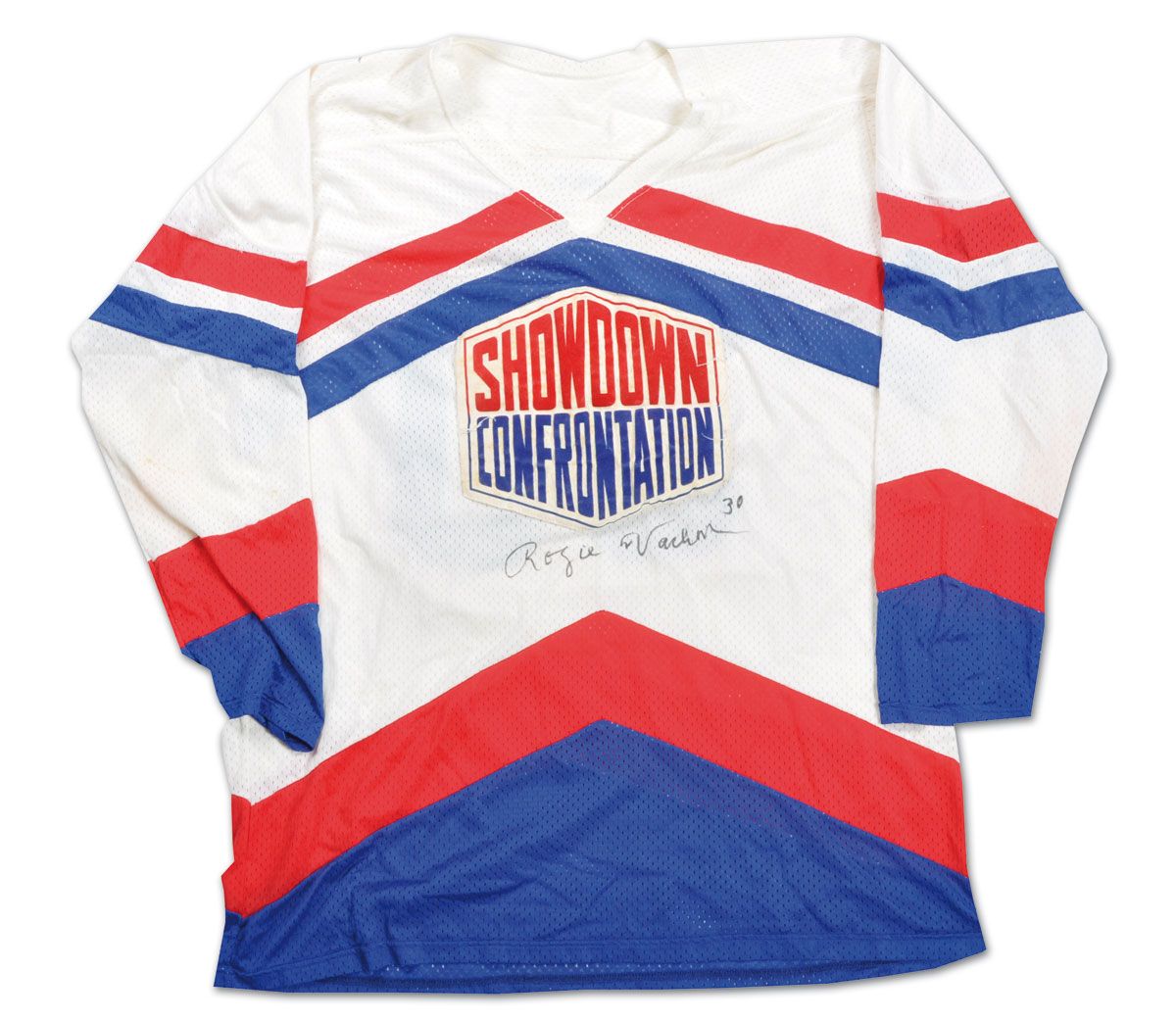
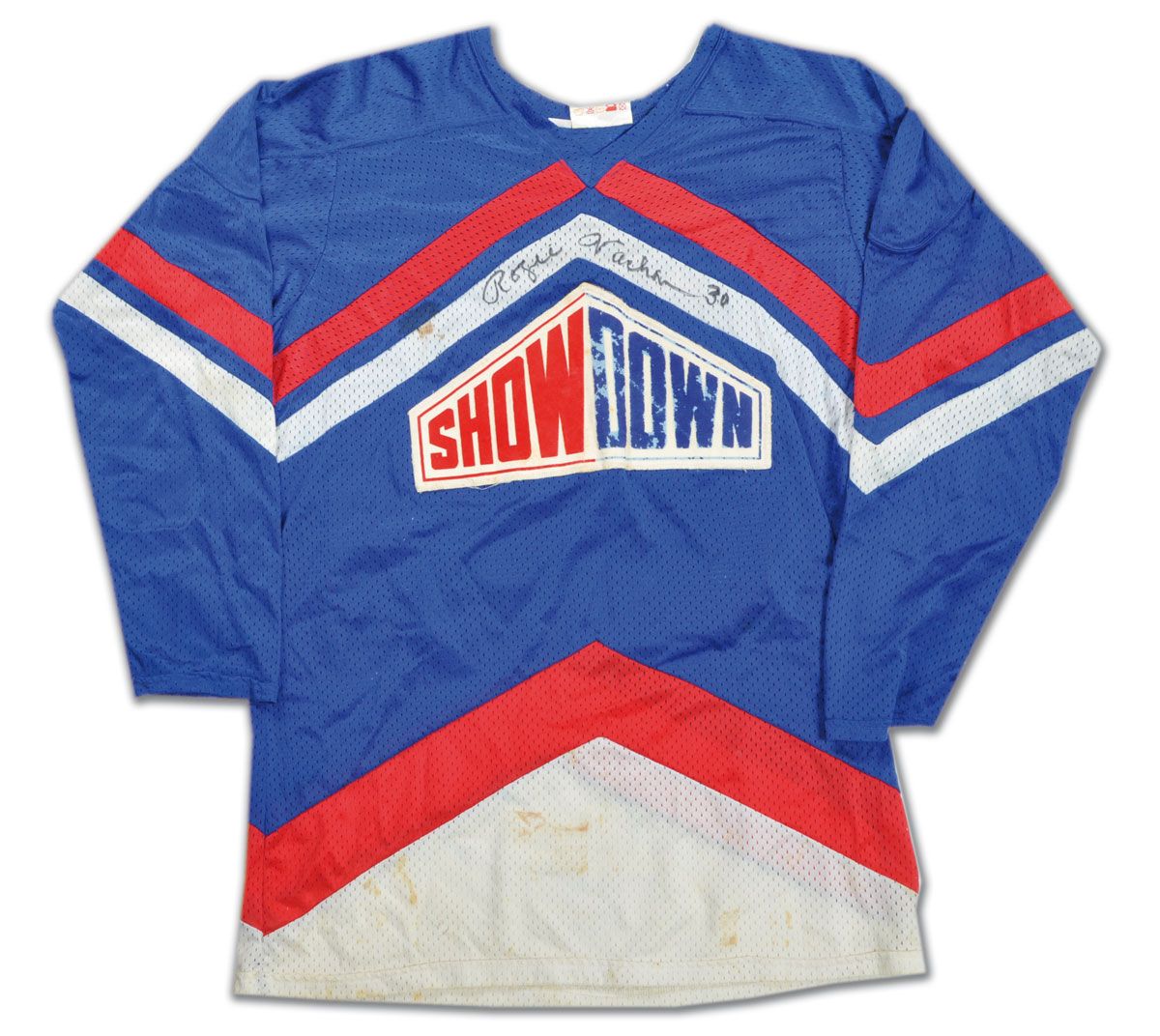
There's something to be said about some of the old promotional stuff that the NHL did to keep people in their seats. Does anyone remember the old "NHL Showdown" series between periods? Rogie Vachon was a participant, and he wore "Showdown" jerseys both at home and on the road. According to the Classic Auctions website, "Hockey broadcast intermissions throughout the 1970s featured the entertaining Showdown competition. Showdown began as a penalty shot tournament with NHL stars vying for cash prizes and bragging rights. Year-to-year variations such as skills contests, obstacle courses, and modified mini-games followed.... The L.A. Kings goalie's 'Fat Cats' won a 3-on-3 competition vs. Philadelphia goalie Wayne Stephenson's 'Sweathogs' to claim the $10,000 prize". Very interesting!

To prove that this isn't made up, here are the two parts of the 1978 Showdown between the Fat Cats and the Sweathogs.

Pretty cool, right? Why don't they do fun things like this now?

Anyway, let's take a look at some of the stuff found on the Classic Auctions website.
  • Rogie Vachon's Burger King jersey is up for grabs. If these jerseys weren't so damned expensive now, I'd totally add one to my collection.
  • Moving to another goaltender, if anyone thinks that the Bruins haven't been in Fenway Park in the past, they're totally wrong! That's goaltender Tiny Thompson standing between two members of the Boston Red Sox. Thompson is credited as being the first goaltender to stop the puck by catching it, and it appears he got some pointers from the BoSox players!
  • There's a good look at the 1926-27 Stanley Cup Champion Boston Bruins. The man pictured in the middle is Sprague Cleghorn. Two spots in on the right on the bottom row is a man synonymous with the Bruins. That's defenceman Edward Shore aka Eddie Shore! And the man in the suit in the top left? That's Manager Arthur Ross aka Art Ross!
  • One year later, the 1927-28 Stanley Cup Champion New York Rangers would be photographed. The key in the photo is the man on the second row, two in from the left right beside the bowl of the Stanley Cup. That is 44 year-old Lester Patrick who is listed as "Mgr. Coach", but appears in a uniform. Why is he in uniform? Patrick played in the NHL Playoffs as goalie for the Rangers after regular goalie Lorne Chabot went down with an eye injury!
  • We jump ahead to 1980-81 where the Philadelphia Flyers decided to change up the hockey world by wearing captaincy designations as white-on-orange-on-white. Another thing to note is how the sixes have that little piece missing as the loop closes on both the back number and the sleeve numbers. It's the first time I've noticed that on the Flyers' numbers for that era.
  • I've been critical of the teams that put their city names outside of their logo on the front of the jerseys (Dallas and Vancouver), but the 1986-87 St. Louis Blues did that with their team name. So, if you were to literally read the front of that jersey, Rick Meagher would have been playing for the Blues St. Louis Blues. Which sounds dumb.
  • I had asked before about the serifs on the Toronto Maple Leafs assistant captain designations from the 1980s, but have yet to receive an answer from anyone who hasn't basically said, "It is what it is". And they wore them both at home and on the road. However, I have now found that the serifs only appear on the alternate captain designations because Brad Marsh's last name doesn't have them despite the "A" on the front having the serifs. So what gives? What was the purpose of the serifs?
  • In keeping with the Maple Leafs, the 1950-51 Stanley Cup Champion Leafs received rings to commemorate their victory as the best team in the NHL. However, in keeping with Maple Leafs budgetary requirements at that time, the rings were quite simplistic and very plain. Not exactly a very memorable way to tell the world you were the best at what you did.
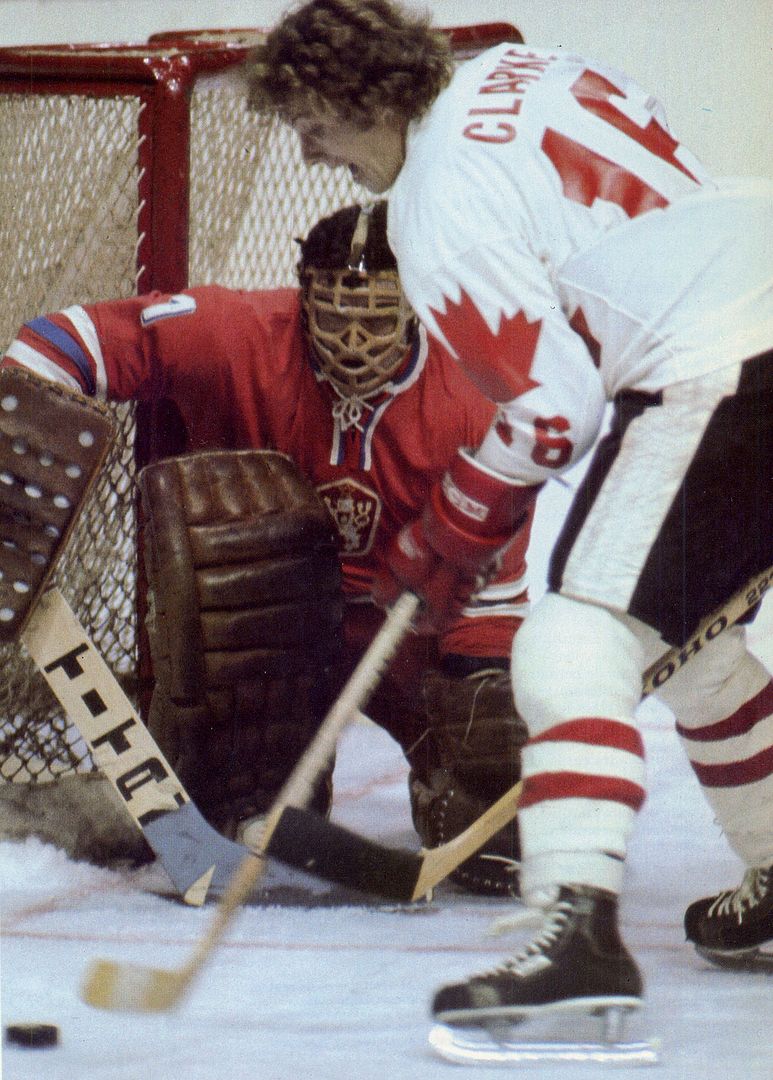
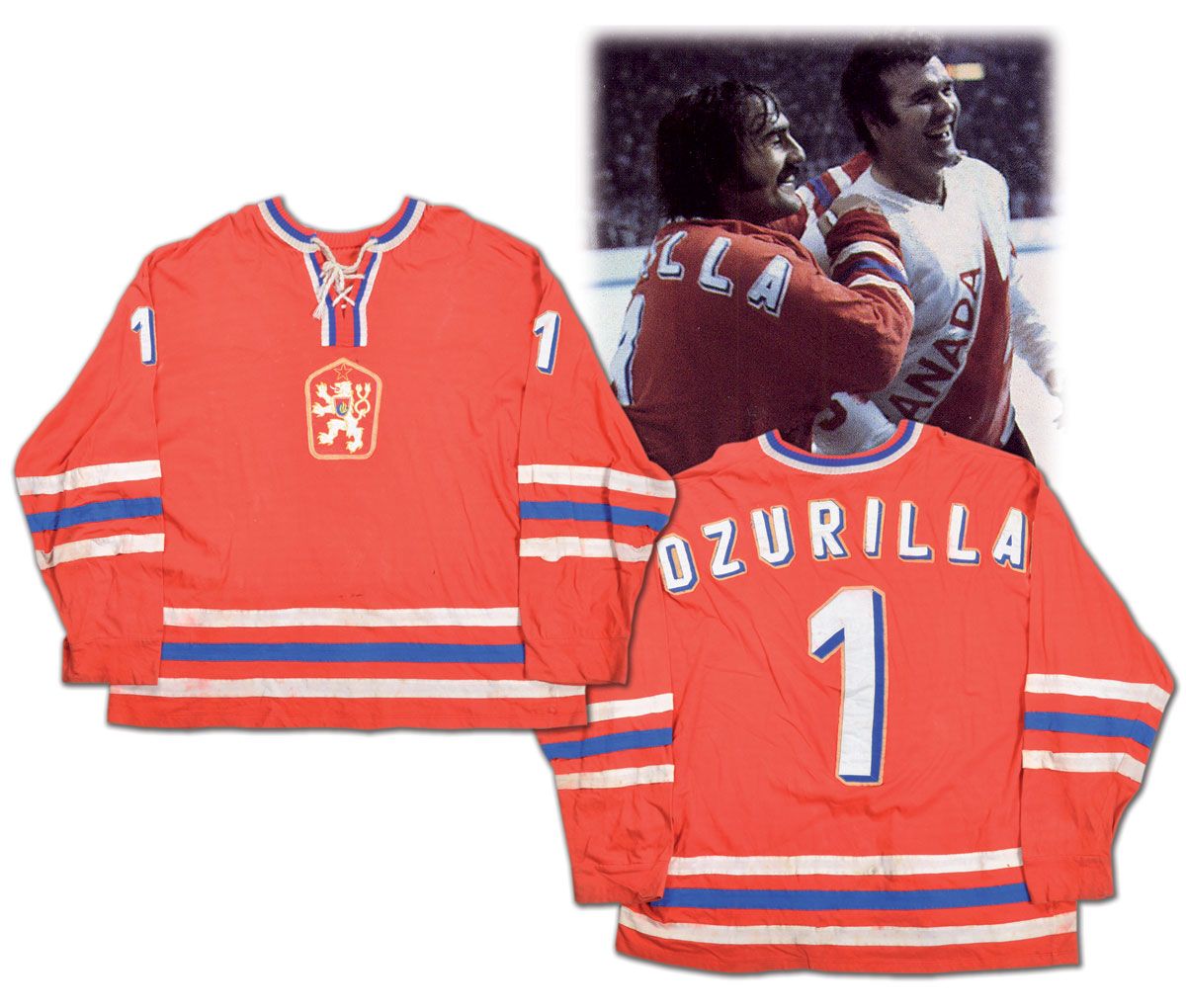
  • The 1976 Canada Cup saw a few of the world's hockey powers come together in the tournament. The Soviets were there as were the Canadians, but the Czechoslovakians were one of the better teams at the tournament. Backstopped by Vladimir Dzurilla, the Czechoslovakians played extremely well to finish with the silver medal behind Canada. They wore these simple yet gorgeous sweaters to compete in, and they certainly made an impact on the hockey world that September.
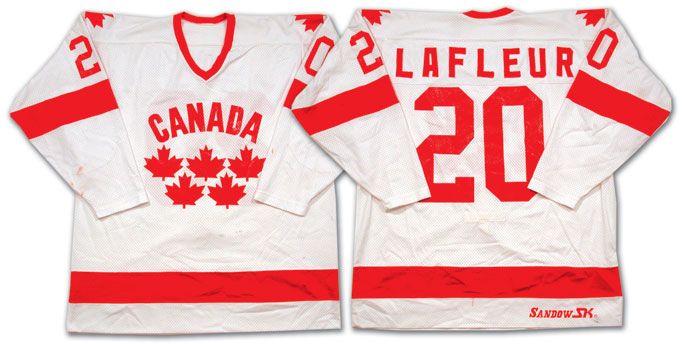
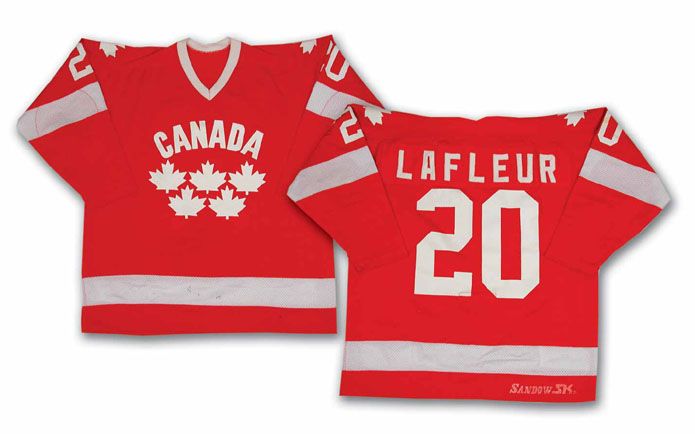
  • The idea of "less is more" is certainly prevalent in the international hockey world. After being stunningly eliminated in the opening round of the 1981 NHL Stanley Cup Playoffs, Guy Lafleur took his talents to the 1981 World Championships. It was there that Canada wore these uniforms when playing as the home team and these uniforms when playing as the road team. I have to say that I really like them, and Hockey Canada might want to look at a design like this if they ever run into another logo controversy at the Winter Olympics.
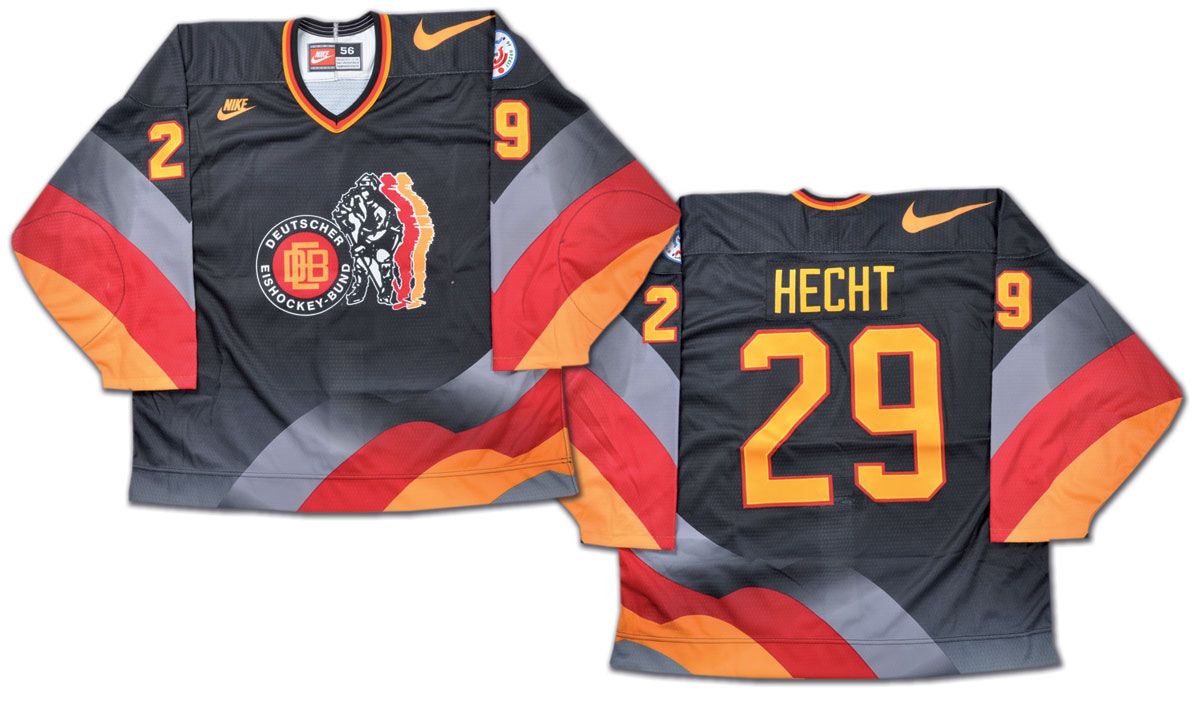
  • I'm not sure what Nike was thinking when they designed the German uniforms for the 1996 World Cup of Hockey. That's a horrendous design with the giant swoosh on the shoulders, the shadowed player in the middle of the uniform, and the wavy hem stripe. Thumbs down from this writer.
  • I wasn't aware of this, but Glenn Anderson's Hall of Fame induction night featured a horrific tribute jersey designed by sports artist Janet Deane. From the auction page, "Sports artist Janet Deane created this distinctive Anderson JAC (Jersey Art Collectible) jersey and brought a sample to the six-time Stanley Cup champion's Hockey Hall of Fame Induction ceremony in 2008. The Oilers great was so taken with the jersey that he collaborated with the artist to produce a limited edition of 300, of which this is number 236. Using Anderson's #9 Oilers jersey as a base, the artwork screened onto this "hockey card on a jersey" features highlights of Glenn's HOF hockey career, including his six Stanley Cup rings on the front of the upper left sleeve. Glenn has added his retired #9 to his blue marker signature on a JAC Hockey patch sewn on the bottom right front tail. The limited edition number "236/300" is written in fine blue marker on the right side of the patch. An "Anderson 9" patch, featuring the notation "Once an Oiler, Always An Oiler" and the team logo, is sewn on the left breast." Notice the part that I highlighted? Anderson actually commissioned her to make more of these! Seriously!
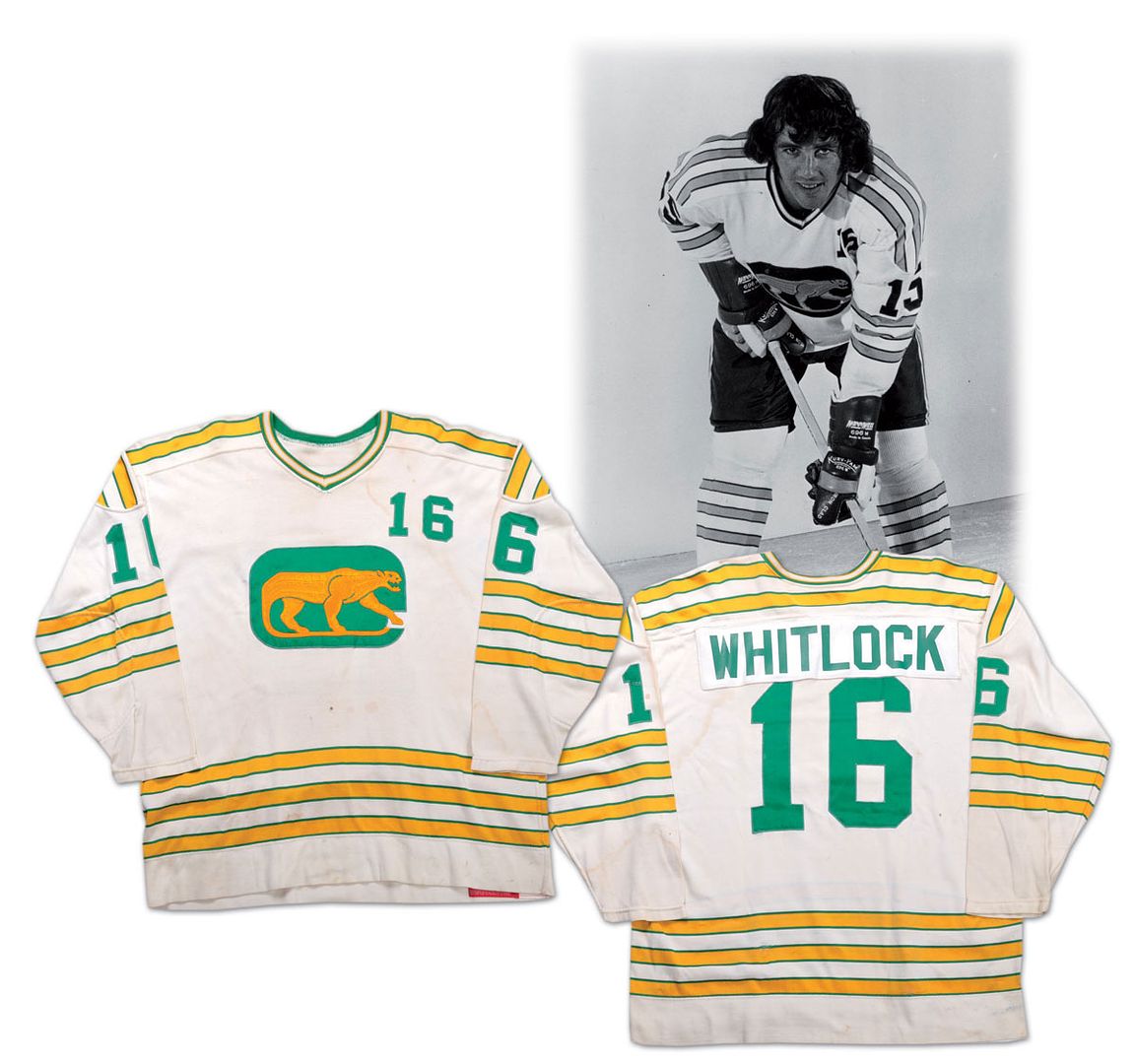
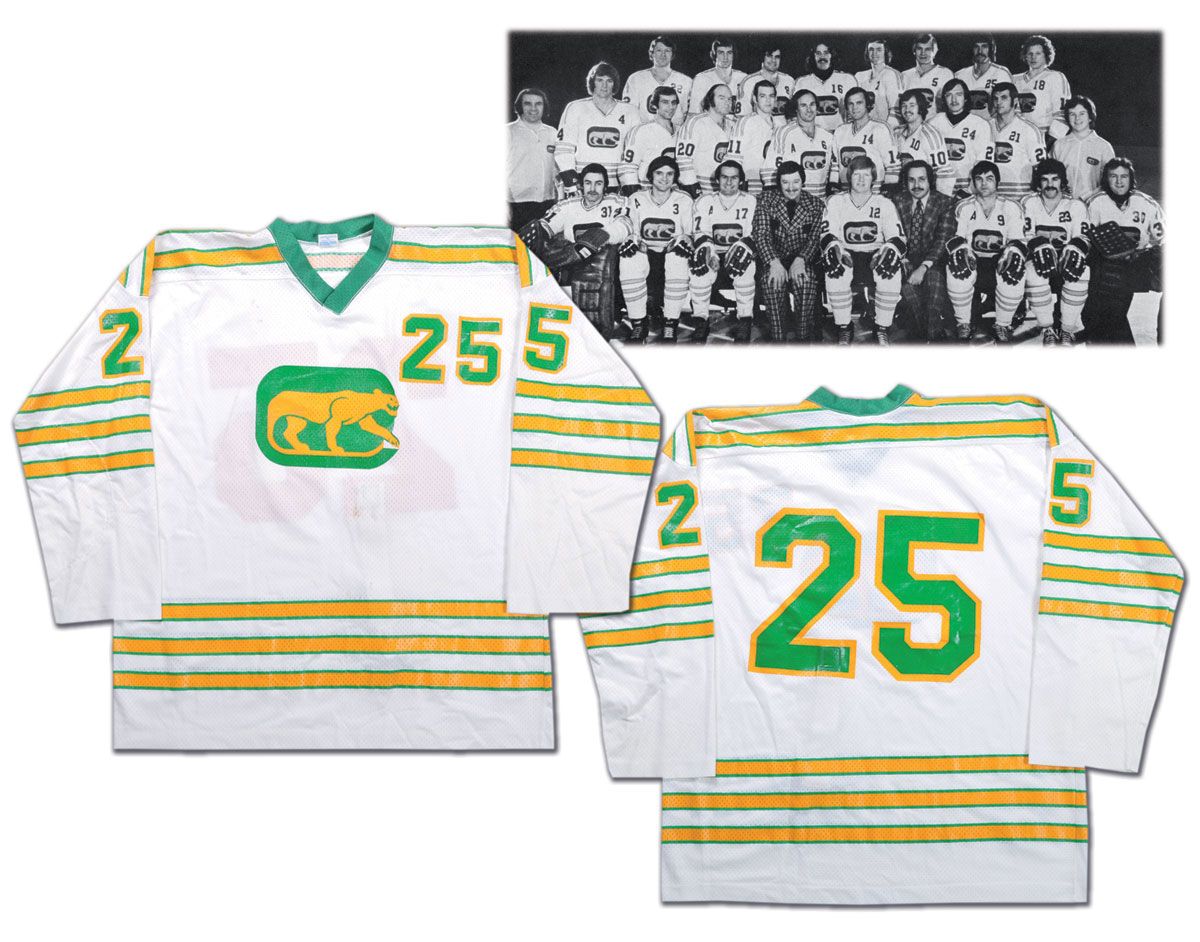
  • And we finish today by taking a quick look at the Chicago Cougars from the WHA. In 1972-73, you can see that the numbers on the jersey have no outline. Also, note the width of the logo and placement of the numbers on the front. By 1974-75, the Cougars had outlined the numbers in yellow, shrunk the logo down, and moved the numbers from above the top right corner of the logo to beside the right corner of the logo. Now, some may say that those are insignificant changes, but they are glaring changes to me. Anytime the logo becomes less important than the number on the jersey, your team has problems.
There is a second day of looks at items being featured on the Classic Auctions website. Again, I love all of the old, historical items featured on the site, and just cruising through the 1000 lots of items is like a trip down memory lane. I hope you found it interesting as well!

Until next time, keep your sticks on the ice!

Thursday, September 9, 2010

We check back in today with some more information on Houston's hockey history. As we saw yesterday, the legacy left by the WHA's Houston Aeros in this city might be difficult to match. Not only were they able to have coach Bill Dineen lure Gordie Howe out of retirement to play with his two sons, Mark and Marty, but the team was extremely competitive and twice captured the Avco Cup. Had it not been for some stubbornness on both the WHA's and the NHL's sides, there might be an NHL team in Houston about which I could be writing. Instead, the NHL wanted nothing to do with Houston, Texas in 1979, and the WHA's Aeros were forced to fold. Today, we pick up when hockey came back to town in 1994 as the Houston Aeros were revived in the IHL.

The 1994 version of the Houston Aeros were actually the second team in the IHL to use a former WHA name. The Phoenix Roadrunners were the first team on the scene, but the Aeros would outlive that franchise in spades, similar to their WHA days.

The 1994-95 season saw former Aeros player Terry Ruskowski behind the bench, guiding the team. They would finish in second-place in the Central Division with a 38-35-8 record. Mark Freer led the team in scoring with 38 goals and 42 assists, while Scott Arniel finished second in goals with 37 on the campaign. Troy Gamble, seen here with the Canucks, and Rob Dopson would split the goaltending duties, but Gamble was the better of the tandem as he finished with an 18-17-5 record, a 3.27 GAA, and one shutout. The Aeros would fall in opening round of the playoffs by a 3-1 count to the Phoenix Roadrunners, but their strong showing in their inaugural season would foreshadow great seasons to come.

The 1995-96 Aeros would miss the playoffs and finish dead last in the Central Division with a 29-45-8 record. The hiring of head coach Dave Tippett in the off-season would prove to be a wise choice as the 1996-97 Aeros rebounded to finish second in the South Division with a 44-30-8 record. Mark Lamb led the team in scoring with 25 goals and 53 assists. Tippett and Lamb took the Aeros to the semi-finals by sweeping the Las Vegas Thunder in three games and beating the San Antonio Dragons in five games.

However, they ran into the Long Beach Ice Dogs who knocked them out of the playoffs in five games. In their third season, Aeros fans were excited with their blue-collar team, and looked forward to the following season.

The 1997-98 Aeros finished second in the South Division again, this time with a 50-22-10 record. Brian Wiseman, seen here with the Leafs, led the team in scoring with 26 goals and 72 assists. The playoffs proved to be the Aeros' weak spot once more as the Milwaukee Admirals dispatched the Aeros by a 3-1 margin in the first round.

The Aeros were a determined bunch in the 1998-99 season as they marched through the IHL by posting a 54-15-13 record for first in the Southwest Division and first overall in the IHL. Wiseman was once again a scoring machine, notching 21 goals and adding an incredible 88 assists to lead the team. The Aeros received a first-round bye thanks to their efforts in the regualr season, meaning they waited until the second round to grapple with division-rival Long Beach Ice Dogs. Houston needed the full five games, but prevailed 3-2 over the Ice Dogs to advance to the Turner Cup Semi-Finals.

In the semi-final, the Aeros battled with the Chicago Wolves in a dogfight. Houston went up 3-1 in the series only to see Chicago win Games Five and Six to force a Game Seven at the Toyota Center in Houston, Texas. However, the Aeros managed to close out the series on home ice with a 4-1 victory in the final game. With that victory, the Aeros advanced to their first Turner Cup Championship!

In the final, the Aeros met the Orlando Solar Bears who finished third in the IHL's Northeast Division. Once again, the Aeros jumped out to a 3-1 series lead over their opponents. But the Solar Bears would not go quietly as they won Game Five by a 5-4 score in overtime before rallying in Game Six by a 3-2 score to force a Game Seven back at the Toyota Center. The Aeros would not be denied on home ice, though, as they defeated the Orlando Solar Bears by a 5-3 score to capture the 1999 IHL Turner Cup! For the third time, a professional hockey championship was delivered to the city of Houston, Texas!

The 1999-2000 Aeros saw head coach Dave Tippett leave as he was hired away by the NHL, and Ron Low would take over. However, Low would only be able to guide the Aeros to the semi-final in his frist season. The Aeros would finish third-place in the IHL West Division with a record of 44-29-9. That record was good enough to earn Houston a bye through the first-round. In the second-round, they eliminated the Utah Girzzlies four games to one to advance to the Turner Cup Semi-Final. The Chicago Wolves got their revenge in this series as they defeated the Aeros four games to two.

The 2000-01 Aeros would see another new coach as Dave Barr was hired to take over the reins. The Aeros would finish second in the West Division with a 42-32-8 record. In the opening round of the playoffs, the Aeros would make a return to Winnipeg where they would play the Manitoba Moose in the Turner Cup Playoffs. The Moose, who finished third in the West, found themselves down 3-1 in the series before pulling off the impossible. The Moose won Game Five in overtime by a 3-2 score, won Game Six in overtime by the same margin, and then rallied in Game Seven in Houston to eliminate the Aeros by a 3-1 score. Heartbreak is the only way this loss can be described as it appeared that Houston had this series won coming home.

In early 2001, it was apparent that the IHL was on thin ice. Travel costs combined with rising player salaries and competition from the American Hockey League forced the IHL into a corner. With little money to save several failing franchises, the IHL decided to close its doors for good. However, where the WHA failed, the IHL succeeded.

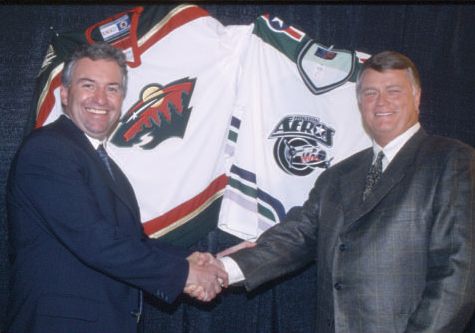
The AHL decided to absorb six IHL franchises into the American Hockey League. The six teams included the Chicago Wolves, Grand Rapids Griffins, Houston Aeros, Utah Grizzlies, Milwaukee Admirals, and Manitoba Moose as the American Hockey League looked to push into the midwestern USA and Canada. The franchises were allowed to align themselves with NHL clubs to bolster their rosters, and the Houston Aeros partnered themselves with the NHL's Minnesota Wild.

The strength of the young Minnesota prospects helped to bolster an already strong club, and the 2001-02 AHL Aeros finished second in the West Division with a 39-26-10-5 record under head coach Todd McLellan. The Aeros earned a bye in the preliminary round of the playoffs, and met up with their former IHL rivals in the Utah Grizzlies in the first round. It took all five games, but Houston knocked out Utah to advance to the second round of the Calder Cup Playoffs.

There, the Aeros met the Hershey Bears. After eliminiating one set of bears in the first round, the Aeros had no trouble with these Bears as they swept Hershey out of the playoffs. Up next stood a different animal, but a very familiar foe in the Chicago Wolves with a berth to the Calder Cup Final on the line.

It was a very different story against the Wolves as Chicago eliminated the Aeros by a 4-1 margin. However, the IHL's former teams had a very success first season as the Wolves went on to win the Calder Cup, and five of the six IHL teams made the playoffs in their first venture. Even more encouraging was the fact that Houston looked very good against the rest of the American Hockey League, and this was more foreshadowing for their success down the road.

The 2002-03 AHL season was a very good one for the Aeros as they finished first in the West Division on the strength of a 47-23-7-3 record, and ended up third overall in the AHL. Jean-Guy Trudel finished second in AHL scoring with 31 goals and 54 assists, just one point behind AHL scoring leader Steve Maltais.

The Aeros were seeded as the second-place team in the Western Conference, and this led to an opening-round matchup against the Milwaukee Admirals. The Aeros made short work of the Aeros, sweeping them out of the playoffs in three straight games. That led to a meeting with the third-seeded Norfolk Admirals. Much like the previous Admirals team, the Aeros defeated the Norfolk Admirals in six games to advance to the AHL Calder Cup Semi-Final.

It was here that the Aeros ran into the top-seeded Grand Rapids Griffins. Much like their history before them, the Aeros managed to go up 3-1 in this series. The Griffins, much like the Aeros' opponents in history, managed to claw their way back to a 3-3 series tie. Houston, however, played solid hockey on the road, and defeated the Griffins by a 2-1 score in Game Seven to secure the series win. Just to show how closely these two teams were matched, six of the seven games were decided by one goal!

The win vaulted the Aeros into the Calder Cup Final against the Hamilton Bulldogs who had been the best team through the regular season. Through five games, the Aeros found themselves with a 3-2 series lead. But these were the Aeros we were talking about, so you knew that Game Six would be a Hamilton victory. And it was as the score was 2-1 in favour of the Bulldogs. Houston, though, would not be denied. A 3-0 victory on Hamilton ice was all they needed to claim their first Calder Cup in just their second season in the AHL!

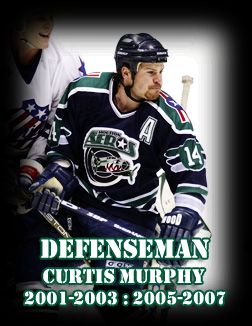
Goaltender Johan Holmqvist was named the Jack A. Butterfield Trophy winner as the Calder Cup Playoff MVP. Curtis Murphy was named as the Eddie Shore Trophy winner as the top AHL defenceman. Homlqvist also wrote himself into the AHL record books by recording the first shutout on the road in a Game Seven of the Calder Cup Final and by playing the most minutes in a Calder Cup postseason with 1498. Head coach Todd McLellan was named the top minor league coach by The Hockey News.

I'd say 2002-03 was a pretty good year for hockey in Houston, and the men listed above had pretty solid campaigns as well!

Since that time, the Aeros have lost in the Calder Cup Semi-Final once, and in the Conference Final twice. They have only missed the playoffs once since joining the AHL in 2001, and definitely one of the solid teams in the AHL at this point.

Thanks to Houston's growing legacy in hockey, there might be a time when the state of Texas can have two cities with NHL teams. Right now, though, the AHL's Houston Aeros are doing a fabulous job in keeping Houston hockey fans proud!

Until next time, keep your sticks on the ice!

Wednesday, September 8, 2010

Having finally arrived in Houston, Texas on Monday night, I've spent the last few days just trying to stay cool. The heat combined with the high humidity makes the environment like a sauna as Sage C. said in the comments a couple of days ago. What strikes me as interesting is that Houston, for the size of the city it is, could very well be an NHL city. However, the similarities to Winnipeg, a former NHL city, are not that far off in terms of its hockey history. Both cities had WHA teams that were bitter rivals, both cities had IHL teams that were bitter rivals, and both teams have AHL teams that are bitter rivals. What makes this story great is that Houston still has a very strong hockey following despite their teams being shuffled through several professional leagues, and this passion of Houston's fans have made Houston a very attractive city for professional leagues.

We'll start with hockey's start in Houston way back in 1972. The WHA had awarded a franchise to Dayton, Ohio, and the Dayton Arrows were to begin play in 1972. However, owner Paul Deneau was less than thrilled with Dayton's lack of enthusiasm for a pro team combined with its lack of a suitable professional arena, so Deneau didn't waste any time in moving the franchise to Houston, Texas.

In retrospect, this might have been the best relocation in the history of hockey in terms of success for both the team and the owner. The newly-moved Houston Aeros would be a cornerstone for the WHA in terms of its success in the early going, and the team would be one of the most successful teams in the rogue league.

In 1972, the puck dropped for the Aeros as they were part of the six-team Western Division of the WHA's inaugural season. They would battle their way to second-place in the division on the strength of a 39-35-4 record. Gord Labossiere led the team in goals and scoring with 36 goals and 60 assists. Don McLeod and Wayne Rutledge nearly split the games, but Rutledge had the better record with a 20-14-2 mark and a 3.05 GAA compared to McLeod's 19-20-1 record and 3.56 GAA.

In the playoffs in 1972-73, the Aeros squared off against the Los Angeles Sharks. It took six games, but the Aeros advanced to the semi-finals against the Winnipeg Jets who had finished first in the Western Division. Winnipeg decimated the Aeros in the series, sweeping them out of the playoffs on their way to the WHA Final. While the first season for the Aeros didn't result in a parade, there would be big news made in coming seasons.

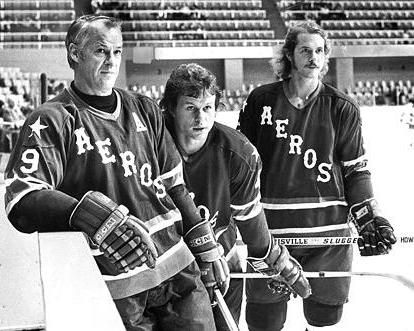
In the off-season of 1973, the Aeros decided to make a major player signing. They discussed the possibility of 45 year-old Gordie Howe, who had retired in 1971, of playing with his sons, Mark and Marty, in Houston. The elder Howe liked this idea, and he signed on to play with the Aeros for the 1973-74 season. It marked the first time that a father-sons combination had played together on the same ice in professional hockey.

The results were encouraging for the Aeros. Gordie Howe scored 31 goals and added 69 assists for a 100-point season, and the Aeros finished first in the Western Division and as the top team in the WHA with a 48-25-5 record. They matched up against the Winnipeg Jets in the first round, and handily swept the Jets aside in four games. They met up with the Minnesota Fighting Saints in the semi-final, and they were victorious in six games to advance to the WHA Avco Cup Championship.

There, they ran into an upstart Chicago Cougars club that had finished fourth-place in the Eastern Conference, and the Aeros proved they were the real deal. They hammered the Cougars in four games, outscoring them 22-9 in the series, and captured their first Avco Cup! Houston had its first professional hockey championship a mere two years after getting a pro hockey franchise!

Gordie Howe was named the winner of the Gary L. Davidson Trophy as the WHA MVP in 1973-74, and he would prove that the Aeros' success in that season was no fluke. His son, Mark Howe, was named the Lou Kaplan Trophy winner as the WHA's rookie of the year. Goaltender Don McLeod was named the winner of the Ben Hatskin Trophy as the WHA's best goaltender. 1973-74 was a great year for the Houston Aeros franchise!
1974-75 saw the Aeros roll over the WHA, posting the league's best record at 53-25-0 as they ended up first in the Western Conference again. Gordie Howe nearly duplicated his previous season as he scored 34 goals and added 65 helpers. But it was in the playoffs where the Aeros march to dominance really continued.

The top-ranked Aeros eliminated the eighth-ranked Cleveland Crusaders in five games. After dismantling the Crusaders, they trounced the San Diego Mariners in a four-game sweep in the semi-finals to give them a berth in the Avco Cup Championship to defend their title. However, there wasn't much defending as they tore through the Quebec Nordiques in a four-game sweep. The Aeros had captured their second consecutive WHA Championship, becoming the first WHA team to do so!

While there were less accolades for the players of the Aeros this season, Ron Grahame, seen here with the Bruins, did win the Ben Hatskin Trophy for leading the WHA in wins, shutouts and goals against average, as well as being named the WHA Playoff MVP after losing only one game on the way to another championship celebration. As a side note, Ron Grahame is the father of former NHL goaltender John Grahame!
The 1975-76 season was more of the same dominance as the Aeros plowed through the WHA's new 80-game schedule with a 53-27-0 record. The finished first in the Western Division, and tied with Winnipeg for the most points. However, Houston finished with one more regular-season win that Winnipeg, and were once again considered the top seed in the WHA. Gordie Howe was the model of consistency again, recording 32 goals and adding 70 assists in 78 games that season.

The WHA Playoffs saw the Aeros dispatch the San Diego Mariners in six games in the quarterfinals before eliminating the upstart New England Whalers in seven games. Whether the extra games took their toll or Houston simply wasn't as strong, the Winnipeg Jets ran over the Aeros in the Avco Cup Final in a four-game sweep. Disappointing to be sure, but the Aeros still had a lot in the tank.

The 1976-77 season saw the Aeros dominate the WHA once more, posting a final record of 50-24-6. They were the top team in the Western Conference, and owned the best record in the WHA that season. Howe had a serious drop-off in production this season as he only appeared in 62 games, scoring 24 goals and 44 assists - the lowest totals in his WHA career. Terry Ruskowski led the team in scoring with 24 goals and 60 assists.

Houston rolled over the Edmonton Oilers in the WHA Quarter-Finals, beating them four games to one. In the semi-final, Winnipeg and Houston clashed once again, the two WHA rivals renewing their rivalry. Winnipeg won Game One on the road by a 4-3 score in overtime. From there, the home team won each game. Unfortunately, that means that Houston won Games Two and Five before their season came to an end at the hands of the Jets once more, this by a four-games-to-two margin. While there was disappointment over the Aeros' finish once more, there were much larger problems on the horizon.

Merger discussions were initiated in 1977 between the NHL and the WHA about moving the most successful teams into the NHL. The NHL, however, informed the WHA that they were not interested in expansion in 1977, and the conversation was laid to rest. The six most successful WHA teams - Winnipeg, Edmonton, Quebec, Cincinnati, New England, and Houston - decided to push the fact by applying to the NHL as a franchise, but the chatter died down with the approaching 1977-78 season after the NHL voted down the offer.

In Houston, the Howes were asked to defer some of their salaries as the team found itself in a financial crisis. The Howes balked at the offer, and the three men walked away from the Aeros. As free agents, they garnered offers from NHL and WHA teams, but it came down to two offers: the NHL's Boston Bruins and the WHA's New England Whalers. The Howes opted to stay in the WHA with New England thanks largely to the guarantees made by the Whalers franchise. As a result, Houston's biggest stars were now playing for the rival New England Whalers.

Without their stars, the Aeros struggled more than they had in the previous four seasons. They finished third overall in the one-division league with a 42-34-4 record. Andre Lacroix emerged from the shadows of the Howes, and posted 36 goals and 77 assists. He finished ahead of teammate Morris Lukowich by an incredible 38 points!
In the playoffs, they met up with the Quebec Nordiques, but it seems that the Aeros couldn't shake the playoff monkey off their backs. Despite finishing ahead of the fourth-place Nordiques, the Aeros fell in six games to Quebec. It maked the earliest exit from the playoffs for any WHA Aeros team, and April 23, 1978 marked the last game they played in Houston. The Aeros defeated the Nordiques 5-2 that night before getting shellacked 11-2 in Quebec City on April 25 to close out the series.

In the off-season, the NHL was willing to listen to the WHA about a merger, but they would only accept four teams rather than the six teams that the WHA wanted to promote. One of the conditions of the merger was that the WHA wanted all three Canadian-based teams included in the merger, meaning that there was one spot remaining in the merger for New England, Cincinnati, and Houston. The NHL was very interested in the Hartford-New England franchise, meaning that the future looked bleek for both Cincinnati and Houston.

However, Aeros owner Kenneth Schnitzer wanted an NHL franchise and proposed that his team be accepted as an expansion franchise outside of the merger. If that was not an option for the NHL, Schnitzer proposed that he be allowed to purchase a current franchise and relocate it to Houston. The NHL declined both of these offers made by Schnitzer, and the Houston Aeros franchise ceased to exist beyond July 9, 1978.

Phew! That's quite the history right there in those seven seasons! Houston's hockey legacy would be cemented with Gordie Howe stories and Avco Cup Championships, but we're not done there. 1994 saw professional hockey return to Houston as the IHL moved into town! However, we'll embark on that leg of the flight tomorrow as we look at the modern Aeros and the history they are currently writing.

Until then, keep your sticks on the ice!