Showing posts with label QMJHL. Show all posts

Tuesday, January 25, 2011

Hockey has had a number of interesting players that have done some amazing things in their careers. From Wayne Gretzky's amazing scoring records to Martin Brodeur's records between the pipes, there have always been players that have been a notch above everyone else in terms of their talents. There have been a few players who have walked a path that no one else has during their times in the NHL, and that's the focus of Hockey Trailblazers, a new book written by Nicole Mortillaro and published by Scholastic. Hockey Trailblazers looks at five players who changed the way the game is played for many people across the world because of their heritages or gender, eventually making it to the NHL through their hard work and determination. These five people are definitely trailblazers in terms of who they are.

Nicole Mortillaro is an accomplished author, having published a number of books such as Something to Prove: The Story of Hockey Tough Guy Bobby Clarke and Jarome Iginla: How the NHL's First Black Captain Gives Back. When she's not writing books about hockey, weather, and the planet Saturn, you can find Miss Mortillaro working as the Associate Editor at Scholastic Canada. Miss Mortillaro works and lives in Toronto with her daughter, Sara.

Hockey Trailblazers looks at the paths carved by five players: Willie O'Ree, George Armstrong, Manon Rhéaume, Bobby Clarke, and Larry Kwong. Each one of these players has a significant story about their path to the NHL, and each player left a lasting legacy that many children have followed when it comes to their dreams of playing in the NHL. Miss Mortillaro does an excellent job at pointing out how each of these players were important not only for their contributions, but also for their ability to break down barriers that some people would have considered impossible to overcome.

If you follow hockey, or at least been keeping up with some of the events over the last few years, you should have a good idea of who Willie O'Ree is. O'Ree is best known for being the first black man to play professionally in the NHL. O'Ree broke into the league as a call-up for an injured player on the Boston Bruins on January 18, 1958 against the Montreal Canadiens. O'Ree's NHL career didn't last very long - just 45 games with the Bruins over two seasons, the last being 1961 - but he would be the only black man to suit up for an NHL team until Mike Marson played for the Washington Capitals in 1974. Miss Mortillaro does an excellent job in telling O'Ree's story, and has some very good quotes from the NHL legend in her first profile.

The next player she covers is George Armstrong. Armstrong played 21 seasons for the Toronto Maple Leafs, and was captain for eleven of those seasons. While this quite an achievement in itself, what made Armstrong's legacy even more impressive is that he paved the way for Native Canadian and Native American kids to look at professional hockey as a potential job! Armstrong was of Irish and Algonquin heritage, and his background led to his nickname of "Chief". Armstrong's captaincy remains the longest tenure of any captain in the Maple Leafs' history. Miss Mortillaro's work in this chapter is outstanding as she really highlights the importance of Armstrong's legacy in leading other Aboriginal players into following their dreams.

Miss Mortillaro profiles another trailblazer in the third section as she looks at someone who more recently made headlines. Manon Rhéaume's introduction to the NHL seemed more like a circus than an opportunity, but Rhéaume's breakthrough into an NHL preseason game has opened doors for other great female players to test their talents out in professional men's hockey. Miss Mortillaro includes all of the barriers that Manon Rhéaume knocked down: becoming the first girl to play in Quebec's International Pee Wee Hockey Tournament, becoming the first female in the QMJHL in joining the Trois-Rivière Draveurs, and becoming the first woman to play in an NHL game with the Tampa Bay Lightning. Miss Mortillaro's look at Rhéaume's career shows that she certainly opened doors for other women to play in professional hockey.

The fourth person profiled by Miss Mortillaro in Hockey Trailblazers doesn't seem like he should be included. Bobby Clarke's legacy in the NHL is quite well-known as he was the captain of the Broad Street Bullies, but his background is not that special. Where Clarke's legacy is seen is with his medical condition as Clarke is a Type-1, insulin-dependent diabetic. Diabetes can be a very difficult condition to balance with the demands and rigors of an NHL career, but Clarke showed many diabetics that they are only limited by their own abilities in controlling the disease. Clarke's ability on the ice opened many doors for players who may suffer from any disease, and he proved that he doesn't have to be held back by anything. Miss Mortillaro illustrates this point well in the chapter on Bobby Clarke.

The last player may have the shortest appearance in the NHL, but Miss Mortillaro shows that Larry Kwong's legacy has not been forgotten. Kwong was born in Vernon, BC to Chinese immigrants in the early-1920s. Growing up in BC meant that the young Eng Kai Geong - Larry's given Chinese name - got to see a lot of hockey, and began playing the game as a result. On March 13, 1948, after having been signed by the New York Rangers in 1946, Larry Kwong got the call-up to the Rangers as they faced the Montreal Canadiens that night. Kwong only saw the ice briefly in the third period, but he became the first player of Chinese descent to play in the NHL! Kwong played many more seasons across the globe, but this short moment in time with the Rangers was all he saw in the NHL. Miss Mortillaro shows the hardships that Larry Kwong faced as he played the game of hockey, but refused to be discouraged by anyone's discrimination towards him.

I really like Hockey Trailblazers due to the fact that Miss Mortillaro shows that not everything in the NHL has to be about statistics. These five players showed determination in becoming NHL players despite being different than the majority of players around them, but not one of them ever gave up. In addition to these five players, Miss Mortillaro gives a number of other examples of players who faced uphill battles to achieve their dreams, and these individual stories in addition to the five players profiled should show that the only person that can hold someone back from one's dream is one's self.

This is an excellent lesson for children today, and I really think Miss Mortillaro has done a great service for the youth of today in Hockey Trailblazers. In youth hockey today, we see all sorts of kids of both genders from various backgrounds playing the game of hockey, and Hockey Trailblazers shows that it doesn't matter who you are or where you come from when you're pursuing a dream. Because of this message, Hockey Trailblazers certainly deserves the Teebz's Book Club Seal of Approval for showing that nothing should hold anyone back from following one's dreams. I highly recommend Miss Mortillaro's 61-page book for everyone as it is an excellent read!

Until next time, keep your sticks on the ice!

Thursday, January 20, 2011

I had visions of writing an article today on the shootout, and how this added bonus at the end of tied games send the fans home with a feeling of satisfaction or defeat. After all, hockey is a sport that prides itself on entertainment value, and no one really likes to go home unfulfilled after spending $500 on tickets, food, and souvenirs. Instead, I changed my focus once I came across an article that spoke of the longest shootout in hockey history, and one that network executive in North America would probably grumble about if it happened here.

We go back a few weeks to the Deutsche EisHockey Liga where the visiting Straubing Tigers played EHC München on December 22, 2010. Not much was out of the ordinary as the teams closed out the regulation sixty minutes tied 4-4. 4999 fans awaited the standard overtime period, and saw the two teams remain tied after the extra frame. So, as we see in most games today, a shootout was on-deck in this game.

The two goaltenders, Sebastien Elwing for München and Dimitri Pätzold for Straubing, have probably faced a number of penalty shots in practice, and I know some teams enjoy having a shootout competition at the end of practices as a little fun. I'm guessing both goaltenders have seen their fair share of penalty shots and shootout moves in their careers.

That being said, the game on December 22 may have doubled the amount of shootout attempts they have faced in their careers in one game. The shootout between Straubing and München went an incredible 21 rounds! The hockey game, including the shootout, lasted nearly three hours for the fans, players, coaches, and officials - a timeframe almost unheard of for professional hockey games.

There were goals in the third round of the shootout as Straubing's Justin Mapletoft and München's Martin Buchwieser each scored on their attempts to keep the shootout knotted at 1-1. Christian Wichart and Tobias Draxinger scored again in the fourteenth round to keep the shootout even at 2-2.

München captain Stéphane Julien appeared to score in the seventeenth round, but the goal was waved off by referee Lars Brüggemann after the video replay showed the puck did not fully cross the goal line. 34 skaters in, two goals, no winner yet. Will this game ever end?

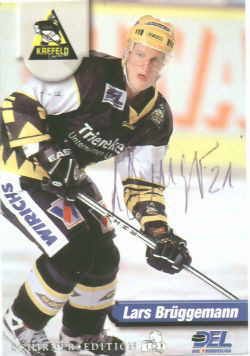
As an aside, Lars Brüggemann is an interesting fellow. He is a former player from the DEL, and has now turned his sights on officiating in the German Elite League. Brüggemann played one season in the QMJHL with the Hull Olympiques in 1993-94, recording one goal, three assists, and 93 PIMs over 58 games. He left for the DEL after that season, but returned to North America to play in the ECHL three years later. He suited up with the Jacksonville Lizard Kings in 1997-98, scoring one goal, six assists, and spending 91 minutes in the penalty box over 49 games. The rest of his career played out in Germany. But back to this story....

Neville Rautert and Andy Canzanello exchanged goals in the eighteenth round, and both Martin Buchwieser and Tobias Draxinger scored again in the twentieth round as the two teams remained knotted at 4-4 through the shootout. But things were about to change in the 21st round.

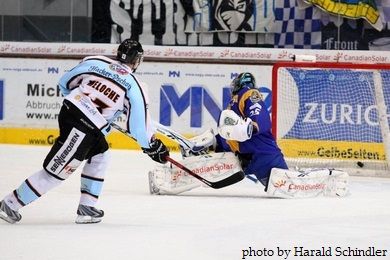
Straubing’s Éric Meloche, who played for the Pittsburgh Penguins and Philadelphia Flyers in the NHL, blasted a slapshot past Sebastien Elwing to put Straubing up by a 5-4 score. The game came down to Stéphane Julien, but the München captain was stonewalled Dimitri Pätzold as Straubing won the shootout by a 5-4 score and the game by a 5-4 score after 21 rounds of shootout.

The longest shootout in IIHF competition was 13 rounds between Belarus and France at the 2002 IIHF U-20 Championship. Belarus eventually won the game on Dmitri Mialeshka's goal in the 25th round as Belarus downed France. The NHL's longest shootout is still remembered between the New York Rangers and Washington Capitals from November 25, 2005. I mean, how could anyone forget this goal?


Eric Meloche's name is the answer to the trivia question: Who scored the goal to end hockey's longest shootout in history?

Until next time, keep your sticks on the ice!

Friday, November 19, 2010

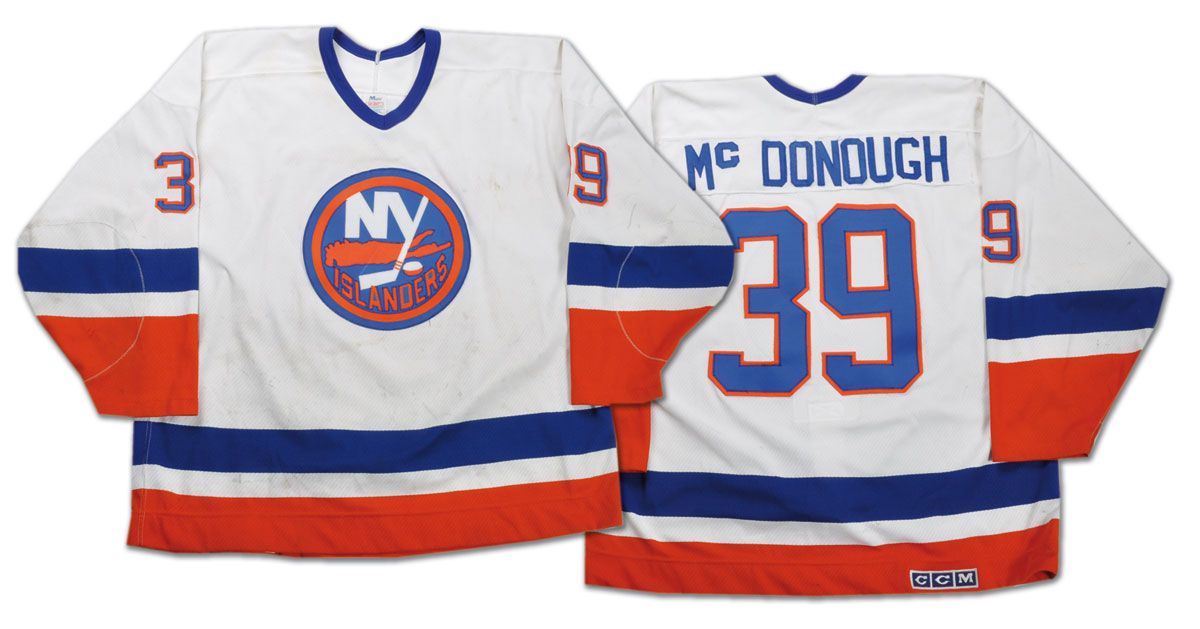
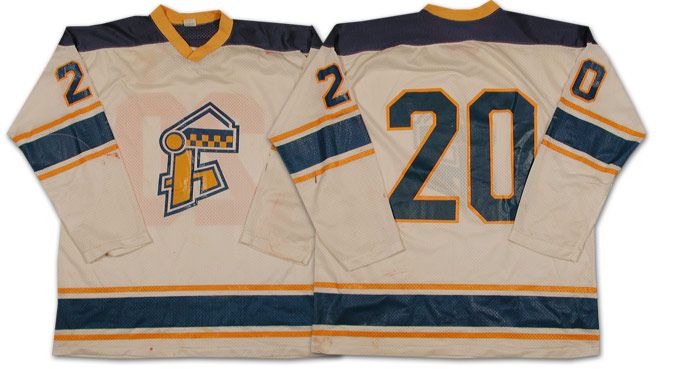
We're back today with another round of images from the Classic Auctions website. I was very impressed by what the site had to offer last time on their current round of auctions, so I went back through the archives to see if I could find some more interesting stuff. Needless to say, the archives are a treasure chest of historical items and, of course, there are a ton of NHL sweaters and jerseys that should be examined for details. With that, we have another edition of the Classic Auctions images today as we look at a number of uniforms once more.
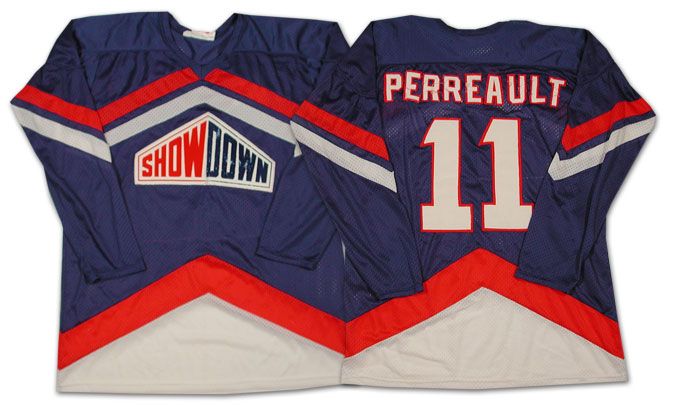
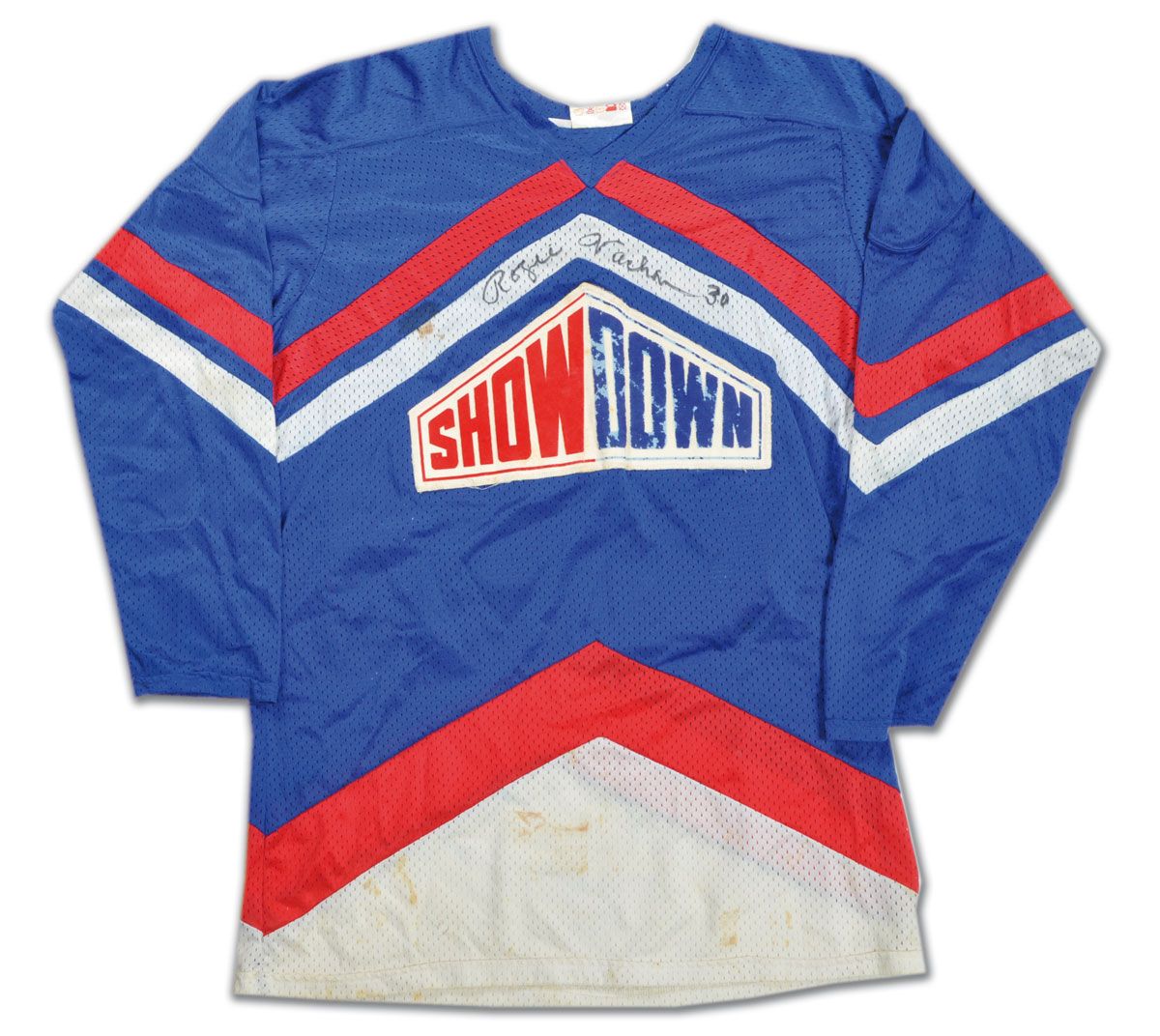
  • As we saw in the most recent set of Classic Auctions images, there was an NHL Showdown segment that used to air between periods that featured a few NHL stars that went head-to-head for cash and bragging rights. I've found more players who were a part of this now. It appears that Gilbert Perreault of the Buffalo Sabres participated for at least one season in the Showdown, and he wore a sweater similar to that of Rogie Vachon! Could they have been teammates in their respective Showdown?
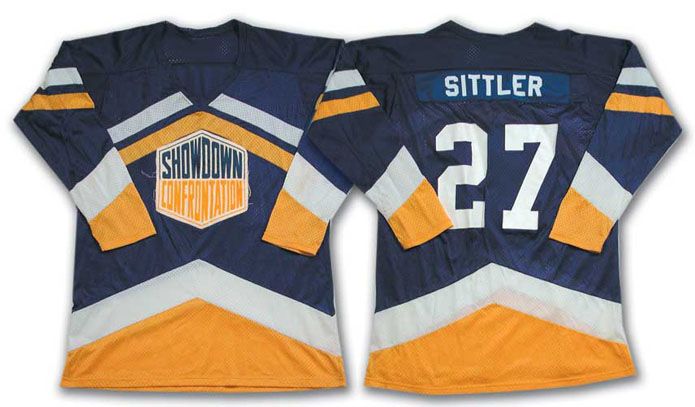
  • Another player who participated was Toronto's Darryl Sittler. However, his sweater is significantly different in terms of colours than those of Perreault and Vachon, so I'm guessing he played in the NHL Showdown in a different season.
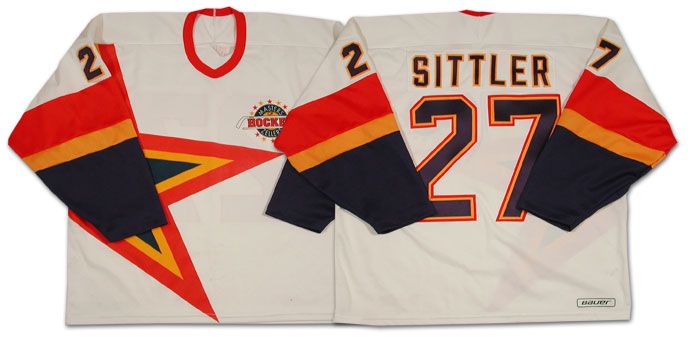
  • Another Darryl Sittler jersey that the Classic Auctions website had up for auction was a Sittler "Masters of Hockey" uniform. I've never seen or heard about this before, so I had to refer to the information on the website. "As part of an important Zellers promotion, Darryl Sittler, along with many other Oldtimers, participated in the 'Masters of Hockey' program. This white hockey [was] uniform produced by 'Hattem'". Nothing like an old promotional jersey for a department store promotion!
  • In the article about the New York Rangers' new alternate uniform, I had stated that there was precedence for the Rangers wearing "New York" diagonally on their uniforms thanks to their 9/11 tribute uniforms. However, there is even more precedence that shows the Rangers wearing "New York" for a much longer time on the road. Here is Bobby Carpenter's 1986-87 New York Rangers road uniform. Obviously, they wore these for at least one season, and, upon further research, they actually wore the "New York" road jerseys from 1978-1987. Lots of precedence!
  • I've rarely seen the patch worn, but there is no doubt that the Toronto Maple Leafs wore the King Clancy patch on their uniforms during the 1986-87 season. Thanks to the auction, we can now clearly see that the Leafs wore the King Clancy patch above the TV numbers on their sleeves on the road that season.
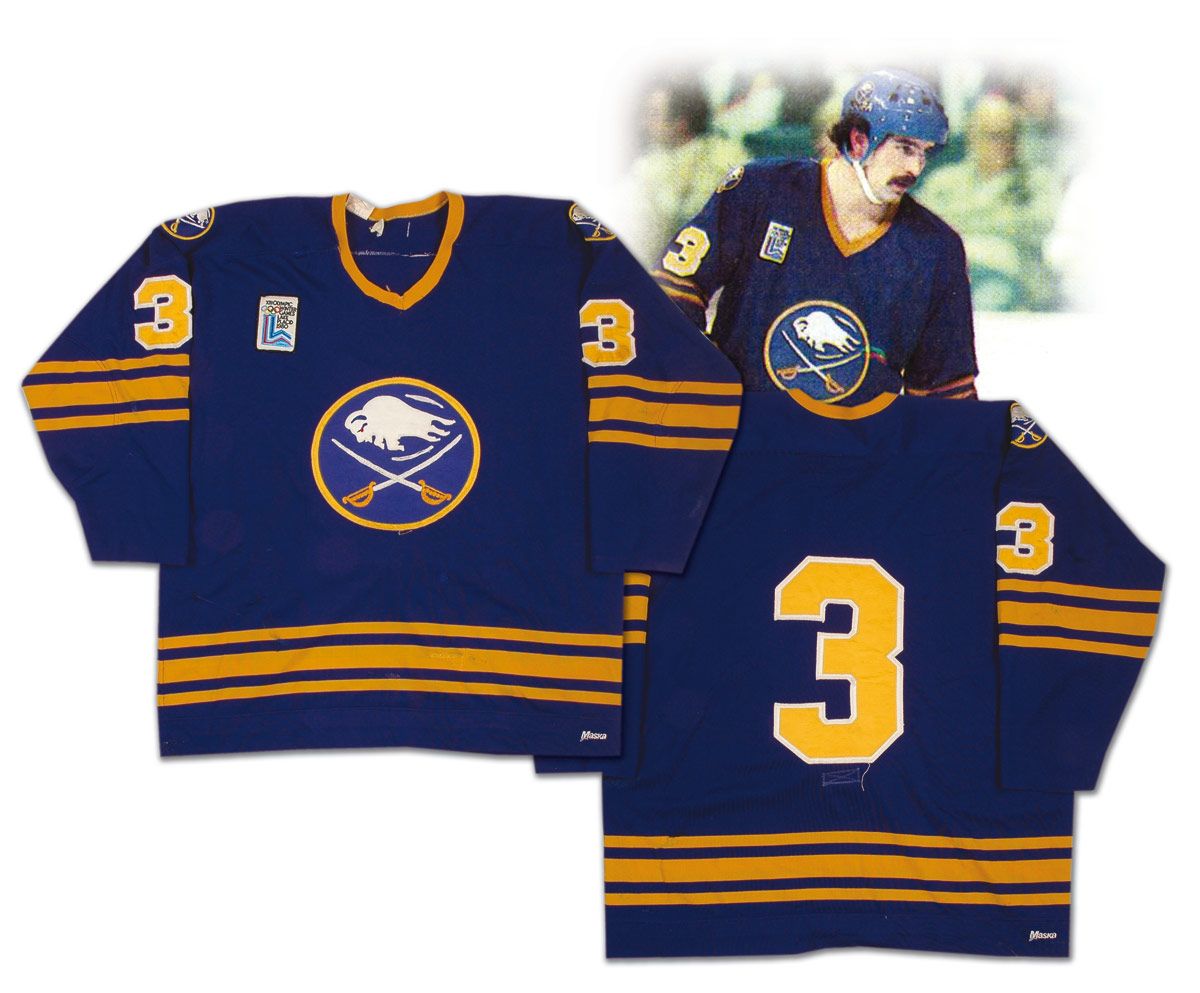
  • Some of the patches worn before photography became a major aspect of the NHL world are much more difficult to find, especially affixed to an NHL uniform. The Lake Placid patch worn by the Buffalo Sabres is one such patch, but this Richie Dunn sweater from the 1979-80 season shows it clearly affixed on the right shoulder. Notice that there are no names on the Sabres' uniforms as of 1980? I had never noticed before that either.
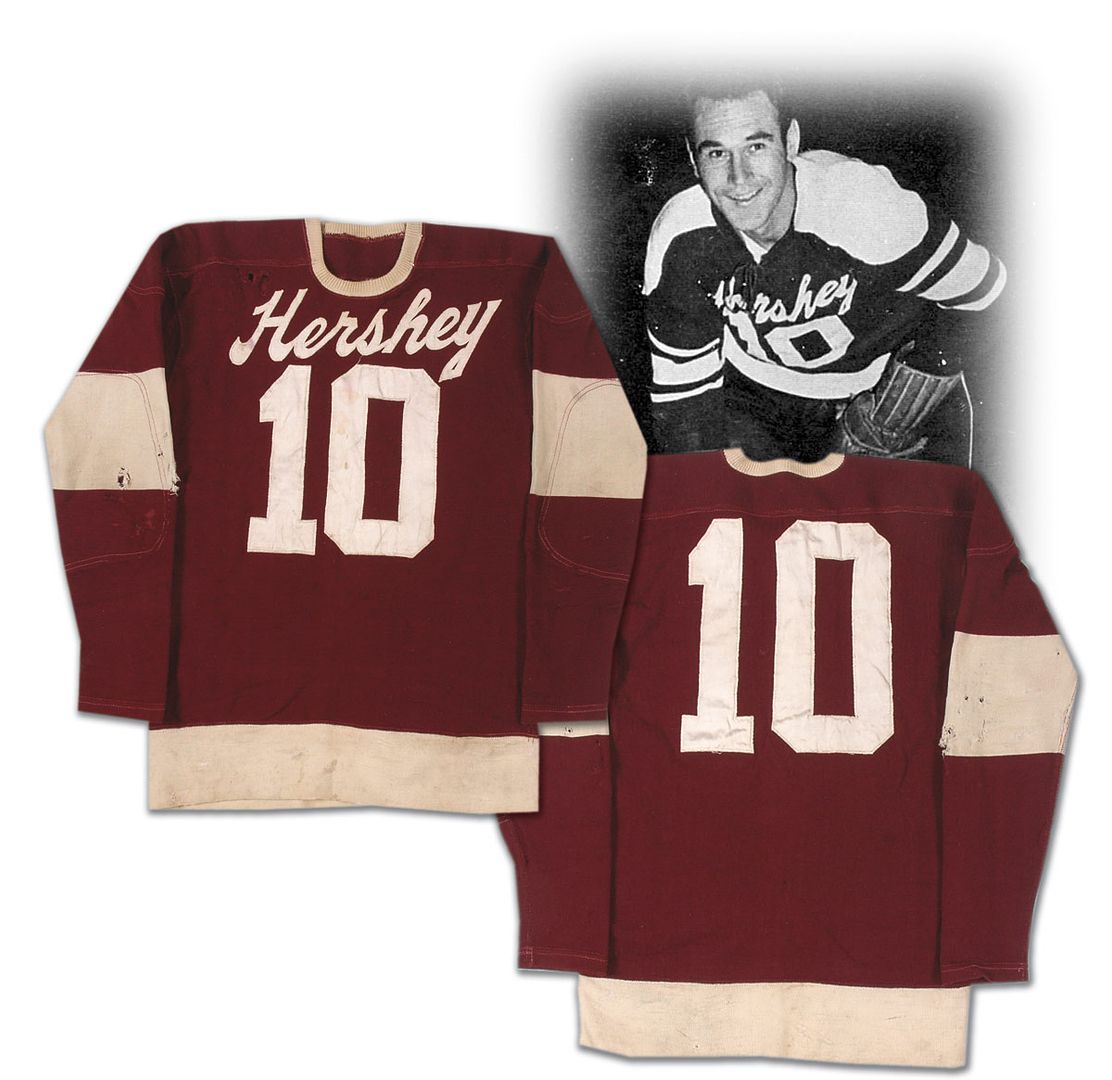
  • Heading into the AHL, we find a trend that seems to have been reproduced in the NHL with the introduction of the Rbk EDGE uniforms. I've never liked the idea of having front numbers on a hockey sweater, but the Hershey B'ars decided that front numbers were fine for a hockey sweater as far back as the 1940s! Here is a sweater that was worn by Mark Marquess as a member of the Hershey B'ars that has the city name over top of the front number. More precedence for a current trend, perhaps?
  • The Detroit Red Wings have a gorgeous jersey due to the colours and the logo. I cannot deny this. However, history shows that the logo routinely was off-centered on the Red Wings sweaters. One such example comes from the 1937 Jimmy Orlando sweater. As you can see, the center of the wheel was used as the focal point for the logo, and that caused the wing to be significantly off-center.
  • In Part One of this series, I discovered a startling trend in the 1980s that showed floating portions of names on a number of teams. Today, there appears to be some sort of discrepancy in terms of how names are displayed on at least one team. I had made mention of Brad McCrimmon's floating "C" in 1988, but I discovered an Al MacInnis uniform from the 1980s that has no floating letters! What gives? Why the change? MacInnis' first game in a Flames uniform came in 1981-82, so we at least have a start date as to when the floating letters may have started, and it had to be after the '81-82 season.
  • Because I miss the uniform and the team, here is Wendel Clark's Quebec Nordiques uniform from the 1994-95 season. Man, I miss that uniform. It's gorgeous!
  • In other lost uniform news, here is Gerry Ehman's 1967-68 Oakland Seals uniform. Does anyone miss the colour green in hockey? I sure do. Why can't more teams go with a bold green instead of these near-black colours?
  • Next, we have the second wave of California's Seal teams as we get a chance to see Joey Johnston's uniform from the 1970 California Golden Seals. I'm not all that fond of this colour scheme, but the yellow uniform is definitely bold. Much like their name, the Golden Seals certainly were living it up in goldenrod.
  • We have a 1979-80 Atlanta Flames uniform worn by Gary Unger. That's still a great uniform, and I'm glad that the Calgary Flames have gone back to those great colours. Yellow-on-red is a very striking uniform... and the lack of black is entirely refreshing!
  • Take a good look at this 1976-77 Colorado Rockies uniform worn by Michel Plasse. See how small the front logo is? Compare that to the 1981-82 uniform worn by Tapio Levo. There's a significant difference in the sizes between the two uniforms. It's almost as if the Rockies were telling everyone in 1976 that they weren't all that relevant.
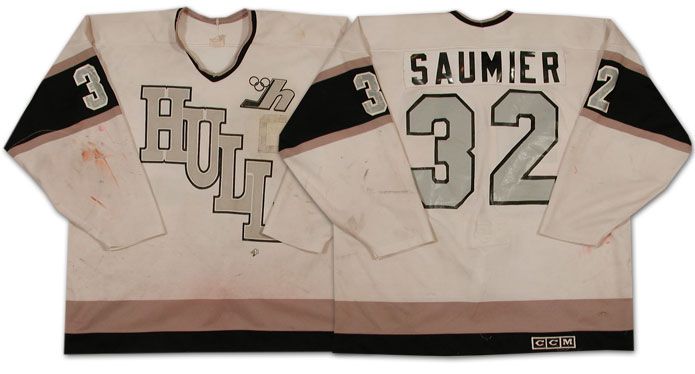
  • In the 1970s, the Hull Olympiques of the QMJHL wore some fairly vanilla uniforms. However, they changed that up in the 1980s by bringing out the black-and-silver colour scheme that became famous thanks to Wayne Gretzky's trade to Los Angeles. As you may have heard, Luc Robitaille played for the Olympiques and Gretzky owned part of the Olympiques, so Bruce McNall made the change to the new colour scheme due to Robitaille's suggestion to make Los Angeles more attractive for Gretzky. Now you have some visual proof of how this change came about thanks to Marc Saumier's uniform.
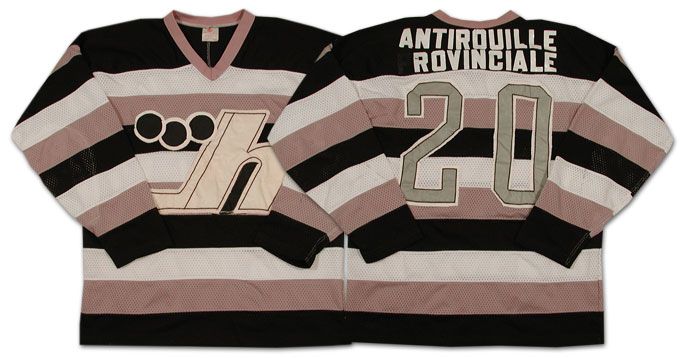
  • In 1985, the Hull Olympiques decided to roll out a different road uniform by wearing some awesome stripes! I love the stripes on this jersey, even if it looks like a black-and-white television's test pattern.
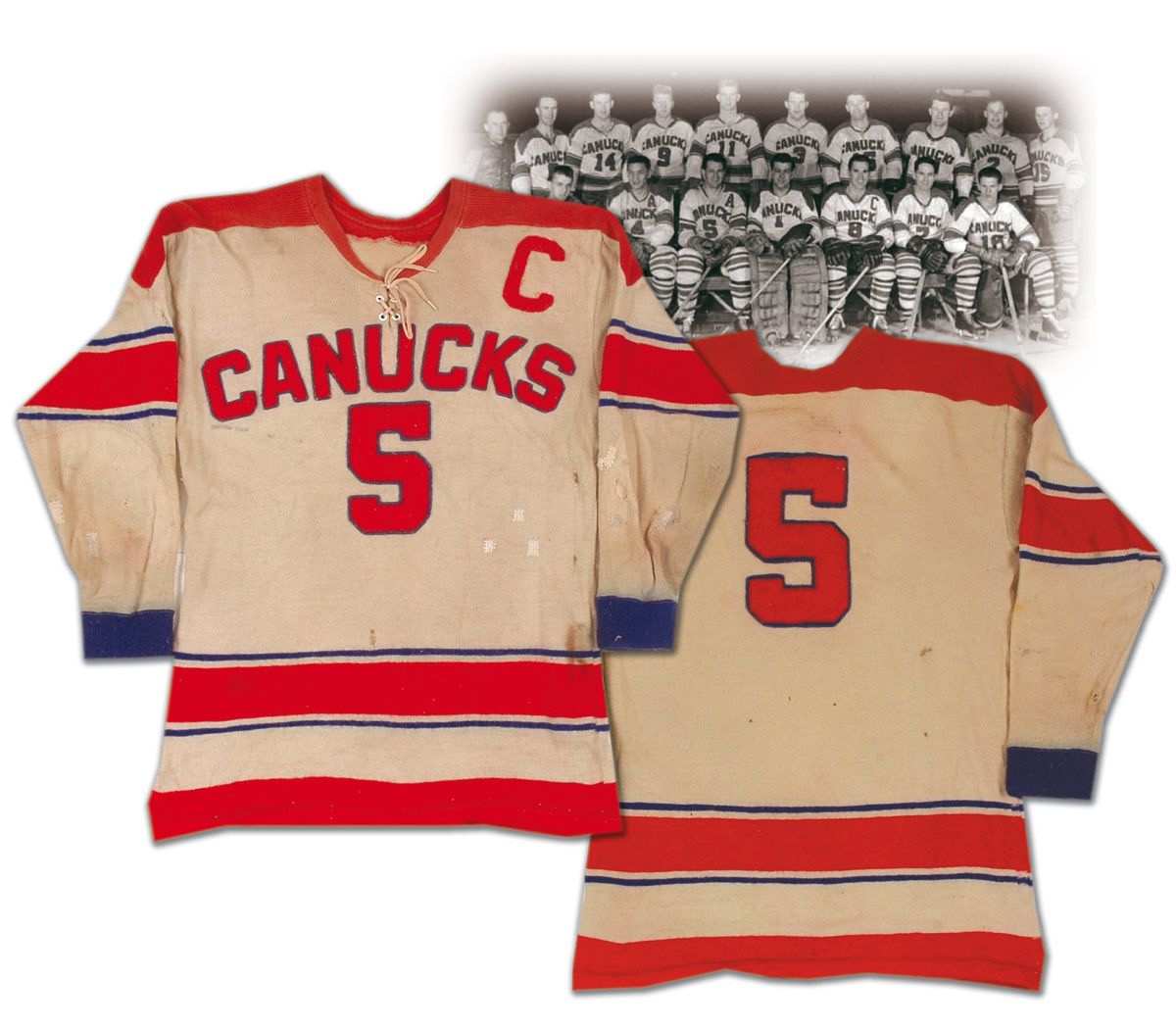
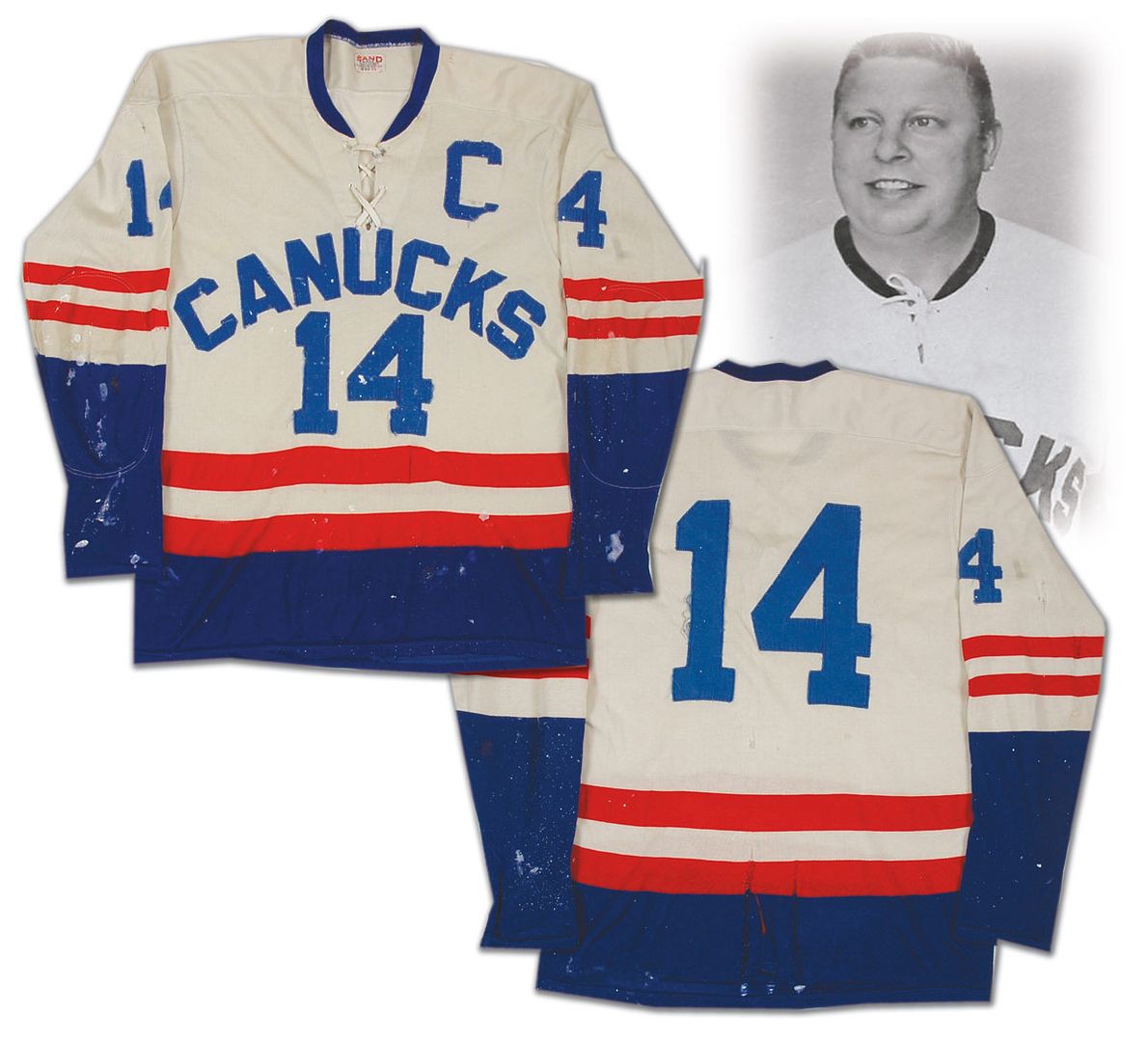
  • The WHL gets a mention on this one as we get to see the Vancouver Canucks in their original form. The WHL Canucks wore this uniform in the 1950s, and they went with a colour change in the 1960s. Of course, Vancouver received an NHL franchise in 1970 so these jerseys weren't needed any longer, but there is some precedence to the Canucks wearing a name on the front of their uniforms. It seems that the trend of front numbers was more of a minor-league thing through the 1940s, 1950s, and 1960s, though. Take note, NHL. MINOR-league.
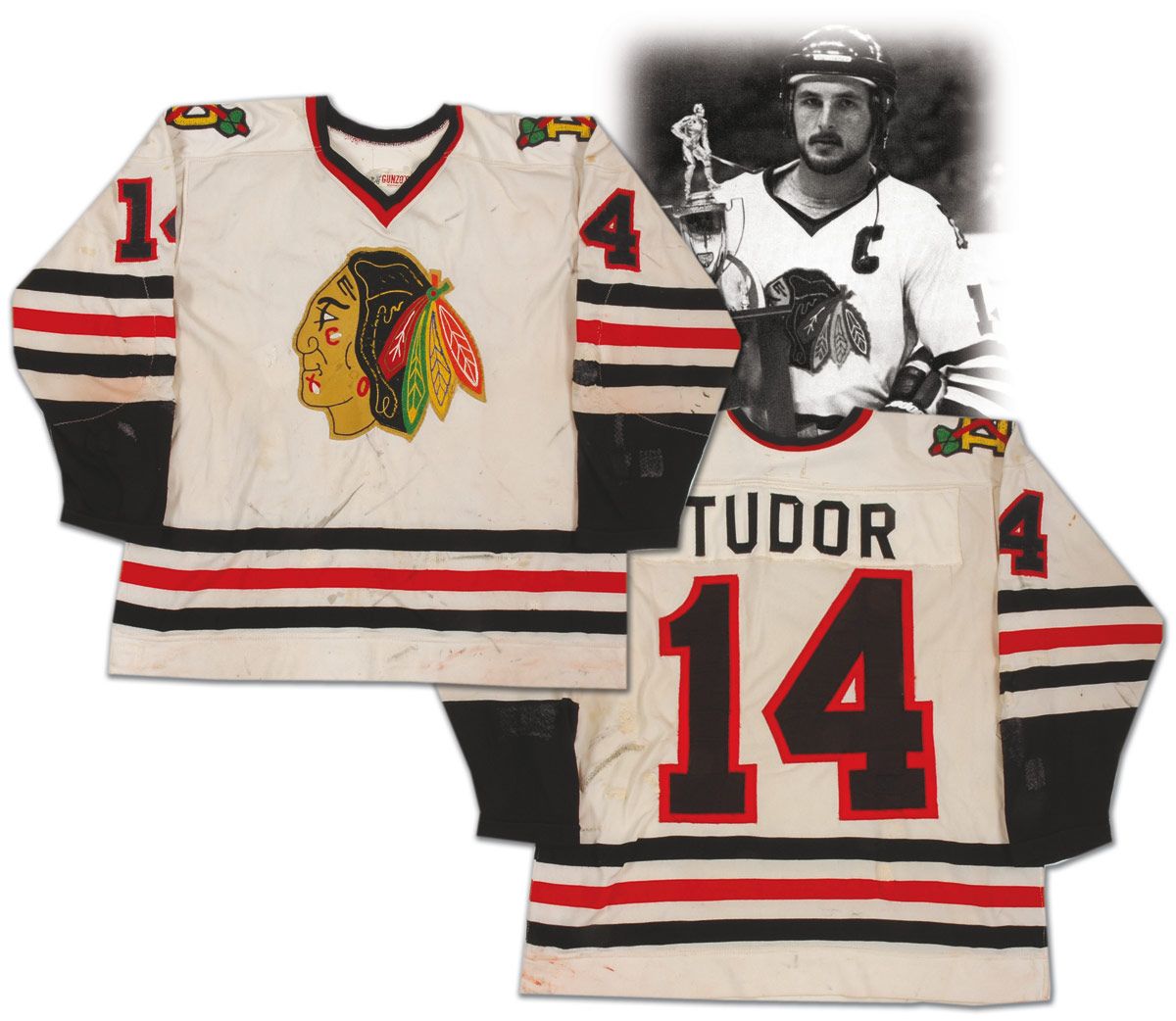
  • It has been well-documented that NHL teams often name their minor-league affiliates after their own NHL franchise name. The Sherbrooke Canadiens, the St. John's Maple Leafs, and the Albany Devils are some well-known examples. Here is Rob Tudor's jersey from the 1978-79 season. If you inspect that jersey closely, you'll see two tomahawks crossed over a "D" on the shoulder. This is a Dallas Blackhawks uniform from the Central Hockey League!
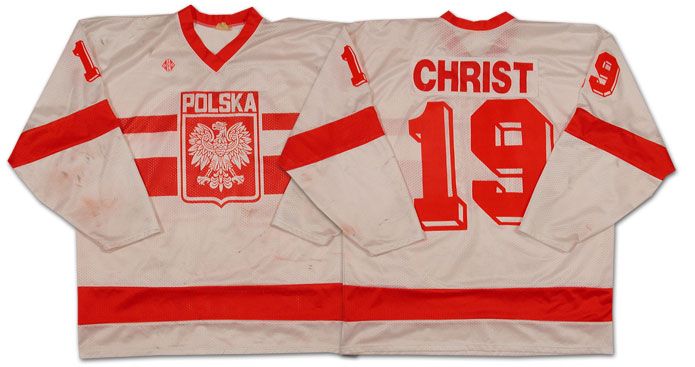
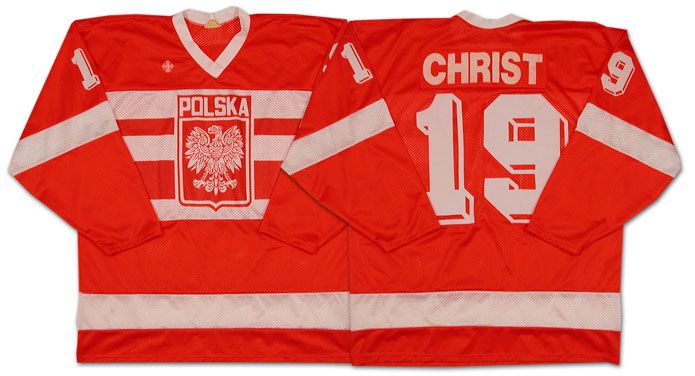
  • International jerseys are always interesting. The 1988 Winter Olympics saw Poland compete in Calgary as a part of the ice hockey competition. One member of that team was a player by the name of Jerzy Christ. Yes, that is his real last name. He was born in Katowice, Poland, and played center for his home country. The highlight of his international career was when he scored both Polish goals in a 2-1 victory over reigning World Champion Czechoslovakia at the 1986 World Championships in Moscow, Russia!
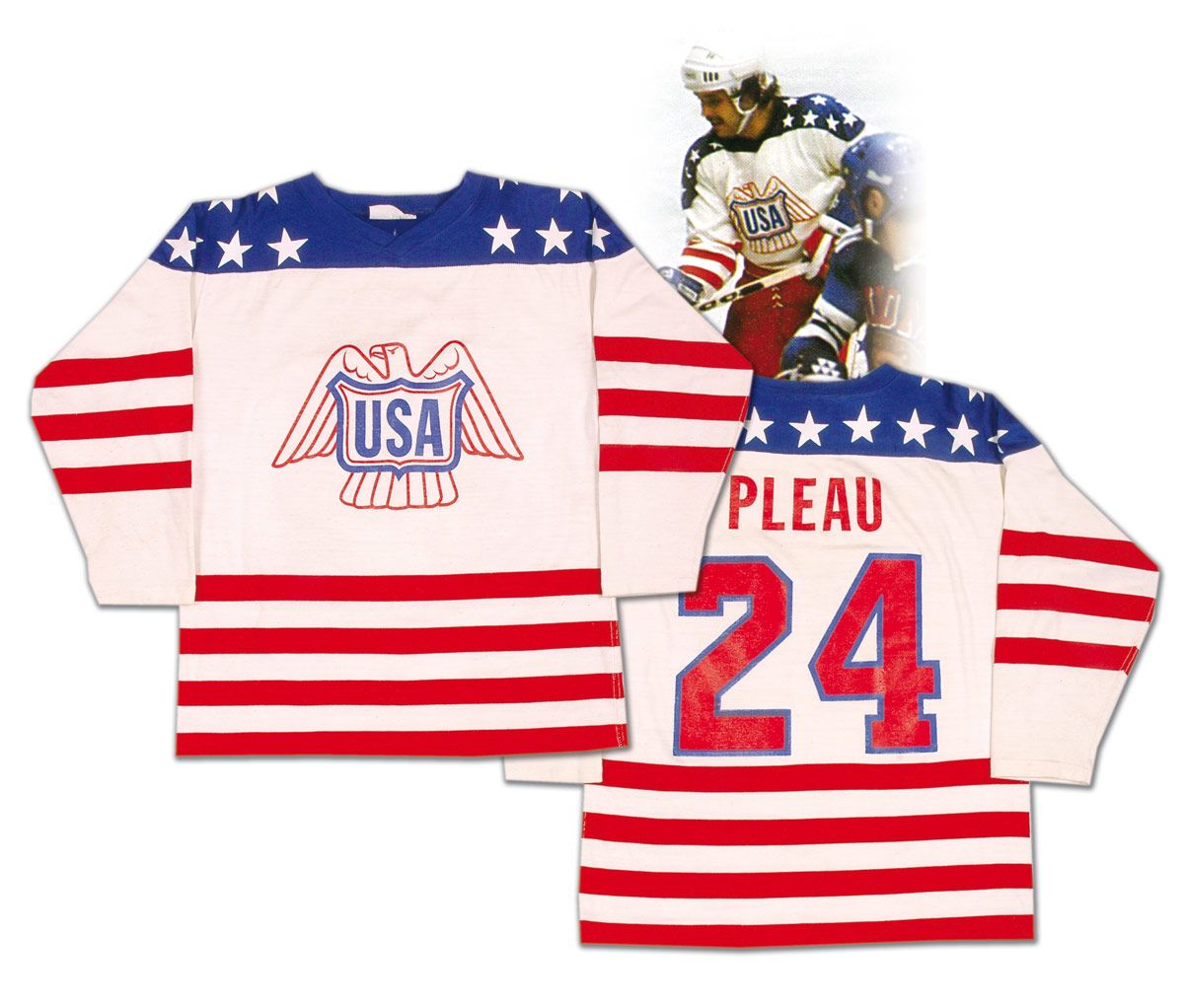
  • Love this 1976 Team USA sweater. Larry Pleau wore this uniform at the 1976 Canada Cup where Team USA finished 1-3-1 and in fifth-place. Regardless of their standing, they wore a gorgeous sweater, and it really feels like a patriotic American uniform.
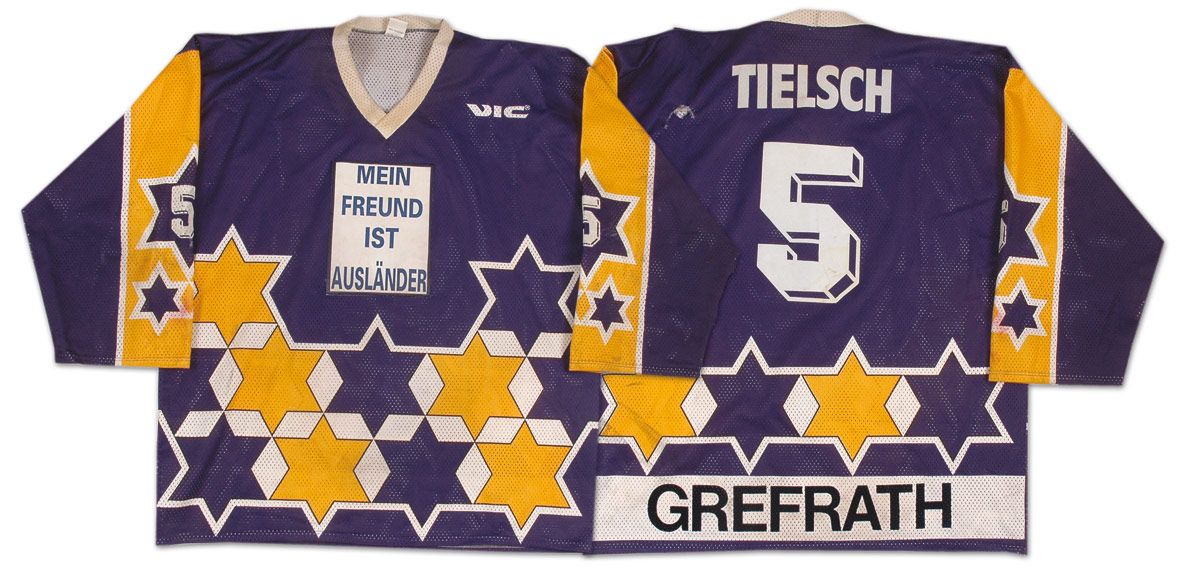
  • We'll close this look at interesting jerseys with a glimpse into German hockey. Grefrath, a German city, played in the second-division of the German Eishockey League in the early-1990s, and wore these uniforms while on the ice. As you can see, there's no logo, but a message where the logo should be. Using a handy translator, the message states, "My friend is a foreigner" or "My friend is an alien". Is this the first time any team has ever used their uniform to convey a written message to its fans? Weird idea.
So there you have it, kids. Lots of good looks at uniforms, and there was some weird and wacky stuff seen. The Classic Auctions website is a great place to find some incredible hockey history, and I encourage you to poke around their website if you're interested in some cool hockey memorabilia.

Until next time, keep your sticks on the ice!

Friday, June 25, 2010

The 2010 NHL Entry Draft went tonight in Los Angeles, California. It's the first time the NHL has had a draft hosted in the state of California, and the fans in the City of Angels seemed enthusiastic when it came to supporting the NHL. Commissioner Gary Bettman didn't get the rain of boos that he normally hears in the northern cities, at least not in the length of time that he normally hears them anyway. The city of Edmonton, Alberta was abuzz with anticipation as the Oilers held the first overall pick for the first time in their franchise history. And in the crowd, thirty young men sat waiting for their names to be called to claim the title of "first-round draft pick".

Let's run through the first round of the 2010 NHL Entry Draft. I'll include my comments below about the first round, as well as a recap of the few trades that actually did happen this evening. Here are the first thirty men who will hopefully suit up in an NHL uniform one day:
  1. Edmonton Oilers - Taylor Hall, Windsor Spitfires (OHL).
  2. Boston Bruins via Toronto - Tyler Seguin, Plymouth Whalers (OHL).
  3. Florida Panthers - Erik Gudbranson, Kingston Frontenacs (OHL).
  4. Columbus Blue Jackets - Ryan Johansen, Portland Winterhawks (WHL).
  5. New York Islanders - Nino Niederreiter, Portland Winterhawks (WHL).
  6. Tampa Bay Lightning - Brett Connolly, Prince George Cougars (WHL).
  7. Carolina Hurricanes - Jeff Skinner, Kitchener Rangers (OHL).
  8. Atlanta Thrashers - Alexander Burmistrov, Barrie Colts (OHL).
  9. Minnesota Wild - Mikael Granlund, HIFK (Finland's SM-liiga).
  10. New York Rangers - Dylan McIlrath , Moose Jaw Warriors (WHL).
  11. Dallas Stars - Jack Campbell, USA U-18 (USHL).
  12. Anaheim Ducks - Cam Fowler, Windsor Spitfires (OHL).
  13. Phoenix Coyotes - Brandon Gormley, Moncton Wildcats (QMJHL).
  14. St. Louis Blues - Jaden Schwartz, Tri-City Americans (WHL).
  15. Los Angeles Kings - Derek Forbort, USA U-18 (USHL).
  16. St. Louis Blues - Vladimir Tarasenko, HC Sibir Novosibirsk (KHL).
  17. Colorado Avalanche - Joey Hishon, Owen Sound Attack (OHL).
  18. Nashville Predators - Austin Watson, Peterborough Petes (OHL).
  19. Florida Panthers - Nick Bjugstad, Blaine High School (Minn).
  20. Pittsburgh Penguins - Beau Bennett, Penticton Vees (BCHL).
  21. Detroit Red Wings - Riley Sheahan, University of Notre Dame (NCAA).
  22. Montreal Canadiens - Jarred Tinordi, USA U-18 (USHL).
  23. Buffalo Sabres - Mark Pysyk, Edmonton Oil Kings (WHL).
  24. Chicago Blackhawks - Kevin Hayes, Nobles High School (Mass).
  25. Florida Panthers - Quinton Howden, Moose Jaw Warriors (WHL).
  26. Washington Capitals - Evgeny Kuznetsov, Traktor Chelyabinsk (KHL).
  27. Phoenix Coyotes - Mark Visentin, Niagara IceDogs (OHL).
  28. San Jose Sharks - Charlie Coyle, South Shore Kings (EJHL).
  29. Anaheim Ducks - Emerson Etem, Medicine Hat Tigers (WHL).
  30. New York Islanders - Brock Nelson, Warroad High School (Minn).
I'll admit that I found a few things surprising in this draft class.

First, only one NCAA player was taken in the first round. The Detroit Red Wings went collegiate in selecting Riley Sheahan, and I was surprised that more NCAA players weren't called in the opening round. The NCAA has been producing some excellent players in recent years, and it seems odd that there weren't more players selected from that pool of talent.

Second, I was surprised - no, make that shocked - that the Islanders used the fifth overall pick to select Swiss-born right winger Nino Niederreiter. I get that the Islanders may have been targeting Niederreiter, but why didn't they offer up the pick in a trade to move down a couple of spots? I'm quite certain that Niederreiter would have been there at the eighth or ninth pick.

Third, Cam Fowler drops to the Anaheim Ducks at pick #12, and suddenly the Ducks have a budding young offensive star on their blueline to replace the retired Scott Niedermayer. Not only are they able to select the best offensive defenceman this draft has to offer, but they don't have trade to move up to get him. Why the New York Rangers didn't scoop up Fowler at tenth spot is something that Glen Sather may only be able to answer.

Fourth, the Atlanta Thrashers get Alexander Burmistrov with pick #8, and they may have themselves a new, dynamic scorer much like they had before Ilya Kovalchuk opted to leave. Burmistrov, unlike some of his Russian counterparts, has stated time and time again that he has no interest in playing in the KHL any time soon, and that should be phenomenal news to GM Rick Dudley's ears. I really like this pick, and I think Atlanta may have selected one of top-three players in this year's draft.

Fifth, Minnesota and Washington continued to build with international stars that are close to home. Minnesota went back to Finland to draft Mikael Granlund, while the Capitals continued their Russian roster building with their selection of Evgeny Kuznetsov. Both of these players appear to be highly skilled, and the other countrymen on the two teams' rosters should make these two youngsters a little more comfortable at their respective training camps.

Sixth, Pittsburgh selected Beau Bennett with pick #20, and Bennett became the highest player chosen from the state of California. What is more impressive is that ten Americans were selected in the first round of the draft, including goaltender Jack Campbell who was the highest American-born player selected at pick #11 by Dallas. It just goes to show that the American development system is growing stronger and stronger each year. Take note, Canadian teams.

The one trade that happened that actually involved current NHL players saw the Western Conference welcome back a tenacious defenceman. The Vancouver Canucks sent Steve Bernier, Michael Grabner, and the 25th overall pick to the Florida Panthers for Keith Ballard and Victor Oreskovich. Ballard provides the Canucks with a good puck-moving defenceman who doesn't shy away from the physical side of the game - something they sorely needed against the Blackhawks in last season's playoffs. For as much as they were given opportunities, both Bernier and Grabner appeared to be spare parts for the Canucks, but they will be given bigger opportunities in Florida.

The Penguins decided to relieve Philadelphia of their Dan Hamhuis problem by trading for his rights. Reportedly, Hamhuis has no interest in signing with the Flyers and was prepared to test the free agency market. However, with Pittsburgh and Sergei Gonchar seemingly at odds in their contract negotiations, Hamhuis may get some decent coin to play in Pittsburgh in place of Gonchar.

Hamhuis is reportedly looking for $4 million per season for four seasons, according to his agent Wade Arnott. The Penguins have approximately $11 million in cap space, and still need to sign a few players from last season. Dan Hamhuis, Bill Guerin, Mark Eaton, Alexei Ponikarovsky, and Jordan Leopold should attempt to be signed, especially if Sergei Gonchar doesn't return. And I would rank them in that order of importance in terms of their signings. Otherwise, Ben Lovejoy may have a roster spot next season by default. Lovejoy is no slouch, but the Penguins could upgrade to have Lovejoy as the seventh man.

All in all, it was a rather uneventful draft outside of the Taylor-vs-Tyler debate. As seen above, Taylor Hall went first overall, Dallas took the first goaltender and American in Jack Campbell, and we're on to Round Two of the 2010 NHL Entry Draft tomorrow.

Let's just see if tomorrow remains quiet as well.

Until next time, keep your sticks on the ice!

Saturday, May 15, 2010

The 2010 Memorial Cup sets up shop for the next two weeks in Brandon, Manitoba, and there's a good chance we could see a repeat winner. Last year, the Windsor Spitfires dramatically stole the show in Rimouski, Quebec after going 1-2 in the round-robin to finish fourth out of the four teams before tearing through the semi-final and final games to secure the Memorial Cup. Of course, Windsor is back this year as the OHL Champions, and they are joined by the Calgary Hitmen (WHL), the Moncton Wildcats (QMJHL), and Brandon Wheat Kings (host team) as these four teams battle for Canadian Major Junior Hockey's biggest prize.

This won't be a preview of each team as there are a number of excellent reports on the Interwebs already. The Sportsnet reviews done by Patrick King are top-notch, and I definitely recommend clicking that link above. King is one of the best when it comes to covering the CHL, and his reports on each team are excellent.

Last night, the defending Memorial Cup Champions and the host team opened the 2010 Memorial Cup. Windsor came in with the hopes of becoming only the fifth CHL team to repeat as Memorial Cup Champions, and the first team to do so since the 1995 Kamloops Blazers. Brandon, on the other hand, was looking to send a message to the other CHL Champions with an upset of the defending champs.

Let's just say that Brandon looked good on the ice in terms of their uniform choice, but had little else from which to rally. The jerseys, in keeping with the Memorial Cup tradition, saw the host team wear a specially-designed jersey honouring the men and women of the Armed Forces. Brandon has a special link with the Canadian Army as CFB Shilo is a mere 20 minutes away from the Manitoba city.

From the MeiGray site:
"The opening game jerseys were designed by the Canadian Hockey League in conjunction with the Brandon Wheat Kings in honour of the Canadian Army and specifically the men and women, past, present and future of CFB Shilo. CFB Shilo is Manitoba’s only army base and is located approximately 20 minutes from the Keystone Centre where the 2010 MasterCard Memorial Cup is being held.

The Memorial Cup was originally donated in 1919 by the Ontario Hockey Association as a memorial to those young men and women who had given their lives in the defence of Canada during World War I. The 2010 MasterCard Memorial Cup marks the 92nd time that the Memorial Cup will be awarded.

All proceeds from this auction will go towards supporting the Dominion Command Poppy Trust Fund. The poppy fund is designed to support veterans and their families, buy hospital equipment, support cadet groups, and provide student bursaries."
The Wheat Kings looked mighty impressive last night as they skated out in these beauties. I absolutely love Brandon's colour scheme, and, while some will say that this is a copy of the Blackhawks' alternate, the Wheat Kings pull it off extremely well with their colours. Of course, in comparison to previous Memorial Cups, it holds its own with Rimouski's Memorial Cup jersey and Kitchener's Memorial Cup jersey.

Windsor, not to be outdone, decided to shine on the ice. At 2:01, Windsor went up 1-0 on Kenny Ryan's first of the tournament. That was followed up by Scott Timmins' first goal of the tournament at 3:25. 1:02 later, Adam Henrique had the Spitfires out to a 3-0 lead. 18 seconds later, Taylor Hall had his first of the tournament to put Windsor up 4-0. Just 4:45 in, and the Spitfires were up 4-0. Wow.

And just for good measure, the Spitfires took a 5-0 lead into the dressing room after twenty minutes when Taylor Hall notched his second of the game and tournament on the powerplay at 18:23. The Spitfires showed Brandon why they had swept three of their four OHL playoff series, and had rallied back from a 3-0 deficit in their series against Plymouth. This Spitfires team is a well-oiled scoring machine.

There was a scary moment in the first period as Brandon defenceman Travis Hamonic lined up Windsor's Taylor Hall and drilled him into the end-boards face-first just 39 seconds into the game. Hall laid in a crumpled heap of humanity for a few minutes before skating off under his own power, but it seemed that was all Brandon could muster in terms of dominating the play in the first period.

Adam Henrique would score his second of the game and tournament just 1:15 into the second period to put Windsor up 6-0. The bleeding didn't stop for Brandon as Timmins had his second of the game and tournament at 6:47 for a 7-0 Spitfires lead. Dale Mitchell jumped in on the scoring with his first at 14:49 to pace Windsor to an 8-0 lead. Thankfully, Aaron Lewadniuk broke the goose egg for the Wheat Kings with his first goal of the tournament at 14:57 of the second period to close the gap to 8-1. However, Zack Kassian restored the eight-goal cushion on the powerplay at 16:21 with his first of the tournament. The Spitfires took a 9-1 lead into the intermission.

Brnadon's Matt Calvert scored his first of the tournament just 35 seconds into the third period to make it 9-2. Jay Fehr made it 9-3 at the 13:28 mark, but it was clear that Windsor was coasting in an effort to not suffer any injuries. When the final horn sounded, the 5381 fans saw the dominant Windsor Spitfires open the 2010 Memorial Cup with 9-3 victory, running over the hometown Wheat Kings.

The Calgary Hitmen will play the Moncton Wildcats at 3PM ET today, and you can catch the action on Rogers' Sportsnet in Canada, and on the NHL Network in the USA. While no expects a blow-out in today's game, anything can happen at the Memorial Cup!

Until next time, keep your sticks on the ice!

Thursday, February 4, 2010

There's your story for the next three days: Ilya Kovalchuk is now a New Jersey Devil. There are already dozens of stories on blogs and sports sites that talk about how Dvils' GM Lou Lamoriello fleeced Thrashers' GM Don Waddell, and, to some degree, you could make that case. The return of Oduya, Bergfors, Cormier, and a first-round pick seems a little low for the scoring prowess that Kovalchuk brings to the table, but this is a rental by all definitions. If GM Lou wants to sign Kovalchuk in the off-season, there will have to be some salary moves to make that happen. Since there will be a bazillion sites talking about Kovalchuk, I'm simply going in another direction. No Kovalchuk trade talk from me aside from posting a few links. Let's get at it.
  • Blueland Blog talks a little about the trade. Kukla runs down the Twitter back-and-forth. Leahy posts the info on Puck Daddy, while Wyshynski's view of the trade has him already awarding the Stanley Cup to his beloved Devils. He could be right, but enough of the trade chatter. The trade happened. Let's play hockey.
  • Something interesting brought up on Uni Watch Blog today. Ray Whitney has been bucking the corporate trend by altering his jersey. There's no NHL logo on his collar. From my estimation, he's been doing this since December 2008. Can anyone shed any light on why he may be doing this? Is it a comfort thing with his jersey? Stick tap to Matt Kuekes for finding this gem.
  • March 12, 2010 will see the Las Vegas Wranglers don another fabulous promotional jersey. This time, the Wranglers will honour the Girl Scouts of the USA by donning this uniform for their game against the Bakersfield Condors. An interesting choice of uniform. I wonder if there will be girl scouts selling cookies in the concourse instead of 50/50 tickets?
  • Nice to see Brampton Battalion forward and former Moose player Cody Hodgson on the ice tonight in the OHL. The Brampton captain, wearing #19 again tonight, had been out all season thus far with a back injury, but returned tonight against the Erie Otters. Hodgson recorded two assists, and looked very comfortable out there. Great news for a kid who missed a lot of hockey this season.
  • Marco Scandella, another of Canada's World Junior team members, will join Patrice Cormier on the sidelines as he awaits a decision after he threw a hit that made contact with the head of a player from the Rimouski Oceanic. The Val-d'Or Foreurs defenceman will most likely get some time off, but it will be interesting to see how the QMJHL rules on this hit after Cormier's punishment.
  • Mike Komisarek's season is over after he was told he'll need season-ending shoulder surgery. Komisarek will also miss the 2010 Winter Olympics, ending what might have been the biggest year of his career thus far. As much as I dislike the Leafs, I have no ill will towards any injured player, and I hope Komisarek makes a full and speedy recovery.
  • The 1-0 victory by the Edmonton Oilers over the Philadelphia Flyers last night had some history to it. The longest game in AHL history was decided by the same player against the same goaltender. Philadelphia's Michael Leighton was the goaltender for the Albany River Rats while Edmonton's Ryan Potulny was the shooter for the Philadelphia Phantoms. Here's the video of how that one ended. After three full periods and four overtime periods, Potulny rips the winner past Leighton in the fifth overtime period. Potulny solved Leighton again last night to give the Oilers the win.
I'm sure there will be all sorts of breakdowns, examinations, and chatter about the trade in the next couple of days, but I'm not very excited about this. Kovalchuk's game is the square peg trying to be pounded into New Jersey's defensive scheme's round hole. While they may be fine during the regular season, it's the playoffs where Kovalchuk will show his mettle. Four playoff games in his career, and only two points to show for it?

That's hardly New Jersey playoff hockey.

Until next time, keep your sticks on the ice!

Tuesday, January 26, 2010

I know this past weekend was a little off in terms of me posting regularly, so I want to be sure that you get a chance to read about some of the things I was up to while I was away in Minneapolis/St. Paul. I tried to post as often as I could, but time was at a premium all weekend, so I was posting a little behind most of the time. Between events and traveling, the laptop didn't see much of me. However, things are now caught up as I finished some articles, and this is just a quick review of what you may have missed in my mad rush to get caught up.

THURSDAY: Frank McClelland's skate guards are introduced to the world. There have been a number of people who have emailed me with suggestions as to what Mr. McClelland should call his product, but the story of how they came to be and how they work is fascinating. If you are interested in a pair, they will be available for purchase shortly. I'll update you when this happens. For now, send me name ideas, and I'll forward them to Mr. McClelland on an on-going basis.

SATURDAY: Having spent the day on Lake Nokomis on Friday watching the first day of the US Pond Hockey Championships, the second day turned quite wet as rain moved into the area. However, the spirit of the competition was never broken, and some teams wore some impressive jerseys. Highly recommended read for jersey ideas if your team is searching for a new look.

SUNDAY: I spent the evening at the Xcel Energy Center in St. Paul for a game between the Minnesota Wild and the Columbus Blue Jackets. Honestly, I really had a good time there with a great friend. Perhaps the best part of the night was a lady by the name of Ciel who was the usher in our section. She was funny and personable all night, and really added to the experience. I took some photos while at the game as well, so check that out. Huge thanks to my good friend Rhonda for getting a couple of tickets, and to her friend Tony for making everything possible.

MONDAY: Patrice Cormier's suspension was handed down by the QMJHL, and I look at how the NHL can become more of a leader in the discipline department. This is something I have been preaching for a while on this site, but it never seems to come up in discussions when the NHL is looking for ways to improve. C'mon, NHL. You're better than this. Or at least I thought you were.

I'll be back tomorrow with some Antler Banter. Things are somewhat back to normal now that I'm no longer stranded in a tiny town with sketchy wireless Internet. HBIC returns to its normal schedule tomorrow!

Until then, keep your sticks on the ice!

Monday, January 25, 2010

I'm a little late to the party thanks to the blizzard we have encountered today, but I want to take a little time to reflect on the suspension handed down by the QMJHL today against forward Patrice Cormier of the Rouyn-Noranda Huskies. As you may recall, Cormier threw a vicious elbow on Mikael Tam of the Quebec Remparts last week that left Tam convulsing on the ice. I called for his career to end in the QMJHL, and Cormier received a suspension for the remainder of the season and the playoffs. There were a lot of people who said that the injury shouldn't warrant any additional time off, but I fully disagree with that sentiment. It's time that I set out on a crusade to make the game of hockey better regardless of what the crime is. While I'm simply a voice in the dark on this, perhaps someone will change his or her opinion on how the game is being played. If I do that, I have succeeded.

The 19 year-old Cormier is a New Jersey Devils prospect, and they were high on his abilities. He is certainly a Lou Lamiorello-type player: he finishes checks, he kills penalties with reckless abandon, and he is a leader. While Lamiorello is still high on Cormier's abilities, this hit has cast a serious shadow on his ability to play disciplined on the ice and within the rules of society. It's not like this is an isolated incident with Cormier either. So what needs to happen for things to change?

First off, we need to teach kids that any act of violence - including those on the ice - will have consequences. That's not to say that a clean hit or facewash is bad for the game. All it means is that the further you cross that imaginary line between clean hit and dirty play, the consequences should be more and more damning.

This could be something as minor as a penalty, but it could reach as far as a court of law. There is precedence now for the criminal justice system to respond to violent acts on the ice. Marty McSorley was charged in Vancouver for his stick-swinging incident against Donald Brashear. Steve Moore is still in a legal battle with Todd Bertuzzi, Marc Crawford, and the Vancouver Canucks. Jonathan Roy pleaded guilty in a Quebec courtroom for his total loss of control in a game last season. While these cases are definitely the farthest reach on the scale, there is certainly precedent for bringing in criminal charges after someone commits a horrendous act of violence on the ice.

Having your team play shorthanded for two minutes is enough to cost your team two points. If you're suspended for any length of time, it could cost you a game or two in the standings at least.

Consider the plight of the Rouyn-Noranda Huskies now. Rouyn-Noranda had swung a trade with the Rimouski Oceanic to acquire Cormier and Jordan Caron in exchange for two 17 year-old players and a package of draft picks. With the two talented players, the Huskies appeared to be setting themselves up for a run to the Memorial Cup - the CHL's most-coveted prize. Now, because of Cormier's elbow, he has not only cost the team his services, but two 17 year-old players and those draft picks. His indiscretion with his elbow not only affects his teammates and his team's standing, but possibly his team's overall success this season and its future.

How selfish is that? This is something that needs to be stressed to young players. Doing something like Cormier did is not only foolish and stupid, but it is extremely selfish. With hockey having a major team component, a selfish player is the last kind of player you want on your team.

Secondly, there has to be some sort of agreement or deal put in place between all of the leagues in North America regarding suspensions. If a player is suspended in League A, he cannot go to Leagues B or C and gain acceptance as a player. Basically, if a player is suspended from hockey, he is suspended for the duration of time set out by the league that suspended him across the board with no exceptions.

I was glad to see that Devils' GM Lou Lamiorello is going to uphold the QMJHL's suspension, and prevent Cormier from joining the AHL's Lowell Devils at the end of Rouyn-Noranda's season. Lamiorello stated that the Devils would "honour the league's suspension, have not considered, and will not explore other avenues for his return this season". I'm not fond of Mr. Lamiorello's business approaches regarding the teams that the Devils own and are affiliated with, but it's nice to see that an NHL executive has respect for the game. Big thumbs-up from me, Mr. Lamiorello.

Lastly, the NHL - the world's premiere hockey league - needs to start ruling with the iron fist that the WHL, OHL, and QMJHL do for several reasons.

Injuries to players in the NHL are never something that the home team wants to see because it affects their ticket sales through star power. If a player like Ilya Kovalchuk is injured by a reckless play, would you buy tickets to watch the Atlanta Thrashers? Since he's really their only highlight reel player on a nightly basis, the chances are slim that you'd plop down a pile of money to go see the Thrashers play. When ticket sales are affected, NHL teams suffer.

These hits that cause major injuries are shown ad nauseum on highlight shows around the continent, and children are watching this. While there have been athletes who have tried to denounce their "role model" status, if you're on TV, you're a role model to someone. It's that simple. So when you do something dumb like throwing a vicious elbow on an unsuspecting player, you have to accept that your actions may be repeated by someone younger who doesn't know how wrong those actions were. With the digital world that we live in now, you can be sure that something as vile as Cormier's elbow will appear online. If imitation is the sincerest form of flattery, I'd be sick about kids imitating me if I did something so heinous.

Your public perception, and that includes players from hockey leagues, will undoubtedly take a serious nosedive. Losing respect of your fellow players is tough enough when you're playing a physical game. Steve Downie and Dale Hunter still carry their baggage around for their lack of discipline, and that's something that may follow them for some time still.

While I don't disagree with parents teaching their children about right and wrong, putting this onus on parents to explain why your actions were wrong is entirely unfair. Again, no one wants to see anyone imitating these actions, but children are highly impressionable. Parents should be responsible for praising their kids after the game, not explaining that what someone did on the ice should never, ever be done by anyone. Right and wrong is hard enough for some parents. We don't need to cloud the picture with vicious elbows.

If the NHL wants to be a leader, they need to start cracking down hard on players who step outside the line of respect for others on the ice. It's not like there isn't any NHL precedent for long suspensions. There have been a number of players who have had the book proverbially thrown at them, and this should be a starting point for discipline and discouraging dirty play.
  • Chris Simon - 30 games. Simon received the longest suspension in NHL history for his stomp on the leg of Pittsburgh's Jarkko Ruutu in 2007.
  • Chris Simon - 25 games. Simon is given 25 games for his baseball-style swing at the head of New York Ranger Ryan Hollweg in 2007.
  • Jesse Boulerice - 25 games. Boulerice was suspended for 25 games after he crosschecked Vancouver's Ryan Kesler across the face in 2007.
  • Marty McSorley - 23 games. McSorley was suspended for the remainder of the season after clipping Vancouver's Donald Brashear in the head with a baseball swing in 2000.
  • Gordie Dwyer - 23 games. Dwyer is given 23 games to think about his actions after abusin officials and leaving the penalty box to join a fight in 2000.
  • Dale Hunter - 21 games. Hunter's bodycheck on the Islanders' Pierre Turgeon after he scored in a playoff game got him a 21-game vacation in 1993.
  • Steve Downie - 20 games. Downie was given a quarter of the season off after he threw a vicious check that targeted the head of Ottawa's Dean McAmmond in 2007.
  • Tom Lysiak - 20 games. Lysiak deliberately tripped an NHL linesman, giving him a 20-game break in 1983.
  • Brad May - 20 games. May watched from the press box for 20 games after he swung his stick at the head of Columbus' Steve Heinze in 2000.
All of these acts are vicious and completely outside the realm of respect for one's fellow players and peers in the game of hockey. All were punished severely, and all could be used as precedence in the NHL in terms of cleaning up the game.

Again, the NHL claims to be a leader in several facets of making hockey better, yet they consistently fail in the department regarding punishing violent acts. While I get that the NHLPA has a hand in preventing its players from being punished too severely, there has to be some give by the NHLPA when it comes to protecting the players as well.

Until that happens, it seems this is entirely a moot point. And that's a sad state of affairs for the NHL to be in when it claims to be a leader.

Until next time, keep your sticks on the ice!

Monday, January 18, 2010

This is a plea from myself to Gilles Courteau, Commissioner of the QMJHL. My plea is simple: despite being a proud Canadian, I do not want to see a player who has worn the iconic red-and-white do something so blatently stupid and disgustingly vicious. I am, of course, talking about Patrice Cormier's sickening elbow thrown on Mikael Tam of the Quebec Remparts.

If you haven't seen the video, brace yourself. This one makes me ill.

If Michael Liambis' OHL career could be ended for his vicious hit on a player, this is one hit that should end Cormier's career with extreme prejudice. Cormier has developed a reputation for using his elbows to incapacitate players since the game against Sweden in the World Junior Championship exhibition games.

That's absolutely disgusting. And Cormier should pay for his lack of judgment by removing him from any scenario where he can throw an elbow.

Godspeed to Mikael Tam. I'm hoping he recovers with no lasting effects of a sickening display of stupidity.

Do the right thing, Mr. Courteau: end Patrice Cormier's junior career.

Until next time, keep your sticks on the ice!

Friday, December 25, 2009

I hope you're all having a wonderful Christmas Day, and that all of your Christmas wishes have or are coming true. People always say that it's a magical time of year, and I have to agree. There is no season like the holiday season as everyone around the world, regardless of their beliefs, looks to celebrate. Traditional practices such as family feasts, the exchanging of gifts, and inviting loved ones to a family gathering are all seen during this season. I'll just point out that the feast at my locale was delicious, and certainly deserving of a culinary award. Gifts were exchanged, so everything about the holiday season has gone to plan. And now, we prepare for another popular tradition in Canada: the World Junior Championships.

There are a couple of teams that probably will be overwhelmed when they step on the ice against the top-six teams. There are a couple of darkhorses that, if given the opportunity, can pull off an upset and possibly find themselves in a medal game. There are also the tournament favorites who will most likely find themselves battling with each other for tournament supremacy.

Today, HBIC will take a look at the teams in the 2010 IIHF World Junior Championships, and rank them in inverse order as to their final standing.

AUSTRIA: The Austrians will be hard-pressed to avoid relegation this year as they come in with only one player who has played in North America. Defenseman Stefan Ulmer will be representing his country after suiting up for the WHL's Spokane Chiefs this season. The majority of the team comes from European leagues, so Austrian players will simply be getting their names out there for the upcoming NHL Entry Draft. Like Michael Grabner, this tournament could help them out in achieving a bigger dream.

LATVIA: The Latvians always come in as an upset choice as they seem to have just enough moxie to steal a game from one of the unassuming favorites. After shocking both Germany and Kazakhstan in last year's relegation round, the Latvians look to build on their success this year. The majority of their team comes from the junior Dinamo Riga team. Dinamo Riga is the only KHL team in the Eastern European country, but having this junior squad has allowed the team to build continuity. Roberts Bukarts, who is suiting up for the senior Riga team this season, should be a player to watch as he seems to have a nose for the net. In a pre-tournament game against Russia, Bukarts scored twice in a 3-2 Latvia victory. While there are players who are currently playing in North America, none are playing in an upper-tier junior program.

SLOVAKIA: As much as I like this team, I feel that the Slovaks may play well below their potential again this year. It's not to say that they don't have the talent; rather, they never seem to reach their full potential. They'll be missing goalie Jaroslav Janus, so their best junior player isn't on this team. Tomas Tatar of the AHL's Grand Rapids Griffins should be their offensive catalyst as he's looked good for the Red Wings' minor-league affiliate. Richard Panek of the OHL's Windsor Spitfires, Adam Janosik of the QMJHL's Gatineau Olympiques, Andrej Kudrna of the WHL's Red Deer Rebels, and Marek Viedensky of the WHL's Prince George Cougars are all North American-trained, and should provide some scoring. The majority of this team, however, comes from HK Orange 20, a junior team based in Puchov, Slovakia that plays in the Slovak Extraliga. This is essentially the national training team for players aged 20 and under in Slovakia, and was formed after 2007 when the Slovaks finished dead last at the WJC tournament. We'll see if they can improve on my prediction this season, but they may find the competition slightly better than the Slovak Extraliga.

SWITZERLAND: The Swiss have an interesting team this year, but they always seem to run into problems scoring against the upper-tier teams. They have talent from top leagues - Luca Sbisa of the WHL's Lethbridge Hurricanes, Alain Berger of the OHL's Oshawa Generals, Lukas Stoop of HC Davos, and Tim Weber of Modo. They normally get solid goaltending, although there are no clear-cut top goalies this season. Again, secondary scoring and defensive zone coverage will determine how far this team goes. Make no mistake, though, in that Switzerland could challenge for a medal if they get hot.

CZECH REPUBLIC: The Czechs performed admirably against Canada in their pre-tournament game, but the defensive shell that the Czechs are forced to employ may only carry them so far. Injuries to their best players will limit this team's success if they aren't near perfect every night. The Czechs have a number of excellent players out of Canada's junior system, including Tomas Vincour of the WHL's Edmonton Oil Kings, but there simply is the lack of a star to carry the offensive load. Jaroslav Hafenrichter, who plays for HC Slavia Praha, is injured and will miss the tournament after he put up 62 points in 44 games for the Czech Extraliga team last season. The team already is missing his scoring.

FINLAND: It's always tough to have Finland finishing out of the medals, but they may not have the firepower that is needed to make a serious run in this year's WJC. They do have solid scoring from the likes of Jyri Niemi of the WHL's Saskatoon Blades, but, like other Finnish teams, this is a group of players who will simply attempt to wear other teams out with gritty, physical play. Defensively, they play a hitting game in their own zone, and finish all checks in the offensive zone. The lack of scoring will hurt the Finns in games against teams like Sweden, USA, Russia, and Canada, so they must do all the little things right to outwork their opponents if they hope to capture a medal in this tournament.

USA: The USA is one team that legitimately could turn this entire tournament upside down. What they lack in experience they could make up for in effort and energy. John Carlson of the OHL's London Knights and Cam Fowler of the OHL's Windsor Spitfires should lead the offensive attack from the blue line, and both play extremely responsibly in their own zone. Up front, Jordan Schroeder from the NCAA's University of Minnesota, Danny Kristo of the USHL's Omaha Lancers, and Jeremy Morin of the OHL's Kitchener Rangers should be prominent in the USA's scoring stats. Mike Lee will tend to the nets, but he hasn't been a standout for St. Cloud State in the NCAA at this point. If he suddenly gets hot, however, the Americans could be looking at one of the top-two medals.

SWEDEN: The Swedes, like Canada, seem to suffer from having their best players in the NHL. Victor Hedman is leading the Tanpa Bay Lightning and Erik Karlsson is sticking with the Ottawa Senators, so the torch will have to be passed to others. Jakob Markstrom is good enough to be the best goaltender in the tournament, and should provide quality backstopping to get Sweden a medal. Magnus Paajarvi-Svensson should be a force in this tournament as the speedster from last year is rounding into his bigger frame. Marcus Johansson, Andre Petersson, and Mattias Tedenby should provide lots of goals for the Tre Kronor. Defensively, this team would be scary if Hedman and Karlsson were in Saskatchewan, but, as it stands, David Rundblad and Tim Erixon will lead the way. Sweden plays hard, but they may get bullied by some of the more physical teams. This may be a concern during the playoff round.

RUSSIA: Despite the lack of NHL draft picks on this team, you can't be fooled by the Russian talent. If it weren't for the lack of a transfer agreement, the majority of the Russian squad would heading for NHL rinks near you in the immediate future. Nikita Filatov of the Columbus Blue Jackets/CSKA Moscow teams should be near the top of the scoring lead. He has immense talent and will look like a man amongst boys in the majority of games. Alexander Tarasov and Kirill Petrov should be decent players in this tournament as well, but because the majority of players are playing in Russia, scouting is tough. The Russians are missing two top players - Dmitri Kulikov is staying with the Florida Panthers, and Kirill Kabanov is out with a wrist injury. Despite these absences, the Russians have a deep team that should challenge for one of the top medal colours.

CANADA: Now, some may call this homer-ism in terms of me awarding Canada the gold medal before the tournament. I'll tell you right now that this is not the case. Canada is deep, solid, and well-coached. Jake Allen appears to be everything that Canadians have come to expect from their goaltenders - reliable, consistent, and athletic.

On the blue line, the Canadians may have the best collection of defensemen in the tournament with Alex Pietrangelo, Ryan Ellis, and Colten Teubert all returning from last year's gold medal-wining group.

Up front, Canada has grit, size, skill, and speed. Taylor Hall, Jordan Eberle, Brayden Schenn, and Brandon McMillan have shown incredible skill and speed in the pre-tournament games, while Nazem Kadri, Luke Adam, Jordan Caron, and Patrice Cormier have taken the body at every opportunity.

The one place that Canada may run into problems is in their physical play, though. Cormier has spent considerable lengths of time in the penalty box, and good teams like the Russians and Americans will hurt the Canadians on the powerplay. Discipline will need to be preached at all times with this Canadian sqaud, but they have looked solid. Canada will also have to match their opponents' tenacity when it comes to playing against Canada. The Czechs threw checks with reckless abandon, and it seemed to rattle the cages of the Canadians just a little.

Overall, this looks to be an exciting tournament as the Canadian prairies welcomes the world. It all gets started tomorrow, and Canada squares off against Latvia at 3:30 EST in a game that might get out-of-hand if the Canadians are firing on all cylinders. The entire tournament schedule is here, and I encourage you to try and catch as many games as possible. Tomorrow, HBIC will announce the WJC Contest, so head back here tomorrow to get the details!

Until then, keep your sticks on the ice!

Friday, December 11, 2009

If it isn't apparent, I'm not Tony Dungy. I have never coached a football game in my life. I don't know Peyton Manning, but I have once been in the same city as him. I certainly don't work for NBC, and, if you know me, you know that I really don't like the NFL. I know: gasp! However, Tony Dungy's recent comments regarding college football programs and their apparent disregard in hiring African-American men as head coaches got me thinking. There have been a plethora of great men who have played hockey who represent the African-American community in the NHL, but that hasn't transformed into a number of head coaching jobs. In fact, there has been only one African-American head coach who has won an accolade at the professional level. And that's shocking.

It takes a pretty good understanding of the game to move into the coaching ranks. Normally, coaches are former players at some level who have stepped behind the bench. Otherwise, they are long-time coaches - men who have perfected their craft at a lower level before moving up the ladder to new challenges. In both cases, these men have worked hard at their trade, earning the respect of their peers and players along the way.

So who was the first African-American or African-Canadian coach to win a major award, and where did he get his start? If you can believe this, the first African-American or African-Canadian coach in any major professional league was John Paris Jr. who coached the IHL's Atlanta Knights in 1993-94 to the IHL Turner Cup Championship.

Mr. Paris was born in Windsor, Nova Scotia into a hockey-loving family. His father, John "Buster" Paris Sr., was an amateur standout with the Windsor Bulldogs in the 1930s. John Paris Sr. became a father to John Jr. and his brothers, all of whom enjoyed the sport that their father excelled at in the 1930s.

John Paris Jr. was an undersized winger, small in stature but good enough to play major junior hockey. He spent the 1966-67 season with the Quebec Aces, a team that had produced some other notable hockey stars. Mr. Paris was recruited by Scotty Bowman and the Montreal Canadiens, putting him on a path that seemed bound for glory.

After spending the '66-67 season in Quebec, Paris made the jump to the EHL for the 1967-68 season and joined the Knoxville Knights. However, Paris' small frame made playing physical hockey in a minor-pro league a little tough. Paris stands at a miniscule 5'5", hardly the big physical wingers that dominated the minor leagues during the late-1960s. Nine games after the season started, Paris called it quits with just two penalty minutes to his name. Not exactly the best finish to a season or a career, but it's the last time that John Paris Jr. would skate in any North American league.

Fast forward to 1989-90, and John Paris Jr. surfaces as the head coach with the Granby Bisons in the QMJHL. Over parts of three seasons with the Bisons, Paris amassed a record of 50-57-9. He moved on to coach the St. Jean Lynx in 1992-93 in the QMJHL as well, putting up a 35-32-5 record. This was good enough for the management of the IHL's Atlanta Knights to notice him and hand him the reins to the Atlanta Fire Ants roller hockey team in the upstart Roller Hockey International league.

After one season in Atlanta, the Fire Ants were relocated to Oklahoma City, and Paris was given an assistant coaching job with the IHL's Atlanta Knights. Coaching alongside former Pittsburgh Penguins head coach Gene Ubriaco gave Paris good insight on how to run a hockey team professionally. With the Knights being the minor-league affiliate of the NHL's Tampa Bay Lightning, it was only a matter of time before Ubriaco was summoned back to the highest level.

With 17 games remaining in the regular season, Ubriaco was made the chief scout for the Tampa Bay Lightning. The Knights' management decided that the best man to take over the team for the rest of the season was John Paris Jr. In the remaining 17 games, Paris coached the Knights to a 9-5-3 record, ending the season as the top team in the Midwest Division with a 45-22-14 record. The Knights swept the Milwaukee Admirals in Round One, and then swept the San Diego Gulls in Round Two to advance to the Turner Cup Final.

The Fort Wayne Komets were the Knights' opponents in the Final. It took the Knights six games to eliminate the Komets, but John Paris Jr. led the Atlanta hockey team to its first professional hockey title as the Knights captured the Turner Cup on home ice. With that win, Paris also became the first African-Canadian hockey coach to lead his team to a professional championship.

After a couple of lackluster seasons with the Knights resulting in his firing, John Paris Jr. was hired by the expansion Macon Whoopee of the CHL to be their first head coach and general manager.

Pretty cool stuff, right? Today, you can find John Paris Jr. coaching at his hockey school. He holds a Master's Degree in Sports Psychology, and has his Level-IV Coaching Certification from USA Hockey and an Advanced Canadian Coaching Certificate. His resume, to be honest, is impressive, and his list of achievements and accolades is highly decorated.

If there ever was an excellent role model for younger African-American and Adrican-Canadian people who were interested in coaching hockey, Mr. John Paris Jr. would be that role model. His story is inspiring, and his achievements are incredible. That is the kind of role model that anyone can and should look up to when needing an example of an upstanding citizen.

Congratulations to Mr. John Paris Jr. on his past successes, and I wish him nothing but the absolute best in his continuing and future endeavours!

Until next time, keep your sticks on the ice!