Showing posts with label Olympics. Show all posts

Saturday, March 12, 2011

There is no quantitative limit with regards to the respect and admiration I have for hockey history. There are so many great stories and so much fascinating imagery from the game that it should be celebrated as often as possible. Thankfully, Classic Auctions is holding another one of its fabulous sports memorabilia auctions, so I think it's time we revisit some of the great history seen in the game of hockey and some of the associated stories that have come along with these small glimpses into the annals of the game. Let's take a look at some of the more interesting pieces up for auction this time.
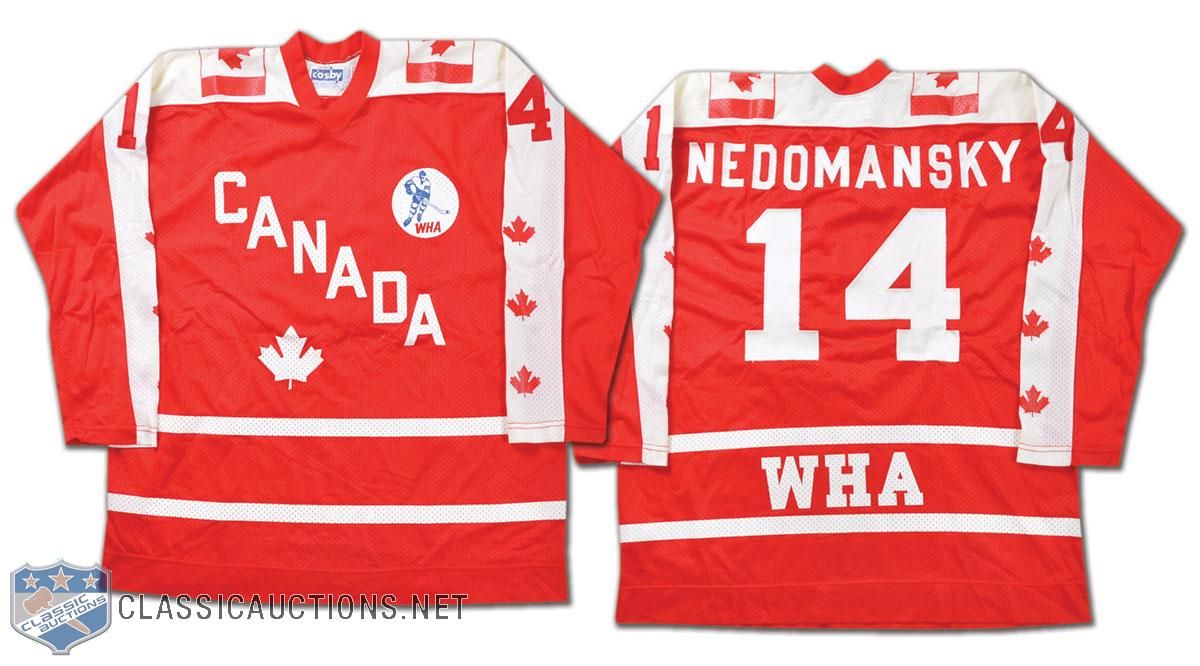
  • We'll start this look into hockey history with a glimpse back at a jersey from an all-star. Vaclav Nedomansky was chosen as a WHA All-Star in 1976, and he played on Team Canada for the game in Cleveland, Ohio despite being from Czechoslovakia! The reason for this is that the WHA chose players for their all-star teams based upon where they played rather than where they were born! The Canadian-based WHA teams sent players as part of the Canada All-Stars and the American-based WHA teams sent players as the United States All-Stars. In 1976, Toronto Toros' star Nedomansky and the Canadian WHA All-Stars beat the US WHA All-Stars by a 6-1 score on January 13 at Richfield Coliseum!
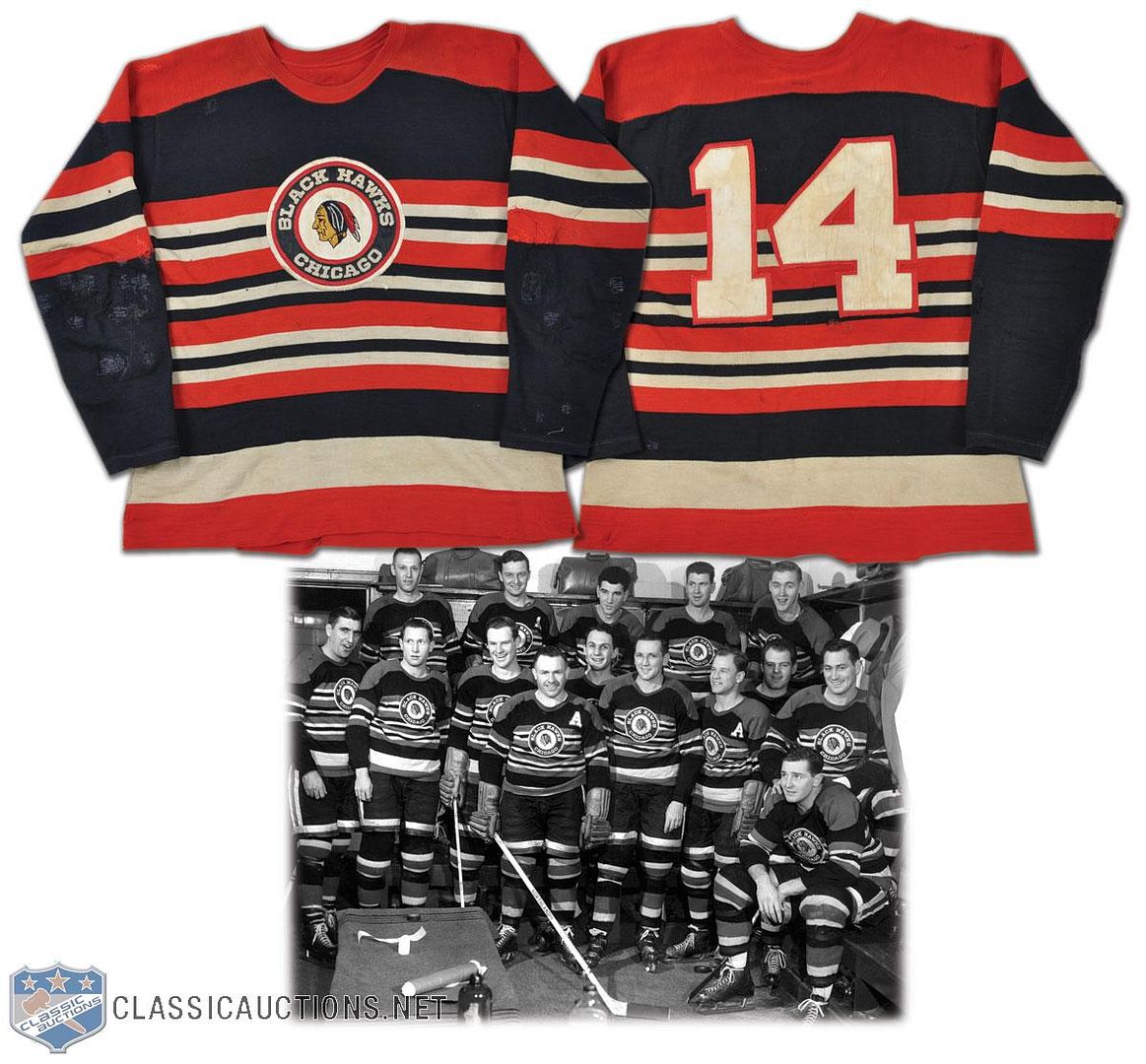
  • We move on to an Original Six team. I have to say that I am a huge fan of this Blackhawks sweater from the 1950s. The colours, the stripes, the logo, the font... it truly is a thing of beauty! If there was ever an opportunity to bring back a different alternate jersey for the Blackhawks, this one gets my vote.
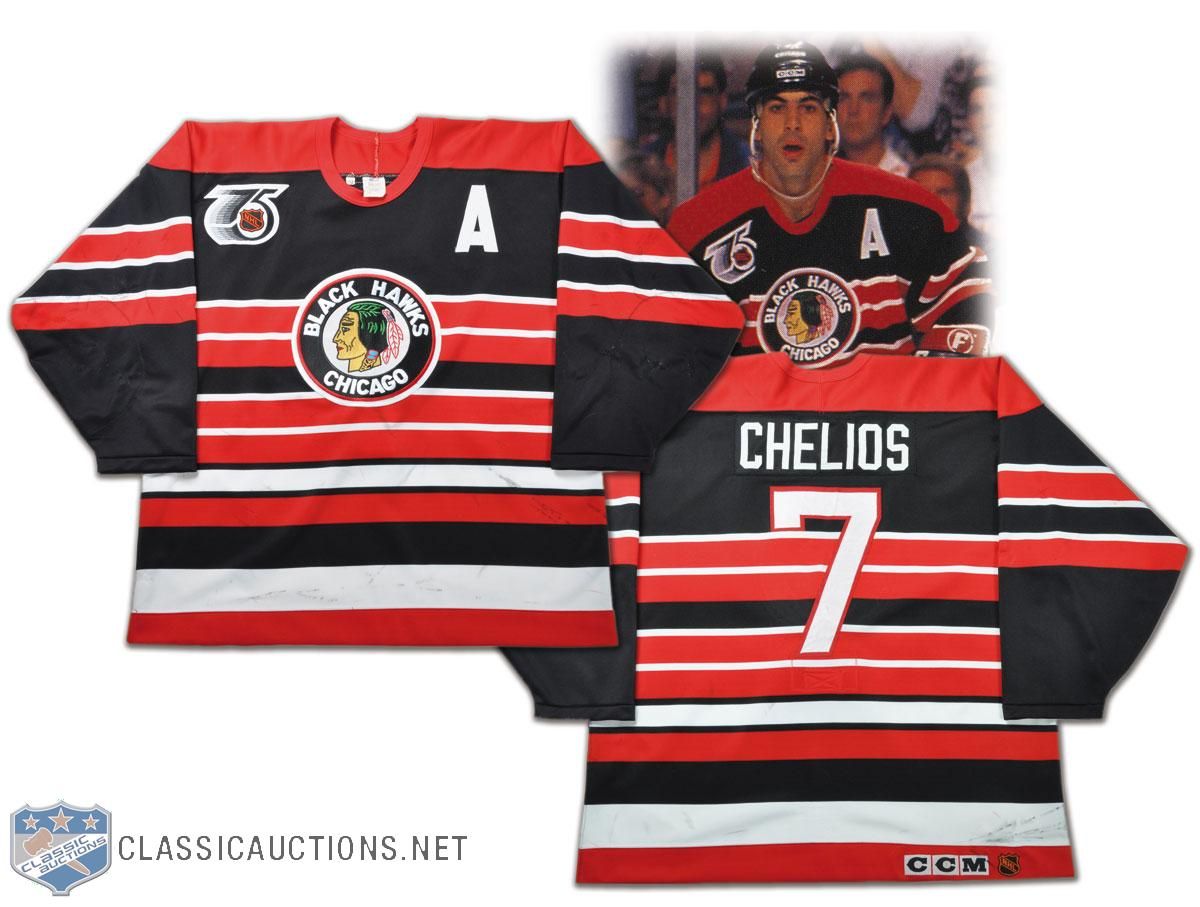
  • Strangely enough, the Blackhawks have worn this look closer to the future. In 1991-92, the NHL had the Original Six teams wear a throwback jersey, and the Blackhawks decided on a jersey that looked remarkably like their sweaters from the 1950s. Two things I don't like: the rear font they decided on, and the name on the back. The font is just too skinny, and if you're going to throwback to a previous incarnation, go all the way or don't go at all.
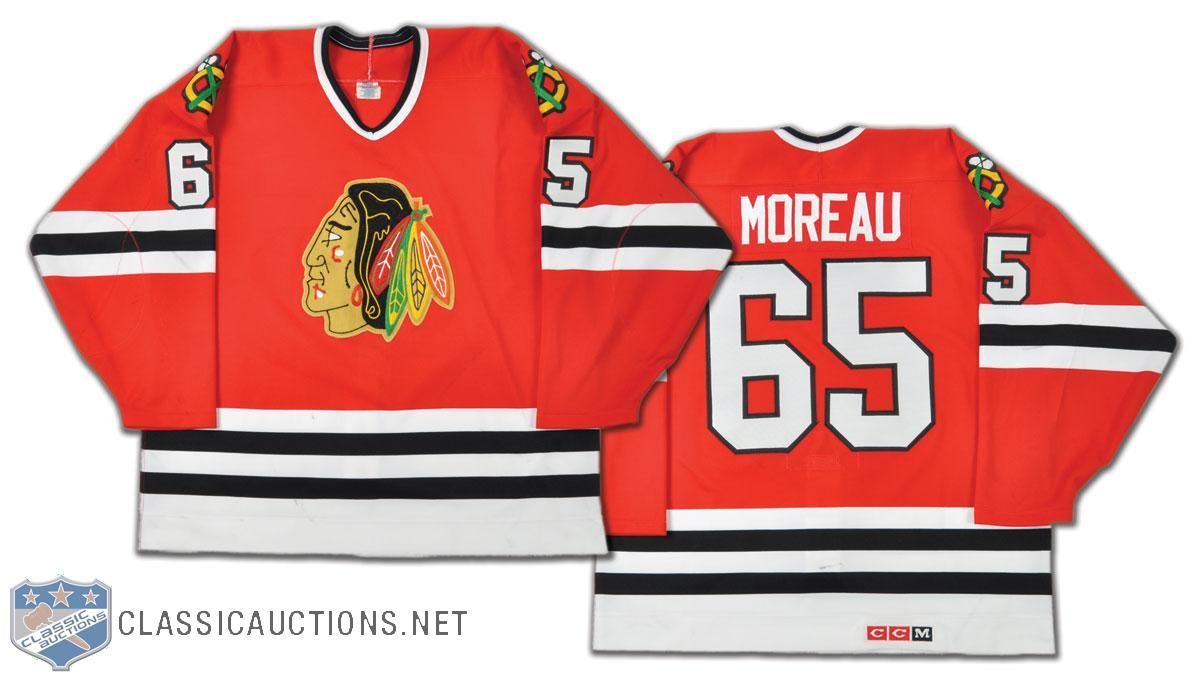
  • This is a rare find, but I'm always intrigued when I come upon a number that I've never seen a player wear. Ethan Moreau apparently wore #65 during the 1994 preseason! If you're a Moreau fan, this number is one of those rare finds - much like Joe Sakic's #88 jersey when he played with the Nordiques!
  • When you think of the Vancouver Canucks, does anyone else miss this look? I'm sorry, but as good as the current look is, there is still something about the skate logo that I truly miss about the Canucks. Maybe we'll see these beauties come back as an alternate one day? No one did yellow-orange-black like the Canucks did.
  • As much as I hated them as a Penguins fan, there is something magical about the red-white-and blue of the Capitals. But I do have one question about this Doug Jarvis jersey from the early-1980s: why are the hem stripes so huge? They literally go right to the logo which is mid-torso! That's a little crazy.
  • Just because there aren't enough Sutters in Calgary, here is more proof that the Sutter bloodline runs through the Flames. That's Shaun Sutter's jersey from the 1999-2000 season. Shaun is the son of Brian Sutter, and was drafted by the Flames when his dad coached there. Currently, Shaun serves as an assistant coach with the WHL's Regina Pats.
  • I've looked at this before, but there was something going on with the Philadelphia Flyers in the late-1970s and early-1980s. Check out the location of the captain's "C" on Bob Clarke's jersey from 1976-77. It's nearly in the middle of his chest! And it's still pretty close to his mid-line in 1980-81! What gives? Why is it so close to the middle of his chest?
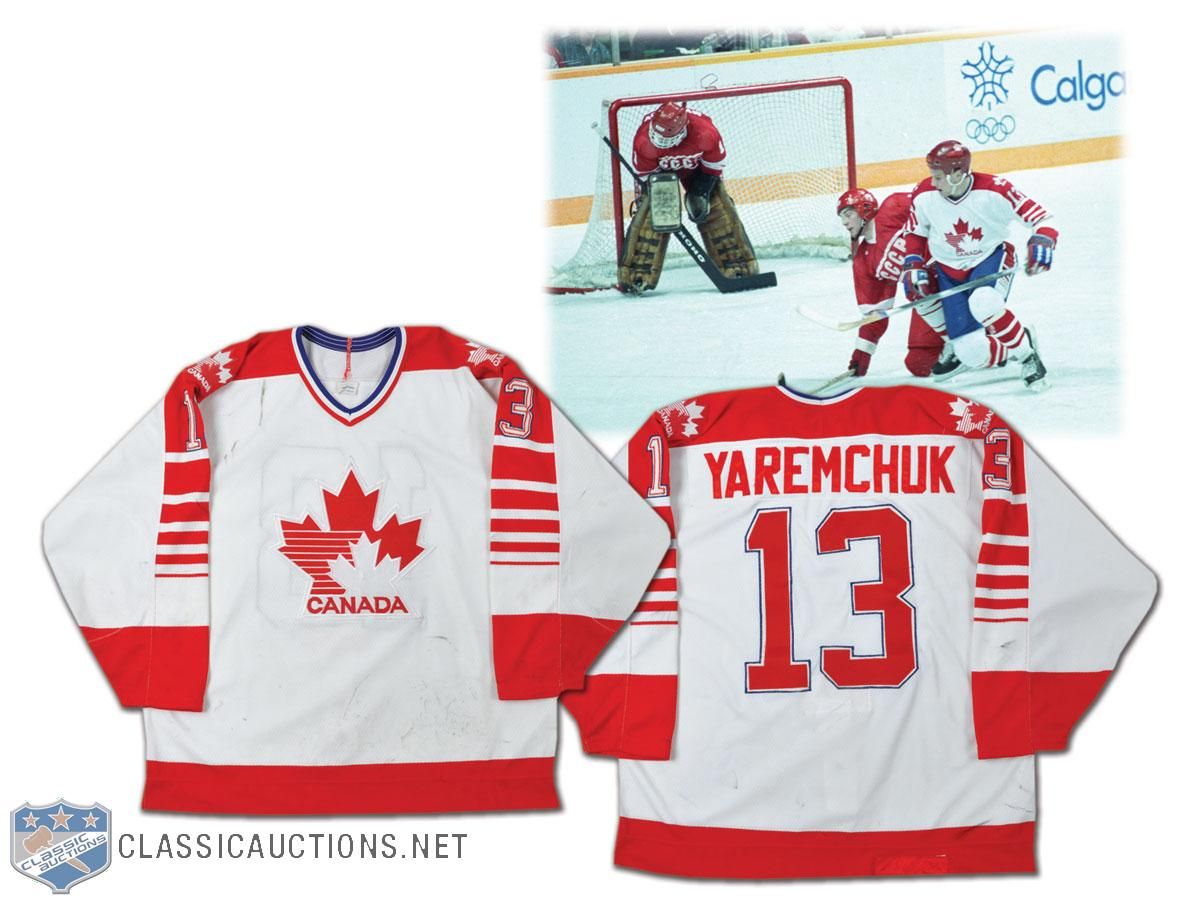
  • We move to the international scene. There's a big story surrounding the 1988 Canada Olympic jerseys that I wasn't aware of before reading the story on the Classic Auctions site. This is Ken Yaremchuk's jersey, and he played alongside NHL players like Sean Burke and Andy Moog as they prepared to represent Canada at the 1988 Winter Games in Calgary. Here's the kicker: "An embroidered CCM crest on the rear hem has been covered with a patch of red tackle twill, obviously to comply with advertising guidelines. Canada received a fine of $100,000 for refusing to wear uniforms made by Tackla at the Games". I never knew that! Corporate America already had a hold on the Olympic Games back then! How cool is that little gem of hockey history? I'm hoping your answer was "very".
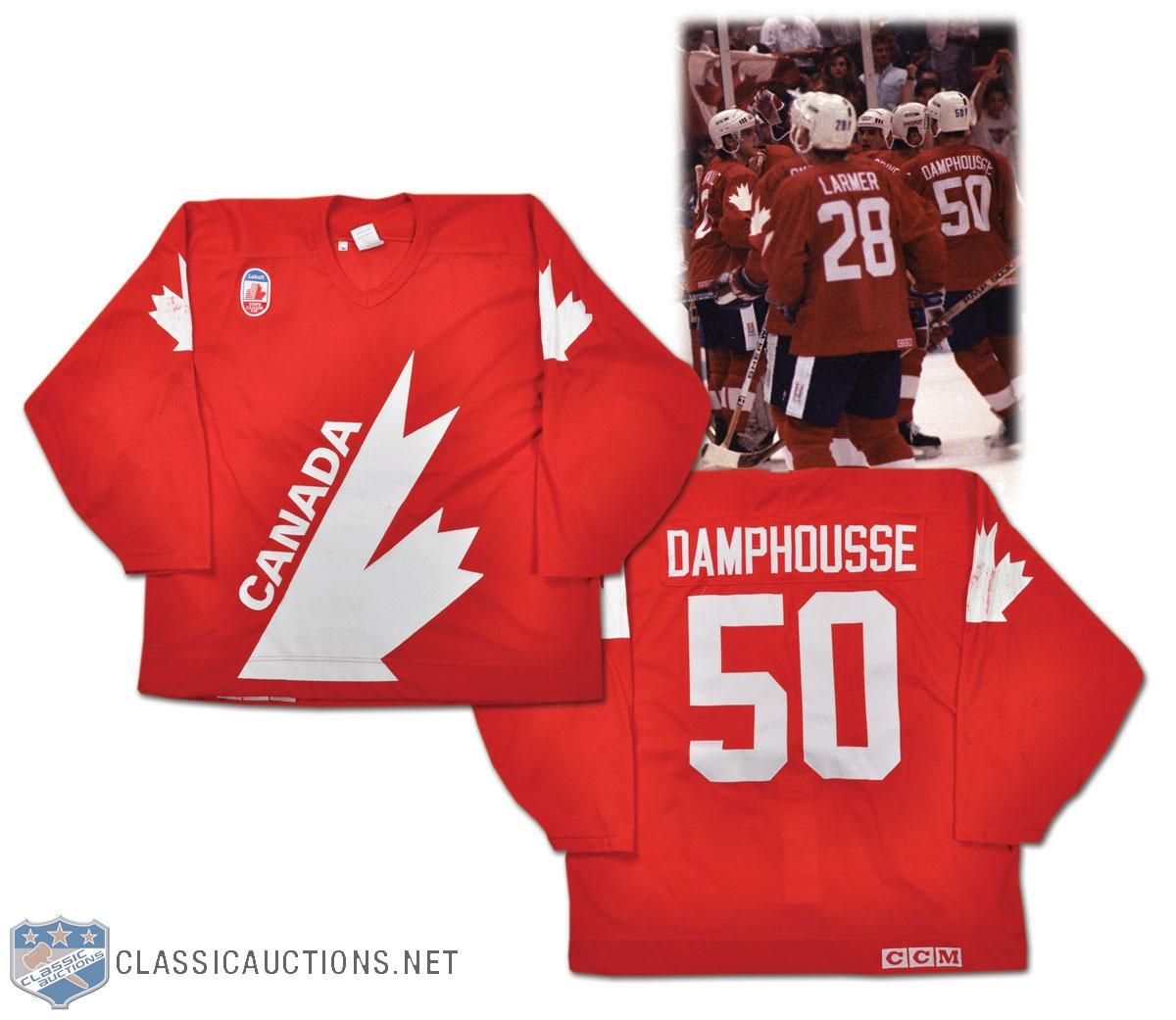
  • Here's a number that wasn't seen on the ice at the 1991 Canada Cup, but Vincent Damphousse played during the selection camp. He wore #50 through the camp as he worked to play his way onto the team, but he was cut days before the Canada Cup started. It's another one of those number cameos by a player who never wore #50 again. We'll see more of Damphousse later in this article as he has another jersey in this exposé.
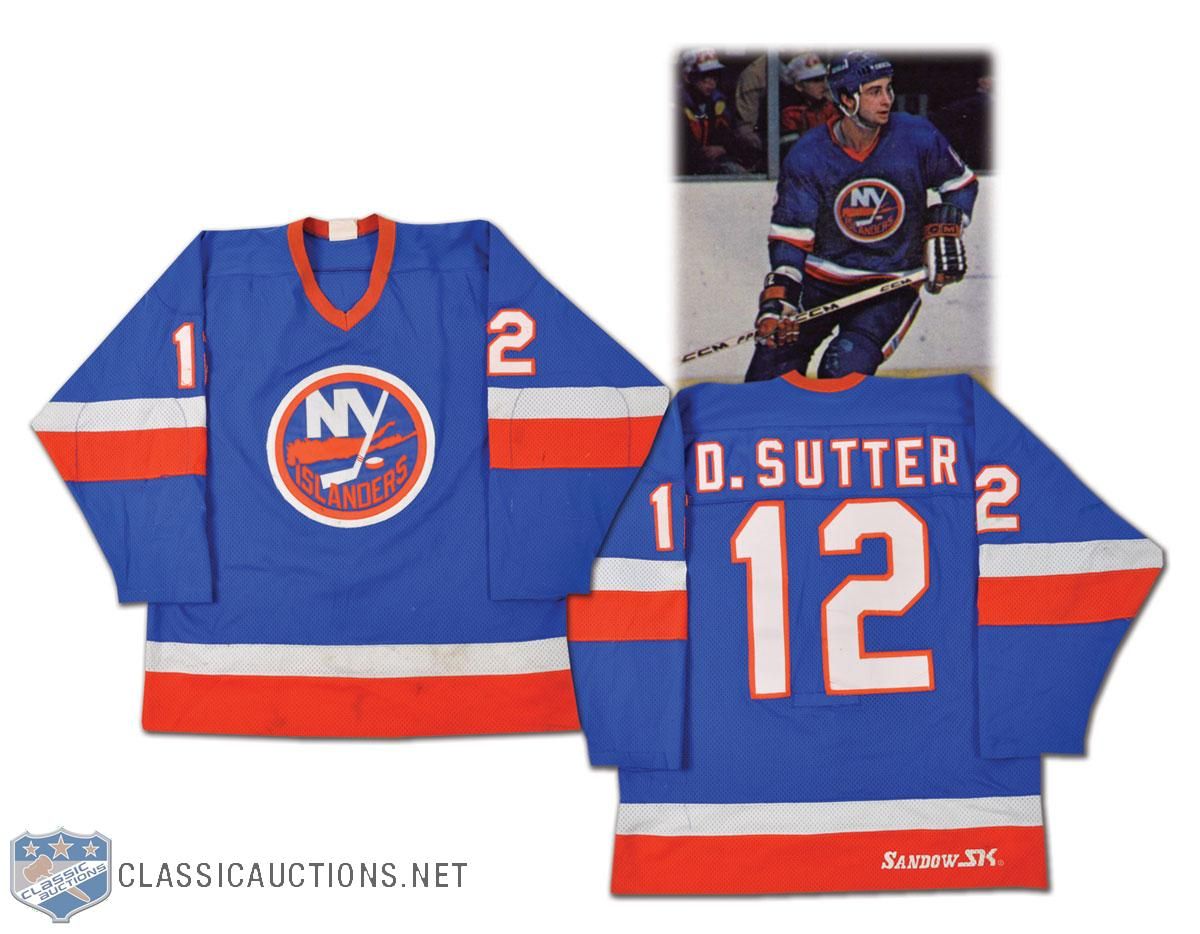
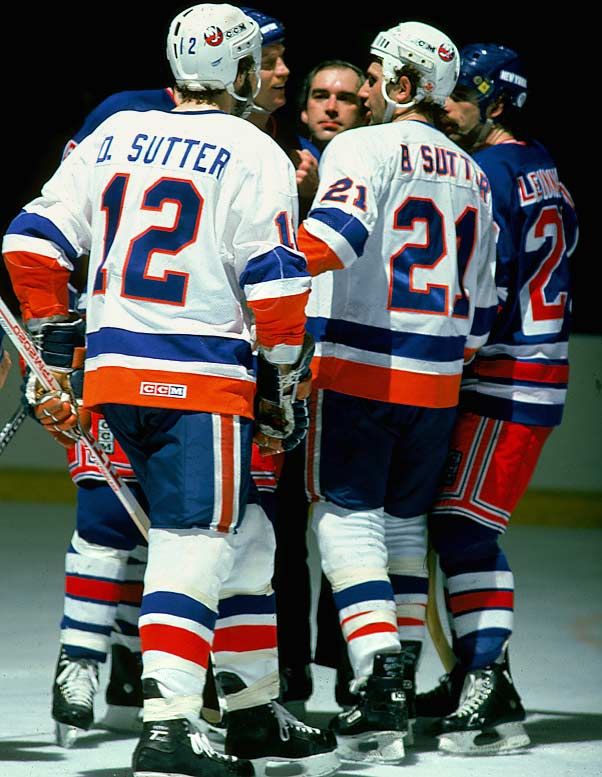
  • We mentioned a couple of Sutters already, so let's bring a couple more onboard in this article. We get a good look at Duane Sutter's jersey with the Islanders from '81-82, and I'm always a fan of the first initial on a jersey. However, as we look at this photo with both Duane and Brent Sutter in it, does anyone see a major difference in the lettering? Duane's appears as single-colour font while Brent's font is double-coloured. It appears this was corrected as of 1981-82.
  • With the Lightning changing their jerseys next season, it's always interesting to look back at some of their previous jerseys. Their inaugural jersey was interesting. Steve Kasper's jersey has that ridiculous font on it. I'm quite happy that it went the way of the dodo and was never seen again.
  • I have to say that I always loved the colours of the Minnesota North Stars. We get to see that gorgeous green colour of the North Stars jersey here on Basil McRae's uniform from the 1987-88 season. This is what Minnesota hockey looks like. Bring back the green!
  • Bob Rouse's jersey from his stint with the North Stars shows the addition of black to the colour scheme. This is how I think most people remember the North Stars. There were so many great memories of that Stanley Cup run in 1991 that ended at the hands of Mario Lemieux and the Pittsburgh Penguins in the final, but these great uniforms will stand out vividly in my mind.
  • The jerseys that the North Stars wore in 1991-92 really took leaps and bounds in the wrong directions with their "re-design". Nothing about that design even comes close to giving off that great North Star vibe, and it feels pretty bland as a hockey jersey. Little did the hockey world know that the "north" part would soon be a thing of the past.
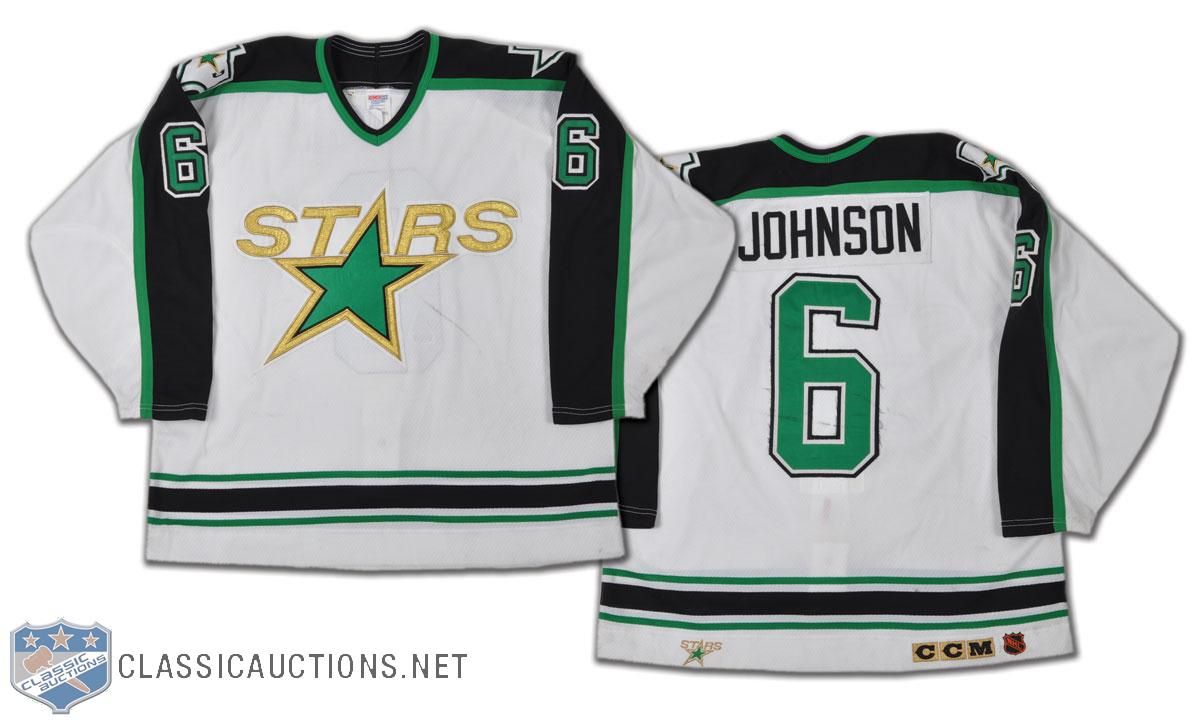
  • By 1993-94, the Stars would be playing in Dallas, and they would be wearing uniforms that seemed to have a lot in common with the earlier re-design. Note to self, fans: if your team suddenly begins to remove the parts of the uniform that make you distinctly unique like, say, part of the team name, I'd be suspicious.
  • Even the officials got in the act with some distinct designs. We've seen this image of Ron Ego calling a penalty in the WHA and discussed his red-striped officials jersey. I never scoured the internet for a picture with much intent because the referees seem to get lost in the shuffle of history. However, Wayne Mundey's referee sweater is a joy to behold!
  • The NHL officials showed that they wore the NHL colours for a long time as this official's sweater from the 1970s has orange numbering to match the NHL shield on the front! Wasn't it nice when NHL All-Star teams and NHL employees all represented the league by wearing the league's colours? The "good ol' days", I suppose.
  • The California Golden Seals seemed to miss the boat in the 1970s when they went pastel instead of staying true to their gorgeous green looks as the Oakland Seals. Bob Girard's uniform looks great, but it just doesn't have the same "pop" as the Oakland jersey does.
  • The 1975-76 Kansas City Scouts jersey is a nice blend of colours, but that logo really draws the eyes to it. That logo features chain-stitching, a favorite of Mr. Paul Lukas over on Uni Watch Blog. I'm not saying the colours should return in the same fashion, but I really think someone needs to come up with a new "Scouts" ensemble. Any takers?
  • Check out the logo on Nelson Pyatt's Colorado Rockies jersey from 1976-77. It looks a little off, doesn't it? That's because the Rockies didn't have their jerseys ready when the season started in 1976. The Kansas City Scouts had moved in the off-season before the 1976 season started to Denver, but they didn't have their jerseys ready in time for the start of the season. Thus the Rockies began the 1976-77 season with an odd-looking Rockies logo instead of their normal logos.
  • Speaking of another jersey that just doesn't seem right, here is a Penguins jersey from the late-1960s. The stripes being light blue just don't seem right after having seen them in yellow-and-black for so many years. Another of the jerseys lost in the annals of history, I suppose.
  • Don Maloney had an interesting career with the New York Rangers. While he wasn't officially the captain, he worked as acting captain whenever the Rangers saw their captain injured. Thus, he routinely is seen with the "C" on his sweater. However, Maloney is probably more well-known for his full name on the back of his sweater. I always thought that was pretty cool.
  • How many people remember Guy Lafleur's tenure with the Broadway Blueshirts? The original "Flower" laced up the skates with the Rangers for 67 games in 1988-89, netting 18 goals and adding 27 assists. I don't remember this, but Lafleur wore #44 while with the Rangers.
  • I found that the Detroit Red Wings did something as they evolved through the 1980s. In the late 1970s (and probably further back), the Red Wings used to use the wheel as the center point for their logo on their chests. The result? Greg Carroll's jersey looks seriously skewed because of the logo.
  • Another gorgeous throwback jersey from the 1991-92 season was worn by the Detroit Red Wings. Doug Crossman played with them that season, and the stripes make this jersey look amazing. This is still one of my favorite hockey jerseys of all-time.
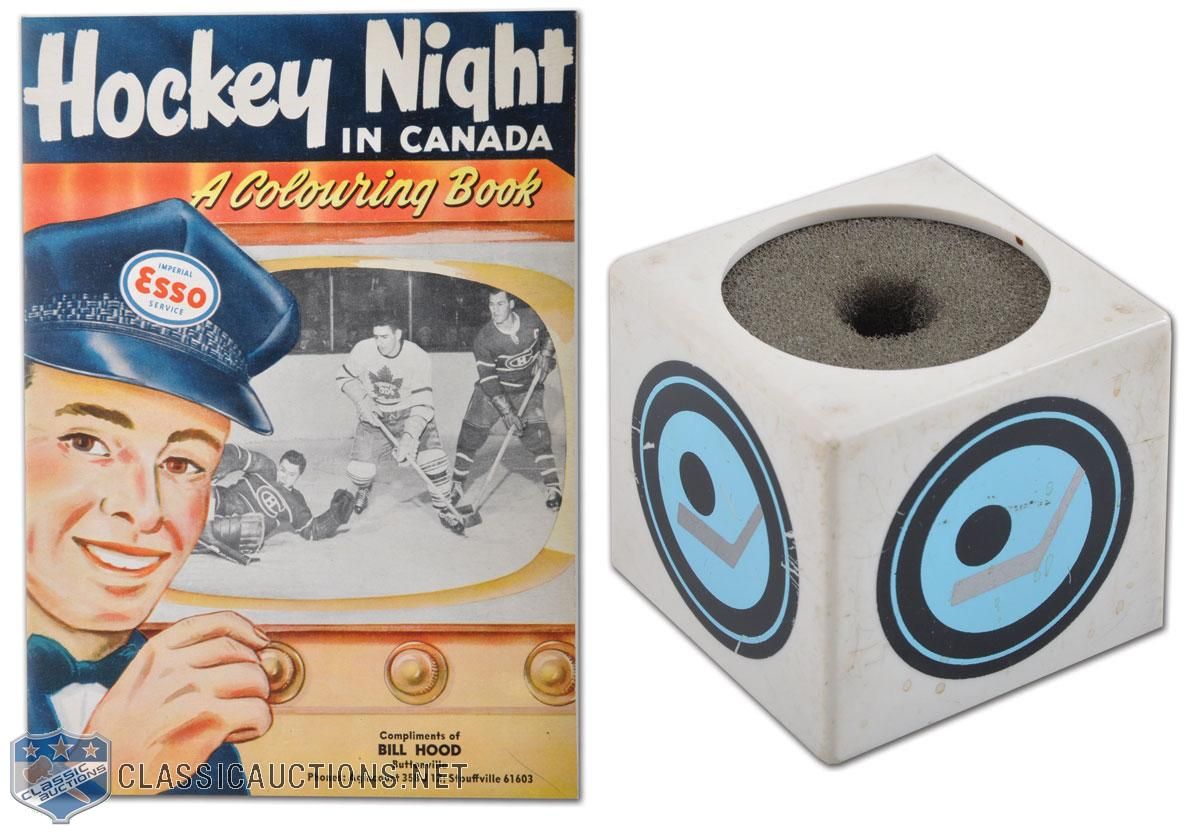
  • How cool is this Hockey Night In Canada microphone cover and book? Ok, the book isn't all that important, but how awesome would it be to have that microphone caddy? I might want one of those more than I want a fabled HNIC towel!
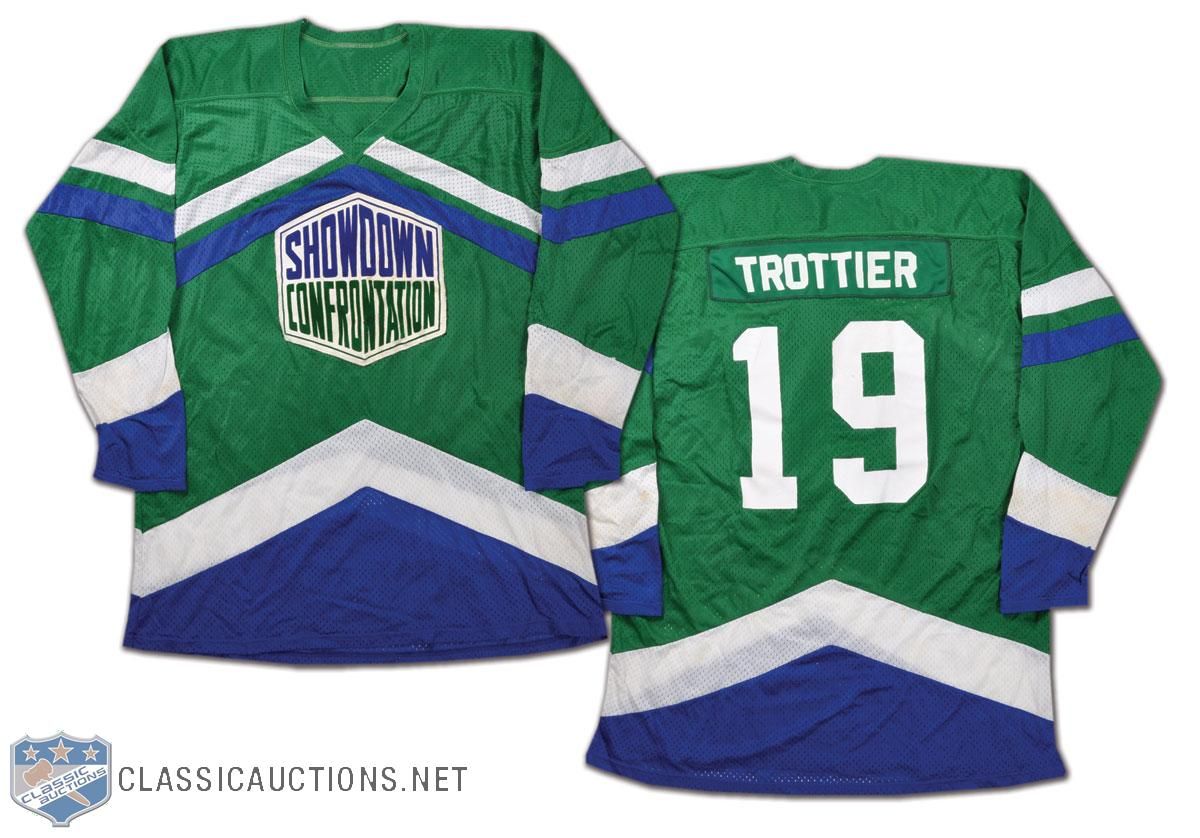
  • We've seen a number of the NHL Showcase Confrontation jerseys in the past, but there's another one in the auction this time around. Bryan Trottier's jersey is up for grabs this time, and I must admit that I really like the colours on this jersey. I may have to research these Showcase Confrontation games a little more!
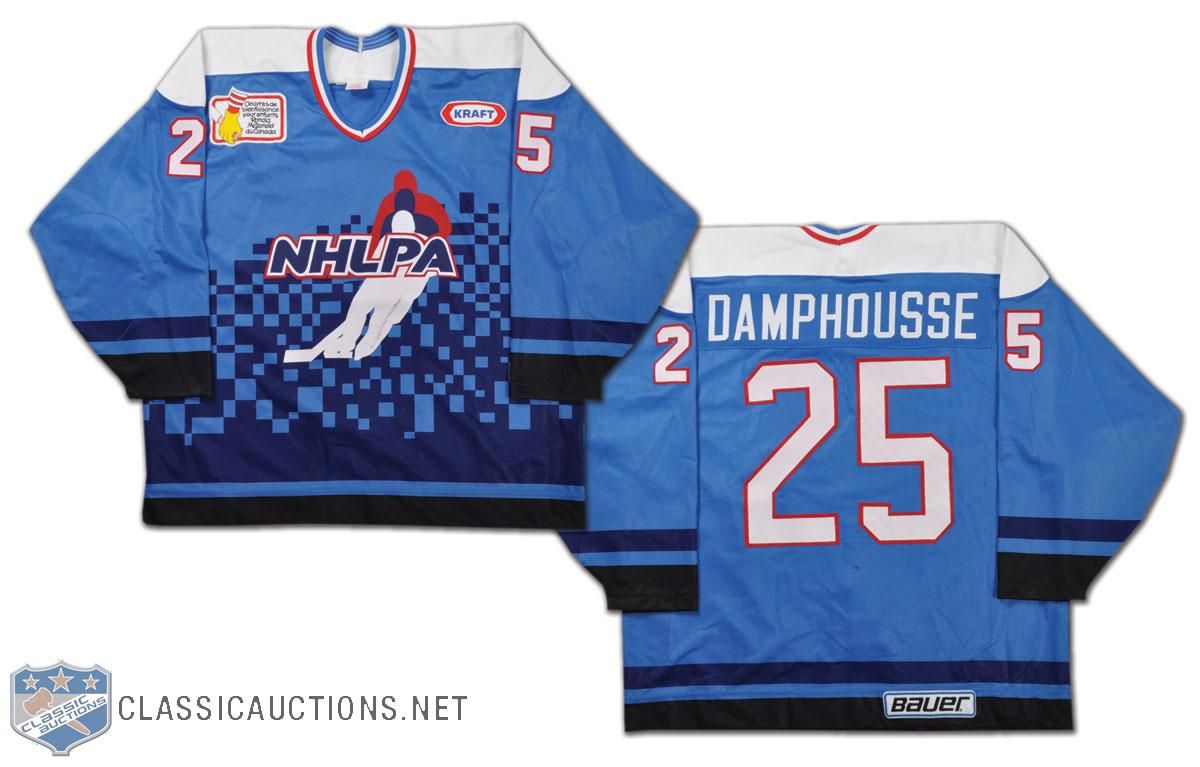
  • There are lots of people who saw the NHLPA 4-on-4 Challenge from Hamilton, Ontario in 1995, but there seems to be zero tape of these games online anywhere. During the strike, the players got together at Copps Coliseum in Hamilton to play some four-on-four hockey while representing their respective regions: Western Canada, Ontario, Quebec, and the USA. Vincent Damphousse was invited, and he played for Team Quebec at the event in this gorgeous NHLPA jersey. I want it!
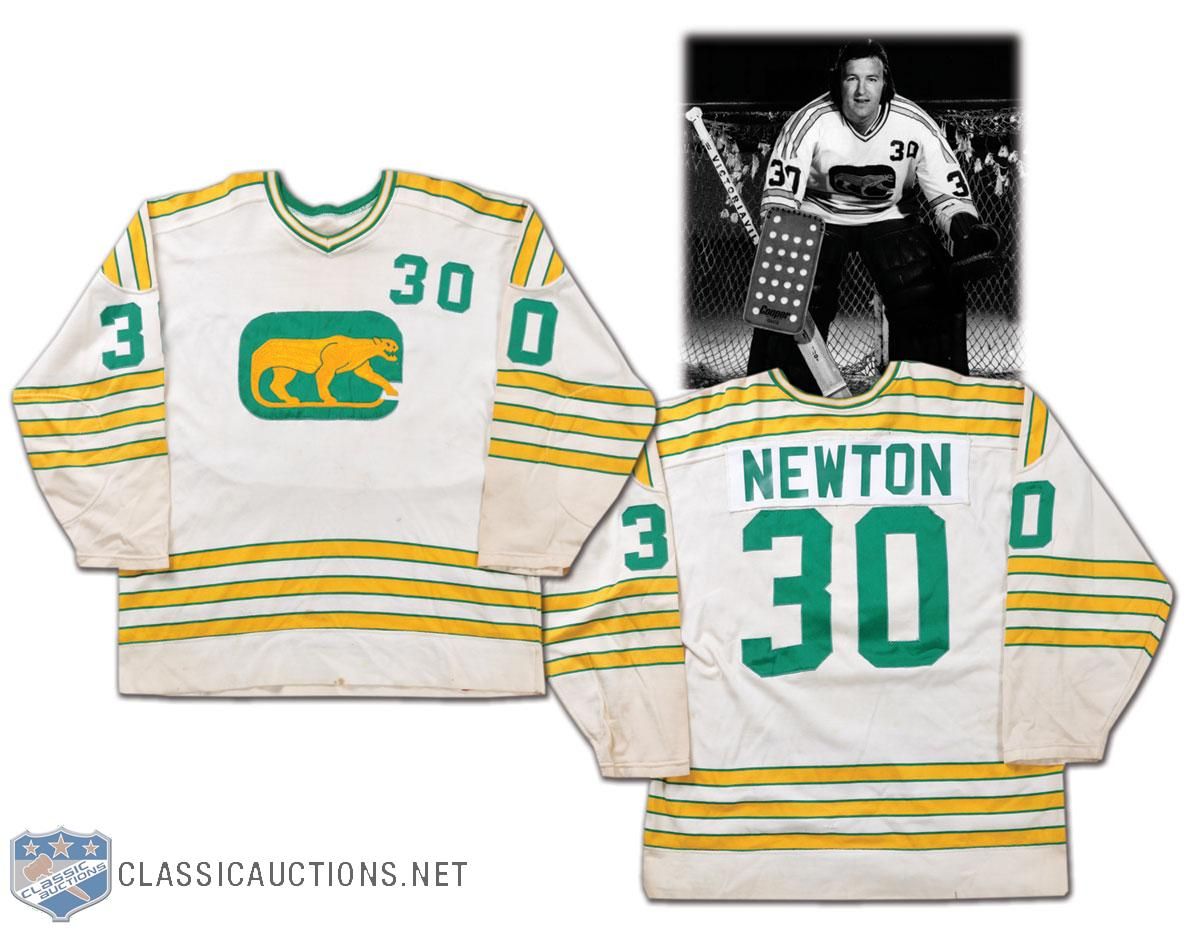
  • We started with the WHA, so let's end it with a few WHA sweaters as well. The original team with the number on the shoulder was the Chicago Cougars, and Cam Newton's jersey from 1973-74 shows the number clearly. I'm still not a very big fan of having the number on the front of the jersey in hockey, but it seems to have made a comeback with some of the NHL teams today.
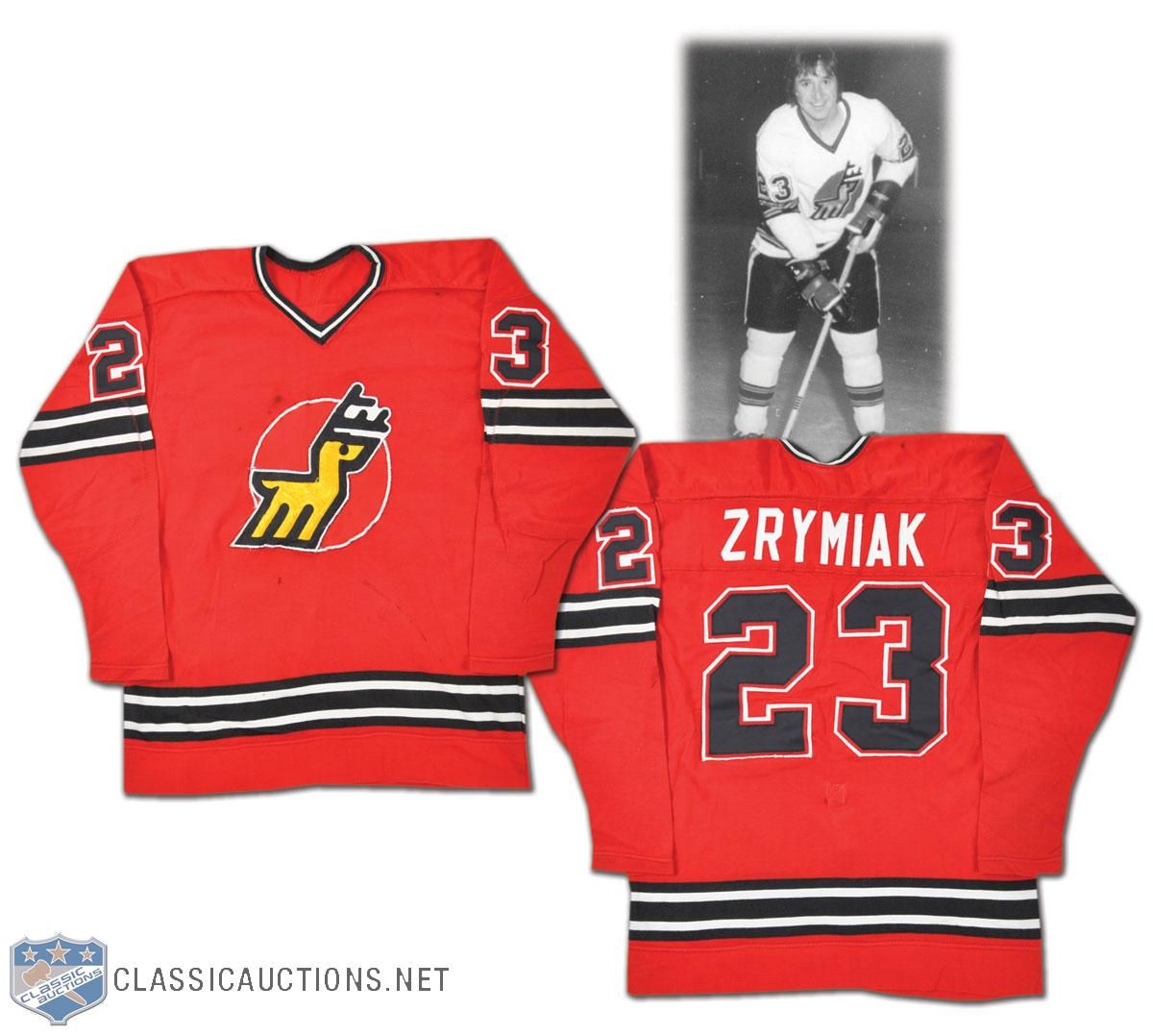
  • Journeyman defenceman Jerry Zrymiak bounced around the WHA for a while, but he played with the Michigan Stags for a while during the '74-75 season. I'm not sure about you, but the name "Michigan Stags" just sounds like a manly name. The colour is a little less manly, though. I love the Stags' logo, though.
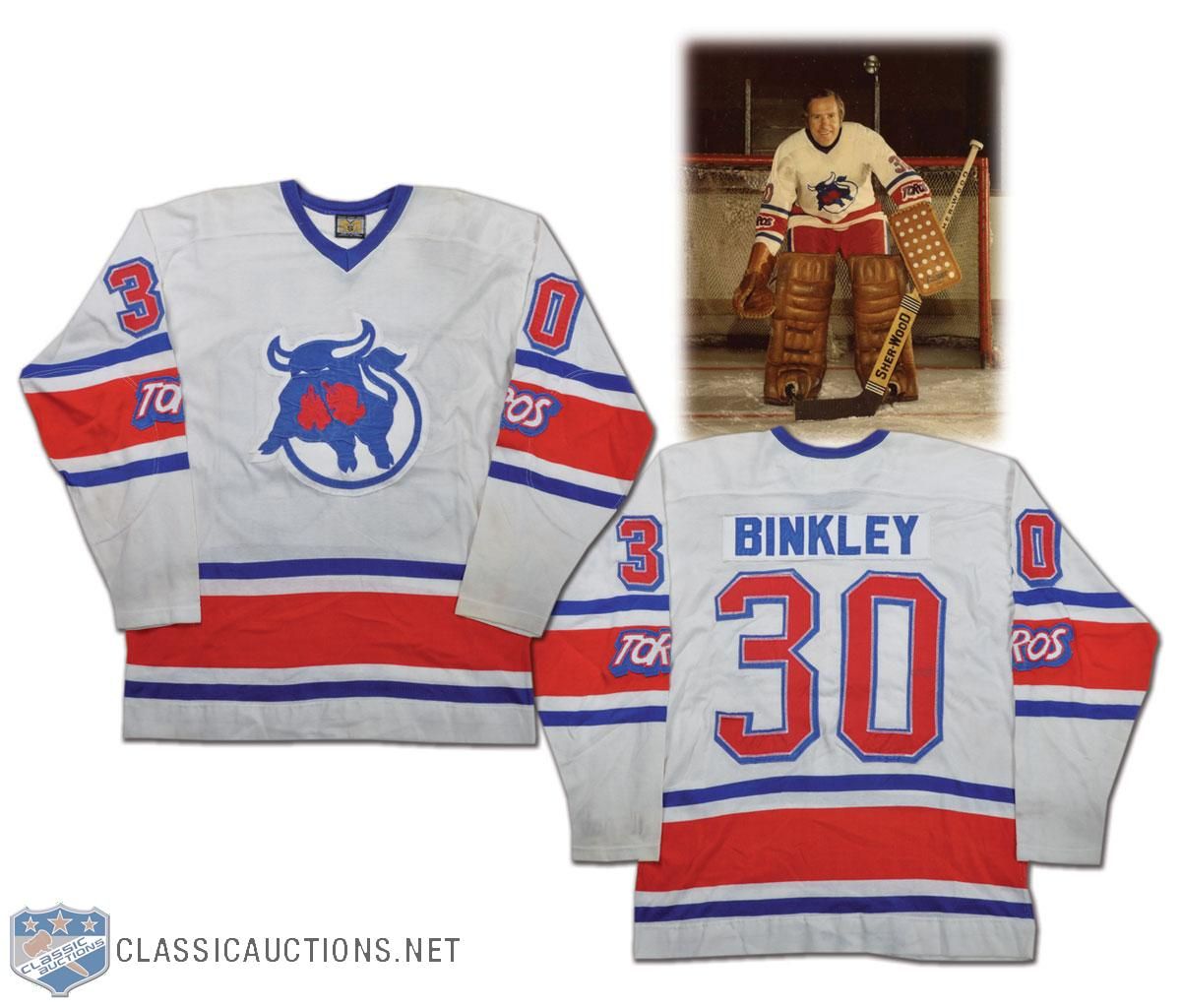
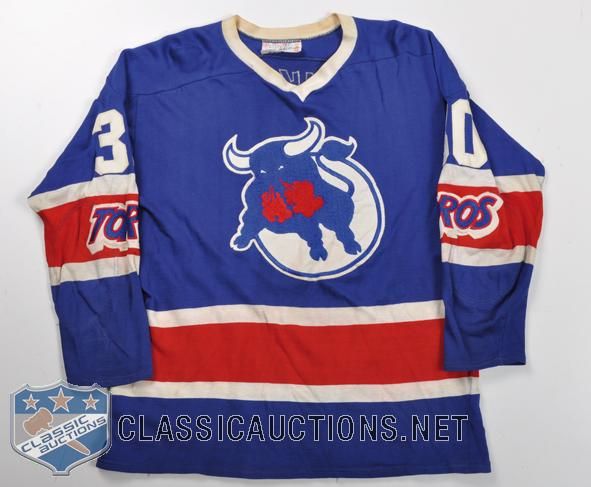
  • Les Binkley starred in net for the Toronto Toros in 1975-76. I like the colours of the Toros' jerseys, but the important part is the "Toros" mark on the sleeve stripe. That's a huge detail on these jerseys, especially when you consider that the team moved after the '75-76 season and became the Birmingham Bulls. Why is this important? Check out the similarities in the Bulls' jersey to the Toros' jersey. The only thing missing is the "Toros" wordmark from the sleeve!
There are a pile of incredible auction items available through the Classic Auctions website. I really would kill for that HNIC microphone cover or that Detroit TBTC jersey, but, being that I'm a poor college student, these luxuries will have to wait. If you're interested, get over to the Classic Auctions website ASAP!

Until next time, keep your sticks on the ice!

Friday, February 25, 2011

I'm not going to lie, readers, when I tell you that this school stuff is taking over my life. Next week, I'm faced with five exams on five days, and that means I'll be studying my rear end off. If my nose is stuck in a book or if I'm flipping through course notes, guess what I'm not doing? That's right: I'm not blogging. As a responsible blogger (at least I think I am), this doesn't sit right with me. I want to be able to spend some quality time with hockey, but I can't because I'm having an affair with books and information. Something, I feel, has got to give.

That's where you can shine, readers. For today, I am opening the doors to HBIC for anyone who wants to drive whenever they get the urge. Officially, I am accepting all articles written about hockey by you! If you have the urge to write something, get something off your chest, or simply post a few picture about hockey, the canvas is waiting for your paint, readers.

If you have an article you'd like to send through, please attach to an email and send it through to me. Full credit will, of course, be given to you, and I'll even chime in on your work. Normally, I'm a pretty supportive guy being that I'm a man by the people, for the people, and of the people, but it will all depend on what you submit. I may take issue, but I will certainly thank you for your work and give you all the credit you deserve.

If you're a college student who is working on some sports-related article, I'd be happy to send something to your professor or instructor stating that you've contributed an article that has been published. I'm not sure how much weight that will carry for you, but if they ask if you have any published works, you can say yes.

If you have something to submit, get it sent in! Otherwise, here are a few things I've found around the Interwebs that could use a little exposure. Some of these come from the Life magazine gallery found on Google. I'll note those where necessary.
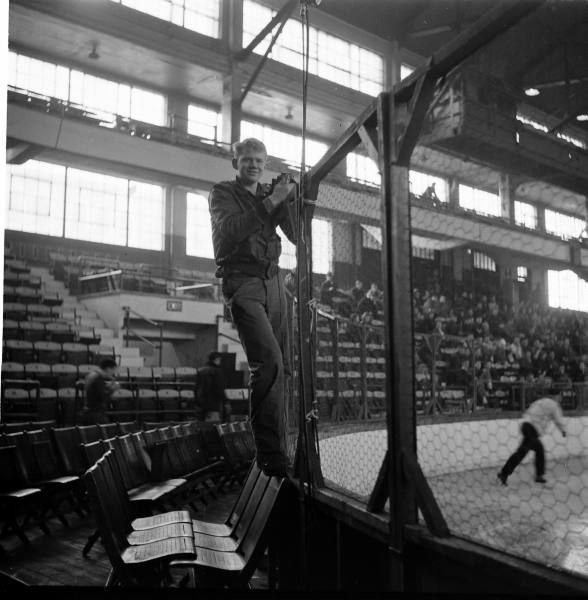
  • Love the images of the old rinks, especially when they have the chicken wire instead of glass. I'm not sure what that fellow is fixing, but he appears to have posed for this picture. If my eyes aren't deceiving me, it looks as though there is a game being played while he's working on the rink! This is a great shot from Life.
  • Speaking of those old rinks, check out how close the fans are in Madison Square Garden to the visiting Canadiens. And they barely have a separator there! I guess life back in the 1950s and 1960s really was a different time. Life brings history into reality once again.
  • Rarely do we get access to places like the team bus or train, but Life snapped this photo of Blackhawks star Bobby Hull and a teammate who appears to be Pierre Pilote sitting aboard the team train! While it's tough to say which newspaper Hull is reading, Pilote clearly is readying himself for the fairways with his edition of Golf magazine. I love this photo as it really shows a side of the players we don't get to see away from the rink!
  • A lot of people I know weren't really fans of the Bruins' yellow alternate jerseys, but I hate to see how many people would really hate the Bruins if they went all yellow. If we go back to 1958-59, though, the Bruins did actually wear mostly yellow as seen here on Fern Flaman! The thing about how the Bruins looked in '58-59 is that there is just enough black to break up the yellow and white. I actually don't mind this look, but I don't know if I'd be happy with it forever. The Bruins just look better in black with yellow highlights.
  • We all know how the Rangers have that very unique shadowing on their numbers, and they seem to be pretty consistent when it comes to using that shadow. My question to you, readers, is this: when did they start using it on their sleeve numbers? The reason I ask is that it appears they were shadowing the back numbers in 1963, but they did not do the same on the sleeve numbers as this picture shows. From what I can find, the earliest that they made the numbers on the sleeves similar to those on the back is 1978. Does anyone know if this is the earliest their numbers had similar shadowing?
  • Just because I can: Wayne Gretzky in the Burger King jersey. Nothing like a little BK on a Friday night, right? No, I'm not selling out to Burger King either.
  • I always like the old photos of international games, so this USSR-USA picture from the 1968 Winter Olympics ranks high. I love the lettering on the front of the USA jersey! The USSR squad has a very understated look for such a dominant team.
That's all for a Friday. I need to get myself ready for five exams next week. I'm pretty sure that my brain going to be mush by the end of next week. However, there is no crying or whining allowed here, so I must do what I have to do!

Until next time, keep your sticks on the ice!

Thursday, December 30, 2010

Time certainly has flown this year as we're two days away from recycling those 2010 calendars hanging on walls and posted on desks. Hockey has seen some great things this year, and we've also lost some icons that made the sport much better with their presence. We've seen players emerge as superstars and we've seen superstars fall to below-average play. All of this is actually a statement about the game - it's fluid, and it's constantly changing and evolving through each shift, each game, and each season. Today, HBIC looks back on the first six months of the year, and the important stories that came from January to the end of June.

January Highlights
  • January 1: We start every year off right with the NHL's Winter Classic, and the January 1, 2010 game was certainly memorable as the Philadelphia Flyers visited the Boston Bruins in historic Fenway Park. What a great day of hockey!
  • January 2: Switzerland's World Junior Championship team pulls off a massive upset as they defeated Russia 3-2 to beat the Russians for the first time in history at the WJC.
  • January 5: The 2010 World Junior Championship is decided in overtime as American John Carlson ends Canada's streak with his goal to give Team USA the gold medal. Great game, and a very impressive showing by America's best young hockey talent.
  • January 21: If you've been following this blog, you know I'm a big fan of Frank McClelland's newest equipment invention. January 21 was the first time I was lucky enough to speak to Frank and bring to light what would eventually be his Skate Fenders product. A very interesting story to see how the plastic skate guards got started!
  • January 23: I arrive in Minneapolis for the US Pond Hockey Championships, and the weather was very un-winter for the tournament. Strange weather is nothing new on the prairies, but January is rarely a month known for rain. Great uniforms seen at the tournament, and a few great stories!
  • January 25: I express my disappointment with the NHL's stance on protecting its players after a major incident in the QMJHL.
  • January 29: I bring to light the story of Alton White, the first professional black hockey player to record 20 or more goals in a season as well as the first professional black hockey player to record a hat trick in a professional game. Since it happened in the WHA, no one seems to care that he doesn't get this recognition. But I do.
February Highlights
  • February 5: The hockey world stops for a few moments to grieve the loss of Brendan Burke, Brian Burke's son. Brendan worked as student manager for the hockey team while attending the University of Miami (Ohio), but made headlines when he announced to the world that he was a gay man. And I still believe in my words: "Being gay doesn't change who he is or how much respect I have for him. Nor should it change you."
  • February 13: Phil Hecken of Uni Watch Blog and I take a look at what each team will be wearing at the Olympics. Some uniforms are good. Others are not.
  • February 14: I discuss some of the ways that women's hockey at the Olympics can fix blowouts between the elite teams and the rest of the field. I still feel that getting more women involved from the other countries will make the game stronger.
  • February 21: Team USA plays a much more complete game in the round-robin at the Olympics and beats Canada soundly. I'm hard on Canada and praise the Americans. And this will only set up the inevitable.
  • February 28: The Goal. Need I say anything more? I take a look at the 2010 Winter Olympics as a whole, and celebrate "The Goal.
March Highlights
  • March 4: Frank McClelland returns with some updates on his Skate Fenders. I'm truly a fan of Mr. McClelland's and LSSU's work, and this product is something that players should really look into for their own health.
  • March 11: HBIC renews its commitment to the Vancouver Olympics by giving the sport of sledge hockey as much coverage as possible. I really like this sport, and there have been some excellent games as of late as a number of countries have improved in this sport.
  • March 18: One of the countries that has improved? Japan. They defeated the heavily-favoured Canadian squad by a 3-1 score in the semi-final to earn a berth in the gold medal final. If you haven't seen a game of sledge hockey in your life, you're missing out.
  • March 21: The 2010 Women's Frozen Four wrapped up in style as there were some incredible games played by the NCAA women. Congratulations go out to the University of Minnesota-Duluth Bulldogs who captured their fifth NCAA Championship!
  • March 30: The 2010 CIS Men's Hockey Championship wrapped up, and the Canadian collegiate champions are the Saint Mary's Huskies! Canadian collegiate hockey, while not as prolific as NCAA hockey, is certainly one of the places where NHL teams can find some hidden talent. There are lots of good players studying across Canada!
April Highlights

May Highlights
  • May 3: The KHL crowns a champion as Ak Bars Kazan won their second KHL Championship in consecutive seasons. While there are still major differences between the NHL and KHL, it appears that Kazan is becoming the "Detroit Red Wings" of the KHL.
  • May 7: I found a great article in Popular Science from 1935 about the game of hockey! It's a very good read with lots of pictures, but it goes to show that some magazines were covering hockey before it was popular!
  • May 14: A reader by the name of Chelsea sent me a great email about head trauma suffered by hockey players. She makes some excellent points in her email, and there are several NHL players who echo her sentiments.
  • May 23: The Czech Republic snaps the Russian's 27-game winning streak at the World Championships, and captured the World Championship title! Jaromir Jagr's reason for winning? "They had stars and we had guys who play in the Czech Republic, but this shows that talent doesn't matter - you have to work hard." Hard work, kids. I can't say it enough.
  • May 25: I still have no clue as to what happened to the Charlie Conacher Memorial Trophy that was awarded annually to an NHL player. Any ideas?
  • May 28: Damian Cox goes absolutely loopy with his suggestion that the Chicago Blackhawks change their logo because it's offensive. Cox stirring the pot? Nothing new.
June Highlights
So there are the highlights from the first six months of HBIC's 2010. I really had a great time writing this year, and the interactions with you, the readers, are what makes this so rewarding. I love reading other opinions and ideas, and I encourage you to continue to email, comment, friend me on Facebook, and whatever else you to do to send me your hockey thoughts.

More tomorrow as we review the year that was from July to December!

Until next time, keep your sticks on the ice!

Friday, September 24, 2010

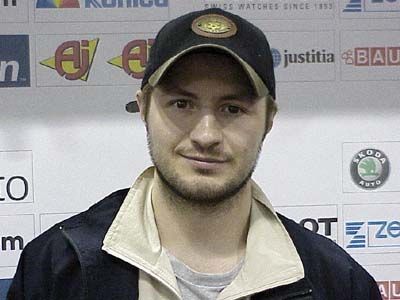
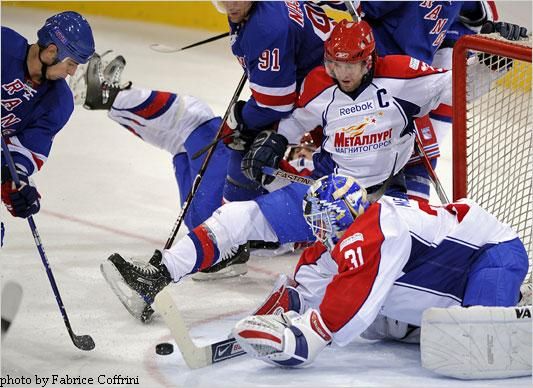
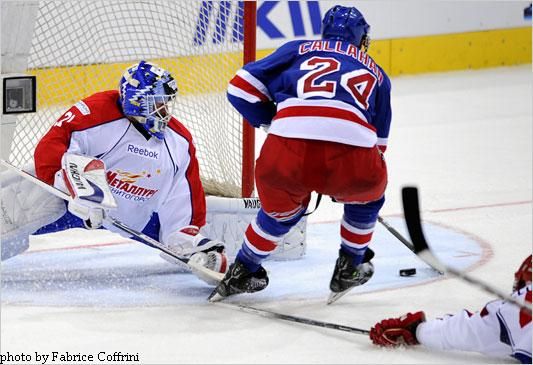
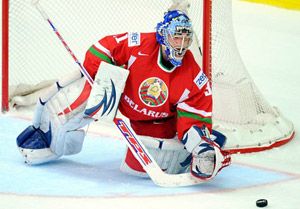
This image to the left probably won't be a memorable moment from the 2010 Vancouver Winter Olympics, but the man making the stop has himself a place in hockey lore. Andrei Mezin, the Belarussian goaltender, is best known for his 2002 Olympic performance against Sweden in the quarterfinals, but he has carved out a pretty good career over in Russia playing in the Russian Super League and the KHL. Today, I want to take a look at the highlights of Mr. Mezin's career after he was named as one of the KHL's Players of the Week for the last week.

Born in Chelyabinsk on July 8, 1974, Andrei Mezin bounced around North America from 1993 until 1998, playing in the ECHL, the Colonial Hockey League, the IHL, and the UHL in those six seasons.

In 1995-96, he starred with the Flint Generals of the Colonial Hockey League where he played 40 games with the team. He finished with a stellar 27-9-2 record despite having a 3.49 GAA and a .883 save percentage. He helped the team finish first in the East Division, and the Generals tore through the playoffs to win the Colonial Cup!

The following season saw Mezin star with the team again as he led them to first in the East Division again, this time with a 19-4-1 record, a 2.46 GAA, and a .902 save percentage. The Generals ploughed through the playoffs once more, but ran into an upstart Quad City Mallards team that had finished second overall in the CoHL. The Mallards downed the Generals in six games, but Mezin shone all season long.

The Generals finished second overall in the inaugural season of the UHL in 1997-98 on the strength of Mezin's 21-5-0 record. He regressed in his stats, posting a 3.47 GAA and a .885 save percentage, but the Generals marches their way to the UHL Final to face the Quad City Mallards once again. This series was much closer than the previous year as the series went back and forth. Quad City won all of the odd-numbered games, while Flint took all the even-numbered games. In Game Seven, it took overtime, but the Mallards finally prevailed by a 3-2 score. Bryan McMullen logged the majority of games in the playoffs, but the Generals had finished strong once again.

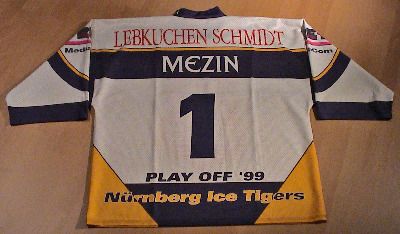
The 1998-99 season saw Mezin jump to a new locale as he began a career in the Deutsche Eishockey Liga with the Nürnberg Ice Tigers. He backstopped the Ice Tigers to first overall in the DEL, and carried them into the playoffs where they were stopped in the final by Adler Mannheim. The 1998-99 Ice Tigers still hold the best record for a Nürnberg DEL team.

After playing one season with Nürnberg, Mezin moved to the Berlin Capitals for three seasons. While he never experienced the same success as he did with Nürnberg, Mezin played no less than 54 games in each of his three seasons with the Capitals. However, with the Capitals experiencing financial problems in 2002, the team dropped to a lower-tiered German league as they worked to re-establish itself. With that, Mezin moved closer to home.

Of course, 2002 was Mezin's shining moment as he led the the winless Belarus team into the quarterfinals against the 3-0 Swedish team at the Salt Lake City Olympic Games. Mezin was brilliant in the game, stopping 44 shots, and he provided the Belarussians with a chance to win. And that's exactly what they did when a Vladimir Kopat shot from 70-feet away was misplayed by Sweden's Tommy Salo, landing in the back of the net for a 4-3 Belarus lead with 2:24 to play.

"For sure, it is a miracle for us," Belarus goalie Andrei Mezin said to CNNSI.com at the time. "But sometimes a gun without bullets can shoot, and that was us. We've made our place in history."

Belarus would lose their next game to Canada, but Mezin's heroics made him the darling of the 2002 Winter Olympic men's hockey tournament.

Mezin's next stop after the Berlin season ended was for Russian superpower Ak Bars Kazan. Kazan, however, used him as a backup only, and he appeared in only one game with Kazan. Kazan finished fourth in the RSL, meaning they had no chance of winning the championship as the top team through the season was awarded the trophy. After spending one year watching from the bench, Mezin was on the move again.

HC České Budějovice in the Czech Extraliga was where Mezin landed for the 2003-04 season, but his record suffered. Some of this may be attributed to his lack of playing time in Russia, but a 4-9-2 record didn't reflect his 2.98 GAA and .904 save percentage. Mezin didn't find many opportunities to play in the Czech Republic, and he was on the move again for the next season.

The Russian Super League would be where Mezin established his career over the next few seasons. He started with SKA St. Petersburg in 2004-05, but the team finished in the bottom half of the standings. Salavat Yulaev Ufa would be Mezin's next stop in 2005-06, and he would stick around Ufa for two seasons. Ufa increased its standing between the two seasons, but Mezin would play a smaller role in the second season than in his first season. Once again, Mezin would be on the move in 2007-08.

2007 saw Mezin move to the northern reaches of the Russia as he joined Metallurg Magnitogorsk. Through this season, Magnitogorsk would battle with Mezin's former team in Ufa for top spot in the RSL. At the end of the season, though, Metallurg Magnitogorsk would fall six points short of Ufa as they finished in second-place in the RSL. Mezin's record wasn't kept, but he did finish with a 1.84 GAA through 35 games - a clear indication that he wasn't done being an elite goaltender.

The 2008-09 season saw a major transformation as the Russian Super League transformed into the Kontinental Hockey League. Mezin stuck with Metallurg Magnitogorsk, and faced the NHL's New York Rangers in the inaugural Victoria Cup on October 1, 2008. Mezin showed he was certainly a very capable goaltender as he stopped 44 shots in a 4-3 loss to the Rangers. However, he would only play 26 games for Metallurg Magnitogorsk that season, posting a 2.82 GAA. He would appear in six games in the KHL Playoffs as well.

In 2009-10, Mezin jumped to Minsk Dynamo, but he joined a fairly weak KHL team. Mezin appeared in 41 games, posting a record of 10-20-5, but his 2.67 GAA and .902 save percentage are evidence that the Belarussian goalie hasn't lost his moxie. Minsk Dynamo finished seventeenth in the 24-team league, though.

Thus far, Minsk Dynamo has seen a major push to start the 2010-11 season. Mezin has posted a respectable 5-2-0 record with a 2.21 GAA and a .922 save percentage. Last week, Mezin was named as the KHL's best goaltender for the week. In three games, Mezin posted three wins, a .917 save percentage, and allowed an average of two goals per game.

Congratulations go out to Andrei Mezin for his work this past week! He's still one of the biggest stories I've witnessed in my time thanks to his heroics at the 2002 Olympics, and he is the only reason I own a Belarus hockey jersey. Thanks to Mezin, hockey in Belarus saw a huge spike, and we could see more Belarussians in the NHL in the upcoming years!

Until next time, keep your sticks on the ice!

Sunday, August 29, 2010

The Globe & Mail, one of Canada's daily national newspapers, has a number of excellent writers at its disposal. One of those writers is Mr. Bruce Dowbiggin. Today, Mr. Dowbiggin's column sounded surprisingly like an excerpt from the NHL Commissioner's various speeches about NHL participation at the Olympics. It is worth pointing out, though, that Mr. Dowbiggin is framing this article very well, and makes a case for why the NHL should be compensated in some way if they are releasing the players they have under contract to the Olympics.

Now don't get me wrong here: I love Olympic hockey. Besides the national pride on the line, there's always a good chance to see a surprising upset, a highlight-reel play, or a show-stopping save. Olympic hockey is fun, fast, and exciting, and the reason it is this way is due to the talents of the men on the ice.

And there's the rub: the NHL employs the best hockey players on the planet, and they get little to nothing in return except a few headaches.

As Mr. Dowbiggin writes,
"The Olympic TV impact is negligible in most of the American burgs where Bettman has hawked franchises, the elite players are exhausted by the travel and it punishes the NHL regional broadcasters who must go on hiatus at a time when hockey has the stage almost alone to itself in February.

"Plus, the NHL gets bupkis in return. As it stands now, the panjandrums of the International Olympic Committee and International Ice Hockey Federation are telling the league to butt out, they’ll be the ones to collect the cash. They’ll also tell you what uniforms teams can wear, how often you’ll play and probably how much luggage you’re entitled to bring.

"It’s a one-sided deal, one not reflecting the NHL’s leverage: the world’s best hockey players."
If you were the owner of an NHL team and you allowed your best players to head over to Sochi, Russia in 2014, what kind of return do you get besides a little national pride? And how does the IOC repay you if your superstar - say, Ovechkin or Crosby - ends up with a season-ending injury during his participation at the Olympics?

Mr. Dowbiggin even points out that the NFL may be pushing the Super Bowl into the Winter Olympics' normal window of time by expanding its season to an eighteen-game schedule. If you're a hockey fan, you want the NHL players there to give the Olympic hockey event some meaning, especially if they are competing against the largest annually televised sporting event. Otherwise, it should be business as usual for NHL teams, and the players watch the national teams from North American soil.

My feelings are that the teams should allow their players to represent their countries. Much like the transfer fees that the respective sport federations demand in Europe, the NHL should turn the tables on those federations and demand compensation for their stars.

After all, if the federations' arguments are that they trained and developed the players that the NHL teams are drafting, the same excuse can be used against them: NHL teams are training and developing those players into stars. If the Russian National Hockey Federation can demand payment from an NHL team, the same can be done by the NHL teams to the federations that demand that payment.

Isn't that fair for both sides?

Until next time, keep your sticks on the ice!

Sunday, July 4, 2010

HBIC is always tries to remain aware of holidays and observances that affect the readers, and today is one of those days. July 4 is a big day south of the Canadian border as the citizens of the United States of America celebrate the anniversary of the biggest day in their country's existence: Independence Day. After defeating the British and gaining their independence, the colonies began organizing themselves into the red-white-and-blue, patriotic country it is today. It's with great enthusiasm that I wish all the best to my American readers on this Independence Day, and I hope your celebrations are fun, and with family and friends.

If I may, however, I would like to create a little topic of discussion if you'll permit. With the idea of great Americans on my mind, it has become a much more difficult decision as to who the greatest American-born hockey players are. There are so many excellent American-born players in the NHL, and we've seen some spectacular performances in international play.

In thinking about this, there are a large number of American players that need to be considered. I'll arrange this discussion by creating two lines of American-born players throughout the annals of time. There will also be one line for the best international players as well. Let's take a look at who I chose as being the best American hockey players.

Forward: Mike Modano
Forward: Joe Mullen
Forward: Brett Hull
Defence: Brian Leetch
Defence: Chris Chelios
Goaltender: Mike Richter

Mike Modano is the leading scorer in terms of American-born players in the history of the NHL. His inclusion is almost elementary with the number of international appearances he has made for USA. Add in the 1999 Stanley Cup ring into the mix, and Modano is a highly-decorated American hockey player.

Joe Mullen has to be included as he was the first American-born player to score 500 goals in the NHL, a benchmark used for Hall of Fame credentials. Mullen also won three Stanley Cups as a member of the Calgary Flames and Pittsburgh Penguins, and he was a major goal-scoring threat right through to the end of his illustrious career.

While there are always critics of Brett Hull's personality, there was no denying that he was the most lethal sniper in the NHL for the better part of four seasons. While Hull never won a Stanley Cup while scoring hundreds of goals in the early-1990s, the transformation of his game into a two-way forward in Dallas brought him a Stanley Cup ring in 1999, and he added another with Detroit in 2002.

Brian Leetch's inclusion was made easy by his amazing career in New York City. He was part of the 1994 Stanley Cup victory by the Rangers, and became the only American-born Conn Smythe winner that year. He has twice won the Norris Trophy as the NHL's top defenceman, and has inspired a large number of young hockey players with his play and his leadership.

There isn't much that needs to be said about Chris Chelios, but I'll try. 1983 NCAA Champion with the University of Wisconsin-Madison, played in four Winter Olympic Games, played in three Canada Cups, played in one World Cup, played in twelve NHL All-Star Games, and has won three Stanley Cups and three Norris Trophies. He's currently the oldest player still active in the NHL, has played the most games by an American player, and has suited up for three of the Original Six teams. Pretty impressive for the veteran of approximately 72 seasons.

Mike Richter did the one thing that Tom Barrasso, another American-born goaltender, could not. With Richter backstopping the 1994 New York Rangers, the goaltender became an icon in North America's largest market thanks to his performance in helping the Rangers capture the Stanley Cup. Richter was a household name in the USA while Barrasso was not. Because of his influence, Richter deserves the start.

What may be more important about all of these men is that they played in markets where hockey is taken very seriously. Modano started in Minnesota, and moved onto Dallas. Mullen played some of his best hockey in Pittsburgh. Hull put St. Louis into a higher echelon before joining Modano in Dallas, followed by a successful run in Detroit. Leetch and Richter were icons in New York during their careers. And Chelios has played in Detroit and Chicago where hockey can be life or death.

The second line of the NHL Americans are as follows:

Forward: Jeremy Roenick
Forward: Pat Lafontaine
Forward: Neal Broten
Defence: Phil Housley
Defence: Ken Morrow
Goaltender: Frank Brimsek

JR is the stuff of video gaming legend, and his real-life personality was pretty awesome as well. Not only could he score, but he could hit, skate, and was a leader for the Blackhawks. While he never captured a Stanley Cup, Roenick piled up the points during his career, and was always a fan favorite.

Pat Lafontaine never got the major chatter like some of his peers did, but he does have the highest point-per-game average of all American-born players in the history of the NHL. Lafontaine totaled up 1013 points in 865 games, averaging 1.171 points-per-game. Not bad at all, if you ask me. If it weren't for a spectacular run by Mario Lemieux, Lafontaine would have won one Art Ross Trophy.

Neal Broten will probably be questioned by a few people, but his inclusion is for what he did in the NHL. He was the first American-born player to record 100 points in a season, and he scored the game-winning goal that clinched the Stanley Cup in 1995 for the New Jersey Devils. He was the 1998 winner of the Lester Patrick Award for his contributions to hockey in the United States. Add on the fact that he was voted as the greatest hockey player from Minnesota, and he comes across as a pretty important player in the annals of American hockey greats.

Phil Housley is still the highest-scoring American-born defenceman in NHL history, and he's second all-time in scoring by American players. Having seen him play, he was one of the best skaters I've ever seen on NHL ice. Housley holds the record of being the player who has played the most games without winning the Stanley Cup - an unappreciated record to be sure. He played in seven NHL All-Star Games, and represented Team USA five teams.

Some may argue that other defencemen should be here in Ken Morrow's place, but there is no American-born player who has had the success that Morrow had at such a young age. By age 23, he had an Olympic gold medal and a Stanley Cup Championship to his name. Morrow would go on to win three more Stanley Cups during the Islanders' dynasty. Morrow didn't score a ton of points, but he was one of the best defensive defencemen to suit up during the early-1980s. In 1996, he won the Lester Patrick Award for his contributions to hockey in the United States.

The choice of Frank Brimsek over players such as John Vanbiesbrouck, Tom Barrasso, or Mike Karakas might come as a surprise, but you don't earn the nickname of "Mr. Zero" without being pretty good. He was the first American-born goaltender inducted into the Hockey Hall of Fame, and won two Stanley Cups which has him tied for the most amongst American-born goaltenders. His forty shutouts are the most by an American-born goalie with six of his forty blankings coming in his first eight NHL games, and he has two Vezina Trophies to his name.

Still with me? Those twelve men would be a pretty amazing all-time fantasy team, and every American should be proud of these men for their accomplishments. However, we're also going to take a look at the best international players that the United States has produced.

Forward: Jordan Schroeder
Forward: Cammi Granato
Forward: Mike Eruzione
Defence: Bill Baker
Defence: John Mayasich
Goaltender: Jim Craig

Jordan Schroeder, who is just beginning his pro career, eclipsed the 25-point Team USA all-time scoring record set by Jeremy Roenick at the World Junior Championships this past year. Schroeder has played in three WJCs, scoring 27 points with a Team USA-record 20 assists. Schroeder won a gold medal at the 2010 WJC. With his pro career just starting, it appears that Schroeder has a long career of international appears ahead of him.

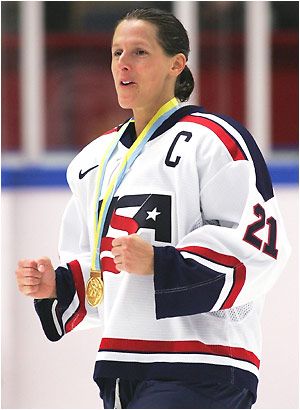
Cammi Granato's influence on the women's game has been instrumental in making the US Women's Hockey Program into an international power. She still leads Team USA in scoring, and has won an Olympic gold medal, an Olympic silver medal, one World Championship gold medal, and eight World Championship silver medals. She is the recipient of the 2007 Lester Patrick Award for her contributions to hockey in the United States, and will be one of the first two women to be inducted as players into the Hockey Hall of Fame in 2010.

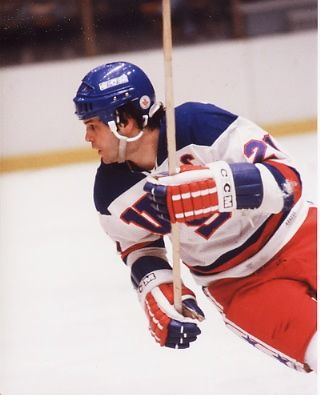
Mike Eruzione needs no introduction. His name is as big in the United States as Paul Henderson's is in Canada. Eruzione played in the 1975 and 1976 World Championships, but his big moment came during the 1980 Lake Placid Olympic Games. Eruzione scored the game-winning goal against the Soviet Union in the "Miracle on Ice" game that made him the most famous American hockey player for a long time.

Bill Baker is probably best known as the extra attacker who scored the tying goal against Sweden in 1980 at the Lake Placid Olympic Games. Baker's goal proved vitally important as the 2-2 tie against Sweden allowed Team USA to advance to the medal round where they would pull off the biggest victory in US Hockey history. Baker's Team USA jersey is currently displayed at the Smithsonian in Washington, DC. Baker also played at the 1981 World Championships and the 1981 Canada Cup.

John Mayasich was a sensational scorer at the international level for Team USA. In 1956, Mayasich scored a hat trick as a forward to lead Team USA over Canada by a 4-1 score, and capture the silver medal. Before the 1960 Olympic Games in Squaw Valley, Mayasich developed a slapshot that would have made Bobby Hull proud. In an exhibition game against Japan, Mayasich fired a slapshot from center that beat the Japanese goalie cleanly! With his return to the Olympics in 1960, Mayasich was shifted to defence so that Team USA could take advantage of his slapshot. Team USA defeated Canada, the Soviet Union, and Czechoslovakia on their way to the 1960 Olympic gold medal! Mayasich played in five World Championships, earning a bronze medal and an All-Star team berth at the 1962 tournament.

The goaltending choice came down to Jack McCartan's 1960 gold medal performance and Jim Craig's "Miracle on Ice" Olympics. However, the most memorable win in USA's history can't go unheralded. Craig went 6-0-1 in the 1980 Winter Olympics, including that historical win over the Soviet Union where he posted 39 saves in the 4-3 "Miracle" win. While his NHL GAA ballooned to 3.77 after leaving the US National Team, he posted an amazing 2.14 GAA in the 1980 Winter Olympics to lead Team USA to the gold medal!

There are my picks for the best American players in the NHL and at the international level. Again, I'll probably stir up more discussion than settle any debates, but that's what this exercise is all about. After all, nationwide celebrations bring people together, and that's what I'm celebrating here: the best American-born hockey players to ever suit up in the NHL and in a Team USA uniform!

Happy Independence Day, my American neighbours, and be safe on this Fourth of July!

Until next time, keep your sticks on the ice!

Saturday, June 19, 2010

The 2002 Salt Lake City Winter Olympics was a special time in Canadian hockey history. Following eight straight losses to the American women, the Canadian women captured the Olympic gold medal by defeating their long-time rivals. The Canadian men, led by Mario Lemieux, Joe Sakic, and Steve Yzerman, started poorly, but rallied to defeat the American men by a 5-2 score to capture their first gold medal in 50 years! There were a lot of hockey storylines at the Olympics that various people followed - Gretzky's rant against the world following Canada's 3-3 tie against the Czech Republic, Belarus' unbelievable upset of the vastly superior Swedes in the quarter-finals, the kissing of center ice by the Canadian women - but the one that author Roy MacGregor followed was the story of Trent Evans. The result? A Loonie for Luck, written by MacGregor, illustrated by Bill Slavin, and published by McClelland and Stewart, which tells the story of how the loonie got into the ice, and how Trent Evans became a legend in the hockey community for his superstitious decision.

Roy MacGregor has written some of Canada's best hockey books in his lifetime. He penned best-selling book Home Game with Ken Dryden, and is a best-selling author for his hockey-based mystery books for children in the Screech Owls series. Born in Whitby, Ontatio in 1948, Mr. MacGregor has written for The Globe and Mail, The National Post, MacLean's magazine, the Toronto Star, and The Canadian magazine. Due to his works, he has won two National Newspaper Awards, several National Magazine Awards, and two ACTRA Awards as the best television drama writer in the country. In 2005, Roy MacGregor was named an officer in the Order of Canada. He and his wife, Ellen, live in Kanata, Ontario with their four children.

There was a lot of hype surrounding the "lucky loonie" once the word got out about the coin being placed in the ice at Salt Lake City's E Center, but it started off as something that Trent Evans would never have thought twice about: pocket change.

While getting a coffee during his normal morning routine at the Tim Hortons on Sherwood Park, Alberta's Main Boulevard, Mr. Evans received change from the five-dollar bill he gave to the server. Amongst the change, he pocketed a loonie, Canada's one-dollar coin minted in 1987 in Winnipeg, that would become a part of the Hockey Hall of Fame three weeks later. With the change in his pocket, he headed to the airport in Edmonton for his flight to Salt Lake City.

So who is this Trent Evans guy?

Trent Evans is an employee of the Edmonton Oilers. His job? Ice technician for at Rexall Place where the Oilers play. His former boss, Dan Craig, was one of the officials in charge of preparing the hockey venues in Utah, and he recommended Trent as one of the official ice-makers for the 2002 Winter Olympics. Trent took the once-in-a-lifetime opportunity after consulting with his family, and he and the loonie were off to Salt Lake City.

The problem he discovered when he arrived at the E Center was that there was no center ice plug on the floor that ice-makers use to measure out all the dimensions on the ice. Every single NHL rink has this plug, but the E Center did not as it only housed the ECHL's Utah Grizzlies. In order to mark the center point after making a number of measurements to find it, Evans used a dime after consulting with Dan Craig as to how he should mark the center ice spot. However, it was something that Craig said that turned Evans onto the idea of using the loonie.
"Craig was checking the ice in one of the two practice rinks.
"'How did they mark it there?' Trent asked.
"'We used a splotch of yellow paint,' Craig answered.
"'How big?'
"'I don't know,' Craig's voice crackled through the static. 'Not big. About the size of a loonie.'"
From that point on, the loonie marked the center ice location at the E Center. Once the ice was finished and the loonie had been buried beneath five-eighths of an inch of ice, the legend of the "lucky loonie" began to grow and circulate amongst the Olympic village. Evans knew that his "secret" was no longer a secret. Sure enough, Dan Craig called to deliver the news: "Take it out."

Evans reluctantly went to the E Center to remove the loonie buried beneath the ice, but he noticed that no one was paying attention to what he was doing on the ice. He drilled the hole and pretended to scoop the loonie up, and no one thought twice about it. And this time, Evans swore, he'd keep it a secret.

Of course, the lucky loonie saw both the Canadian men's and women's hockey teams capture the gold medal in hockey in 2002. It's final resting place, including the three dents that it picked up over the course of the Olympics, is now the Hockey Hall of Fame where fans from all over the world can gaze upon the coin that inspired a nation. Even this guy.

In regards to A Loonie for Luck, Mr. MacGregor has written an excellent story about how the loonie made it to the Hockey Hall of Fame, but has also included some incredible historical notes. There's a short piece on how the loonie was hated by Canadians when it was first introduced. There's a phenomenal chapter on a number of the superstitions that players have had in the NHL, and how it carries over to coaches and staff of NHL and hockey teams.
"When you’ve got both Roy MacGregor and Wayne Gretzky involved in a project, it’s pretty much a lead pipe cinch to be good. And this little book doesn’t disappoint.…The quality of the writing and the compelling nature of the story, not to mention the fact that a portion of the proceeds will go to the Wayne Gretzky Foundation to help under-privileged kids buy hockey gear, make this a great book to buy the hockey fan, including yourself." - Oldtimers Hockey News
The main story about Trent Evans and the lucky loonie is definitely the draw to this book, though. There's a great foreword written by Wayne Gretzky that talks about his experience with Trent over the years and the Olympic experience. Trent's story, told on the 96 pages of the book, is an excellent read, and Mr. MacGregor's writing made it interesting and appealing. I could not stop reading this book. The best part is that it is appropriate for children of all ages, and is suitable for readers aged nine and older.

Because of Mr. MacGregor's excellent work, A Loonie for Luck definitely deserves Teebz's Book Club Seal of Approval, and is recommended for all readers! If you'd like to hear Mr. MacGregor and Mr. Evans speak about their collaboration on this book, please click here for a radio interview. The information they give about the lucky loonie is pretty incredible!

Just before we part, there's a charitable aspect included in this book. With the sale of each copy of A Loonie for Luck, a large portion of the royalties will be donated to the Wayne Gretzky Foundation. The Gretzky Foundation helps underprivileged North American children get hockey equipment and join minor hockey teams in their areas in order to get them into sports. The book is reasonably priced, and I'm proud to have helped such a worthy charity!

Until next time, keep your sticks on the ice!

Thursday, May 6, 2010

It's kind of funny to be reviewing this book now, but I feel that the information contained within its covers makes a lot more sense today than it may have a few years ago. Today, Teebz's Book Club is proud to review The Rookie, written by Shawna Richer and published by McClelland & Stewart. Shawna Richer, a sportswriter for the Globe and Mail in Canada, decided that she would like to follow around the NHL's most-hyped freshman in some time during his first year in the spotlight in the NHL as a member of the Pittsburgh Penguins, chronicling his season as he embarked on an NHL career. What she found in her year-long tailing of Sidney Crosby is that the young man is remarkable in terms of the time he gives to fans, and how dedicated to and passionate about hockey he is.

Shawna Richer was the Globe and Mail's Atlantic bureau chief before embarking on her year-long crusade following Pittsburgh's new star. She was based in Halifax where she got to see and hear a lot about Sidney Crosby's exploits as he made his way towards the NHL. Richer worked as editor-in-chief for the Telegraph-Journal in New Brunswick, but is now writing for the Globe and Mail once again.

Miss Richer leaves no stone unturned in her examination of Crosby's rookie season in the NHL. She documents how the Penguins were awarded the first pick in the NHL Draft Lottery coming out of the 2005 Lockout, and how lightning would strike again as the Penguins - in dire financial straits - found another dynamic, young player to pull them out of the fire when they needed it most. Much like his idol and new owner, Mario Lemieux saved the Penguins from financial despair when he was drafted, and now Crosby would be suiting up in the same dressing room as his favorite player.

It was rather interesting to hear Crosby's perspective on his first season in the NHL. The Penguins had a rather poor season in the win-loss column, but there were definitely highlights that Miss Richer identified. From Crosby's phenomenal play that allowed him to join the 100-point club as an 18 year-old to his competition with Washington's Alexander Ovechkin for the Calder Trophy to the development of the younger Penguins to the adversity his team went through, Crosby's views on the Pittsburgh Penguins show an extraordinary young man through Miss Richer's recordings.

There was a lot of adversity in his first year. A couple of injuries slowed Crosby down. A Olympic team roster spot was put on hold when Wayne Gretzky and his management team decided to leave the youngster at home. But the biggest surprises came in January 2006. On January 18, a frustrated Zigmund Palffy - one of Pittsburgh's prized free agent signings - walking into GM Craig Patrick's office and asked a simple question: "Can we talk?"

Patrick didn't have to be clairvoyant to see what was coming. Palffy stated that he was retiring due to a shoulder injury that simply hadn't felt right all season long. Due to his personal reasons, Patrick was hardly in a position to convince the winger to stay on, and Palffy left mid-season despite playing on a line with Crosby.

The second biggest surprise came just six days later on January 24. The man who had saved the Pittsburgh Penguins on a number of occasions, both on and off the ice, had found himself as an old man in a young man's game. Mario Lemieux, standing before Pittsburgh media and his teammates, announced he was retiring from the game of hockey at the age of forty. Crosby's landlord, idol, captain, and friend was leaving the game just as Crosby was beginning. However, in Lemieux's eyes, the torch had been passed to Crosby as the rookie led the Penguins in scoring.

It's interesting to see how Crosby kept all of these events from becoming much larger than some people were making them. Through all of the disappointment, he was realistic and practical about the events unfolding around him. On not being selected for the 2006 Canadian Olympic team:
"It would have been nice, definitely. But there are so many good players in Canada, and being so young, I don't think I expected to be picked. I prepared myself. I tried to have the best first half possible and give myself an opportunity, and I was right in the mix. I'm not there, but at least I can say I gave it a good shot. Like with World Juniors, when you play so much hockey you always know there's other teams to play for. But if you focus on playing for your own team, everything else takes care of itself. I just tried to worry about helping the team here. If I can contribute and make things happen here, then that's the best way I can make a difference."
That's a pretty good sign that Crosby had been prepared for moments like this for a long time. And it's not just the maturity he shows, but the way he handles himself and speaks glowingly about others that shows he might be one of the most mature eighteen year-olds to ever play in the NHL.

The Rookie is a very interesting look at the Penguins' season and how Crosby worked through his first professional season. Shawna Richer wrote the book in a chronological manner, but her insight into Crosby's past allows for a number of excellent side stories to be told. The Rookie is probably not the best story for non-Penguins fans, but it is certainly a story worth reading by hockey fans, and I encourage everyone to put aside any "Crosby bias" to give this book a shot. I enjoyed reading it, and I feel it is worthy of the Teebz's Book Club Seal of Approval for its honest look at Crosby's first season in the NHL. Richer does editorialize occasionally, but she's on the mark with most of her comments in reflection.

Until next time, keep your sticks on the ice!

Friday, April 30, 2010

Something struck me as I read the various blogs and newspaper articles asking why the Washington Capitals will be booking tee times rather than preparing to play the Flyers. You're probably going to tell me that you've heard it all before when I tell you the revelation that struck me, but the proof was no more evident than in Game Seven of the Washington-Montreal series. If there is any reason why the Capitals aren't playing right now, this revelation, to me, is the entire reason why. And I'm going to sound like a broken record, but the truth was shown as Montreal advanced and Washington went home empty-handed. Again.

HARD WORK WILL BEAT TALENT EVERY TIME.

There is nothing I appreciate more than seeing a team grab their lunch pails, throw on their hard hats and work gloves, and rub in a healthy dose of elbow grease when they take the ice. The Montreal Canadiens put forth an effort that would have built Rome in a day, while the Capitals seemingly were content with not stepping on the gas pedal when they had their chances.

Everyone wants to point to Jaroslav Halak as being "the difference", but we've known Halak was a very good goaltender for some time now. The key is that you have to be paying attention, and the two players that I assumed would have known how good Halak was would have been Alexander Ovechkin and Alexander Semin.

You see, those two gentlemen had the pleasure of dealing with Halak in February when a major accolade was on the line. Halak was the starting goaltender for Slovakia at the 2010 Vancouver Olympic Games, and he led the Slovaks to a 2-1 shootout victory in Vancouver over the highly-touted Russian squad.

Said Puck Daddy's Greg Wyshynski: "Unable to convert on the power play; unable to solve goalie Jaroslav Halak, whose only goal allowed was on a deflected puck; and unable to put away a Slovakian team that played in an intense and exhausting loss to Czech Republic less than 24 hours earlier."

Russia was outworked by a team that was dedicated to defence, and the Great Eight was shutdown in regulation time and overtime. His only highlight? Going one-for-three in the shootout. On the other side, Halak finished with 36 saves, and recorded six more in the shootout before the Slovaks prevailed. Halak was outstanding all night long, and helped his team to the best finish in his country's history as they finished fourth - ahead of the Russians who finished a disappointing sixth.

Perhaps Nicklas Backstrom should have known that Halak could shut the door as well. After all, he had three shots on net, and finished the Olympic quarter-final game with just one assist in a 4-3 Sweden loss to Slovakia. Backstrom, however, came to play in the opening round of the NHL Playoffs, but his scoring dried up when it mattered as well. Sweden finished fifth at the Winter Olympics, right behind fourth-place Slovakia.

All three men had a chance to exact a little revenge on the man who ousted their medal chances at the Winter Olympics, and appeared to have exorcised the demons as Washington built a 3-1 lead in the series. But a funny thing happened before Game Five.

The Montreal Canadiens, still believing that they could keep this series going, held a team meeting without practicing. Head coach Jacques Martin juggled his lines a little bit. And he opted to put Halak back in net after having Carey Price in his nets for Game Four.

The team refocused its efforts on shutting down the high-flying Capitals, and returned to playing five men in the defensive zone rather than looking for a quick break-out with a man releasing. The team bought into blocking every shot it could, and allowing Halak to see any long shot from the outside by clearing bodies in front and keeping the Capitals' snipers on the outside.

Basically, the Montreal Canadiens bought into the theory that this series would be won on hard work - bearing down on defence, working a solid cycle game to wear down the Capitals' defencemen, and keeping rebounds to a minimum. In a word, they were willing to sacrifice everything to win something. That is "desperate" hockey in a sense, but I prefer to call it NHL Playoff hockey.

The Capitals? They had three opportunities to put the Canadiens away, and couldn't find the extra gear they needed. They tried to wheel-and-deal like they had all season long, and it caught up to them when a defensive unit put the roadblocks out.

The Russians and Swedes? They had their opportunities to put the Slovaks away, and couldn't find the extra gear they needed. They tried to wheel-and-deal like they had all tournament long, and it caught up to them when a defensive unit put the roadblocks out.

Sound familiar?

In case no one has noticed, defence wins championships. The Pittsburgh Penguins found that out in 2008 when the Detroit Red Wings showed them that hard work and effort will trump talent every time. The Penguins came back in 2009 - a little grittier, a little meaner, and a whole lot more hard-working - and steamrolled the Ottawa Senators before ousting the Capitals in a lackluster Game Seven for the team from DC.

Talent goes a long way in the regular season. There's no denying that. Playoff hockey, however, is all about effort and sacrifice. Combine that with talent, and you have a lethal combination of scoring and willingness to win.

The Capitals have more talent on paper than most teams do. But they simply don't bring the work ethic necessary to win a Stanley Cup at this point. If I were head coach Bruce Boudreau and General Manager George McPhee, I'd come into next season preaching the benefits of bringing your lunch pail to work every night.

In the end, it might just pay off for Ted's crew of highly-skilled hockey players. Otherwise, Ted might just have himself a formidable crew of scratch golfers by the time the organization gets itself in order.

Point at Halak and tell me he was good. I'll agree with you. But I'll also add that the twenty men in front of him gave him everything they had in preventing Washington from doing any damage. Montreal's hard work trumped the abundance of Washington talent in the series, and it just goes to show how true that statement is.

Until next time, keep your sticks on the ice!

Monday, April 19, 2010

There is absolutely nothing better than overtime in the NHL Stanley Cup Playoffs. No shootouts to follow, no points to be won or lost. Instead, you get pure passion, intensity, and life-or-death in overtime during the playoffs. Except if your goalie looks like Ryan Miller does to the left. That was Miller after an overtime loss in the gold medal game at the 2010 Winter Olympics, and it's pretty evident that if you're on the losing end, overtime sucks. That's exactly why players give everything they have and more during the extra period or periods required to end a playoff game. The joy, the exuberance, and the unbridled happiness that players show after scoring an overtime goal might be the image of hockey that should be used when promoting the game.

With that, let's take a look at last year's overtime goals and late-game goals that show the emotions of players, both winners and losers, as the goals are scored.

This is why I love playoff hockey. Overtime goals mean so much more! We've already seen a few games go into extra time this year, and there's nothing like seeing the players pour onto the ice after that big goal is scored!

Until next time, keep your sticks on the ice!

Friday, March 19, 2010

Two teams are left standing after the other six teams have finished their placement games at the 2010 Paralympic sledge hockey tournament. Team USA and Team Japan will meet in the gold medal game tomorrow in what should be an exciting finish to the week's games. USA defeated Japan earlier in the week by a 6-0 score, so there's a little retribution on the line for Japan as well. Of course, Team USA is the heavy favorite in being the defending World Champions. They have yet to surrender a goal in the tournament, and they are getting balanced scoring for everyone on the team. But no one believed Japan would beat Canada, yet here they are. This should be a great game, so check it out here at 3PM ET!

The bronze medal game went late last night for those of us not on the west coast, and it was a great game. Canada played Norway, and both teams showed some amazing skill, speed, and determination in this game that literally came down to the last seconds.

Both teams played a scoreless game into the third period, but there were chances. Canada had outshot the Norwegians 17-4 through the first two periods, but Nowegian goalie Roger Johansen was up to the task as the game remained scoreless. Paul Rosen has an easier time in the Canadian net, making just four saves, but the third period is where the two teams found some holes.

Canada struck first at 2:45. Adam Dixon took a Greg Westlake pass just inside the left hash marks and ripped a high shot to the far post that Johansen couldn't knock away. Dixon's high, hard shot was his fourth of the tournament, and Canada was out to a 1-0 lead.

During a scrum in the Canadian crease, referee Johnathan Morrison blew the call dead and immediately indicated a penalty shot was to be awarded to Norway at the 6:08 mark. Goaltender Paul Rosen snapped and had to be restrained by defenceman Ray Grassie as he attempted to get to Morrison because it appeared that he had covered the puck. The referee indicated that he saw Adam Dixon cover the puck in the crease, and Norway would have a penalty shot.

Rolf Einar Pedersen broke in on Rosen down the middle and made a gorgeous move to his right, sliding the puck underneath his sled as Rosen attempted the pokecheck. With Rosen down and out, Pedersen had all day to slide the puck in the open net. He calmly slide a backhander across the ice, and Norway was tied with Canada at 1-1 on Pedersen's first goal of the tournament.

The game pressed on late, and the final goal would be scored. With Norway looking to keep a play alive along the boards after Canada couldn't clear, Norwegian defenceman Eskil Hagen threw a shot on net with less than five seconds remaining. The shot, however, hit Billy Bridges as he attempted to block the shot, sending the puck high into the air away from its original trajectory. Paul Rosen, who had come out of his crease to cut down the angle, could only watch in horror as he couldn't reach the high, fluttering puck with his stick as he fell backwards. With 3.5 seconds remaining, the puck landed in the net, and Norway went into a mad celebration!

Hagan's first of the tournament would be the game-winner as the puck was dropped seconds later, and Norway secured the bronze medal with the 2-1 victory. Honestly, it was another heartbreaking game for the Canadians who appeared to control most of the game. Again, though, this is why they play the games.

Congratulations to Norway on their 2010 Paralympic bronze medal! Norway continues their streak of being the only team to medal in every Paralympic Games since sledge hockey was introduced!

In the other placement games, the Czech Republic needed overtime to defeat South Korea in the 5th/6th-place game. Korea took the lead earlier in the third period off a goal by Sang-Hyeon Park, his first of the tournament, but the Czechs tied it up a few minutes later. Erik Fojtik notched his third of the tournament to tie the game at 1-1. 2:16 into overtime, Michal Geier scored his second of the tournament, and gave the Czech Republic the fifth-place finish.

In the 7th/8th-place game, Italy met Sweden. Sweden was never expected to finish this low, so there was a great deal of pride on the line for both teams. Sweden, though, continued to struggle to score goals, and Italy showed that their strong performance in the preliminary games wasn't a fluke. Werner Winkler and Andrea Chiarotti scored single goals, Florian Planker scored a pair of goals, and
Santino Stillitano recorded the shutout in the 4-0 victory, earning the seventh-place finish.

With only one game to play, here are your updated standings:
  1. USA/Japan
  2. USA/Japan
  3. Norway
  4. Canada
  5. Czech Republic
  6. South Korea
  7. Italy
  8. Sweden
Congratulations to all the team for an extremely entertaining week of hockey, and some great finishes in a number of the games! I'll be watching the gold medal game tomorrow afternoon!

Until then, keep your sticks on the ice!

Thursday, March 18, 2010

Remember when I said that Japan was a darkhorse for a 2010 Paralympic medal? I had stated that last Thursday, one week to the day before Japan pulled off its biggest upset ever in sledge hockey. Everyone was expecting the defending Paralympic Champions in Canada to matchup against the defending World Champions in the USA in the 2010 Paralympic gold medal game, but Japan had other ideas. And they showed that they are a force to be reckoned with in the world of sledge hockey as they defeated Canada in the early semi-final game by a 3-1 score.

Marc Dorion opened the scoring late in the first period for Canada. On the powerplay, Jeremy Booker found Dorion, but his initial shot was stopped by Mitsuru Nagase. Dorion poked away at the rebound, though, and his third attempt pushed the puck across the goal line. Canada jumped out to the 1-0 lead on Dorion's fifth goal of the tournament at 9:56 of the first period.

To say that Canada looked off in the first period would be an understatement. Passes were sloppy, lines were out of sync, and Japan's trap-style of play really seemed to throw Canada off its game entirely. Canada may have outshot Japan 10-6, but it certainly didn't feel that way.

7:27 into the second period saw Japan notch the equalizer. Takayuki Endo fired the unassisted marker past goaltender Paul Rosen, and Japan was even with Canada at 1-1. Honestly, there had to be some discussion on the Canadian bench about the speed and skill that the Japanese were showing, outclassing the Canadians up to that point because it was clear that Japan was controlling the game.

Brad Bowden had a chance to put Canada up on a breakaway, but Nagase made the stop with his mask to keep the game knotted at one goal apiece.

"I saw the puck and moved my head into the right place to make the save," Nagase told reporters after the game. "That is my style."

The third period saw the tight-checking affair continue. Both goaltenders played well enough to earn the win, but the game was essentially decided with 1:13 remaining. The puck found its way out of the Japanese zone after a late Canadian flurry, and the speedy Japanese players pounced on the loose puck.

A three-on-one developed, and the Japanese players showed great passing as Kazuhiro Takahashi fed a wide-open Daisuke Uehara who went top corner past Rosen. Uehara's second of the tournament was perhaps the biggest of his career. Rosen had no chance, and the Japanese team had the 2-1 lead late in the game.

Canada pressed from the face-off, and got the puck into the Japanese zone where they controlled it. This allowed Paul Rosen to make a break for the bench, and Canada sent out the extra attacker. However, some additional bad luck struck the Canadians when Greg Westlake centered a pass from behind the Japanese net, and the puck eluded everyone. The bad luck came into play when the puck slid the distance of the ice and came to rest inside the empty Canadian net. Takayuki Endo was credited with the insurance goal with just 16 seconds to play, his fourth of the tournament.

Heartbreaking? Absolutely. Canadian players could be seen with tears in their eyes as they left the ice. Some still had tears as they addressed the media. However, as Greg Westlake said, "We deserved a better fate than this but sometimes life is not fair."

Japan will play the winner of the USA-Norway semi-final game to see who advances to the Saturday gold medal game. Canada will play the loser of that game in Friday night's bronze medal game. If you're interested, the bronze medal game goes 10PM ET, and the gold medal game will take place on Saturday at 3PM ET.

It is disappointing for Canada not to be in the running for another hockey gold medal, but that's why they play the games. Anyone can beat anyone else, and it goes to show that the favorites don't always win. Congratulations to Japan on their victory, and I say "chins up" to Canada. After all, there is still a medal on the line, despite it not being the preferred colour.

Go out there and finish the tournament with a win. After all, you still have an entire country cheering you on, and they're proud of you no matter what colour the medal is that you bring home!

Until next time, keep your sticks on the ice!