Showing posts with label playoffs. Show all posts

Tuesday, March 15, 2011

It's that magical time of year again, readers. Teams are gearing up for the playoffs, non-playoff teams are getting their scouts out to junior games and NCAA games for some last-minute studying of players, and players are gearing up for the stretch drive where they'll play the role of hero or spoiler in the drama we call "hockey". One team that has been a regular contributor on the spolier side has been the Toronto Maple Leafs. Last year, the Maple Leafs "death watch" began sometime after the puck dropped in the opening game, but the Leafs went on a big run this year to make things interesting. Let's take a look at their remaining schedule to see how the season will play out.

I just want to make this clear: I DO NOT HAVE A CRYSTAL BALL, AND I HAVE BEEN KNOWN TO BE WRONG ON MOST, IF NOT ALL, PROGNOSTICATIONS. IF I AM FOUND TO BE WRONG ON ANY OF THESE PREDICTIONS, YOUR SUBSCRIPTION FEE TO HBIC WILL BE REFUNDED IN FULL!
  • at Carolina: should be a good test for the Leafs. They need to keep chasing down teams in front of them.
  • at Florida: the home team has won each game in the three games these two have played. If the trend continues, the Leafs will be on the wrong end of this one. They need these points.
  • vs. Boston: the Leafs beat the Bruins on February 15, so they'll need another big game. Beating teams above them in the standings = good!
  • at Minnesota: if Minnesota doesn't lull them to sleep, this is a game that Toronto must win. Minnesota is in the same boat as Toronto, so this game might be a dogfight.
  • at Colorado: Toronto has to win this game. Colorado is battling for a lottery pick, so these are two points that could prove large in the long run.
  • at Detroit: Detroit is a well-oiled machine. Unless they develop a rash of injuries, this one looks like a loss for the Leafs.
  • vs. Sabres: Buffalo has proven plucky over the last few weeks. Toronto is 2-3 against them at this point, but the last two games were won by Toronto. This is another team the Leafs are chasing, so these two points are huge in the standings.
  • at Boston: Four points in one month from the same team in your division? Huge. Is it possible? Yes. And the Leafs need it.
  • at Ottawa: Another divisional game, but this time against a foe at the bottom of the standings. Giving away any points to the Senators could prove fatal.
  • vs. Washington: Tough game for the Leafs against a team that will be hungry down the stretch leading into the playoffs. I'm not confident in Toronto's chances against the Capitals.
  • at New Jersey: This game features the two teams that seem to have the best chance to make a run at that eight-seed. One of these teams will play the role of spoiler in this game. The question is: which one?
  • vs. Montreal: This might be a pivotal game for the Leafs if they are within a point or two of the eighth and final playoff spot. Toronto holds a 3-2 series lead thus far this season.
Toronto plays eight of their remaining twelve games on the road. That's a tough schedule, and not the best of times for a team that is below .500 on the road. They'll need to dig deep to pull this miracle off. I'd say they need 20 points to gain entry as the eighth-seeded team. That's ten wins, kids. The odds don't look good.

According to Sports Club Stats, a fabulous website that determines the chances of any team making the playoffs, the Leafs have a 3% chance of making the playoffs at this point. As far as Sports Club Stats can determine, the Leafs are destined to finish the season as the tenth-best team in the Eastern Conference. Again, the odds don't look good.

The key is that there is a 3% chance for them to make it. That means there's a chance, and that's all a team needs. Whether or not the Leafs make it will entirely depend on how they play over their remaining games, but there's a still a chance.

And that's good enough for most Leaf fans this late in the season.

Until next time, keep your sticks on the ice!

Monday, February 28, 2011

Yesterday, we took a look at the opening games for the Western Conference in the 2011 KHL Gagarin Cup Playoffs. One team, SKA Saint Petersburg, had already moved on to the second round after sweeping Spartak Moscow, but the other three series were still on-going. I didn't look at the four series in the Eastern Conference that began on Thursday, so tonight would be an appropriate time to update those skirmishes. One of these teams will represent the Eastern Conference in the Gagarin Cup final, so let's take a look at who is marching towards glory!

(1) Avangard Omsk Oblast vs. (8) Neftekhimik Nizhnekamsk

Avangard was the top team in the KHL this season after having amassed 118 points in 54 games, so there wasn't much hope for Neftekhimik when this series started on Thursday night as 43 points separated these teams in the standings. However, an early goal by Igor Polygalov put the underdogs up just nine minutes into the game! Neftekhimik battled hard and refused to give up any chances through most of the game, but Avangard finally broke through just 54 seconds into the third period. Alexei Kaluzhny scored for Avangard, and the game was tied at 1-1. The two teams continued to play stingy defence, and we were off to overtime after sixty minutes. Just 4:19 into the extra frame, Igor Polygalov notched his second of the night past former NHL goaltender Karri Ramo, and Neftekhimik recorded the 2-1 overtime victory in Game One!

Game Two went on Friday night, and we saw more of the same defensive play in the second act of this series. In fact, both teams held each other at bay through all three periods, sending the game to overtime tied 0-0 as both Karri Ramo and Neftekhimik's Ivan Kasutin were perfect through sixty minutes! It didn't takevery long to decide a winner once overtime started, though. Avangard's Dmitry Semin put the puck behind Kasutin, and Avangard recorded the 1-0 overtime victory in Game Two to even the series at 1-1.

With the series heading back to Omsk on Sunday, there was some concern on the Avangard side about their play. More goals would be needed if the team was to succeed, and we got to see a few more in Game Three. Niklas Persson opened the scoring for Neftekhimik with a shorthanded marker just 2:52 in, but that deficit would be erased by Igor Volkov six minutes later. Renat Mamashev put Neftekhimik up by one goal 2:15 into the second period, but Avangard responded five minutes later when Yegor Averin wired home his first of the playoffs. With less than three minutes left in the second period, Neftekhimik's Libor Pivko deposited another puck behind Karri Ramo as Neftekhimik closed out the period up 3-2. Solid defence was played the rest of the way, and Neftekhimik closed out Game Three with the 3-2 victory to go up 2-1 in the series.

Game Four saw one of the poster children for the KHL come alive. Avangard's Jaromir Jagr, who had been held pointless in the first three games, set up two goals on this night. Avangard's Roman Cervenka also added a pair of helpers as three different scorers found the back of the net for Avangard on Monday. Pavel Brendl was the only player to beat Ramo on this night, and Avangard skated to the 3-1 victory. Once again, the series was tied, and the 2-2 deadlock meant that this series was now a best-of-three!

Game Five of this series is set for Wednesday, March 3, and Game Six appears to be scheduled for Friday. If a Game Seven is necessary, we're looking at a Saturday or Sunday date for that game.

You have to think that Avangard will break pout of their funk and start scoring some goals on Neftekhimik. However, I really like the job that Neftekhimik is doing in neutralizing Avangard's scorers, especially Jaromir Jagr. If Neftekhimik can keep this up, we might see another upset! I'm pulling for Neftekhimik in this one just to see if I can predict both first-seeded teams eliminated in the first round!

(2) Ak Bars Kazan vs. (7) Barys Astana

Kazan are the defending Gagarin Cup Champions, and are looking to make it three KHL Championships in a row! Standing between them and glory are Barys Astana from Astana, Kazakhstan. Game One, like the series above, was a defence-first game as the two teams combined for one goal. Yep, just one. Barys' Vitaly Yeremeyev played an outstanding game, but he was the goaltender who allowed the one goal. Kazan's Jarkko Immonen scored at 13:34 of the first period, and it was all the offence that Petri Vehanen needed as he shut the door on Barys. Ak Bars Kazan win the game by a 1-0 score, and go up in the series 1-0.

Game Two on Friday saw Kazan treat Barys in the same fashion as they did in Game One. Goals by Alexei Morozov, Marcel Hossa, and Alexei Tereshchenko powered Kazan to a second straight victory. How was this game the same, you ask? Petri Vehanen pitched his second straight shutout in backstopping Kazan to the 3-0 victory. It doesn't look promising for Barys when they have yet to record a goal in two playoff games. Kazan jumps ahead 2-0 in the series with the victory.

Sunday's Game Three saw Kazan rolling again as they took Barys to the woodshed. Kazan hung half a dozen goals on Barys as Janne Pesonen, Danis Zaripov, Jarkko Immonen, and Grigory Panin all scored singles while Alexei Morozov recorded a pair of goals. Morozov finished the night with four points, and Evgeny Medvedev had a pair of helpers. Petri Vehanen was looking for his third straight shutout, but his bid to open a playoff series with three straight blankings ended when Lukas Kaspar scored a powerplay goal at 3:04 of the third period for Barys. If you're keeping track at home, that 163:04 of shutout hockey that Vehanen had going. Kazan rolls to the 6-1 victory in Game Three, and Barys found themselves on the wrong end of a 3-0 series deficit.

Game Four has already been completed, and I can tell you that the champs are marching onward. Kazan jumped out to a 2-0 lead on goals by Danis Zaripov and Alexei Tarashchenkov, but Barys made this one interesting. A powerplay goal at the end of the second period by Maxim Khudyakov made it a 2-1 game, and then a shorthanded marker 4:33 into the third period from Roman Starchenko squared the game at 2-2. Less than two minutes later, Zaripov scored again, and Kazan was back up 3-2. With 32 seconds remaining and Barys' Jeff Glass sitting on the bench for an extra attacker, Kazan iced the game and series when Niko Kapanen scored into the vacant net. Kazan wins Game Four by a 4-2 score, and sweeps the series against Barys Astana.

No additional games or predictions are needed as Kazan now gets some precious time to rest up and get ready for the second round as they look to three-peat as KHL Champions!

(3) Salavat Yulaev Ufa vs. (6) Sibir Novosibirsk

Salavat and Sibir may have finished third and sixth in the conference, but the 26-point difference between the two teams became obvious as this series progressed. Game One on Thursday night saw Salavat build a 5-0 before Sibir woke up. Two goals each by Petr Schastlivy and Igor Grigorenko along with a single by Vladimir Anitpov had Salavat up 5-0 with 18 minutes to play. A couple of late goals by Sibir only took some shine off the win as Salavat cruised to the 5-2 victory, and moved to a 1-0 series lead.

Game Two on Friday night saw Sibir jump out in front as Stepan Sannikov scored 4:20 into the second period to open the scoring. That would be the last lead in the game that Sibir would have as Petr Schastlivy, Igor Grigorenko, and Kirill Koltsov scored for Salavat to lead them to a second straight win. Former LA King netminder Erik Ersberg stopped 25 of 26 shots for his second win as Salavat moved to a 2-0 series advantage. Former Nashville Predator Alexander Radulov had a pair of assists for Salavat on the evening.

Game Three had Salavat at home, and they continued to roll. Alexander Radulov had a goal and three assists, Robert Nilsson scored twice and added a helper, Patrick Thoresen record his fourth and fifth assists of the series as Salavat thumped Sibir by a 6-2 score. Alexander Kutuzov had a goal and an assist for Sibir, but it clearly wasn't enough as Sibir's Liv Stefan allowed five goals on 32 shots before being relieved by Yuri Klyuchnikov. With the win, Salavat pushed Sibir to the brink as they led the series 3-0.

With Sibir facing elimination on the road, they would need a substantial effort to get out Ufa and back on home ice. It didn't start well on Monday as Alexander Svitov opened the scoring for Salavat just 2:37 in. Viktor Kozlov made it 2-0 before the opening period was done with his second goal of the playoffs. The hole got deeper for Sibir in the second period as Alexander Radulov scored his second goal of the series with five minutes left in the second. Just to make it a little worse, Svitov scored his second goal of the game and playoffs two minutes later. It was all but over when former NHL star Vyacheslav Kozlov added his first goal of the playoffs midway through the third period. Erik Ersberg shut the door on Sibir as Salavat recorded the 5-0 win, ending the series in a sweep.

Much like the Kazan-Barys series, no additional games nor is a prediction needed as Salavat wrapped up the series this evening. Salavat now awaits to find out who their opponents are in the next series.

(4) Metallurg Magnitogorsk vs. (5) Yugra Khanty-Mansiysk

While these two finished right next to each other in the standings, there was a clear divide in terms of talent when looking at the standings. Metallurg finished 13 points ahead of Yugra in the standings, so there seems to be a clear favorite in this series. Game One seemed like Metallurg had an advantage as they got goals from Juhamatti Aaltonen and Oleg Kvasha over a six-minute span in the second period. However, a powerplay goal by Ivan Khlyntsev pulled Yugra within one goal again. Another powerplay goal by Evgeny Blokhin just 19 seconds into the third pulled Yugra even. However, goals by Metallurg's Petri Kontiola and Enver Lisin less than a minute apart put Metallurg up for good. Georgy Gelashvili closed the door the rest of the way, giving Metallurg the 4-2 victory and the 1-0 series lead.

Game Two in Yugra's hometown of Khanty-Mansiysk saw the home team score first midway through the second period. Ivan Khlyntsev's second goal in as many games put the home squad up 1-0. Former NHL star Sergei Fedorov evened the score less than six minutes later as his shot found its way past Yugra goaltender Edgar Masalskis. 7:50 into the third period, Yugra would jump ahead again as Alexei Pepelyaev notched his first marker of the series. Masalskis would stop everything else thrown his way as he recorded saves on 37 of 38 shots while preserving the 2-1 win for Yugra. With the win, Yugra pulled the series even at 1-1.

Game Three would see another game decided by that one-goal margin. Yugra wasted no time in the opening frame as they got goals from Alexei Pepelyaev, Andrei Sidyakin, and Kirill Petrov to put Metallurg in a 3-0 hole. Juhamatti Aaltonen began chipping away at the deficit with his goal two minutes into the second period. Mikhail Tyulyapkin then restored the three-goal margin 40 seconds later for Yugra. Four minutes later, Enver Lisin drew Metallurg within two again with his second of the series. Sergei Fedorov tacked on another goal for Metallurg five-and-a-half minutes later, making it 4-3 for Yugra through two periods. Both goaltenders held their ground in the third period, giving Yugra the 4-3 victory to put them up 2-1 in the series.

The Monday game was another low-scoring affair. Stanislav Chistov opened the scoring for Metallurg at 18:21 of the first period. Yurga drew even 4:17 into the second period as Dmitry Altaryev beat Georgy Gelashvili to even the game at 1-1. The game-winner was scored at 7:29 of the third period on a penalty shot! Yurga's Dmitry Altaryev hauled down Metallurg's Denis Platonov on a breakaway, so Platonov got a chance to do it all over again. On the penalty shot, he made no mistake as he buried the puck behind Edgar Masalskis. That goal on the uncontested breakaway was the winner, and the 2-1 victory pulled Metallurg even in the series at 2-2.

Game Five goes Wednesday night, Game Six is scheduled for Friday night, and it appears Game Seven will go sometime on Saturday.

As for predictions, I really like Metallurg simply because of their legacy of producing strong teams and great players. While Yurga is an intriguing pick simply due to their underdog status, I have to go with Metallurg.

There are the Eastern Conference series up to this point. I'll try to update these on the weekend to round out who is moving on and who is going home. Of course, we'll check my fearless, albeit uneducated, prognostications and see how I fared with my limited KHL knowledge.

Until next time, keep your sticks on the ice!

Sunday, February 27, 2011

While we approach and anticipate the NHL Trade Deadline in North America tomorrow, there's a big event going on in the NHL's rival league as the KHL began the Gagarin Cup Playoffs on Wednesday. Sixteen teams qualified for the playoffs, and there are some definite favorites that could go all the way to Gagarin Cup final, so we'll break down this look at the KHL's "second season". There have definitely been a couple of surprises so far in the playoffs, so let's break down each series and see who the favorites are based upon the already-decided games.

We'll start with the Western Conference series today, and tomorrow will have the Eastern Conference series showcased.

(1) Lokomotiv Yaroslavl vs. (8) Dinamo Minsk

Lokomotiv saw three former NHL stars pace them to a victory as Josef Stumpel had three asissts, Pavol Demitra had a pair of assists, and Josef Vasicek had a goal and two assists. Jeff Platt pulled Dinamo Minsk to within a goal late in the second period as Lokomotiv led by a 5-4 score, but two third-period goals by Lokomotiv sealed the deal as they won Game One on Wednesday by a 7-4 score.

Game Two was played on February 24, and there was definitely a different feeling about this one. Jeff Platt had himself a great game for Dinamo Minsk as he chipped in a goal and two assists. Had it not been for a Pavol Demitra goal on a penalty shot with less than three minutes to play in the game, Robert Esche would have recorded the shutout. However, Dinamo Minsk tied the series at 1-1 with a 4-1 victory.

Game Three was played last night, and Dinamo Minsk continued to roll. Four different scorers put pucks past Dimitrij Kotschnew, including Jeff Platt's third goal of the series. Robert Esche stopped 37 of 38 shots sent his way, and Dinamo Minsk took the 2-1 series lead on the strength of a second 4-1 victory.

Game Four was already completed today, and the series is now even at two games apiece. Alexander Kalyanin had two goals to give him four in the series, and Andrei Kiryuhin's first of the series was the game-winner as Lokomotiv drew even with a 4-2 victory.

Game Five is scheduled for Tuesday night, and Game Six is set for Thursday, March 3. If a seventh game is necessary in this series, that will most likely be played on Friday, March 4.

I'm going to have to go out on a limb here and say that I like Lokomotiv's offence, but Dinamo Minsk does have solid goaltending with Robert Esche between the pipes. Defence, as you know, wins in the playoffs, so I'm calling an upset here as choosing Dinamo Minsk to advance!

(2) Dynamo Moscow vs. (7) Dinamo Riga

Wednesday night saw this series open in thrilling fashion. Both teams battled hard defensively, not allowing for many opportunities to be had. Mark Hartigan opened the scoring midway through the second period for Riga. With less than five minutes to play, Leo Komarov even the game with his unassisted goal. With the way that this game had been played over the previous 56 minutes, you had to know that overtime was coming. However, just 2:43 into overtime, Oskars Cibulskis wired a shot past Michael Garnett to give Riga the 2-1 overtime victory and the early 1-0 series lead.

Game Two on Thursday was the polar opposite of the opening game in this series. Scoring came fast and furious as the two teams combined for twelve goals! Former NHL bruiser Chris Simon had a pair of goals for Dynamo Moscow as Moscow hung eight goals on the Riga goaltending tandem of Mikael Tellqvist and Chris Holt. Dynamo Moscow ties the series at 1-1 with an 8-4 victory.

Saturday saw Game Three played in Moscow. Riga's Leo Komarov scored his third goal of the series in as many game, and forward Brock Trotter put three helpers on the board for Riga. Mikael Tellqvist looked like himself again as he only allowed one goal in this one as Riga took Game Three by a 5-1 score to go up 2-1 in the series.

Much like the series above this one, the results for Sunday's game have already been posted. Game Four was another nail-biter as this game needed extra time as well. Dmitry Pestunov scored 7:51 into the first period for Moscow. Riga responded 12:18 into the second period as Girt Ankipans notched his first goal of the playoffs. The third period was played scoreless, so we were off to the second overtime game of this series. It took nearly a full period, but Riga's Krisjanis Redlihs scored a powerplay goal in overtime after Moscow's Alexei Kudashov was sent off for roughing. Sandis Ozolinsh picked up his fourth assist of the series on the game-winner, and Riga found themselves up 3-1 in the series after the win on Sunday.

Game Five will be played on Tuesday, March 1. If necessary, Game Six appears to be scheduled for Thursday while I would assume Game Seven, if necessary, would happen on Friday to wrap up this series.

I have to go with Riga in this one. Mikael Tellqvist, aside from the Game Two blowout, has only given up three goals in the other three games, and the Riga defence has really been stingy in terms of scoring chances. Overall, Riga has been the better team thus far, and they deserve to move on.

(3) SKA Saint Petersburg vs. (6) Spartak Moscow

Wednesday night saw this game go down to the wire as well. This game had a number of former NHL players hit the scoresheet, and the game went back-and-forth before a winner was crowned. Evgeny Artyukhin scored for SKA, and it was matched by Spartak's Branko Radivojevic. Anton But and Alexei Yashin put SKA up by two goals, but they were erased by Kirill Knyazev and Radivojevic once again. With no winner after sixty minutes, overtime was needed. 7:31 into the extra frame saw SKA's Mattias Weinhandl score the game-winner to give SKA the 4-3 victory and the 1-0 series lead.

Game Two went Thursday night, and it seemed almost like a replay from the night before. Denis Denisov opened the scoring for SKA on the powerplay, and Maxim Sushinsky made it 2-0 for SKA. Before the end of the first, Oleg Piganovich cut the deficit in half for Spartak as his goal made it 2-1. Petr Cajanek made it 3-1 eight minutes into the second, but Stefan Ruzicka scored shorthanded at 13:46 to close the gap to one goal again as the period closed with SKA up 3-2. 12:53 into the third period saw Spartak complete the comeback as Alexander Yunkov scored his first goal on the powerplay to make it 3-3. There was no winner after sixty minutes, so we were off to overtime for the second straight game. And for the second time in two nights, Mattias Weinhandl ended the game, this time at 6:43 of the overtime period. With their second 4-3 overtime victory, SKA led the series 2-0.

Game Three was much different as SKA's former NHL stars came to play. Mattias Weinhandl scored in the first period for a change, Petr Prucha added his first goal, and Maxim Afinoganov had a pair of goals. Alexei Yashin and Denis Grebeshkov each recorded one assist while Petr Cajanek had two assists. There was no comeback on this night as SKA recorded the 5-2 victory over Spartak to go up 3-0 in the series. Spartak, backstopped by Dominik Hasek, now face elimination if they can't pull off four straight victories over SKA.

Game Four was played today, and there was certainly some energy in the air as SKA could close out the series as home. While Spartak got the first goal from Stefan Ruzicka, Maxim Sushinsky and Petr Prucha put SKA up 2-1 before the end of the first period. Two goals by Kirill Knyazev canceled out Matias Weinhandl's second period marker, and the teams would go into the last twenty minutes tied 3-3. 8:28 into the third period, Petr Prucha would convert a Sergei Brylin pass to put SKA up 4-3, and Prucha's third goal of the series would stand as the winner as SKA would close out this game and series with a 4-3 victory.

No other games are necessary, and there's no needed predictions here, so I'll leave you with this quote from 93 year-old Dominik Hasek after his team was eliminated in four straight games: "I need two or three weeks to decide about my career. I will think about my family. I hope that if I will continue my career, it will be in the KHL. It is the best league in Europe."

Maybe the 45 year-old stopper isn't done just yet.

(4) Atlant Moscow Oblast vs. (5) Severstal Cherepovets

The fourth series to start Wednesday featured Atlant and Severstal. Atlant has three former Vancouver Canucks on their roster, and all of them figured into the scoring in their first game. Kirill Lyamin and Vadim Shipachev scored for Severstal while Igor Musatov and Jan Bulis had goals for Atlant. However, nothing was settled through sixty minutes, so extra time was tacked on for a winner to emerge. It took 13:22, but defenceman Jaroslav Obsut finally gave Atlant the 3-2 overtime win. Obsut also added an assist on Bulis' second-period goal, and former Canuck Fedor Fedorov recorded an assist on Obsut's game-winner. Atlant was out to the early 1-0 series lead.

Severstal and Atlant clashed again on Thursday evening, and there was fire behind the Severstal lads. Severstal jumped out to a 2-0 lead before the game was nine minutes old as Yury Trubachev and Andrei Shefer scored their first goals of the playoffs. Fedor Fedorov closed the gap to 2-1 before the period ended, but the second period was all Severstal. Another goal early in the second period by Josef Straka chased Atlant goaltender Konstantin Barulin as he was replaced by Vitaly Koval in the blue paint, but that change didn't help. Goals by Vadim Shipachev and Sergei Soin made it 5-1 as the second period closed. Atlant got a third period goal from Edward Lewandowski, but Severstal cruised to the 5-2 victory to knot up the series at 1-1 again.

Game Three on Saturday was all about three: three goals in three periods. Ivan Nepryayev scored for Atlant in the first while Severstal got goals in the second and third periods from Evgeny Ketov. Vasily Koshechkin stopped 37 of 38 shots for Severstal in the victory as Severstal skated to the 2-1 victory for the 2-1 series lead.

Game Four on Sunday saw Atlant break out of their scoring funk in a big way. Oleg Petrov recorded a natural hat trick in the first period in three minutes, and Atlant had staked themselves to a 5-0 victory after the first frame! Had it not been for a second period goal by Alexei Tsvetkov on the powerplay, this would have been a whitewashing with a shutout! Instead, Petrov had three, Fedor Fedorov had two, and Atlant skated to a dominant 8-1 victory over Severstal to even the series at 2-2.

Game Five is scheduled for Tuesday evening, and Game Six has been set for Thursday night. If Game Seven is necessary, I'm guessing Friday would see this series wrap up.

As for predictions, this is a tougher series, but it seems as though Atlant has too much firepower to be held down for four games out of seven. While Severstal has done an excellent job in their two wins, Vasily Koshechkin has seen a lot of rubber already in this series, and we've only played four game. I have to think that Atlant will eventually dispose of Severstal, but it doesn't look to be an easy task.

Those are all the games thus far from the Western Conference of the KHL. The Western Conference is made up of eleven teams in two divisions: the Tarasov Division and the Bobrov Division. If you're counting, that's eight of eleven teams making the playoffs, meaning only CSKA, Vityaz Chekhov, and Torpedo Nizhny Novgorod missed the playoffs in the Western Conference.

Tomorrow, we'll look at how the Eastern Conference has been faring on their side of the bracket in the KHL Gagarin Cup Playoffs!

Until next time, keep your sticks on the ice!

Thursday, January 6, 2011

There's nothing worse for a male than taking one to the berries. Getting kicked in the grapes is an age-old trick that can reduce a male to a puddle in mere seconds, and too often it happens to men when they are least expecting it. You've probably seen it a thousand times on video replay shows and "America's Funniest Videos", but when it happens to you, it is less than funny. In fact, if hit hard enough, you feel like you want to vomit. Thanks to the Canadian boys' spectacular collapse at the World Junior Hockey Championships, I believe that all Canadian hockey fans have the same feeling that many men have had after taking a swift kick to the gonads. And this pain will be felt for some time. We're talking swollen and bruised after this latest heartbreak.

Up 3-0 heading into the third period, Canada was twenty minutes away from their sixteenth gold medal. Russia, looking like a team that had been battered and bruised, suddenly turned the tables on Canada with speed, skill, and a swagger not seen since the days of the Soviet Union.

They deked. They juked. They shot. They scored. And they absolutely destroyed a country's confidence in their selected heroes. And it hurt. It hurt bad.
However, Canadians shouldn't be surprised by this. After all, the majority of these Russians came over to play during the recent CHL Subway Series, and won four of six games against the Canadian Hockey League. It's the first time that the Russians took the series, and they literally shocked a number of CHL All-Star teams with their skill and tenacity. The Canadian World Junior squad - those same players who played in the CHL Subway Series - should have known that this Russian squad was more than what it appeared on paper.

Instead, Canada took its foot off the gas pedal when it had built a comfortable lead through 40 minutes. In other tournaments, this might have been acceptable as the Russians may have decided to fight another day, but these Russians decided to push back. Just as they did during the CHL Subway Series. And no one, according to all the reports filed by news media, saw this coming.

Russia was down late against Finland. Russia won.
Russia was down late against Sweden. Russia won.
Russia was down late against Canada. Russia won.

Anyone see a trend there?

These Russian kids aren't that bad. In fact, despite their poor showing through the round-robin, they actually got better as the tournament progressed. The one thing that this Russian team did better than anyone else in the latter stages of this tournament is that they outworked their opponents.

That last statement feels really weird to write because the Russians haven't outworked anyone since players like Federov, Bure, and Mogilny were junior players. In recent history, players like Yashin, Afinogenov, and Kovalchuk thought that they could win games based on talent alone. They got steamrolled by Canada at the Olympics when the "best of the best" Russian players were on the ice because they didn't put the work in to get the results.

This Canadian loss will sting for a while. And not because we lost. That happens to all teams, and I accept that. No, this one will sting because we got outworked by a team that traditionally relies far too heavily on talent and not heavily enough on hard work. We got beat by a better team... for the second year in a row.

The Canadian identity of hard work over talent was lost in the last 20 minutes of the World Junior Championship gold medal game. And it will take at least a year to earn that credence back for Hockey Canada's Under-20 team. That, readers, is what hurts.

Until next time, keep your sticks on the ice!

Wednesday, October 6, 2010

If you're reading this, I am going on record in saying that it was written late on Wednesday night in a somewhar drunken stupor. Ok, maybe I wasn't that bad since I have to work tomorrow, but I definitely had a number of wobbly-pops tonight as I was out celebrating. Celebrating what, I hear you ask. Well, readers, Tuesday was my birthday. While the number of candles on the cake shall remain a mystery, I can tell you that I had a very good time chatting with friends about hockey over some ice-cold brews. Here are a few things that I think will happen this season, and a few things I'd like to see this season, from teams and players in the NHL.

  1. All six Canadian teams in the Stanley Cup Playoffs. Will it happen? Probably not. Vancouver is almost a lock for the playoffs, but it gets murky after that. Toronto, Montreal, and Ottawa all have their problems in the East, while Calgary has retooled and tinkered as much as anyone can in the West. Edmonton is knee-deep in a youth movement, and I'm sure they'll have enough in the tank for 82 games. The last time that happened? 1986. The team that won the Stanley Cup that year? The Montreal Canadiens.
  2. More fights that follow "The Code". Honestly, can we not have the scrums that result in four roughing penalties? Can we not have the charity fights after someone throws a crushing, clean check? I want to see a return of the enforcers - the men who knew how to police the game properly. RIP, Mr. Bob Probert... your kind of scoring and toughness will most likely never be seen again.
  3. A relatively-forgotten player who puts up insane point totals. I want to see one of those players who makes every team who wrote him off come back to haunt those teams. There are a few players who have that opportunity: Brendan Morrison of the Flames, Mike Comrie of the Penguins, and Patrick O'Sullivan of the Coyotes could be your under-the-radar veterans this season. Then again, my fantasy team didn't finish well last season, so maybe don't listen to me.
  4. Taylor Hall will be good, but MPS will be better. Don't get me wrong - Hall will have a good season with the Oilers. But the bigger, stronger Magnus Paajarvi-Svensson will have a better rookie campaign in my view. If you put these two on a line together? There may be some magic in Edmonton.
  5. Thanks to Scott Arniel, the Blue Jackets surprise everyone. I've seen Scott Arniel coach very good teams to the AHL's Calder Cup Final. I've seen Scott Arniel coach very average teams to 40+ wins. I've seen Scott Arniel coach very offensiely-anemic teams to 40 wins and a playoff spot. If there is one guy besides Barry Trotz who will have his team outworking everyone, it will be Scott Arniel's Columbus Blue Jackets. And there might be a Jack Adams Trophy at the end of the tunnel if the Blue Jackets can make the playoffs.

Will any of this actually happen? I'll guarantee you this: all of these predictions are free, or you can collect a full refund at the end of the season. Would I like to see these happen? Sure, it would be nice. But there are 82 games for 30 NHL teams that have to be played first.

Until next time, keep your sticks on the ice!

Friday, September 24, 2010

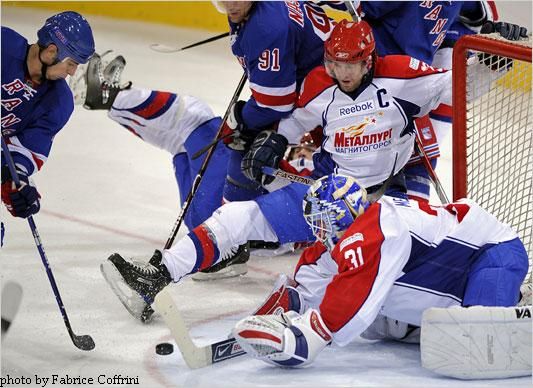
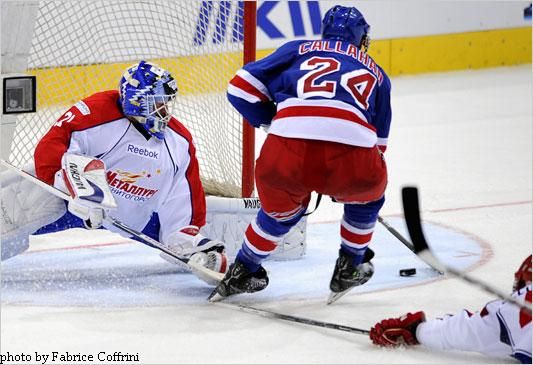
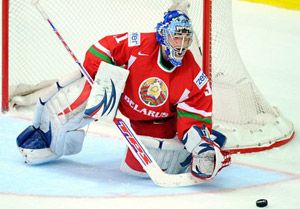
This image to the left probably won't be a memorable moment from the 2010 Vancouver Winter Olympics, but the man making the stop has himself a place in hockey lore. Andrei Mezin, the Belarussian goaltender, is best known for his 2002 Olympic performance against Sweden in the quarterfinals, but he has carved out a pretty good career over in Russia playing in the Russian Super League and the KHL. Today, I want to take a look at the highlights of Mr. Mezin's career after he was named as one of the KHL's Players of the Week for the last week.

Born in Chelyabinsk on July 8, 1974, Andrei Mezin bounced around North America from 1993 until 1998, playing in the ECHL, the Colonial Hockey League, the IHL, and the UHL in those six seasons.

In 1995-96, he starred with the Flint Generals of the Colonial Hockey League where he played 40 games with the team. He finished with a stellar 27-9-2 record despite having a 3.49 GAA and a .883 save percentage. He helped the team finish first in the East Division, and the Generals tore through the playoffs to win the Colonial Cup!

The following season saw Mezin star with the team again as he led them to first in the East Division again, this time with a 19-4-1 record, a 2.46 GAA, and a .902 save percentage. The Generals ploughed through the playoffs once more, but ran into an upstart Quad City Mallards team that had finished second overall in the CoHL. The Mallards downed the Generals in six games, but Mezin shone all season long.

The Generals finished second overall in the inaugural season of the UHL in 1997-98 on the strength of Mezin's 21-5-0 record. He regressed in his stats, posting a 3.47 GAA and a .885 save percentage, but the Generals marches their way to the UHL Final to face the Quad City Mallards once again. This series was much closer than the previous year as the series went back and forth. Quad City won all of the odd-numbered games, while Flint took all the even-numbered games. In Game Seven, it took overtime, but the Mallards finally prevailed by a 3-2 score. Bryan McMullen logged the majority of games in the playoffs, but the Generals had finished strong once again.

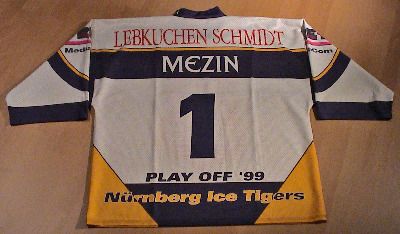
The 1998-99 season saw Mezin jump to a new locale as he began a career in the Deutsche Eishockey Liga with the Nürnberg Ice Tigers. He backstopped the Ice Tigers to first overall in the DEL, and carried them into the playoffs where they were stopped in the final by Adler Mannheim. The 1998-99 Ice Tigers still hold the best record for a Nürnberg DEL team.

After playing one season with Nürnberg, Mezin moved to the Berlin Capitals for three seasons. While he never experienced the same success as he did with Nürnberg, Mezin played no less than 54 games in each of his three seasons with the Capitals. However, with the Capitals experiencing financial problems in 2002, the team dropped to a lower-tiered German league as they worked to re-establish itself. With that, Mezin moved closer to home.

Of course, 2002 was Mezin's shining moment as he led the the winless Belarus team into the quarterfinals against the 3-0 Swedish team at the Salt Lake City Olympic Games. Mezin was brilliant in the game, stopping 44 shots, and he provided the Belarussians with a chance to win. And that's exactly what they did when a Vladimir Kopat shot from 70-feet away was misplayed by Sweden's Tommy Salo, landing in the back of the net for a 4-3 Belarus lead with 2:24 to play.

"For sure, it is a miracle for us," Belarus goalie Andrei Mezin said to CNNSI.com at the time. "But sometimes a gun without bullets can shoot, and that was us. We've made our place in history."

Belarus would lose their next game to Canada, but Mezin's heroics made him the darling of the 2002 Winter Olympic men's hockey tournament.

Mezin's next stop after the Berlin season ended was for Russian superpower Ak Bars Kazan. Kazan, however, used him as a backup only, and he appeared in only one game with Kazan. Kazan finished fourth in the RSL, meaning they had no chance of winning the championship as the top team through the season was awarded the trophy. After spending one year watching from the bench, Mezin was on the move again.

HC České Budějovice in the Czech Extraliga was where Mezin landed for the 2003-04 season, but his record suffered. Some of this may be attributed to his lack of playing time in Russia, but a 4-9-2 record didn't reflect his 2.98 GAA and .904 save percentage. Mezin didn't find many opportunities to play in the Czech Republic, and he was on the move again for the next season.

The Russian Super League would be where Mezin established his career over the next few seasons. He started with SKA St. Petersburg in 2004-05, but the team finished in the bottom half of the standings. Salavat Yulaev Ufa would be Mezin's next stop in 2005-06, and he would stick around Ufa for two seasons. Ufa increased its standing between the two seasons, but Mezin would play a smaller role in the second season than in his first season. Once again, Mezin would be on the move in 2007-08.

2007 saw Mezin move to the northern reaches of the Russia as he joined Metallurg Magnitogorsk. Through this season, Magnitogorsk would battle with Mezin's former team in Ufa for top spot in the RSL. At the end of the season, though, Metallurg Magnitogorsk would fall six points short of Ufa as they finished in second-place in the RSL. Mezin's record wasn't kept, but he did finish with a 1.84 GAA through 35 games - a clear indication that he wasn't done being an elite goaltender.

The 2008-09 season saw a major transformation as the Russian Super League transformed into the Kontinental Hockey League. Mezin stuck with Metallurg Magnitogorsk, and faced the NHL's New York Rangers in the inaugural Victoria Cup on October 1, 2008. Mezin showed he was certainly a very capable goaltender as he stopped 44 shots in a 4-3 loss to the Rangers. However, he would only play 26 games for Metallurg Magnitogorsk that season, posting a 2.82 GAA. He would appear in six games in the KHL Playoffs as well.

In 2009-10, Mezin jumped to Minsk Dynamo, but he joined a fairly weak KHL team. Mezin appeared in 41 games, posting a record of 10-20-5, but his 2.67 GAA and .902 save percentage are evidence that the Belarussian goalie hasn't lost his moxie. Minsk Dynamo finished seventeenth in the 24-team league, though.

Thus far, Minsk Dynamo has seen a major push to start the 2010-11 season. Mezin has posted a respectable 5-2-0 record with a 2.21 GAA and a .922 save percentage. Last week, Mezin was named as the KHL's best goaltender for the week. In three games, Mezin posted three wins, a .917 save percentage, and allowed an average of two goals per game.

Congratulations go out to Andrei Mezin for his work this past week! He's still one of the biggest stories I've witnessed in my time thanks to his heroics at the 2002 Olympics, and he is the only reason I own a Belarus hockey jersey. Thanks to Mezin, hockey in Belarus saw a huge spike, and we could see more Belarussians in the NHL in the upcoming years!

Until next time, keep your sticks on the ice!

Thursday, September 23, 2010

I spent a night in the city of Des Moines, Iowa and I have to say that I feel this city deserves the bright lights of hockey more than it has received in the past. The AHL has tried a few different faces here while the CHL and USHL have both stopped by for a taste of the Iowa capital. There has been one team that has been a consistent performer on the ice, though, and that is the team that will occupy most of this article. Granted, this team has also spent the most time in Des Moines, but we'll look at a few teams that have barnstormed their way through the most populous city in Iowa as well.

In 1969-70, the Minnesota North Stars shifted their CHL franchise from Memphis, Tennessee to Waterloo, Iowa, establishing the Iowa Stars. This is the first edition of the Iowa Stars, and, while not in Des Moines, needs to be touched upon from a historic standpoint.

The Stars only played one season in the CHL, but they were fairly successful. They posted a record of 35-26-11, making the playoffs in their first season in Iowa. They boasted future NHL greats in Rick Dudley and Marshall Johnston, and were led in scoring by Mike Chernoff and Bill Orban, both of whom scored 75 points in 1969-70. A young John Muckler was the GM of the Iowa Stars, and Parker MacDonald coached the squad.

The Adams Cup Playoffs were two rounds, and the Stars squared off with the Tulsa Oilers in the first round. Iowa jumped out to a 3-1 lead, but Tulsa battled back in Game Five to cut the deficit. However, Game Six saw goaltender Fern Rivard stand out as he led the Stars to a 4-0 win, helping the team earn the victory in six games.

The Adams Cup Final had the Stars against the Omaha Knights, but the series was far from similar to the previous one. Omaha and Iowa split the first two games, and then it was all Omaha for the next three games. After all was said and done, the Omaha Knights had downed the Iowa Stars in five games.

While it seemed the franchise had fared pretty well in its first season, the news behind the scenes wasn't as pretty. The North Stars decided that hockey in Iowa wasn't as profitable as they thought it would be, and uprooted the franchise from Waterloo to Cleveland, Ohio.

According to this website, the North Stars had every intention of making hockey work in Iowa if it was profitable. "Speaking for the North Stars," Muckler stated, "it was our feeling and good intention that this thing should become a success and obviously it never did.

"I would have to agree that a 30 percent increase in business next year, as suggested, would be possible, but it would still leave $130,000 cushion for us to make up. At Cleveland we will have none of this."

With that, the CHL days in Iowa would come to a screeching halt. However, hockey would return years later to the Iowa capital. With the return of hockey came an established commitment to winning.

In 1979, the US Olympic team, coached by the legendary Herb Brooks, visited Des Moines to play the St. Louis Blues in an exhibition game. After the game, concerned citizens and parents of hockey players asked Brooks how to keep the youth hockey program intact after it was announced that the Metro Ice Sports Arena may be sold. Brooks' advice was simple: get a permanent hockey tenant for the building.

In 1981, that tenant was found as the Des Moines Buccaneers took to the ice in their first season in the USHL, the Junior-A system in the United States. They finished in second-place in their inaugural season, and this would prove to be a harbinger of the Bucs' future success. However, it would take them a decade of building before they would bring home victory to Des Moines.

In 1991-92, the Buccaneers saw dramatic improvement as they finished the season with a 35-11-2-0 record. Jamie Adams led the team in scoring with 92 points, and head coach Bob Ferguson had his team ready for the postseason. They rolled through the playoffs, winning the Clark Cup as champions of the USHL, and then captured the Gold Cup as the top Junior-A squad in the United States! Des Moines saw its first two championships in the same season!

In 1993-94, the Buccaneers won the Anderson Cup for being the top regular-season team in the USHL at 36-12-0, but they fell short in the playoffs. The USHL Triple Crown still eluded the team, but they had captured all three championship statuses within three seasons under Bob Ferguson.

In 1994-95, the Buccaneers put it all together. They went an incredible 38-5-5 in the regualr season to capture the Anderson Cup as the top USHL team. After steamrolling the USHL in the regular season, they continued their dominance in the USHL Playoffs by winning their second Clark Cup in team history. The Buccaneers took their dominance into the National Championship and won their second Gold Cup, capturing the team's first Triple Crown in history! Brad Frattaroli led the team in scoring with 72 points, and was one of six Buccanneers to record more than 60 points. Balanced scoring and solid goaltending resulted in major success for the team!

The Buccaneers have also captured the National Championships in 1997-98 and 2005-06, making them a four-time US Junior-A Champions, but their staying power is what has made them a part of Des Moines. They consistently produce high quality players, including 2009 Dallas Stars' draft pick forward Alex Chiasson, Florida Panthers' goaltender Scott Clemmensen, Carolina Hurricanes' forward Erik Cole, New York Islanders' forward Kyle Okposo, and St. Louis Blues' forward Peter Sejna.

In 2005, Howard Baldwin and Bob Schlegel took the dormant Louisville Panthers franchise, and relocated it to Des Moines, Iowa. The new team signed an affiliation agreement with the Dallas Stars, and the Iowa Stars were born in the look of their NHL affiliate.

In the 2005-06 season, the Stars posted a 41-31-0-8 record under Dave Allison, leaving them fourth-place in the seven-team AHL West Division. They did qualify for the playoffs in their first season, though. Toby Petersen led the team in scoring with 73 points, while Loui Eriksson showed his NHL mettle by leading the team with 31 goals.

In the opening round of the AHL Calder Cup Playoffs, the Stars met the Milwaukee Admirals who had finished fourth overall in the AHL that season. Milwaukee and Iowa split the first two games before Milwaukee won Games Three and Four in Iowa. With their backs against the wall, the Stars went to work. They won Game Five by a 5-1 score, and went into Game Six in Milwuakee and won Game Six by a 4-2 score. However, the bottom would fall out in Game Seven as the Admirals downed the Stars by a 4-1 score to close out the series. The Stars showed that they could run with the top teams in the AHL by scaring the Admirals, and they took that determination into the following season.

The Stars looked to improve their standing in 2006-07, but found themselves in the same spot as the previous season as they finished in fourth-place in the AHL West Division. Dave Allison led the team to a 42-34-3-1 record, and Junior Lessard led the team in scoring with a mere 52 points. However, eight players scored 30 or more points that season, and the Stars idea of defensive hockey would help them in the playoffs.

The Stars opened the AHL Calder Cup Playoffs against the West-leading Omaha Ak-Sar-Ben Knights. The two teams split the opening games, but Iowa took a stranglehold on the series after winning the first two games in Des Moines. Omaha won Game Five by a 3-2 score in overtime in Omaha, but Iowa closed out the series in Game Six with a 5-2 score to give the Stars their first AHL Playoff series victory.

The Stars moved on to play the Chicago Wolves in the second round. The Wolves wasted no time in establishing their dominance, winning the three of the first four games of the series by a combined score of 23-8. Iowa's 5-4 victory in Game Two made up for half of their offence. The Stars fired back in Game Five with a 5-1 victory, but the Wolves closed out the series in Game Six with their own 5-1 victory. Again, hope was high for the Stars after closing out the season with some excitement.

The 2007-08 season was not the culmination of two seasons worth of building excitement. The Stars finished eighth in ultra-competitve AHL West Division, missing the playoffs for the first time in their existance. Dave Allison led the team to a 35-37-5-3, and Marty Sertich led the team in scoring with just 52 points. Tobias Stephan had a solid season statistically, but the team's defence-first philosophy couldn't score enough to put them on right side of the scoreboard most nights.

In February 2008, with the Iowa Stars looking like they would miss the playoffs, the Dallas Stars announced that they would be starting their own AHL franchise based in Cedar Park, Texas at the start of the 2009-10 season. Because of this, the Stars pulled their affiliation from the Iowa franchise. However, the Anaheim Ducks were in need of an AHL affiliate, and they signed an agreement with the Iowa franchise for the 2008-09 season.

With the change in the affiliation, the Iowa Stars reinvented themselves as the Iowa Chops, a desperate attempt to "illustrates Iowa’s agricultural heritage" as per Kirby Schlegel, CEO of Schlegel Sports, who owned the franchise. Look, I still can't believe they named the franchise as "Chops", but there is a history in Iowa of that term. Let's take a look at the Chops' legacy.

Gord Dineen was hired to coach the Chops in the 2008-09 season, and he led them to seventh-place finish in the AHL West Division with a 33-33-0-14 record, finishing just ahead of the San Antonio Rampage. TJ Trevelyan led the team in scoring with just 47 points. They missed the playoffs, and really were looking forward to the 2009-10 season.

However, hard times fell on the franchise. In May 2009, the Ducks abruptly ended the affiliation agreement after the Chops failed to make contractual payments as part of their agreement. Following that, the Chops franchise was involuntarily suspended by the AHL's Board of Governors after it was discovered that the club "had used the franchise as collateral to obtain a loan in March, 2008, from a North Carolina branch of Wachovia Bank", according to the Des Moines Register newspaper. Those funds, $1.99 million, had been used to cover operating costs, something that the AHL strictly forbids. As a result, AHL CEO David Andrews suspended the franchise for the 2009-10 season for violating the league's constitution. As such, AHL hockey would come to an immediate end in the Iowa capital, and the USHL's Des Moines Buccaneers would remain as the only hockey franchise in Des Moines.

So there is some hockey history from Iowa. Lots to digest, but there has been some very good NHL talent that has passed through the state of Iowa and, specifically, Des Moines. I have a few days left on my whirlwind tour of the US Midwest, so check back in when possible for more info!

Until next time, keep your sticks on the ice!

Wednesday, September 22, 2010

There is a lot that can be said for those who can accurately predict the future. While some prefer to read the fairly-generic horoscope each day in the local newspaper, others seek out mediums who may be able to catch a glimpse of the future. I am no cliarvoyant whatsoever, and all predictions I make are worth the money you pay for access to this site (E5). You'd be better off not listening to me, but HBIC will provide you with one man's vision of the 2010-11 NHL season. HBIC is proud to bring back Justin St. Louis with his predictions for this upcoming hockey season.

We met Justin last week when he took a look at five records that may never be broken. Justin and I are co-workers, and he's a devoted hockey fanatic. He has a miniture Stanley Cup on his desk, he never misses a minute of playoff hockey, and he even runs his own hockey pool! Details on that one below, but here's Justin with his look at the ten biggest questions of the 2010-11 NHL season.

Want to hibernate for the winter? Don't want to watch 1230 NHL games plus playoffs? Want to know what happens in advance? I have all the information here for you. I have peaked into the crystal ball and here it what it says will happen in the 2010-11 NHL season. Warning: best used when betting with someone else's money!

1. Will a Canadian team win the Stanley Cup?

No. Vancouver is the closest team this year but as has been the case since Montreal in 1993, Stanley will elude home soil again.

2. Which team will win the President's trophy?

Safe bet - Washington. They return the core group of players and have all the firepower of the US military. Ovie, Backstrom, Green lead the offence. There will be lots of shoot-outs this season in DC as the Caps go into the season with two unproven goaltenders. Hard to not see them as the class of the NHL again this year.
Mild bet - Vancouver. Lots to like with this group of players led by Hart trophy winner (and soon to be captain) Hank Sedin. Brother Daniel, Ryan Kesler, Alex Burrows and Bobby Lou in goal. Suspect defence could be the downfall.
Wildcard - LA Kings. Solid young team on the way up.

3. Who will win the Art Ross?

Safe bet - Sidney Crosby, Alexander Ovechkin.
Mild bet - Henrik or Daniel Sedin.
Wildcard - Ilya Kovalchuk.

4. Will the Blackhawks repeat?

No. They will be a good team but it takes so much to even get to the Stanley Cup tournament, much less win the sixteen games required to hoist the hardest trophy to win in sports.

5. Will the Winter Classic be "classic"?

Yes. Sid vs Ovie? Check. Backstrom vs Malkin? Check. Green vs Letang? Check. This has all the makings of a great day at Heinz Field.

6. What about the Leafs?

Safe bet - They will suck.
Medium bet - They will improve their standing from last season, but still miss the playoffs.
Wildcard - They make the playoffs.. barely. Even if they do, they are not Montreal and they will bow out in the first round.

7. Will the Jets return to Winnipeg be a headline this season?

Yes. There is a building and an ownership group in place backed by the richest man in Canada. This will happen prior to the start of next season. Whether it will be the Coyotes remains to be seen. If not there are other teams on the bubble right now - hello Atlanta?

8. Will the Nordiques return to Quebec City before 2011-12?

No. Even with the support to build a $400 million sports complex, the city is not ready to support the return... yet.

9. Where will NHL attendance be this year?

The league will tell you that it is up; the highlights will tell you that it is down. In this recession era I am not sure how teams like Atlanta, Nashville, Tampa Bay, or Florida will survive. Actually they won't - they will move. Eventually.

10. Does anyone else know that Sean Avery has his own website?

Seriously... www.seanavery.com.

West Playoff Seeds
1. Chicago
2. Vancouver
3. LA Kings
4. Detroit
5. San Jose
6. St. Louis
7. Phoenix
8. Calgary

East Playoffs Seeds
1. Washington
2. Pittsburgh
3. Boston
4. New Jersey
5. Ottawa
6. Buffalo
7. Philadelphia
8. NY Rangers

Conference Finals - Washington vs Pittsburgh; Vancouver vs San Jose
Stanley Cup Champion in 2010/11 - San Jose Sharks

There you have it - all you have to do now is sit back and watch.

For those that are interested, I have created a Fantasy league for hockey through Yahoo Sports. I made it as easy as possible and used their default rules. The first eleven teams entered there get in, and it is head-to-head for the season and set to auto-draft. Let's put the skills to the test, readers. This will only be open for readers of this blog so you don't have to worry about any ringers... in theory. Follow this link!

BRING IT!!


Great article, Justin, and some very good questions and answers! Thanks for the preview of some of the major stories of this season, as well as your predictions for the playoffs. We'll examine those at the end of the upcoming season to see how well your crystal ball sees the future!

I can't see Detroit finishing below Chicago this season, but I do feel that those two teams will be neck-and-neck for most of the season as they battle for the Central Division title. I think Buffalo will finish higher than Ottawa unless Alex Kovalev has a magical season. If he does, I see Ottawa finishing as high as fourth. My guess is that Ottawa finishes seventh, though, and matches up with Pittsburgh in the first round again.

As always, all predictions are guaranteed or your money back, kids! Settle in, and let's see how this season plays out!

Until next time, keep your sticks on the ice!

Monday, September 20, 2010

After spending a day in the fine city of San Antonio, it occurred to me that hockey hasn't known the city of San Antonio for any length of time. They have had three professional hockey teams in the history of their city, and the current AHL team known as the Rampage is the highest level of hockey that city has seen. With the growth of hockey throughout the state of Texas in the 1990s after the arrival of the Dallas Stars, cities that never knew hockey suddenly found a home on the hockey map. San Antonio was one of these cities, and their inclusion to both the IHL and AHL made sense geographically. However, there was one team before the IHL and AHL arrived in town, and we'll start with at this point in our examination of San Antonio's hockey history.

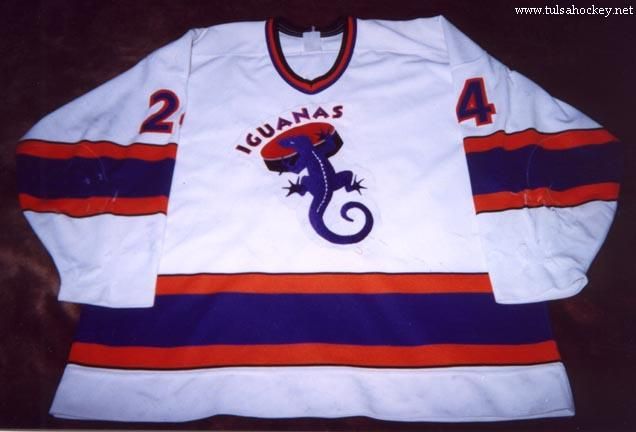
The Central Hockey League saw its first expansion team join the league in 1994 when the San Antonio Iguanas joined the league for the 1994-95 season. The team started with former Minnesota North Star Bill Goldsworthy as their head coach, but he only spent ten games behind the bench, going 5-4-1. Goldsworthy stepped down after being diagnosed with AIDS in November 1994, the first professional hockey player to acknowledge having the disease. In 1996, Goldsworthy passed away due to complications from the disease, and his gravesite is located in Lakewood Cemetary in Minneapolis, Minnesota.

After Goldsworthy announced his early retirement, he was replaced by John Torchetti. Torchetti guided the Iguanas to a 37-22-7 mark, good for second-place in the seven-team CHL. Paul Jackson would lead the team in goals with 51, and Brian Shantz would lead the CHL in assists with 80 and in points with 119. With the top four CHL teams making the playoffs, the Iguanas would meet up with the Tulsa Oilers in the playoffs in their first season.

The two teams battled through seven games. Only Games One and Six would be decided by less than three goals, and those two games went to overtime. Tulsa won both of those games - Game One was a 6-5 overtime win, while Game Six was a 5-4 overtime win. The other five games were all significant wins with margins of three goals or more. The series would flip back and forth before San Antonio wrapped up the series in the seventh game by a 6-1 score at the Freeman Coliseum in San Antonio. Their win gave them a berth in the CHL Final!

The Iguanas would face-off against the CHL regular-season champions in the Wichita Thunder. The Thunder would win Games One and Two before the Iguanas cut the deficit in half on home ice with a 5-2 win in Game Three. The Thunder would rally back to push the Iguanas to the brink, but the Iguanas staved off elimination in Game Five with a 6-2 victory. Game Six, however, saw the Iguanas fall 9-4 to Wichita as the Thunder captured the first Ray Miron President's Cup. John Torchetti won the Commissioner's Trophy as coach of the year at the conclusion of the season.

The Dallas Freeze would drop out of the CHL in 1995-96, leaving only six teams to compete for the championship. The Iguanas would finish in second-place for the second straight season, ending the campaign with a 39-17-8 record. Brian Shantz would have an outstanding season for the Iguanas, leading the team in goals with 56, and leading the league in assists with 85 and in points with 139. It appeared that the Iguanas were set to make another run at the CHL Championship.

The Iguanas would host the Memphis RiverKings in the opening round of the CHL Playoffs. The series was split 2-2 through four games, but the Iguanas poured on the heat in Games Five and Six, winning them 4-2 and 6-3, respectively. The six-game series win put the Iguanas into the CHL Final for the second consecutive season!

The Iguanas would meet the Oklahoma City Blazers in the final. The Blazers finished as the top-team in the CHL in 1995-96, so the Iguanas faced the same uphill battle as they did in the previous season. The Blazers would jump out to a 3-1 series lead, but the Iguanas were a determined bunch. They won Game Five in Oklahoma City by a 6-4 score before returning home to win Game Six by a 5-4 score in overtime. However, Game Seven saw the Blazers capture the Ray Miron President's Cup on home ice as they downed the Iguanas by a 4-2 score. Again, the Iguanas came up short, but they had been bridesmaids in their first two seasons of existance - not too shabby at all!

John Torchetti wouldn't be behind the bench for the Iguanas to start the season in 1996-97, but he was still in San Antonio. Torchetti took an assistant coaching position with the IHL's San Antonio Dragons as they began play in San Antonio. Instead, Dale Henry would guide the team through the first 36 games. Henry's reign would be cut short as he posted an abysmal 9-24-3 record in those 36 days, and he decided that he would rather help the team on the ice. He resigned his position as coach and took a seat on the bench as a player while Ric Seiling stepped behind the bench. Seiling would go 17-12-1 down the stretch, but it wasn't enough to get the Iguanas into the playoffs. They would finish the season in last place in the East Division with a 26-36-4 record.

Dale Henry played 23 games that season for the Iguanas, posting 12 goals and 19 points after his brief coaching stint. Paul Jackson led the Iguanas in goals (44), assists (46), points (90), and PIMs (391). Yes, you read that last stat correctly - leading scorer with nearly 400 PIMs! He would finish second in the league in PIMs and seventh in goals. Not a bad season's worth of work!

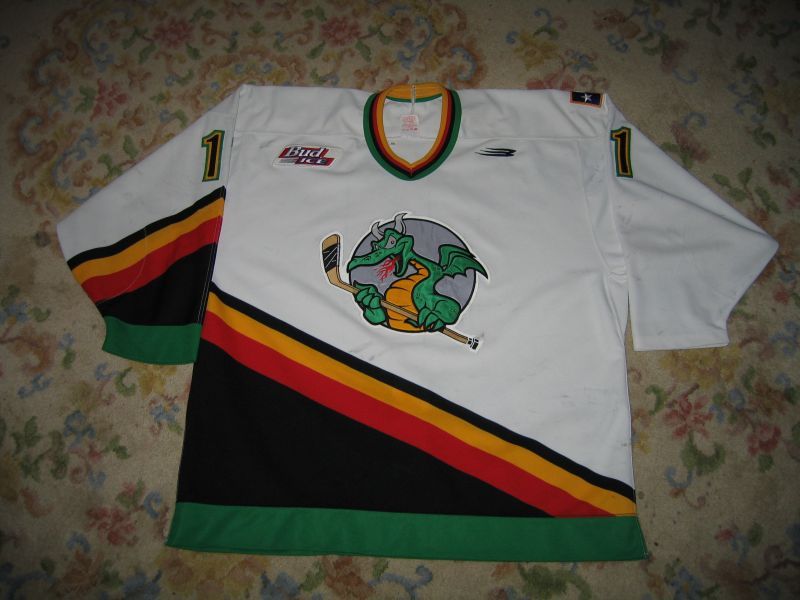
However, the Iguanas found themselves in a bit of a bind when another reptilian team took up residence in San Antonio in 1996. The IHL decided to set up shop in San Antonio after moving the Peoria Riverman franchise to Texas, and the Dragons took flight for the 1996-97 season. At first, the Iguanas and Dragons shared Freeman Coliseum, but the Dragons eventually forced the Iguanas out of their home. The Iguanas decided to suspend operations over the 1997-98 season while the IHL tested the waters in San Antonio.

The IHL Dragons lasted all of two seasons in San Antonio - not quite the lasting power that the IHL wanted. However, they had some success in their two-year existance. Head coach Jeff Brubaker hired former Iguanas' coach John Torchetti to help behind the bench, and the 1996-97 Dragons posted a record of 45-30-0-7. Daniel Shank led the team in all the major stats with 33 goals, 58 assists, and 91 points. He was also second on the team in PIMs with 293 minutes in the sin bin! David Littman and Bruce Racine split the goaltending duties fairly evenly.

The Dragons finished their first season in first-place in the Midwest Division. That finish gave them a first round date with the Chicago Wolves. In the best-of-five series, the Dragons were more than the Wolves could handle despite three of four games being decided by one goal, and San Antonio advanced with a 3-1 series win.

The Dragons would run into their cross-state rivals in the Houston Aeros in the second rund of the Turner Cup Playoffs. Houston jumped out to a 3-0 series lead before San Antonio picked up a 2-1 win to force a Game Five. The Aeros didn't let it go any longer, though, as they closed out the series with a 4-3 win to secure the 4-1 series win.

The 1997-98 season saw only one in San Antonio as the IHL's Dragons no longer had to share the Freeman Coliseum. The Dragons, unfortunately, would not survive past this season as they ran into financial problems. Despite being the better draw compared to the Iguanas, the Dragons simply couldn't make it work.

The 1997-98 season was certainly not the best way to go out, either. John Torchetti left the Dragons to take the head coaching job of the Fort Wayne Komets, and the carousel of coaches in San Antonio began. The Dragons stumbled through the season, posting a 25-49-8 record. Along with the Quebec Rafales, they were the only two teams to miss the Turner Cup Playoffs that season in the sixteen-team IHL. The Dragons were the worst team in the IHL in the 1997-98 season, closing out their existance with nothing more than a whimper. Once the season came to a close, the franchise folded due to their money problems.

Daniel Shank was clearly the star of the team once again in this season-to-forget. Shank finished 34 points ahead of the next closest scorer on the Dragons, Micah Aivazoff. Once again, he led the Dragons in goals with 39, assists with 43, and points with 82. The carousel of goaltenders saw six men dress for the Dragons. Scott Bailey played in 37 games, sporting a record of 11-17-3, a GAA of 3.73, and one shutout. Statistically, Eldon "Pokey" Reddick was the best goaltender that season. He played in 17 games for the Dragons, going 5-9-1 with a 3.13 GAA, a .900 save percentage, and one shutout.

With the Dragons extinct, the Iguanas returned to the ice in the CHL for the 1998-99 season. Their one-season time-out didn't seem to ruin their fan support. Head coach Todd Simpson led the team to a 37-26-0-7 record, good for second-place in the CHL's Western Division and a playoff spot. Johnny Brdarovic led the team in goals with 56 and points with 115, while goaltender Ken Shepard backstopped the team with a 16-11-2 record, a 3.64 GAA, and one shutout. Brdarovic was also named as the CHL's Rookie of the Year in 1998-99.

The Iguanas squared off with the Wichita Thunder in the opening round of the playoffs, and they showed that hadn't missed a beat. Wichita opened the series with a 3-2 ovetime victory, but the Iguanas rattled off three straight wins to clinch the series by a 3-1 margin.

In the second round, the Iguanas ran into an old nemesis as they matched up against the Oklahoma City Blazers. The Blazers finished first in the Western Division, so this was also a divisional rivalry between these two clubs. Unfortunately, the comparisons run short when looking at the series as the Blazers dismantled the Iguanas in a four-game sweep. Despite the loss, the Iguanas made a pretty good return to San Antonio!

Chris Stewart would take over behind the bench for the 1999-2000 season, but his first season didn't fare very well. Despite leading the Iguanas to a 33-32-5 record, the team missed the playoffs. Brian Shantz led the team in scoring with 109 points, 79 of which were assists!

Stewart would guide the Iguanas to another second-place finish in the Western Division and to the playoffs in his second season on the strength of a 42-21-0-7 record. A familiar name in Johnny Brdarovic would return to San Antonio to claim his team's scoring title. Brdarovic scored 29 goals and added 56 assists to lead the Iguanas in scoring just two seasons after leading the Dragons in scoring.

The Iguanas faced off against the Topeka Scarecrows in the first round. Much like their last trip to the playoffs, they allowed the Scarecrows to draw first blood with a 4-2 win before rattling off three straight wins to secure the 3-1 series win.

The second round was reduced to a best-of-five series, and the Iguanas and Blazers would clash again in this round. San Antonio took Games One and Three to go up 2-1 on the Blazers, pushing their rivals to the brink. However, the Blazers hammered the Iguanas 5-2 in San Antonio to push the series back to Oklahoma City. There, the two teams battled to a 1-0 score through overtime. However, the Blazers were the team to score, and San Antonio went home empty-handed once more thanks to the Blazers.

Stewart would be the first coach to last three seasons with the Iguanas, and he guided the club to a second-place finish in the Southeast Division on a 40-16-8 record in 2001-02. Blair Manning would lead the club in scoring with 77 points.

The Austin Ice Bats - the Iguanas' in-state rivals and first-place in the Southeast Division - were the Iguanas' opening-round opponents. While the two teams split the first two games, the Ice Bats took the next two games to close out the Iguanas' season with a 3-1 series loss. Not quite the finish they were looking for, but the Iguanas had larger issues at hand.

The San Antonio Spurs and the Florida Panthers had annouced a partnership to bring an AHL franchise to San Antonio's SBC Center in May 2002. Because the Iguanas' lease had expired, they had to look at the Alamodome as a possible place to play their home games. However, the search for an ownership group to purchase 25% of the team fell through, and the team had to cease operations without suitable ownership.

This, of course, opened the door for the San Antonio Rampage to be born, and the AHL moved into the SBC Center as the San Antonio Spurs and Florida Panthers launch an expansion team to be stocked with Panthers' prospects. The AHL franchise was awarded to the Spurs/Panthers ownership group on May 6, 2002. Before the team had been named, however, the group made a shrewd decision in hiring John Torchetti as the first head coach of the AHL franchise on May 31, 2002. Torchetti would return to San Antonio as part of the third professional hockey franchise in the history of the city.

On Jume 3, 2002, the Spurs announced that the AHL franchise would be named as the "Stampede", and would feature a rampaging bull with a blue, black and silver color scheme. The blue came directly from the Panthers while the silver-and-black are the colours of the Spurs. However, the Spurs made a second announcement just eleven days later stating that the AHL franchise would be named as the "Rampage", but all logos and the colour scheme would remain the same. On September 14, 2002, the Rampage unveiled their jerseys to the public just weeks before their first pre-season game against the Houston Aeros on October 4, 2002.

The Rampage haven't seen very much success in their eight seasons, but they started off fairly well. They opened their franchise history on October 12 in Milwaukee against the Admirals with a 6-2 loss. October 18 saw the Rampage record their first victory, a 5-4 win over the Utah Grizzlies. Their first home win in the brand-new SBC Center happened on November 7, 2002 when they defeated the Cincinnati Mighty Ducks by a 4-3 score. Filip Novak is selected as the team's first AHL All-Star, playing for PlanetUSA. Jeff Toms led the team in goals with 30 and scoring with 63 points in their inaugural season.

With a 36-29-11-4 record, the Rampage qualified for the Calder Cup Playoffs in their first season. They would match up against the Norfolk Admirals, but the series wouldn't last long as the Admirals swept the Rampage out of the playoffs. While their first season showed promise, this season would be one of two where the Rampage played past the last regular season game.

Since their inaugural season, the Rampage have made the Calder Cup Playoffs twice. They made the playoffs in their first season, as seen above, and in 2007-08 under the watchful eye of Greg Ireland who guided the team to their best finish at 42-28-3-7 thus far. The team finished fifth in the eight-team West Division, and met up with the Toronto Marlies in the opening round of the Calder Cup Playoffs. Despite falling behind 3-2 in the series, the Rampage pushed the Marlies to seven games before falling in Game Seven by a 2-1 score.

The Rampage have had some highlights, though. On February 14, 2005, Jay Bouwmeester represented the Rampage at the AHL All-Star Game for Team Canada. On June 30, 2005, the Spurs bought out the Panthers to become the sole owners of the Rampage. They hired the front office and coaching staff of the Utah Grizzlies to run their team after the Grizzlies had decided to pull out of the AHL. In early August of 2005, the Spurs announced that they had come to an agreement with the Phoenix Coyotes to be their AHL affiliate.

December 1, 2005 saw the San Antonio Rampage host the Cleveland Barons in the AHL's 30,000th regular season game. The game featured two NHL goaltenders as both Vesa Toskala of Cleveland and Brian Boucher of San Antonio took to the nets. Both goaltenders battled to a scoreless draw into the shootout. Karl Goehring replaced Boucher in the Rampage net for the shootout, and stopped four of five shots to post his first win as a member of the Rampage while giving the Rampage the victory in the 30,000th AHL game.

September 7, 2006 marked a new look for the Rampage as they changed their uniforms to reflect their affiliation with the Coyotes. The new colour scheme is black, gray, and silver, and the primary chest logo on the jersey has just the bull's head, replacing the full Rampage logo. Not that this should be a major piece of news, the Rampage also were afflicted with the Rbk EDGE jersey in 2007.

The Rampage will continue to write history this season as they begin their ninth AHL season. While the history of hockey has been short in San Antonio and there have been no championships to speak of yet, hockey appears to be thriving in the Texas city. Having both the Texas Stars and the Houston Aeros as in-state rivals should only help to fuel the rivalry that burns in the Texas winter!

Until next time, keep your sticks on the ice!

Sunday, September 12, 2010

In spending time examining the hockey history of Houston, I began to wonder why there aren't more hockey players from Texas. Of course, they have a burning passion for football, both NCAA and NFL, and they love their Rockets and Astros like any fans should. However, I've only seen one rink oustide the Toyota Center since arriving here, and that might be part of the reason. There have been a couple of high-profile players who have made their mark on the NHL, and these two men, besides both being from Texas, are also world-class defencemen. While Texas may not produce many NHL-caliber players, there have definitely been two that should make the state proud.

The one man that stood out as one of the best defencemen ever born in the United States is Brian Leetch. Leetch was born in Corpus Christi, Texas, and starred mostly with the New York Rangers as an offensive threat from the blueline. Leetch was the first American-born player named as the Conn Smythe Trophy winner when the Rangers captured the Stanley Cup in 1994, and he represented the USA internationally on a number of occasions. Leetch also captured two Norris Trophies as the best defenceman during his career, and was the NHL's top rookie in 1988.

While Leetch was born in Corpus Christi, his training came elsewhere. Leetch's father was a flight instructor, and the Leetch family moved to Cheshire, Connecticut when Brian was just three months old. Brian's father would continue the flight instructor business, but also managed an ice rink when the winter rolled around, giving Brian unrestricted access to skating opportunities.

While Brian grew up playing and excelling in both baseball and hockey, he truly shone in the sport of hockey. He earned All-State honours while in high school, putting up ridiculous numbers as a defenceman. At Avon Old Farms, Leetch scored an incredible 70 goals and added 90 assists in a mere 54 games!

In 1986, the New York Rangers, impressed by his remarkable scoring ability, chose Leetch ninth overall. However, Leetch followed the footsteps of his dad by enrolling at Boston College where he would be an All-American in 1987. He would only spend one year with the Eagles, though, as he jumped at an opportunity to play with Team USA in 1988.

On February 29, 1988, Leetch made his debut with the New York Rangers in St. Louis. He would record his first point that night, drawing an assist on a Kelly Kisio goal. While playing in only 17 games, Leetch looked right at home as he recorded 14 points. One year later, Leetch captured the Calder Trophy as the league's top rookie after scoring 73 points in the 1987-88 season.

Leetch would continue to impress the hockey world with his abilities. In 1992, he became the first American-born defenceman and only the fifth NHL defenceman to record 100 points in a season. His 100-point season prompted the NHL to award him his first Norris Trophy as the league's most outstanding defenceman. Leetch's 100-point season is the last time that an NHL defenceman has reached that pinnacle to date.

Leetch's 1994 season saw the Rangers captured the President's Trophy as the NHL's top regular-season team, the Stanley Cup, and he was named as the first American-born player to receive the Conn Smythe Trophy as the Stanley Cup Playoff MVP. He is still the only American to have won the award.

After Mark Messier left the team, Leetch was named as the captain of the Rangers in 1997. He would carry that honour until he handed the captaincy back to Messier in 2000 once he returned to the Rangers. But along with the captaincy, Leetch earned his second Norris Trophy in 1997 as the league's top defender.

While Leetch bounced around the NHL in the twilight years of his career, he formally announced that he was retiring from the NHL on May 24, 2007. That September, Leetch was one of four recipients of the 2007 Lester Patrick Trophy for his contributions to the US hockey program. January 24, 2008 saw the New York Rangers retire Leetch's #2 to the rafters of Madison Square Garden alongside the other legends. In October 2008, both Leetch and former Rangers teammate Mike Richter were inducted into the US Hockey Hall of Fame in Denver, Colorado. In November of 2009, Leetch was inducted into the Hockey Hall of Fame in Toronto, Ontario to sit alongside the game's greatest names.

Brian Leetch, in my estimation, might be the greates hockey player to have been born in Texas. His resume of work is second-to-none, but there is one young man who broke into the game in Texas after having been born in Houston.

Tyler Myers was born in Katy, Texas just outside Houston, and lived in the city until he was ten years-old. Myers moved to Calgary, Alberta at that point with his father and stepmother. However, Myers became smitten with hockey after attending Houston Aeros games as a child with his father when he was six. Moving to Calgary allowed Myers to pick up the game he watched in Houston.

Myers played minor hockey at Athol Murray College of Notre Dame, and followed an outstanding period there by jumping to the WHL's Kelowna Rockets. Myers was a towering defenceman in the league, standing at 6'7" tall, and routinely delivered bone-crushing hits while playing excellent defence.

Myers was just coming into his own when the Buffalo Sabres came calling in the 2008 NHL Entry Draft. With the 12th overall pick, the Sabres added Myers to their team, and both GM Darcy Regier and head coach Lindy Ruff were excited to get Myers.
"There are two oddities to Tyler," Regier told USA Today. "One is size, and one is that he is a right-handed defenseman. (Coach) Lindy (Ruff) says find us a right-handed defenseman. But when I call up the rosters and look at every team's right-handed defensemen, there aren't many out there."

While the Sabres returned Myers to Kelowna, Myers stirred up a little controversy by choosing to play with Team Canada instead of Team USA in 2009. Hockey Canada began the controversy by naming Myers to their U20 team, and Myers' decision to accept the invitation was a slight role reversal in terms of Canada grabbing talent from the US Hockey Program.

"It was tough, I was born in the States," Myers told The Hockey News in 2010. "I based my decision on, if I hadn't of moved to Canada, I probably wouldn't be where I am today. I don't even think I'd be playing hockey right now.

"I just feel I owe Canada a lot and it feels good to put on the red and white."

The 2009 Team Canada World Junior team went on to capture the gold medal in Ottawa, and Myers was on the lists of many NHL scouts. That same year, the Kelowna Rockets went on to capture the 2009 Ed Chynoweth Cup as the WHL Champions, and he was named as the WHL Playoff MVP after scoring 20 points. Both tournaments allowed Myers to grow and mature as a player, and the Sabres were anxious to bring the young man back to training camp.

May 11, 2009 saw Myers sign a three-year, entry-level contract with the Sabres, and it was apparent through training camp that the young man was light years ahead of the Sabres' development plans. Because of his impressive camp, the Sabres chose to keep Myers with the club for the entire 2009-10 season. And what a season it was for Myers!

Myers recorded his first NHL point with an assist against the Phoenix Coyotes on October 8, 2009. His first NHL goal came eight days later as a Myers' blast found its way behind Dwayne Roloson of the New York Islanders on October 16. Myers hit another first eight days after his first goal by netting his first shootout goal against the Tampa Bay Lightning on October 24. Myers recorded his first multi-goal game on January 8, 2010 against the Toronto Maple Leafs when he scored a pair of powerplay goals.

What made the transition of Myers from junior player to NHL player impressive was his growth as a top player. He logged the most ice time of all NHL rookies last season, and played on Buffalo's top pairing on the blueline for the majority of the season. He finished third in rookie scoring last season, and his incredible play earned him the 2010 Calder Trophy as the NHL's top rookie.

Myers looks to have a long and successful career ahead of him, and he got his start by watching the IHL Aeros in Houston! While he has chosen to play for Canada, he is still one of the two best Texans to come out of the Lone Star State to play in the NHL.

With Leetch and Myers, Texas is beginning to produce quality hockey players despite not having a lot of places to play!

Until next time, keep your sticks on the ice!